That money feeds my son. I will not give it to you
Nobody in that diner moved, and I do not think anybody breathed.
The deputies stood in the shattered frame of the back door with their rifles half-raised. The German Shepherd held the aisle between them and the red vinyl booth, a hundred pounds of muscle with its hackles up and its lips drawn back from white teeth.
“Put it down, Cole,” Sheriff Holloway said, and his voice cracked in the middle like a dropped plate. “You’re outnumbered six to one.”
“I’ve been outnumbered most of my life, Grant,” Cole said. “It never once made me wrong.”
Emily Hart sat perfectly still with her fingers wrapped around a dusty leather notebook. Her heart was pounding so hard that the whole diner seemed to pulse with it.
My name is Emily Hart, I am thirty-one years old, and I wait tables at Maggie’s Place in Red Creek, Nevada, to pay for my son’s heart medication.
Three years ago I had buried a husband who was supposed to have driven his patrol cruiser off Dutton Ridge in the rain.
I had never believed it.
I had only never been able to prove it.
“Emily,” Cole said, without turning his head. His voice was low and steady, the voice of a man talking to a skittish horse. “I need you to slide that book across the floor to the man by the jukebox.”
“The old man?”
“He’s not old, and he’s not who you think. Do it slow.”
I looked past the sheriff. At the end of the counter, where he had been sitting since noon nursing a cold cup of coffee, a thin gray-haired man in a canvas jacket had quietly set down his cup. He held a small black badge case in his open palm.
FBI, it said.
“Special Agent Walter Okafor,” he said, in a quiet, dry voice. “Mrs. Hart, I’ve been waiting two years for somebody to find that ledger. Please don’t be afraid.”
Holloway whirled around.
“You son of a bitch,” he said.
“Language, Sheriff,” said Okafor.
The deputies swung their rifles toward him, and in that instant the diner exploded.
Cole fired once into the ceiling, and a hail of plaster rained down on the lunch crowd. The dog lunged across the floor and took the nearest deputy’s rifle in its jaws with a wrench that spun the weapon clean out of his hands. Somebody screamed. Plates shattered. Thirty frightened customers dove behind booths and under tables.
I did the only thing I could think of.
I threw the notebook.
It sailed across the diner in a clumsy tumbling arc, and Agent Okafor caught it against his chest with both hands, and for one slow second he looked at me with something very close to awe.
“Down!” he shouted. “Everyone down!”
The front windows blew inward.
Black vans had pulled across the parking lot, three of them, and a line of figures in federal vests came pouring through the glass with rifles raised and red laser dots dancing across the walls. A loudspeaker roared from the road.
“Federal agents! Drop your weapons! Drop them now!”
The deputies froze.
One by one, with the look of men waking from a long bad dream, they let their rifles fall to the linoleum and raised their hands. Holloway stood in the middle of the floor with his arms half lifted and his face the color of ash.
“This is a mistake,” he said. “I’m the sheriff of this county.”
“Not as of this morning,” said Okafor, and set the ledger on the counter. “The governor signed the suspension at nine.”
Cole holstered his weapon, and the dog padded back to his side, tongue lolling. He crouched and scratched its ears and murmured, “Good girl, Atlas. Good girl.”
“He’s a she?” I said faintly.
“He’s a she. I named her wrong when she was a puppy and never fixed it.”
A shaky laugh broke out of me, and then I realized I was crying.
Cole stood, and took one step toward my booth, and stopped, as if he were unsure of his welcome. Up close he was enormous, six and a half feet of tattoos and weathered leather. But his eyes, under the heavy brows, were a gentle, tired gray, and they were fixed on the silver cross at his throat.
“You wore his chain,” I whispered.
“He gave it to me.” Cole’s throat worked. “Three days before he died. He said, if anything happens, give this to Em. Tell her I tried to come home.”
The silver cross glinted in his scarred palm.
I took it with trembling fingers. It was warm from his skin, and the tiny scratch along the bottom was exactly where Daniel had dropped it on our kitchen tile the year we married.
“I should have brought it sooner,” Cole said. “I wanted to. But there was a case to build. If Holloway had known I was alive, he’d have come for you and the boy.”
“Alive?”
“I was reported dead too,” he said quietly. “On the same night. Another accident.”
The diner had gone very quiet around us.
“My name is Cole Maddox,” he said, to the room. “I rode with Daniel Hart for eleven years. He was a Nevada state trooper before he was a husband and a father. Three years ago he came to me with proof that the Red Creek sheriff’s office was shaking down every trucker on Highway 93, and I told him he was a fool to try it alone.”
“What happened?” asked a small voice from under a table.
“He went to the sheriff’s department with his evidence on a Thursday night,” said Cole. “On Friday he was dead.”
Holloway made a noise in his throat.
“You can’t prove that.”
“I can,” said Okafor, opening the ledger. “Page forty-one. Dated the fourteenth of March. Payment to deputy Roy Daley, five thousand dollars, for services on Dutton Ridge.”
Behind the sheriff, a lean man in a tan uniform went slowly pale.
“Daley,” Okafor said. “Step forward.”
“I didn’t,” said Daley. “I swear to God. It was Holloway’s order. He said it was an accident.”
“Shut up, Roy!”
“He said we’d all be rich!” Daley was shaking. “He said nobody would ever look twice at a dead trooper. I didn’t want to. I told him I didn’t want to.”
“Roy,” Holloway hissed.
“I’m sorry, Mrs. Hart,” Daley sobbed. “I’m so sorry. He was a good man. He asked me not to. He asked me to call you.”
My knees went out from under me, and I sat down hard in the booth.
Cole slid in across from me and put his big scarred hands flat on the table, and for a long moment neither of us said anything.
The arrests took most of the afternoon.
I sat in the booth with a paper cup of water and a blanket someone had draped around my shoulders and watched them lead the deputies out, one by one, into the white glare of the parking lot. The customers came out from under their tables and gave statements, and a young federal agent with kind brown eyes brought me a plate of pie I could not eat.
Holloway went last.
They walked him slowly across the diner in handcuffs, his shirt untucked, his silver badge torn from his chest. At my booth he stopped, and looked at me, and for the first time I saw him as a plain, tired, heavy man in his fifties with a bald patch and a stomach and a wife’s phone number written on the inside of his wrist.
“It was only supposed to be money,” he said hoarsely.
“A man died for it.”
“I know.”
“You pointed at my face. In front of my customers.”
“I know that too.” His mouth trembled. “I wanted you to be afraid. I wanted somebody to be afraid of me.”
“I was afraid,” I said. “I just wasn’t going to give it to you.”
“What?”
“The money,” I said. “That money feeds my son.”
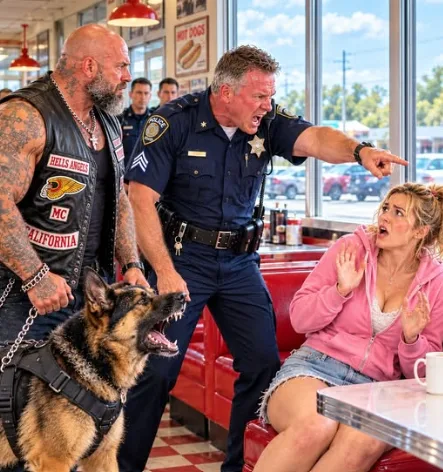
He stared at me for a long time.
Then he lowered his head, and the agents led him out into the sun.
The door swung shut, and a faint breeze came through the broken windows, smelling of hot dust and diesel and, far off, rain.
“Mom?”
I looked up.
A small boy stood just inside the front door, holding the hand of a plump gray-haired woman in an apron. He was seven years old, with Daniel’s dark hair and my own stubborn chin, and he wore a Spider-Man backpack that was a size too big.
“Noah,” I breathed.
“Mrs. Peters said there were police,” he said gravely. “She said to come and see if you were okay.”
I was across the diner before I knew I had moved, on my knees on the broken glass, with my arms around my son. He smelled of crayons and school paste and the lemon shampoo I bought on Sundays. I buried my face in his neck and he patted my back, very seriously, like a tiny doctor.
“You’re squishing me, Mama.”
“I know.”
“Are you sad?”
“No, baby.”
“You’re crying.”
“I’m happy,” I said. “It’s the same thing, sometimes.”
“That’s weird.”
“It is weird,” I said, and laughed, and wiped my face.
Noah’s eyes had wandered over my shoulder. He was studying the enormous man at the booth and the big brown-and-black dog sitting beside him with perfect composure.
“Is that a police dog?”
“She’s a retired one,” said Cole gently. “Her name’s Atlas. Would you like to meet her?”
Noah looked at me.
“It’s okay,” I whispered.
He crossed the floor with small careful steps, and stopped in front of the shepherd, and put out one hand with the fingers curled, exactly the way his father had once taught him. Atlas sniffed, and licked his knuckles once, and then lay down at his feet with a long contented sigh.
“She likes me,” Noah said, astonished.
“She likes everybody who’s brave,” said Cole.
“I’m not brave.”
“Sure you are.”
“I’m scared of the dark.”
“Everybody’s scared of something,” said Cole. “Brave is just what you do about it.”
Noah thought about that very seriously.
“Okay,” he said, and sat down on the floor and began to scratch the dog’s belly.
Cole’s gray eyes were wet.
I wanted to say something, but the words would not come, so I only reached across the table and laid my hand over his scarred knuckles.
“Thank you,” I said at last.
“For what?”
“For coming back.”
“I wasn’t going to leave you with that,” he said roughly. “Dan was my brother. Not by blood. By choice. And a man doesn’t walk away from his brother’s family.”
“You could have.”
“No,” said Cole. “I couldn’t.”
The trial began in September, in the old stone courthouse in Elko, and ran for eleven weeks.
It was the biggest corruption case in the history of the state. Sheriff Grant Holloway, six deputies, a county commissioner, and a retired judge sat in a long row at the defense table in suits that no longer fit, and every day the benches filled before dawn. Truckers came, and ranchers, and waitresses from three counties, and a long, silent line of motorcycle riders in clean leather vests who stood along the back wall with their helmets in their hands.
I testified for four days.
I told the jury about the night the cruiser was found at the bottom of Dutton Ridge, and the closed casket, and the sheriff who had held my hand at the funeral and said he was sorry. I told them about the envelopes that arrived at the diner every month, and the day I had refused to take one.
When the prosecutor asked what had made me say no, I looked at the jury and tried to find the words.
“My husband used to say that a thing you give away out of fear never stops costing you,” I said. “I figured I’d rather lose the diner than lose that.”
A woman in the front row put her hand over her mouth.
Cole testified for six days.
He sat in the witness box in a plain gray suit that someone had found for him, with his huge hands folded and the silver cross tucked inside his collar. He answered every question in the same low, steady voice, and when the defense lawyer tried to paint him as a hardened outlaw with a grudge, he only smiled and said, “Yes, sir. I’ve done some things I’m not proud of. That’s exactly how I know a bad man when I see one.”
The jury deliberated for two days.
When they filed back in, the foreman, a stooped retired rancher with a hearing aid and a Bible under his arm, unfolded a sheet of paper in hands that shook.
“On all counts,” he said. “Guilty.”
The courtroom let out a single enormous breath.
Holloway received life without parole. His deputies received between twenty and forty years, and Roy Daley, who had wept through his testimony and begged my forgiveness in open court, received twelve. The commissioner and the judge went to federal prison, and by Christmas every sheriff’s office along Highway 93 had been audited and cleaned out.
Nobody paid for protection in Red Creek anymore.
On the last day of the trial, as the bailiffs led Holloway away, he stopped at the rail and looked back at me one final time. His face had changed, gone soft and old and strangely empty.
“Mrs. Hart,” he said. “Tell the boy something for me.”
“What?”
“Tell him his father was the bravest man I ever knew.”
I stood very still.
“I’ll tell him,” I said. “But not because you asked.”
He nodded, and went out, and the door closed behind him.
We buried Daniel properly in the spring.
The ground on the hillside above Red Creek was soft with new grass, and the cottonwoods along the creek were bright with pale green leaves. Two hundred people came, state troopers in dress uniform, truckers in clean shirts, a long gleaming line of motorcycles parked along the road with their riders standing quiet in the sun.
I wore a navy dress, and Noah wore a tiny black suit, and Cole stood on my other side with Atlas sitting beside him like a statue.
The honor guard folded the flag with slow, careful hands, and a young trooper knelt and placed it in my arms. I felt Noah’s small fingers slip into mine and squeeze.
“Is Daddy in there?” he whispered.
“Daddy’s in your heart, baby.”
“That’s what everybody says.”
“It’s true, though.”
“Okay.” He thought for a moment. “Can I say something to him?”
“Of course you can.”
He stepped forward in his oversized shoes and laid a single sunflower on the dark polished stone.
“Hi, Dad,” he said. “I’m brave now. Mr. Cole says so. I’m still scared of the dark, but I do it anyway.”
A breeze moved through the cottonwoods, warm and soft, and I could have sworn that somewhere above us a man laughed.
When it was over, and the crowd had gone, Cole and I stood together at the grave in the long gold light of late afternoon.
“I never said it properly,” he said. “How sorry I am.”
“You don’t need to.”
“I do.” He swallowed. “I was supposed to be with him that night. We had a plan. I got delayed, a flat tire on the interstate, and by the time I reached the ridge, it was over.”
“Cole.”
“I’ve carried that for three years.”
“Then put it down,” I said. “Please. He wouldn’t want you to carry it.”
He looked at me, and I saw the whole long weight of those years pass behind his eyes.
“I don’t know how.”
“Come to dinner on Sundays,” I said. “Bring the dog. Noah will make you watch cartoons.”
“Emily.”
“It’s not charity. It’s an invitation.”
A slow smile broke across his face, tired and astonished and wonderfully young.
“I’d like that,” he said.
He came every Sunday.
At first he sat stiffly on the edge of the sofa with a glass of iced tea, a giant in a tiny living room, afraid to break something. Then Noah dragged him onto the floor to build a cardboard fort, and Atlas curled up in the middle of it, and by the third week the whole house rang with laughter.
He fixed the leaky faucet in the kitchen. He repaired the porch swing. He taught Noah to ride a bicycle in the gravel lot behind the diner, running beside him with one enormous hand on the seat, shouting, “Look where you want to go, not where you’re afraid to land!”
“I’m looking!” Noah shrieked.
“Then stop staring at the dirt!”
He fell off four times, and on the fifth try he pedaled the whole length of the lot with his arms stretched wide and a grin that lit up the sky, and Cole stood in the middle of the gravel with both fists raised and tears running down into his beard.
“He did it!” he roared. “Em, did you see? He did it!”
“I saw,” I said, laughing, with my hands over my mouth. “I saw.”
Maggie’s Place reopened that summer with a fresh coat of paint and a new sign over the door, hand-lettered by Noah in crooked blue crayon and then carefully traced by a sign painter in Elko.
RED CREEK DINER. COFFEE’S ALWAYS ON. NOBODY GOES HUNGRY.
I ran it with Maggie, who had retired but refused to stay away, and two new waitresses from the high school. We served pie, and eggs, and a daily special that changed with Maggie’s mood, and on Friday nights a long row of motorcycles pulled up along the shoulder and a dozen big gentle riders in leather vests came in for dinner and conversation.
They tipped enormously, and every one of them called me ma’am.
On the first anniversary of the arrests, in a blaze of golden July heat, I stood behind the counter pouring coffee and looked out through the clean new windows at the parking lot.
Cole was sitting on the hood of his truck with Noah beside him, the two of them sharing a bag of sunflower seeds. Atlas lay in the shade of the diner with her head on her paws, watching the road.
A long white sedan pulled in off the highway, and a small silver-haired woman in a navy pantsuit climbed out and came in through the door.
“Mrs. Hart?” she said. “I’m Dr. Priya Shah. From the children’s hospital in Reno.”
My heart stopped.
“Noah’s cardiologist,” she said gently, and held up a folder. “I wanted to tell you in person. The latest scans came back this morning.”
I gripped the counter.
“The valve has repaired itself,” she said. “Completely. I’ve never seen anything like it. He won’t need the surgery. He won’t need the medication. Mrs. Hart, your son is going to be fine.”
For a moment the whole diner swam.
I heard a sound, and realized it was me, a small broken cry like a bird, and Maggie was suddenly beside me with her arms around my shoulders, rocking me back and forth.
“Fine?” I whispered. “He’s really going to be fine?”
“Perfectly healthy,” said Dr. Shah, and her own eyes were bright. “Whatever you’ve been doing, keep doing it.”
“We’ve been eating pie,” said Maggie.
“Then I recommend more pie.”
I ran out the front door.
I ran across the gravel with my apron flying and my heart in my throat, and Cole turned on the hood of the truck with an alarmed look and stood up. Noah looked up from his sunflower seeds, startled.
“Mama?”
I scooped him off the hood and spun him around in the hot bright air, laughing and crying, with the whole blue desert sky wheeling overhead.
“What?” he shrieked. “What happened? Is somebody hurt?”
“Nobody’s hurt!”
“Then why are you crying?”
“Because you’re perfect,” I said. “Because your heart is perfect. Because you’re going to be fine.”
“I knew that,” said Noah, with great dignity.
“You did?”
“Mr. Cole said so. He said I’m the toughest kid he ever met.” He patted my wet cheek with a small sticky hand. “You’re squishing me again.”
Cole had gone very still beside us.
He stood with his hat in his hands and his gray eyes brimming, and I took one step and put my arms around his neck, boy and all, and he caught us both and held us in a great warm crush of leather and sunflower seeds and dust.
“Thank you,” I whispered into his shoulder.
“I didn’t do anything.”
“You did everything.”
“I just showed up.”
“That’s everything,” I said.
We stood that way for a very long time, in the middle of an Arizona-hot Nevada parking lot, with Atlas barking happily in circles around our ankles and a line of motorcycles roaring up the highway toward the sun.
Late that evening, after the diner had closed and the dishes were done, I sat on the back step with a cup of tea while the sunset spilled rose and gold across the desert.
Cole came out and sat beside me, and Noah, who was supposed to be asleep, crept out in his pajamas and wedged himself between us, with Atlas stretched across all our feet.
Nobody spoke.
In the distance, the long road ran dark and straight toward the mountains, and a single pair of headlights rolled slowly along it, like a small patient star.
I thought of a hot afternoon, a red vinyl booth, and a man screaming and pointing a finger at my face. I thought of the eleven words I had said, so quietly I had hardly heard them myself.
That money feeds my son. I will not give it to you.
They had been the bravest thing I ever said, and I had not known it until a stranger and his dog walked through the door.
Noah’s head drooped against my arm. A minute later he was asleep, breathing slow and even, with one small hand curled around the scruff of the dog’s neck.
Cole looked down at him, and then at me.
“Em,” he said softly.
“Yes?”
“Dan used to say something to me, the last night. I never knew whether to tell you.”
My heart skipped.
“He said, if I’m not around, don’t let her be alone.”
“Cole.”
“I’m not asking for anything,” he said quickly. “I’m only saying, I don’t intend to be anywhere else.”
I looked at his rough, scarred, gentle face in the last pink light, and the silver cross at his throat, and the boy sleeping against my shoulder.
I thought of Daniel, and of how he would have laughed at us, sitting on a back step like three old friends.
“Good,” I said. “Neither do we.”
A slow, shining smile spread across his face.
The stars were coming out, one by one, above the desert, bright and unafraid. Atlas sighed in her sleep. Somewhere far off, an owl called, low and soft, and the first cool breath of the evening drifted across the hills.
I leaned my head against his shoulder, and he did not move, and we stayed there together, safe and quiet in the lamplight spilling through the kitchen door.
The war for Red Creek was over.
And what was left, at the end of the long hot road, was a small yellow diner with the coffee always on, and a family built out of the wreckage, and a light in the window for anyone who needed to come home.