Standing completely humiliated in the wood-paneled county courthouse while the town mayor snatched my father’s property deeds and branded him a criminal in front of everyone
The horses did not slow until the town lights had drowned in the fog behind the first bend of the canyon. Snow needled my face. The ledgers dug into my ribs with every stride, their corners sharp through the wool of my coat, and I held them as if a loose grip might let twenty years of stolen ground spill into the dark. Ben rode half a length ahead, coat snapping, head turned just enough to watch the trail and the ridgeline at once. Behind us the shouts had thinned to nothing. That silence frightened me more than the gunshot had.
“They will cut across the switchback,” he called. “If the mayor has any sense left, he already sent a rider to the north fork.”
“Then why are we still on the road?”
“Because the north fork is where they expect fear to take us.” He pointed with his chin toward a narrow cut between two black pines. “We leave the track here. Keep low. If the bay balks, do not fight him. Let him find the footing.”
I turned the horse where he indicated. Branches raked my sleeves. The animal’s breath smoked and broke against my wrists. For a while there was only the creak of leather, the soft collapse of snow under hooves, and the hard small sound of my own teeth. I tried not to think of my father’s study the morning after the carriage was brought back empty of him, the ink still wet on a letter he had not finished, the way the sheriff had stood in our doorway with his hat in both hands and called it an accident of ice and a frightened team. Three years of that story. Three years of black dresses and closed accounts and neighbors who would not meet my eyes when the tax notices came.
The cut opened onto a shelf above the creek. Ice had sealed the water except where a dark seam still moved. Ben halted and listened. Far off, a single shot cracked, then another, not aimed at us. Signal fire, or warning.
“They have the bridge,” he said.
“You said the marshal’s house is on the upper ridge.”
“It is. And if the judge has already reached the telegraph, the marshal may be the man waiting for us with a warrant instead of a lamp.” He looked at me then, really looked, and the hardness in his face shifted by a degree. “Your father trusted the seal on a federal letter once. I will not make you do the same blind. If you want to turn back and hide the books until spring, say so now. I will take you as far as the old trapper’s line and leave you the key to the cache.”
The offer sat between us, decent and terrible. I thought of the mayor’s hands on the deeds, clean nails, bourbon breath, the way he had said little girl as if the valley had been his to rename. “We go up,” I said.
We climbed until the pines thinned and the wind came clean off the high snowfields. The safehouse was a squat cabin tucked under a rock overhang, chimney cold, door latched from the outside with a strip of rawhide that had not been cut. Ben slid down and checked the snow. No tracks newer than the storm’s last pass. He cut the latch anyway and went in with the revolver low. I waited with the horses, counting my breaths, until he called that it was empty.
Inside, the air smelled of cold ash and mice. A table, two bunks, a crate of tinned meat, a locked iron box under the boards that Ben opened with the same brass key he had pressed into my palm. The box held cartridges, a second pistol, a folded map marked in my father’s hand, and a letter addressed to the United States marshal at the territorial capital, unsent. Ben lit a stump of candle. I spread the ledgers beside the map and understood, with a clarity that made my stomach turn, what my father had been building in the months before the carriage left the road.
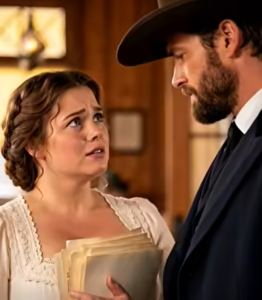
The pages were not only signatures. They were a chain. Homestead certificates altered after filing. Mineral surveys dated before the claims they voided. Payments entered in a clerk’s private hand and initialed by men whose names I had seen on courthouse brass: the mayor, the county judge, a railroad surveyor, and above them a federal signature I had to read twice before I believed it. Judge Harlan Crowe. The same Crowe who had written my mother a note of condolence on cream paper with the eagle stamped at the top. In the margin of one page my father had written, small and furious, They will call it development. It is a grave with a fence around it.
“He found the assay,” Ben said quietly. “Silver under the west pastures. Not a rumor. A government assay Crowe buried so the railroad company could buy the valley for grazing prices and sell the ore rights back to itself. Your father refused to sign the quitclaim. They arranged the ice.”
“You knew.”
“I rode survey with him the autumn before. I was the man who carried the duplicate plates to a printer in Silver Creek under another name. When the carriage went off the grade, I was already in your kitchen as the hired man your aunt thought she had written for. He asked me to stay if anything happened to him. I stayed too long in the role. That is on me.”
I wanted to hate him for the months of bread and quiet lies. What I felt instead was the meaner thing, the understanding that my father had expected to die and had spent his last season building a witness instead of a fortress. I closed the ledger before my hands could shake the pages loose.
“The marshal,” I said.
“Dead, or bought. This cabin has not been lived in since the first snow. If we wait for a badge that is not coming, Crowe will have the records ruled forgeries by morning and a posse on the ridge by noon.” Ben tapped the map. “There is a spur line crew camped at Red Clay Bend. Displaced families. Men who already lost paper. If we can put a copy of these pages on the morning freight to the capital, and another in front of those families before the mayor gets to them, Crowe has to answer in daylight.”
“And if the freight is watched?”
“Then we are two people with old paper against a county. We have been that since the courthouse clock struck.”
We ate cold meat and slept in turns. I did not sleep so much as fall under and climb out again, dreaming of splintered glass and my father’s unfinished letter. Near dawn Ben woke me with a hand on my shoulder and a finger to his lips. Hooves, more than two, moving careful on the shelf below the overhang. He blew out the candle. We stood in the dark with the iron box open and the ledgers already bound in oilcloth inside my coat.
The first man who came through the door died believing the cabin was empty. I did not see his face. I heard the shot, the fall, Ben’s low curse, and then the others shouting my name as if I might be bargained for. Ben shoved the second pistol into my hand and pointed at the rear window, a square of lesser black.
“Count to five. Then go for the horses. If I am not behind you, ride for the Bend and do not trade the books for me.”
“I will not leave you to them.”
“You will leave the books to no one. That was the bargain your father made, and I am keeping it. Five.”
I counted. On four a lantern flared in the doorway and a deputy I knew from Sunday market aimed at the shape of Ben and fired wide, blasting clay from the chimney. Ben’s answer took the lantern down. I went through the window into snow to my knees, stumbled, found the bay where we had tied him under the rock, and got into the saddle with my skirt rucked and my heart so loud I thought they would hear it over the guns. Ben came out the side, limping, coat torn, and swung up. We dropped off the shelf on a game trail I would not have trusted in daylight. Behind us the cabin took fire. Someone had kicked the stove. Orange climbed the overhang and threw our shadows long on the snow ahead, and then the trees took the light away.
By the time we reached Red Clay Bend the sky was the color of tin. The camp sat in a scrape above the creek, tents and two log huts, a cookfire already going, women moving between them with the economy of people who had learned not to own more than they could carry. A boy saw us first and ran. Men came out with rifles that were not new. Ben raised empty hands and said my father’s name. That was enough to keep them from shooting and not enough to make them lower the barrels.
A woman with a burn scar along her jaw stepped through them. I knew her. Esther Quinlan, whose south fence had been the first to go under a county resurvey. She looked at the oilcloth under my arm and then at my face.
“If you brought paper,” she said, “it had better be better than the paper they used to take my well.”
I unfolded the ledgers on a crate and let them see the signatures. I read the dates. I read Crowe’s name until the word stopped sounding like a title and started sounding like a man who could be addressed. Esther listened without blinking. When I finished, she spat into the fire.
“They told us your father drank and drove his team off the grade,” she said. “I did not believe the drink. I believed the grade, because believing the rest meant the law was a costume. You are asking us to stand where costumes get holes in them.”
“I am asking you to witness a copy before they burn the original,” I said. “And to put your names beside his, if you will. Not as soldiers. As the people the deeds were written for.”
She was quiet a long moment. The camp had gone still enough that I heard grease pop in a pan. “We have buried two men who argued at the clerk’s window,” she said. “We will not bury a third for a speech. But we will copy. And we will walk to the spur at noon, when the freight takes on water, and we will stand on the public side of the track with the pages in our hands. If the mayor wants a riot, he will have to start it in front of the section boss and the water crew. Those men report to a company that does not love Judge Crowe enough to hang for him.”
Ben bound his leg while the women copied in three hands at once, working fast, misspelling nothing that mattered. I watched my father’s margin note appear again in Esther’s stricter script. They will call it development. It is a grave with a fence around it. Seeing it in another woman’s writing made it heavier, not lighter, as if the sentence had finally been allowed to leave our house.
We reached the spur an hour before noon. The freight sat breathing steam, crew walking the cars, a superintendent in a town coat pretending not to watch the cluster of homesteaders gathering on the loading side with school slates and copied pages held against their chests. I had begun to think we might simply hand a packet to the conductor and survive the afternoon when the mayor arrived from the county road with six deputies and Judge Crowe in a closed carriage, as if weather were a thing that happened to other people.
Crowe stepped down in a beaver hat and a coat too fine for the mud. He was older than his letters had suggested, soft at the jaw, eyes the pale color of shallow ice. He looked at the crowd, at the ledgers in my arms, at Ben, and smiled the way men smile when the room is already theirs on paper.
“Miss Hayes,” he said, loud enough for the crew. “You are overwrought. These gatherings help no one. Surrender the forgeries and the court will consider your father’s debts a family misfortune rather than a prosecution. Mr. Hayes, or whatever station you are using today, you are under federal warrant as of last night.”
“The warrant is in your pocket because you wrote it,” Ben said.
“And yet it will hang you, which is the only part of authorship that matters in a territory.” Crowe’s gaze returned to me. “Your father was a difficult man. Bright. Unwilling to understand that a valley cannot remain a pasture once the assay is known. I offered him a share. He preferred a sermon. Accidents follow sermons in winter.”
Something in me went very quiet, the way a room goes quiet after a dish breaks. “You are saying you killed him.”
“I am saying the grade was icy and the team was badly driven, and that any other story is a girl’s grief looking for a villain with a title.” He held out his hand. “The books.”
Esther moved before I did. She lifted her copy so the superintendent could see the signature block. “If they are forgeries,” she said, “the judge will not mind the water crew reading the names. If they are not, he will mind it very much. I have always found that a useful test.”
The mayor swore and started forward. A deputy reached for Esther’s pages. She did not step back. The section boss, a broad man with coal ground into his knuckles, set a brake iron casually across his shoulder and said that company ground was not a courthouse and that anybody discharging a weapon near a boiler would answer to the railroad before they answered to a county star. It was not courage. It was jurisdiction. In that moment jurisdiction was enough to keep fingers off triggers.
Crowe’s smile thinned. “Then we will do this in order. Deputies, arrest the woman and the man. Confiscate every page. The rest of you may go home before I decide this assembly is unlawful.”
“Home,” Esther said, “is the word you used when you fenced our water.”
I saw the mayor’s hand move under his coat and I saw Ben see it. The shot, when it came, was the mayor’s, panicked and low, kicking mud between Esther’s boots. The second shot was Ben’s. The mayor sat down in the slush with a look of insult, as if the ground had breached etiquette. Deputies yelled. The crew dropped behind cars. Crowe backed toward his carriage, no longer performing calm, and shouted for the line to be held. I ran, not away, but along the freight to the conductor’s door, oilcloth clutched to my chest, Esther behind me with the copies, while Ben and two homesteaders kept the deputies honest at a distance no one wanted to close.
The conductor was a thin man with a telegraph key scar on his thumb from years of tapping. He looked at Crowe, at the blood in the mud, at my face, and made a choice I will owe him for until I die. “Packet goes in the express car,” he said. “I do not read it. I do not give it back if a county star asks. Capital office signs for it. That is as far as my bravery extends.”
“It is far enough,” I said, and put the original ledgers into his hands.
Crowe saw the transfer. He forgot the carriage and came along the cars with a pistol he clearly did not love using, voice cracking into command. “That is stolen evidence. Stop that train.”
The superintendent did not stop it. He looked at the judge, at the section boss, at the women still holding copies where anyone on the crew could see them, and he waved the brakeman off. Steam roared. The freight jerked. I had one foot on the iron step and Crowe’s hand on my coat when Ben hit him from the side and both of them went into the mud. The train began to move in earnest. Esther shoved the last copy through the express door and stayed on the ground, because someone had to remain to say what had been put aboard. I should have stayed with her. I went, because the books were going and I was the only one who could swear to every page between Red Clay and the capital without being called a copyist with a grudge.
Ben rolled clear of Crowe as the wheels gathered speed. He ran three strides beside the step, bad leg failing him, and got a hand up. I caught his wrist. For a second his weight was the whole world, and then he was on the step, chest heaving, Crowe small already beside the track with his fine coat ruined and his pistol in the mud. The mayor did not get up. Deputies milled, unwilling to fire into a railroad car with a company man watching. The canyon took the curve, and the spur was gone.
We rode in the express car among parcels and a crate of lamp oil, the ledgers locked in the conductor’s box, neither of us speaking until the shake of the train became ordinary. Ben’s leg bled through the bind. I tore a strip from my hem and did what I could. He watched my hands.
“You were supposed to trade nothing for me,” he said.
“I traded a minute,” I said. “The books are in the box. Do not make a sermon of it.”
He almost smiled. It looked like it hurt. “Your father hated sermons too. He still wrote in the margins.”
At the capital the marshal Crowe had not managed to buy was a tired woman with gray in her braid and no interest in my tears. She read for an hour. She compared seals. She sent two deputies of her own, not ours, back down the line before dusk. I slept in a chair outside her office and woke to the news that Judge Harlan Crowe had been taken off a private coach at the territorial junction, still insisting the ledgers were a daughter’s invention. The mayor lived. He bargained. Bargains, I learned, are how counties survive their own crimes, and I hated the shape of that truth even while I used it.
The hearings took weeks. I said the same facts so often they stopped feeling like mine. Esther came up by freight and said hers. The section boss, to his own surprise, said what he had seen. Ben said the part about the assay plates and did not embellish. Crowe’s lawyers called me hysterical, then calculating, then both. The mineral maps were pulled from a department archive Crowe had believed sealed. The prices on the quitclaims did not survive the comparison. In the end the valley rights were voided back to the original homestead entries, not because the territory had grown a conscience, but because the railroad company preferred a scandal it could blame on a judge to a scandal that reached its own board. Crowe was indicted. Some of the money was gone into other names. Some of the deputies were fined and returned to their fences. Justice arrived looking like a settlement. I signed where they told me to sign and felt my father’s margin note sitting under the legal language like a stone under snow.
We went home in mud season, when the canyon coughed brown water and the courthouse steps were slick with it. Someone had already pried the mayor’s name off the clerk’s door. The deeds were refiled in a hand that shook less than mine. Esther walked her south fence with a new post and an old anger that had somewhere to stand. Ben stayed through the planting, then talked of the survey crews heading west, then did not go. I did not ask him to explain the months he had worn a false name. He had already explained them in the only way that counted, by putting his body between a page and a pistol and trusting me to finish the errand.
On the first warm evening I sat at my father’s desk and rewrote the letter he had not finished, not to send, only to close it. I told him the books had arrived. I told him the grade had not been an accident and that saying so in a room with a stenographer had not brought him back and had still been necessary. I told him the valley was ours again in the way paper can make a thing ours, which is to say provisionally, and only for as long as someone is willing to read what the powerful would rather have burned.
The lesson was not that truth always wins. Crowe had almost won with a carriage, a smile, and a seal. The lesson was smaller and harder. Records outlive the men who fake them only if someone treats paper as a form of courage, carries it into weather, copies it into other hands, and refuses the bargain that trades a dead man’s name for a quiet life. I had wanted safety. What I got was a duty that fit in a ledger and a house that no longer felt built on a lie. When the light failed I lit the lamp, sanded the last line, and left the door unlatched, because the valley was listening again, and I intended to answer it in my own hand.