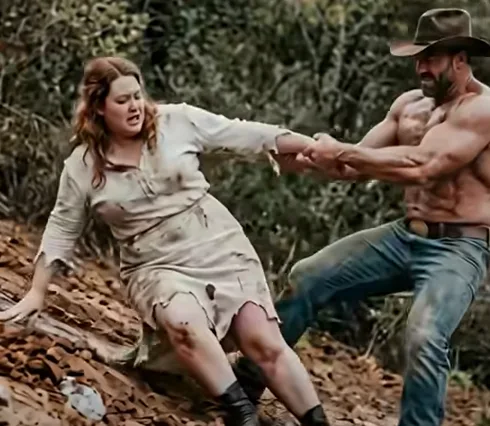
Shoved down a steep, rocky ravine by my fiancé while my torn dress snagged on sharp briars was terrifying
“…and her marshal, then burn the cabin to the ground. Signed, A.V.”
I read the line twice, and the paper shook so hard in my fingers that the typed letters seemed to crawl across the page.
“A.V.,” I whispered. “Caleb, those are my uncle’s initials. Arthur Vance.”
Caleb took the slip from my hand, and his jaw went hard as granite. “Then Richard was never the head of this snake,” he said. “He was only the mouth.”
Beneath our feet, something pounded against the cellar door, and Richard’s muffled voice rose in a stream of curses that grew thinner and more frightened with every minute.
“Let him shout,” Caleb said. “The bolt will hold, and the marshals will be here by noon.”
He knelt beside me and began to wrap my swollen ankle in a strip of clean linen, working with a gentleness that seemed impossible for such large, scarred hands.
“You are shaking,” he said quietly.
“I am angry,” I said, and my voice cracked. “Arthur sat at my father’s funeral. He held my hand and told me that he would look after me.”
“Men like Arthur always do,” Caleb said. “It is how they keep the lamb close to the knife.”
Outside, the storm had faded to a soft gray drizzle, and the first birds had begun to sing in the dripping pines, as though nothing in the world had changed.
I dozed against the hearth with a blanket over my shoulders, and I woke to the jingle of harness and the murmur of voices in the yard.
A tall woman in a gray federal coat stepped through the splintered doorway with six deputies behind her, and her tired green eyes swept the wrecked room and came to rest on me.
“Miss Hartwell,” she said, removing her hat. “I am Special Agent Ruth Calloway, and I am very glad to find you breathing.”
“The marshal has been telling me that for an hour,” I said, trying to smile.
“The marshal is a fool who rushes into gunfire without waiting for backup,” Calloway said, and Caleb ducked his head with an embarrassed grunt.
Two deputies hauled Richard up out of the cellar, covered in root dust and spider webs, with a swelling bruise across his forehead and all of his arrogance drained away.
“Clara,” he said hoarsely, as they dragged him past. “Clara, I can explain, it was your uncle, he forced me.”
I looked at the man I had almost married, and I felt nothing, no hatred, no grief, only a quiet, enormous distance, like looking at a stranger across a river.
“Save it for the judge, Richard,” I said.
They took him away in chains, and the wedding that was supposed to happen the next morning dissolved into the mist of that gray spring day.
Calloway sat beside me at the hearth and spread a map across her knees.
“Arthur is at the Hartwell lodge,” she said. “He believes that Richard succeeded, and that by tonight he will inherit the whole valley without a single signature in dispute.”
“Then let him believe it,” I said slowly. “Let him think I am dead.”
Calloway and Caleb exchanged a glance, and a thin, dangerous smile curved the agent’s mouth.
“I was hoping you would say that,” she said.
They planned it for the following evening, at the grand dinner Arthur had arranged to announce the engagement of the century.
The long dining hall of the Hartwell lodge blazed with a hundred candles, and the whole valley’s gentry sat at the polished table in silk and broadcloth, murmuring over their wine.
Arthur Vance rose at the head of the table, a silver-haired, silk-voiced man of sixty with a heavy gold watch chain across his waistcoat.
“My friends,” he said, lifting his glass, “it is my sad duty to tell you that my beloved niece, Clara, has been lost in a tragic accident on the ridge.”
A gasp rolled around the room, and several ladies pressed handkerchiefs to their lips.
“Richard, poor boy, is too overcome with grief to attend,” Arthur continued, with a theatrical catch in his throat. “But in her memory, I will carry on her father’s great work, and the Hartwell estate will prosper.”
“I do not think it will,” I said.
The doors at the end of the hall swung wide, and I stood framed in the candlelight in my mother’s gray silk gown, with Caleb at my right shoulder and Agent Calloway at my left.
Arthur’s glass slipped from his fingers and shattered on the floor, and the color drained from his face as though someone had pulled a plug.
“Clara,” he said, and his voice came out in a croak. “You are… you are alive.”
“I am, Uncle,” I said, and I walked down the length of the table with my head high and my ankle throbbing. “And so is a great deal of paper.”
I laid my father’s letters on the white cloth in front of him, yellowed pages in my father’s slanted hand, and beside them the real financial audits, the flash drive, and the typewritten note signed A.V.
“Target confirmed,” I said clearly, so that every guest could hear. “Eliminate Clara and her marshal, then burn the cabin to the ground.”
A murmur of horror swept the hall, and a dozen chairs scraped as the guests rose.
“This is a forgery!” Arthur shouted, his face going from white to purple. “This is the delusion of a hysterical girl!”
“Is it, Mr. Vance?” said Calloway, stepping forward with a folded warrant in her gloved hand. “Because your handwriting is on the back of this page, and your voice is on a recording made by Richard Hale in your own study three days ago.”
She nodded to the corner, where a young deputy lifted a brass listening horn and a spool of wax cylinders from behind a velvet curtain.
“Richard was clever enough to protect himself,” she said. “He recorded everything, in case you ever turned on him.”
Arthur lunged for the door, but a half dozen deputies had already slipped in through the servants’ entrance, and iron cuffs closed around his wrists with a sharp, final click.
“You ungrateful girl,” he spat, as they dragged him away. “I raised you, I fed you, I gave you everything!”
“You gave me nothing,” I said, and my voice did not shake. “You took everything, and you called it love.”
The hall fell silent, and then an old rancher at the far end of the table rose slowly to his feet and began to clap.
One by one the others joined him, bankers and farmers and widows, until the whole room thundered with applause, and I stood in the candlelight with tears running down my face.
Caleb’s hand found mine beneath the edge of the table, and I held it so tightly that my knuckles ached.
The trial lasted three weeks, and it was the talk of the territory.
Arthur Vance and Richard Hale were convicted on every count, murder, fraud, forgery, and conspiracy, and the judge sentenced them both to life in the territorial penitentiary.
Eleven other men, bankers and land agents and a county judge, were swept up in the same net, and the black-market land ring that had bled the valley for a decade collapsed in a single spring.
On the courthouse steps afterward, a crowd of neighbors pressed around me, weeping and laughing, shaking my hand.
An old woman in a black bonnet told me that my father had once carried her sick husband ten miles through a snowstorm, and that she had prayed for this day every night for ten years.
A small boy shyly handed me a bouquet of wild lupines and asked if it was true that I had survived a fall down a ravine.
“It is true,” I said, kneeling to his level. “And do you know what saved me?”
“The marshal?” he asked, round-eyed.
“A friend,” I said, and I looked up at Caleb, who stood a few paces away with his hat in his hands and his ears bright red.
The Hartwell estate was restored to me in full, every acre of timber, every mill, every water right, and I stood on the porch of the old lodge one bright June morning and looked out over the rolling green valley.
It was mine, and it was my father’s, and for the first time in ten years it felt like home.
“What will you do with it?” Caleb asked, coming up the steps beside me.
“I am going to do what Father always wanted,” I said. “I am going to build a place where nobody is cast down a ravine and told that they are worthless.”
We opened the lodge to the valley that summer, and we turned the great dining hall into a school and a gathering place, with long pine tables and a stone hearth big enough to roast an ox.
We hired widows and orphans and out-of-work loggers, and we paid every one of them a fair wage and fed them a hot noon meal at the long tables in the yard.
Above the front door, we hung a hand-lettered sign that read, All Who Fall Are Welcome Here.
Caleb resigned his federal commission that autumn, though Calloway grumbled that she had never lost a good marshal so stupidly, and he took over the timber operations with a quiet, steady hand.
He planted two saplings for every tree we cut, and he walked the ridges every dawn with a notebook, and he whistled through his teeth in a way that I found, to my own astonishment, that I could not do without.
One golden evening in October, when the aspens on the ridge had turned to flame and the air smelled of woodsmoke and apples, he asked me to walk with him to the ravine.
We stood at the top of the red embankment where Richard had pushed me, and the sun slanted low across the grass, and the pines whispered all around us.
“I thought that I would hate this place,” I said. “I thought that every stone would remind me of falling.”
“And?” said Caleb.
“And it only reminds me of the moment you held out your hand,” I said.
He was silent for a long moment, and the wind stirred his hair, and then he drew a small box from his shirt pocket.
“I have been carrying this for six months,” he said, and his voice was not quite steady. “I did not know when I would be brave enough to ask.”
Inside lay a plain gold ring with a tiny sapphire, the color of a river in sunshine.
“It was my mother’s,” he said. “She told me to give it to the woman who made me feel as though I had finally come home.”
“Clara Hartwell, I am not a rich man, and I am not an eloquent one, but I will mend your fences and keep your fire lit for as long as I draw breath.”
“Will you marry me?”
I looked at the ring, and at the rugged, scarred, tender face of the man who had come out of the mist, and I laughed with tears running down my cheeks.
“I told you in the cabin,” I said. “I have been trying to say yes since the moment you took my hand.”
He slid the ring onto my finger, and it fit as though it had been made for me, and he lifted me off my feet and kissed me while the wind swept golden leaves around us like confetti.
We were married in November, in the great hall of the lodge, with snow falling softly past the tall windows and a fire roaring in the hearth.
Agent Calloway stood as Caleb’s witness, in her gray coat with a sprig of holly pinned to the lapel, and the old rancher who had first started the applause gave me away, weeping openly all down the aisle.
I wore my mother’s cream-colored gown and a crown of dried wildflowers that the schoolchildren had woven, and when I reached the end of the aisle, Caleb’s face did something that made half the room reach for their handkerchiefs.
“You look like the first morning of spring,” he whispered.
“You look like a man who is about to cry in front of everyone,” I whispered back.
“I intend to,” he said, and he did, and so did the whole valley.
When the preacher pronounced us husband and wife, the hall rang with cheers, and the snow fell soft and silent over the mountains as though blessing the day.
The years that followed were gentle and bright.
The school grew until we had three rooms and four teachers, and children rode in from every corner of the valley to learn at our long pine tables.
A daughter came to us in the third spring, a black-haired girl with Caleb’s blue eyes and my stubborn chin, and we named her Eleanor, after my mother.
Two sons followed, wild and sunburned, who spent their summers in the creek and their winters begging Caleb for stories about the marshal who had once pulled their mother out of the mud.
On a warm afternoon many years later, I stood at the top of the red embankment with Eleanor, now ten, and she skipped a flat stone across the glittering river far below.
“Mama,” she said, “is it true that Papa found you here?”
“It is,” I said. “I was cold and frightened, and I thought that I had lost everything, and a stranger held out his hand.”
“Was he scary?” she asked, wide-eyed.
“Terribly,” I said, and smiled. “He was big and quiet and he never said what he meant, but he was the kindest man I have ever known.”
She considered this with great solemnity, and then she took my hand.
Down the hill, I could see the lodge with its smoking chimneys and its garden of wild roses, and the children spilling out of the school into the sunlight, and Caleb coming up the path with a boy on each shoulder, laughing.
He reached us and set the boys down, and slid his arm around my waist, and I leaned my head against his chest and felt the steady drum of his heart.
“What are you thinking?” he asked.
“That I fell down a mountain once,” I said, “and it carried me home.”
He kissed the top of my head, and the river sang below us, and the evening light turned the whole valley to gold.
“We are home,” I whispered.
“We are home,” he answered, and together we walked down the green hill toward the light.