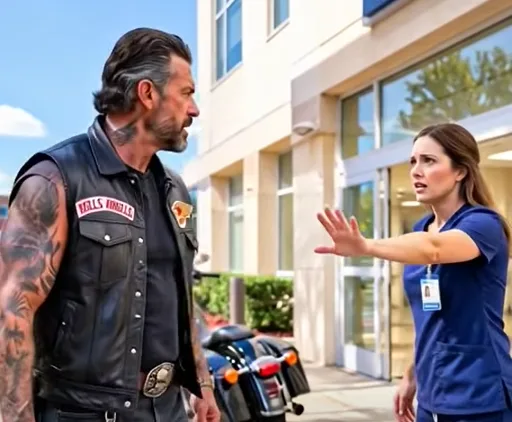
Screaming for help outside the hospital doors while a terrifying biker president shoved past me and demanded to know where my dying sister was buried
Maya’s fingers tightened around his, and for a moment the whole chaotic room seemed to fall away.
The alarms still screamed, and the guards were still dragging Jaxson’s brother across the broken glass, but all I could see was the two of them, a gruff outlaw on his knees and a pale girl in a hospital gown looking at each other like two halves of a torn photograph.
“You have my mother’s eyes,” Jaxson whispered, and his voice shook so badly that the words nearly came apart.
“Everyone says I have my father’s chin,” Maya murmured, and a weak, crooked smile touched her cracked lips.
“I guess now I know whose it was.”
Jaxson laughed, a wet, broken sound, and he pressed his forehead against the back of her hand while his shoulders trembled.
“Nurse Clara,” said a sharp voice behind me, and I turned to find Dr. Ibsen, the head of the intensive care unit, standing in the shattered doorway with two orderlies at his back.
He was a stern, silver-haired man who had worked the night shift for thirty years, and I had never once seen him look rattled until now.
“I need everyone except medical staff out of this room immediately,” he said.
“The patient is stable, but she has been through a trauma, and I will not have her heart rate climbing.”
“I’m not leaving her,” Jaxson said, and he did not raise his head.
“Sir,” Dr. Ibsen began, and then he looked closely at the man kneeling by the bed, at the tears running openly down the weathered face, and something in his stern expression softened.
“You can stay,” he said quietly.
“But you will sit in that chair, and you will keep your voice low, and you will let my nurses do their work.”
Jaxson nodded once, and he rose stiffly and lowered himself into the plastic visitor’s chair, never letting go of Maya’s hand.
I checked the monitors and found that her pulse had settled into a steady rhythm, and her oxygen was holding.
The syringe had rolled beneath the bed, and I picked it up with a gloved hand and sealed it in an evidence bag, my fingers trembling as I thought of what might have been inside.
Twenty minutes later, the hallway filled with the tramp of heavy boots, and a tall, lean woman in a dark windbreaker stepped through the broken door with a federal badge on her belt.
“Special Agent Ruth Calloway,” she announced, and her tired gray eyes swept the room, taking in the shattered glass, the toppled equipment, and the two figures by the bed.
“Mr. Reyes, I presume?”
“Jaxson Reyes,” he said, lifting his head slowly.
“And you must be the one who has been tailing my club for six months.”
“Eight,” said Calloway dryly.
“But who is counting?”
She crossed the room and looked down at Maya, and her face softened with something that looked like relief.
“Miss Hartley,” she said gently.
“I am very glad to see your eyes open.”
“Hartley?” Jaxson repeated, frowning.
“It is the name her adoptive parents gave her,” Calloway explained.
“Her birth name was Maya Reyes, and it was buried beneath eighteen layers of forged paperwork, which took my team the better part of a year to untangle.”
She glanced at me, and her mouth quirked.
“Fortunately, we received some help from an unexpected source.”
I felt my cheeks flush hot.
“The envelope,” I said.
“From my father’s Bible.”
“Your father’s Bible,” Calloway agreed.
“You dropped a copy of those documents into our tip line at six o’clock this morning, and I have never been so grateful for a nervous nurse in my life.”
“I did not know what else to do,” I confessed.
“I found out last night that my whole family had been lying to Maya, and to me, and I could not stand it.”
Jaxson turned in his chair, and for the first time he looked at me not as an obstacle but as a person, with a long, searching, solemn gaze.
“You are her sister,” he said.
“Her adoptive sister,” I said.
“But I have never once thought of her as anything less than my own.”
“Clara,” Maya whispered from the bed, and she reached out her other hand, and I took it, and the three of us sat linked together in the wreckage of the room.
Agent Calloway cleared her throat and pulled a folded paper from her jacket.
“I wish I could give you more time,” she said.
“But there are warrants to serve before the day is over, and I need to tell you what is coming.”
“Judge Harlan Voss was taken into custody an hour ago at his lakeside home, along with Dr. Peter Lang, the physician who removed Maya from the clinic twenty years ago.”
“Your brother, Mr. Reyes, is already in a holding cell downstairs, and he has begun to talk.”
“Begun to talk,” Jaxson repeated, and his jaw hardened.
“He has asked for a deal,” said Calloway.
“He claims that he acted under duress, that the judge threatened to expose his embezzlement, and that he never meant for the child to be harmed.”
“He is lying,” Jaxson said flatly.
“He has been lying since the day we buried our father.”
“He may be,” Calloway agreed.
“But the evidence will sort it out, and I intend to see that every person who touched this crime pays for it.”
She hesitated, and her voice grew quieter.
“I should also tell you, Mr. Reyes, that your arrest record from twenty years ago has been formally reviewed.”
“The charge that put you in prison, the one that kept you away from your daughter, was manufactured by the same judge, and the state is prepared to vacate it entirely.”
Jaxson did not move.
“Vacate,” he said, as though the word were written in a foreign language.
“It means that you are an innocent man,” I said softly.
“It means that you always were.”
He stared at the floor for a very long time, and then a great shudder passed through his enormous body, and he lowered his face into his scarred hands.
Maya’s fingers slipped free of mine and crept across the blanket until they found the edge of his sleeve and held on.
Nobody spoke, and the monitors beeped, and outside the broken window the thunder rolled closer across the valley.
That night, the storm broke over the hospital in a great silver torrent, and the rain hammered the windows of the fourth floor like a thousand small fists.
I had worked a double shift, and my feet ached, and my eyes burned, but I could not make myself go home.
Instead I wandered back to room four hundred and twelve, which the maintenance crew had patched with a sheet of plywood where the glass had been, and I stood in the doorway for a long time, watching.
Maya was asleep, her dark hair spread across the pillow and her breathing slow and even.
Jaxson sat beside her in the same plastic chair, with his heavy leather vest hung over the back and his sleeves rolled up past his tattooed forearms, and he was reading aloud from a battered paperback in a low, rough, astonishingly tender voice.
It was a children’s book, a worn copy of a story about a bear who lost his way home, and I realized that he must have bought it from the hospital gift shop.
“And the little bear climbed the last hill,” he read, haltingly, tracing each word with a thick finger, “and there, at the top, was his mother, waiting with the lantern lit.”
“Every night she had left it burning,” he whispered, and his voice caught.
“Every single night, so he could find his way.”
I pressed my hand against my mouth, and my eyes stung.
He looked up and saw me in the doorway, and he did not look embarrassed, only tired and open and strangely young.
“I never read to her,” he said quietly.
“I missed every bedtime for twenty years, and I thought I could make up some of it, even if she cannot hear.”
“She can hear you,” I said, and I stepped into the room.
“They always say that people in her condition can, and she moved her fingers when you got to the bear.”
“Did she?” he said, and hope flared in his face so fiercely that it hurt to look at.
“I saw it myself,” I said.
He bent his head, and his lips moved silently, and I think it was a prayer.
I sat down on the windowsill across from him and drew my knees up to my chest, and for a long while we listened to the storm.
“Why did you come to find her today?” I asked at last.
“What changed?”
“Somebody sent me a letter,” he said.”Three days ago, with no return address and no signature, just a single page in a woman’s handwriting.”
“It said that my daughter was alive, and that she was in the county hospital, and that she was in danger.”
He reached into the vest and drew out a folded sheet of cream-colored paper, creased and softened from being handled, and he held it out to me.
I unfolded it, and the handwriting looked at once strange and heartbreakingly familiar.
Your daughter lives, it read.
Forgive me for the silence, because I was afraid, and I am afraid still.
Go to her before it is too late.
It was not signed.
“I do not know who wrote it,” Jaxson said.
“But I think someone in that house carried the secret for twenty years and finally could not hold it any longer.”
I stared at the delicate loops of the letters, and my heart began to hammer, because I knew that handwriting better than my own.
“It is my mother’s,” I whispered.
Jaxson’s head came up sharply.
“Your adoptive mother?” he said.
“Rosalind,” I said, and my throat felt tight and dry.
“She has been sick for a long time, and she never told me why she cried at night, and I thought it was only her illness.”
“She must have known about Maya all along, and she could not stop him, and she could not tell us.”
I lowered the page into my lap, and tears blurred the words, and the storm seemed to roar louder outside the glass.
“I have to go to her,” I said.
“I have to ask her why.”
“I will drive you,” said Jaxson at once, and he rose from the chair.
“Maya will be safe with the agents at the door, and I will not let you walk into that house alone.”
I looked at him, at the rough, scarred face of the man I had been taught to fear, and I understood that I had never in my life been offered a protector more willing to stand in front of me.
“Thank you,” I said.
We drove through the rain in his old black pickup, because his motorcycle had been impounded, with the wipers slapping and the headlights stabbing out into the dark.
Neither of us spoke for a long time, and the silence was not uncomfortable, only full.
“What was she like?” I asked eventually.
“My sister, I mean, as a baby, before everything.”
Jaxson was quiet for a moment, and when he spoke his voice was very soft.
“She was the loudest baby in the whole county,” he said.
“She screamed for the first three weeks as though the world had personally offended her, and then one night I picked her up and sang to her, and she stopped.”
“What did you sing?”
“Something terrible,” he said, and he laughed.
“An old country song about a truck, and I did not know half the words, so I made up the rest.”
“She fell asleep on my chest with her fist in my vest, and I did not move for six hours, because I was afraid that if I did, she would wake up and be gone.”
His voice trailed away, and his hands tightened on the wheel.
“And then she was,” he said.
“Gone.”
I laid my hand lightly on his arm, and he glanced at me with a flicker of surprise.
“She is not gone now,” I said.
“No,” he said.
“She is not.”
The house stood at the end of a long gravel drive beneath a canopy of dripping oaks, a white two-story farmhouse with green shutters and a wide porch, the only home I had ever known.
A single light burned in the upstairs window, and I knew at once which room it was.
I climbed out of the truck with my heart pounding and walked up the porch steps, and Jaxson followed a step behind with his hands in plain sight.
The front door was unlocked.
I found her in her bedroom, propped against a pile of pillows in the old oak bed, a frail, silver-haired woman in a gray cardigan with an open Bible on her lap.
She looked up when I came in, and she did not seem surprised.
“Clara,” she said, and her voice was thin as paper.
“I wondered how long it would be.”
“Mama,” I said, and I crossed the room and knelt beside the bed.
“You sent the letter.”
“I did,” Rosalind whispered, and her eyes filled.
“I wrote it three times before I could mail it, and then I made your father’s friend at the post office promise not to say a word.”
“Why?” I asked, and the question tore out of me like something that had been waiting for years.
“Why did you wait so long?”
Her thin hands twisted in the blanket, and she looked past me and saw Jaxson standing in the doorway with the rain dripping off his shoulders.
A tremor ran through her, and she closed her eyes.
“You are Maya’s father,” she said.
“I am,” he said quietly.
“I have prayed for you every night for twenty years,” Rosalind whispered, and a tear slid down her sunken cheek.
“And I have prayed to be forgiven, because I do not think I can be.”
Jaxson crossed the room slowly and stopped at the foot of the bed.
“Tell me,” he said.
“Everything, from the beginning.”
She told it in a trembling voice, with her hands pressed over her chest as though holding something in.
She and my adoptive father, Walter, had been unable to have children, and after eleven years of heartbreak, Walter had come home one winter evening with a newborn girl wrapped in a blanket, saying that a kind doctor had found her a home.
“I wanted to believe him so badly,” Rosalind said.
“I took her in my arms, and she looked up at me, and I never asked a single question.”
“Then, when she was three, I found a letter from the clinic in his desk, and I understood what we had done.”
“I confronted him, and he told me that the judge had arranged everything, and that if I ever spoke of it, the judge would take both our girls away and ruin us.”
“He said that you were a dangerous man, Mr. Reyes, a murderer, and that a child could never be safe with you.”
“I believed him,” she whispered.
“God forgive me, I believed every word, because the alternative was too terrible to face.”
“And later?” Jaxson asked, and his voice was rough.
“Later, when you knew it was a lie?”
“Later, I was a coward,” said Rosalind.
“I watched Maya grow up, and she was so happy, and every year it became harder to break the spell.”
“Then I got sick, and Walter died, and when the doctors told me I had only months left, I realized that I could not go to my grave without telling the truth.”
“I found the old letter, and I put it in his Bible, hoping that Clara would find it.”
“I mailed the other one to you, Mr. Reyes, and then I waited.”
“The night of the accident, I knew,” she said, and her face crumpled.
“I heard it on the radio, a car wreck on the county highway, and the name of the victim was not Maya Hartley.”
“They used a false name, and I knew exactly what that meant.”
“I begged the sheriff to protect her, and he laughed at me.”
I wrapped my arms around her thin shoulders, and she leaned against me and wept, great shaking sobs that seemed to come from the very bottom of her soul.
“I am so sorry,” she said into my sweater.
“I am sorry for Maya, and for you, and for all of it.”
“You saved her,” I said fiercely.
“If you had not written that letter, she would be dead, and he would never have known.”
“I did not save her,” said Rosalind.
“I only stopped being afraid for long enough to ask for help.”
“That is what saving means,” said Jaxson.
We both looked at him, and he was standing very still at the foot of the bed, and his eyes were wet.
“I spent twenty years being angry at a family I thought had stolen my child,” he said slowly.
“I imagined every kind of cruelty, and I promised myself that if I ever found the woman who raised her, I would never forgive her.”
“But you did not steal her, Mrs. Hartley, you were lied to, and you loved her, and you gave her a good life.”
“I do not know how to thank you for that, but I am going to try.”
Rosalind stared at him, and her lips trembled.
“You do not hate me?” she whispered.
“I tried,” said Jaxson, with a rueful, shaky smile.
“I do not think I have the strength left.”
He came around the side of the bed and held out his large, scarred hand, and after a moment, she placed her small pale one inside it.
“Come and meet her,” he said.
“She would want to see you.”
The next morning, the storm had passed, and a washed and sparkling sun rose over the valley.
We brought Rosalind to the hospital in a wheelchair, wrapped in a blanket, and the nurses at the fourth-floor station stood and applauded as we came through the doors.
Maya was awake and sitting upright against a mound of pillows, with a tray of untouched oatmeal on her lap and her dark hair brushed back from her face.
When she saw us, she dropped her spoon, and her face lit up like sunrise.
“Mama,” she said.
“Maya, my darling,” said Rosalind, and she held out her arms, and Jaxson wheeled her to the bedside and lifted her up so that she could embrace her daughter.
They held each other for a long, long time, a frail old woman and a bruised young one, and I stood beside the bed with my hands pressed over my mouth.
“I am so sorry,” Rosalind kept saying.
“I am so sorry, my baby, my sweet girl.”
“It is all right,” Maya murmured, stroking her hair.
“You are here, and I am here, and nothing else matters.”
When at last they drew apart, Maya looked from her mother to her father and then to me, and a trembling smile spread across her face.
“I have three people who all claim to be mine,” she said.
“I think that might be a record.”
“Four,” said a gentle voice from the door, and we turned to see Agent Calloway standing there with a bouquet of yellow tulips in her hand and a faint, sheepish expression on her face.
“I hope I am not intruding,” she said.
“I brought flowers, and I also brought news.”
“Judge Voss confessed this morning,” she said.
“He is cooperating fully, and he has named eleven other officials who took part in the scheme.”
“Your brother, Mr. Reyes, has been formally charged with attempted murder, conspiracy, and fraud, and the district attorney has announced that he will seek the maximum sentence.”
Jaxson let out a long, slow breath, and his shoulders came down for the first time in twenty years.
“It is over,” he said.
“It is over,” said Calloway.
“And I want to say something, Mr. Reyes, which my superiors would prefer I did not.”
“I came into this case believing that you were a criminal, and I have never been so glad to be wrong.”
“You are a good man, and you have been wronged in every way a man can be, and I am sorry that the system took so long to see it.”
Jaxson looked at her, and his throat worked, and he nodded.
“Thank you, Agent,” he said.
She set the tulips on the windowsill, tipped an imaginary hat, and slipped out of the room.
Maya recovered over the following weeks, slowly at first and then with a speed that astonished her doctors.
She took her first steps down the hallway on the nineteenth day, leaning on Jaxson’s arm, and the whole fourth floor lined the walls to cheer her on.
“Like a baby deer,” Jaxson said proudly.
“Like a baby deer with a very annoying father,” Maya said, and he laughed so hard that he had to lean against the wall.
I moved my shifts to the day so that I could visit every evening, and we spent long hours in the little hospital garden, three odd, mismatched people on a wrought iron bench.
Maya asked Jaxson a thousand questions about her mother, and he answered every one, with a patience that I would never have guessed he possessed.
“Her name was Lila,” he told her one golden afternoon, with the sun slanting through the maple leaves above us.
“She was a seamstress, and she could sew a wedding gown in a single night, and she laughed at every one of my jokes, even the bad ones.”
“She died of a fever when you were two weeks old,” he said, and his voice softened.
“Right before they took me away, I held her hand, and she told me to look after you.”
“I failed her,” he whispered.
“You did not fail,” Maya said, and she took his hand between both of hers.
“You were locked in a cage by people who lied, and you spent twenty years fighting your way out to find me.”
“That is not failure, Dad.”
The word fell between us as softly as a feather, and Jaxson went very still.
“Say it again,” he said hoarsely.
“Dad,” said Maya, and her own eyes filled.
“Dad, Dad, Dad.”
He pulled her into his arms and buried his face in her hair, and I turned my head away to give them a little privacy and found that I was crying too.
Rosalind died peacefully that autumn, in her own bed, with Maya on one side and me on the other and Jaxson standing quietly in the doorway.
She had told us that she was not afraid, and that she had made her peace, and that she hoped that we would make ours.
Her last words were a murmur so faint that I had to bend close to hear them.
“The lantern is lit,” she whispered, and a small, radiant smile crossed her face.
We buried her beneath the oak tree behind the farmhouse, beside Walter, on a bright cold morning with the leaves falling around us like golden rain.
Jaxson stood at the graveside in a borrowed black suit, holding Maya’s hand on one side and mine on the other, and when the preacher finished the last prayer, he bent and laid a single sprig of lavender on the fresh earth.
“Thank you for raising her,” he said softly.
“I will take it from here.”
Winter came, and then a new spring, and the old farmhouse blossomed with life.
Jaxson sold the clubhouse and dissolved the motorcycle club, to the quiet relief of the sheriff’s department, and he used the money to buy the neighboring acreage and open a small repair shop beside the barn.
He called it Lila’s Garage, and he hung a hand-painted sign above the door that Maya had designed, with a tiny silver needle and thread curling around the letters.
Men who had once ridden beside him in the club came by on Saturday afternoons to drink coffee on the porch and fix engines, and they told stories about the old days in rumbling, gentle voices.
Maya enrolled in nursing school, because she said she wanted to be the kind of person who sat beside frightened people in the dark, and she and I studied side by side at the kitchen table, quizzing each other on anatomy until we giggled uncontrollably.
On the first anniversary of the day Jaxson walked into the hospital, we held a small dinner in the farmhouse dining room.
Agent Calloway came, with a basket of cornbread and a rare, relaxed smile, and Dr. Ibsen came, and so did half the night nurses from the fourth floor.
We ate at a long table beneath strings of paper lanterns, and Jaxson told the story of the bear who found his way home, and nobody laughed at the way his voice shook.
When the plates had been cleared and the last pie had been eaten, Maya stood and tapped her glass with a spoon.
“I would like to say a few words,” she said, and the room fell quiet.
“A year ago, I thought I was alone in the world, a girl with no past and a name that did not quite fit.”
“I woke up in a hospital bed with no idea who I was, and I found out that I was loved more than I could have dreamed.”
“I have a sister who risked everything to tell the truth, and a mother who found the courage to speak at the very end, and a father who crossed twenty years to bring me home.”
“To Clara, to Rosalind, and to Dad,” she said, raising her glass, and her voice rang out clear and bright across the room.
“To the people who lit the lantern.”
“To the lantern,” everyone echoed, and the lanterns above us swayed in the warm draft from the open door.
Jaxson rose from his chair and came around the table, and he took one of us in each arm, and for a long moment the three of us stood together in the gentle gold light, no longer a nurse and an outlaw and a nameless girl, but simply a family.
Later that night, long after the guests had gone, I sat on the porch swing with a blanket around my shoulders and watched the stars wheel above the dark fields.
Jaxson came out and sat beside me, with two mugs of hot cocoa, and he handed me one without a word.
The swing creaked softly, and somewhere in the barn a sleepy owl called.
“I never thanked you properly,” he said at last.
“For what?” I asked.
“For stopping me in front of the hospital,” he said.
“For calling out when everyone else would have run, and for telling me the truth when it would have been easier to look away.”
“I was terrified,” I admitted.
“I know,” he said, with a faint smile.
“That is the part I will never forget, because you did it anyway.”
I leaned my head against his shoulder, and he put his arm around me, and the sweet smell of woodsmoke and lavender drifted across the yard.
Through the kitchen window, I could see Maya moving about in the warm yellow light, washing the dishes and humming an old country song about a truck, getting half the words wrong.
Jaxson heard it too, and his whole face softened, and a single tear rolled down into his graying beard.
“That is the song,” he whispered.
“The one I sang to her when she was a baby.”
“She remembers,” I said.
“She remembers,” he said, wonderingly, and he laughed softly.
On the porch rail, a single lantern glowed, the one that Maya had hung there on the day she came home, and it cast a small circle of gold across the weathered boards.
“We will keep it lit,” I said.
“Every night,” said Jaxson.
“So that anyone who is lost can always find the way.”
The stars blinked above us, steady and bright, and the owl called again from the barn, and in the kitchen, my sister kept singing.
I closed my eyes and let the peace wash over me, and I knew, with a certainty deeper than any fear, that the long dark night had finally ended.
“We’re home,” I whispered.
And from the open window came my sister’s voice, warm and wavering and sweet, singing the last line of a terrible song, and my father, beside me, sang it with her.