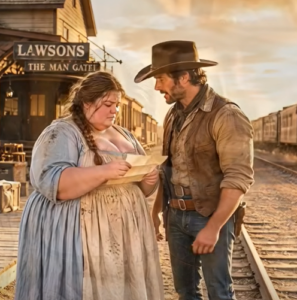
Outside Lawson’s General Store by a rugged, arrogant lawman who mockingly scrutinized my appearance while townspeople stared
The dossier struck the floorboards with a sound no louder than a falling glove, yet it landed in my chest like a rifle shot. I did not move at first. Whitmore’s cuffs clicked as the marshal hauled him upright, coffee still dripping from the table’s edge onto the worn planks, and every agent in the room had eyes on the prisoner. Only I had seen the paper leave his vest. Only I knew the ink on the top page.
My father’s name. Thomas Bennett. The same careful hand that had signed my school prizes and the letter that sent me west with a warning not to trust any man who smiled before he spoke.
I bent as if to retrieve a dropped glove of my own and closed my fingers around the folder before the nearest deputy could turn. The leather was warm from Whitmore’s body. Inside, the first page was a territorial land order dated twenty-five years prior, authorizing seizure of the river parcels that later became the railway right-of-way. Beneath the official seal sat my father’s signature, steady, unforced, and dated three weeks before my mother died.
“Miss Bennett,” the lead marshal said. His name was Calder. I had worked beside him for eleven months without ever telling him the name I was born with. “You’ll ride with the evidence wagon. We need your statement before sundown.”
“Of course,” I said. My voice did not shake. Two years of practice held it.
Whitmore looked back as they pushed him through the doors. The arrogant lawman’s face had gone gray, but the calculation had not left his eyes. He had carried that dossier against his ribs on purpose. He had wanted me to find it in the moment of his fall, so the fall would not be only his.
Outside, the town had gathered the way prairie towns always gathered when badges arrived: silent, hungry, already rewriting the story to suit whoever still held land. The steam engine hissed on the siding. Dust lifted around the steel-toed boots. I kept the folder flat against my skirt beneath the canvas bag and walked to the wagon as if the weight were nothing.
We took Whitmore to the territorial jail at Red Bluff, a stone building that smelled of lime and old fear. I gave Calder the ledgers, the forged deeds, the signed confession from the railway clerk who had cracked three nights earlier. I did not give him the dossier. When he asked whether Whitmore had passed me anything in the saloon, I said the man had offered marriage and coffee and very little else. Calder nodded. He trusted the work. He did not yet have cause to distrust the worker.
That night I read by a cracked lamp in the room above the assay office. The pages were worse than the signature. My father had not merely authorized one seizure. He had sat on the territorial claims board. He had approved six transfers in a single season, each one moving ground from small holders into a company whose directors were never named in the public record. One of those directors, a younger Marcus Whitmore, had been listed in a private memorandum as “our man in the capital.” The memorandum was in my father’s hand.
I set the page down and pressed my palms to my eyes until the lamplight broke into red sparks. For two years I had told myself I was cleaning a wound the territory had ignored. I had not known I was cutting into my own blood.
At dawn I rode to the river parcels. The grass had grown back over the old cabin sites. A woman named Ruth Keene still kept a fence line at the eastern edge, though the title office in Red Bluff said the fence was trespass. She came out with a rifle held low, not aimed, the way people hold tools they hope not to use.
“Federal?” she said.
“Investigator Bennett.” The name tasted different now. “I need to ask about the seizure in ‘sixty-one.”
Ruth studied my face longer than the badge. “Bennett,” she said. “There was a clerk by that name. Soft voice. He came with the surveyors and told my father the river would flood the corn if we didn’t sign. My father signed. The river never flooded. The railway did.” She spat into the dust. “Your people took the corn and the graves. What do you want now?”
“The truth of who ordered it.”
“Paper ordered it,” she said. “Paper don’t hang.”
I left her a copy of the public order and rode back with the private pages burning against my ribs. Calder found me at the jail steps before noon. Whitmore had asked to speak to the woman who arrested him. Calder thought it was vanity. I knew it was a knife.
They put us in the interview room with a deputy outside the door. Whitmore’s wrists were raw from the cuffs. He smiled anyway, the same smile that had not reached his eyes in the saloon.
“You kept it,” he said.
“I kept evidence.”
“You kept your father.” He leaned back. “Thomas was not coerced. I want that clear before you build a prettier story. He liked the fees. He liked being the man the capital wrote to. When your mother took sick he used the board money for doctors who could not save her, and after she died he used it to keep you in school back east. You were fed on stolen bottomland, Elizabeth. Every book you read had a furrow under it.”
“You’re lying to save your neck.”
“I’m bargaining with the only person in this territory who can still be ruined by a true sentence.” He tapped the table once. “Give me the dossier and a letter saying the syndicate began after your father left the board. I’ll plead to the railway theft. Your name stays clean. His stays a clerk who died of drink in ‘seventy-two, which is what the obituary already says.”
My father had died in ‘seventy-two. I had been fourteen. The letter that reached me said fever. I had not asked which kind.
“And if I don’t?”
“Then I tell Calder at the arraignment. I have copies. Not all of them were in the vest.” His eyes flicked to the door. “You can still be the hero who brought me in. Or you can be the daughter who buried the first theft so the later ones would look like they started with me. Choose before tomorrow. Judges like simple villains.”
I left him without an answer. In the corridor Calder waited with a tin cup of coffee and the look of a man who had slept in a chair.
“He rattle you?” Calder asked.
“He tried.”
“They always try. We move him to the capital on the Thursday train. I want your full report in my hand before the engine leaves.” He paused. “You did good work, Bennett. Two years in that town and nobody made you. That’s rare.”
I thanked him and hated the warmth in it.
That afternoon I wired the records office under a request Calder had already signed, asking for the claims board roster from ‘sixty to ‘sixty-five. The reply came after dark. Thomas Bennett had resigned in November of ‘sixty-four, citing family illness. The last three transfers bore his name. The fourth, filed two months later, bore a new clerk’s name and Whitmore’s witness signature. The machine had not needed my father once it learned his method. It had only needed his beginning.
I walked the jail yard until the stars came out hard and cold above the bluff. A lesson tried to form and I refused it. Lessons were for people who had already decided. I had not.
On Wednesday I went back to Ruth Keene with the roster and the memorandum. She read them on the porch while her grandson stacked firewood and pretended not to listen. When she finished she folded the pages carefully, as if they might still be useful.
“So the soft-voiced clerk was yours.”
“Yes.”
“And the man in the jail is the one who kept the theft alive after your father quit.”
“Yes.”
Ruth nodded toward the river. “My father’s name was Josiah Keene. He’s under that cottonwood. He signed because a Bennett told him the water was coming. I don’t need your guilt. I need the fence recognized and the parcel returned to the estate. Can your badge do that?”
“Not alone. With the dossier, with your testimony, with the ledgers, a judge can void the chain of title. Whitmore’s arrest makes the later forgeries fall. The first order falls only if someone puts it in the record.”
“And that someone is you.”
“If I put it in the record, I put my father in it.”
Ruth looked at the cottonwood. “He’s already in it. The only question is whether the living get the ground back.” She handed me the pages. “Don’t bring me your tears. Bring me a hearing date.”
I rode to Red Bluff with the decision still unfinished and found Calder in the evidence room, comparing railway invoices against the clerk’s confession. He glanced up, saw my face, and set the pen down.
“Say it plain.”
I set the dossier on the table between the invoices. “Whitmore didn’t start this. A claims board clerk named Thomas Bennett authorized the first seizures in ‘sixty-one. He was my father. Whitmore kept the copies to use against me. I kept them from you for a day and a half. That’s the truth. The rest of the case stands. This page has to stand with it.”
Calder did not speak for a long moment. The lamp hissed. Outside, a wagon passed and the sound of it faded down the street toward the depot.
“You know what this does to the report,” he said.
“It makes the report honest.”
“It makes you a witness and a liability. Defense will say you hid paper to protect blood. They’ll try to poison the ledgers with it.”
“Then we don’t let them. Ruth Keene will testify. The resignation date is in the territorial file. Whitmore’s own memorandum shows he continued the transfers after my father left. The railway theft is his. The land fraud begins earlier, and I won’t cut the beginning off to keep my name comfortable.”
Calder rubbed his jaw. “I should pull you off the case.”
“You should. And you should still take the page to the judge.”
He studied me the way he had studied Whitmore in the saloon, measuring what a person would do when the easy door was open. Then he initialed the dossier and slid it into the evidence crate.
“You’ll give the statement tonight,” he said. “All of it. If the capital wants your badge after that, that’s their trouble. Thursday we put him on the train. You ride in the second car, not as arresting officer. As the woman who corrected the record.”
Whitmore heard before I reached the cell. News moves through stone walls faster than keys. He stood at the bars with the smile gone.
“You fool,” he said. “You could have walked out clean.”
“Clean was the lie.”
“Your father built the door I walked through. You just locked us both behind it.”
“No,” I said. “He opened it. You stayed. I am closing it. Those are three different acts, and the court will be made to tell them apart.”
He laughed once, short and ugly. “Courts tell the story that keeps the railway running. You’ll see.”
Thursday morning the platform was crowded. Townspeople from Lawson’s store had come up on the freight, wanting to watch the lawman who had mocked them leave in irons. Ruth Keene stood at the edge of the crowd with her grandson, a paper parcel under her arm that I later learned was her father’s signed order, kept for twenty-five years in a tin box. Calder boarded Whitmore first. I boarded second, the dossier copied and sealed, my statement already in the marshal’s satchel.
Halfway to the capital the train slowed for a grade. Whitmore’s car was ahead of ours. I heard the shout, then the shot, then the sound of boots on the coupling. A deputy assigned to the prisoner had taken money, or fear, or both. The lock gave. Whitmore came over the roof in his shirtsleeves, cuffs broken open with a smuggled pick, and dropped into the vestibule of our car with a pistol that had belonged to the deputy.
People screamed. Calder rose with his own weapon half drawn. Whitmore fired into the ceiling to freeze the car and pointed the barrel at my chest.
“The copies,” he said. “The statement. You still have time to be your father’s daughter instead of his confessor.”
The train leaned into the curve. Dust and cinder blew through the open vestibule. I thought of Ruth’s cottonwood and of the school fees and of the letter I had held outside Lawson’s store while this man scrutinized my dress and called it worthiness. I thought of how easy it would be to hand him paper and survive the grade.
“The copies are in Calder’s satchel and in the capital already,” I said. “Killing me doesn’t unread them. It only adds a body to a case that was already finished.”
“Then I’ll take the body,” he said, and his finger tightened.
Calder fired from the aisle. The shot took Whitmore high in the shoulder and spun him into the rail. The pistol clattered onto the platform and vanished under the wheels. Deputies were on him before he could rise. Blood spotted the boards. He looked at me while they pinned his arms, and for the first time the calculation failed.
“You still carry him,” he said.
“I do,” I said. “That’s why the page stays in.”
They chained him to a bench for the rest of the run. No one spoke much. The grade leveled. The capital’s smoke showed in the afternoon, and the courthouse dome caught the light like a dull coin.
The hearing took nine days. Whitmore’s counsel tried the poison Calder had predicted. They called me a daughter first and an investigator second. They read my father’s obituary and asked whether grief had invented conspiracy. Ruth Keene took the stand with the tin-box order and named the surveyor, the fee, and the year the river did not flood. The railway clerk confirmed the later skims. The memorandum in my father’s hand was entered beside Whitmore’s own ledger. The judge, a tired man with ink on his cuff, voided the chain of title on the Keene parcel and three others, bound Whitmore over for racketeering, and issued a public note that the original board authorizations were irregular and would be reviewed. He did not call my father a mastermind. He called the record incomplete until now. That was as much justice as paper could manage for the dead.
I resigned the undercover post the morning the note was posted. Calder argued for an hour in the corridor. He said the service needed people who would rather break their own name than hide a page. I said the service would survive one fewer Bennett, and that I had used the name long enough as cover. We parted without enemies. That was a rarer outcome than a conviction.
I went east only long enough to stand at my father’s grave, which was smaller than I remembered and unmarked except for the dates. I did not forgive him and I did not prosecute him to the grass. I told the stone what the judge had told the record: the beginning was his, the continuation was Whitmore’s, and the correction would not be either of theirs. A groundskeeper watched from a distance and did not approach. People rarely approach a woman talking to a grave if she does not weep.
In the spring I returned to the river parcels with a survey flag and a letter of introduction from the territorial court. Ruth met me at the cottonwood. The fence had been moved to the old line. Her grandson was turning soil where the corn had been. She did not thank me. She handed me a cup of well water and asked whether I knew how to plant so the rows would hold when the real flood finally came.
“I can learn,” I said.
“Then learn here,” she said. “Bad paper took this ground. Good paper gave it back. The ground doesn’t care what your father signed. It cares what grows.”
I stayed through the planting. At night I wrote the long report Calder had asked for, not for the service but for the file that would outlive both of us: names, dates, fees, the resignation, the copies Whitmore had meant as a weapon and which had become a map. I included my concealment of a day and a half. A record that flatters the teller is only another forged deed.
The lesson was not that blood absolves, or that exposure cleanses, or that a badge is stronger than a father’s hand. The lesson was narrower and harder. Corruption travels by inheritance when the heirs agree to call it history. It stops when someone who benefited, even unknowingly, puts the first page on the table and accepts the smaller name that follows. Worth is not bestowed by a lawman’s invitation or a town’s stare. It is the decision, made in dust and lamplight, to let the truth cost what it costs and to plant anyway on the ground that remains.