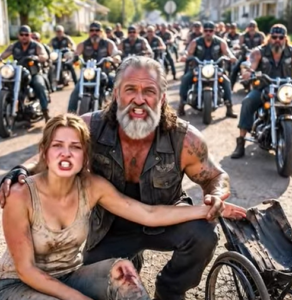
On the sun-baked asphalt of a suburban neighborhood while three laughing local thugs kicked my broken wheelchair away
I pushed the diner door open and the bell above it gave a thin, guilty ring.
“You left something behind.”
The Miller brothers sat in the corner booth like they still owned the afternoon. Tyler had a milkshake halfway to his mouth. Brett had his boots on the seat. Cody was the first to see the leather wall forming behind me and the color left his face so fast it looked like someone had pulled a plug.
Silas stepped in at my shoulder.
“Stay in the chair of the conversation, boys. Don’t get cute.”
Tyler tried a laugh that died in his throat.
“We were just messing around. It’s a chair. She can get another one.”
I crossed the linoleum without rushing. Two patched members set the twisted wheelchair down in the aisle like evidence.
“It was not just a chair,” I said.
“It was my road.”
Brett snorted.
“Your old man ain’t here to buy you another toy, Ellie.”
Silas’s voice dropped.
“Say his name right or don’t say it.”
Cody’s eyes flicked to the patches, then to the street where fifty bikes had turned the curb into a checkpoint.
“We didn’t know she rode with you.”
“She doesn’t ride with me,” Silas said.
“She owns the ground my clubhouse sits on.”
The diner went so quiet I heard ice melt in a glass. A waitress froze with a pot of coffee. A trucker near the window put both hands on the table where everyone could see them.
Tyler found a smirk he could not afford.
“That’s a story. Paper don’t mean nothing if nobody enforces it.”
I took the folded deed from the inside pocket of the jacket a prospect had given me in the street. The county seal was still crisp. My father’s signature sat under the transfer line like a last instruction.
I set it on their table.
“Read.”
Brett leaned in, then shoved the paper away as if it burned.
“Your daddy was a mechanic who fixed bikes. He didn’t own Black Viper land.”
Silas picked the deed up, glanced at the parcel number, and set it down again.
“He owned it the night he pulled me out of a ditch with a collapsed lung and a club war coming down the highway. He didn’t ask for a patch. He asked for a promise. If anything happened to him, the land stayed with his kid so no one could evict the club with a forged lien and a smile.”
Cody swallowed.
“We didn’t know.”
“You knew enough to kick a wheelchair into traffic and call it a joke,” I said.
“You knew enough to loot the workshop after the funeral. You knew enough to tell the sheriff I was hysterical when I reported the missing tools.”
Tyler stood up too fast. A dozen men shifted their weight. He sat back down.
“What do you want? An apology? Fine. Sorry. Now take your circus and go.”
Silas looked at me, not at them.
“Your call, kid.”
I had imagined this moment for three years in a smaller voice. In the imagining I screamed. In the diner I did not.
“I want the chair replaced with one that works. I want every tool you stole returned by sundown. I want the sheriff’s report amended so it stops calling me confused. And I want you to say my father’s name without laughing.”
Brett muttered.
“Daniel Hale.”
“Again.”
“Daniel Hale.”
“Louder.”
He said it loud enough that the trucker by the window looked down.
Silas nodded once.
“That’s the cheap part. Now we talk about the expensive part.”
He pulled a folded incident print from his cut. Hospital admission. Time stamp. Three names in a neighbor’s statement that had never made it into the official file.
“Your father didn’t die of a ‘mechanical accident’ in his own shop. Someone loosened a jack stand. Someone who knew his routine. Someone who needed the workshop empty and the daughter too busy surviving to read a deed.”
Tyler’s hands started to shake.
“That’s a lie.”
“Then you’ll love the camera your father hid in the rafters after the first break-in,” Silas said.
“We pulled the card last winter. Three boys in hoodies. One of them wears the same boots you have on the seat, Brett.”
Brett yanked his feet down.
Cody whispered.
“We were just supposed to scare him. Make him sell. There was a developer. Cash. We were kids.”
“You were twenty-two, twenty-four, and twenty-six,” I said.
“You were old enough to kick a chair and old enough to loosen a stand.”
The waitress set the coffee pot down like it had become evidence too.
Silas rested both palms on the table.
“Here is how this block works now. The Millers do not own this town. They never did. The trust my club pays taxes through exists because Daniel Hale signed a paper when I couldn’t breathe. That paper sits in her name. You touch her again, you touch the house, you touch the shop, you even look at a wheel on her chair the wrong way, and you will find out how long a county road can feel when fifty bikes decide you don’t get to use it.”
Tyler tried one last angle.
“You can’t prove the jack.”
I took out my phone and played the ten-second clip my father had labeled in a folder called IF. The audio was ugly and short. A laugh I knew. A curse I knew. The sound of metal giving way.
When it ended, Cody put his face in his hands.
“What happens to us?”
Silas looked at me again.
I thought of the months of eviction notices, the neighbors who closed blinds, the police who said kids will be kids. I thought of the handkerchief against my arm and the way Silas had crouched instead of towering.
“You return what you stole,” I said.
“You pay for the chair. You tell the sheriff the truth. Then you leave this county for a year. If you come back, you come back quiet. If you come back loud, the deed is not the only paper I know how to use.”
Brett laughed once, broken.
“That’s mercy.”
“That’s a debt,” I said.
“Mercy would be pretending my father died of bad luck.”
Silas straightened.
“You heard her. Clock starts now. Sundown.”
They stood like men leaving a sentencing. At the door Tyler looked back.
“Your dad saved him. That don’t make you a Viper.”
I met his eyes.
“I don’t need a patch to own the ground you just lost.”
The door closed. Engines filled the street again, then settled into an idle that sounded like a held breath.
Silas turned to me.
“You good to ride back?”
“I need a chair that rolls before I need a speech.”
A prospect was already on a phone. Another was folding the ruined frame into a van. An older member I did not know brought a spare lightweight chair from a chase vehicle as if they had planned for the possibility that the world would be cruel on a Tuesday.
Silas helped me into it. His hands were careful in a way that did not ask for thanks.
“Your father made me promise two things,” he said.
“Keep the land in your name. Don’t turn you into a mascot.”
“Which one are you breaking?”
“Neither, if I can help it.”
We rolled to the curb. The pack opened a lane. I could have asked to go home. I asked to go to the shop instead.
The workshop still smelled like solvent and old coffee. Dust lay in the shape of tools that had been missing. On the back wall my father had pinned a faded photo of a younger Silas on a gurney, oxygen mask, one thumb up like an idiot who refused to die politely.
Silas stood in front of it for a long time.
“He should have let the club bury that picture.”
“He kept it so I’d know the difference between men who roar and men who show up.”
By sundown the Miller brothers’ truck backed up to the bay. Boxes. Wrenches. A compressor they had sworn they bought used. An envelope with cash that was not enough and would never be enough. The sheriff arrived pale and took a new statement while looking at the deed like it had grown teeth.
Cody was the only one who said the sentence I needed.
“Daniel Hale didn’t slip. We made it look like he did.”
The sheriff wrote it down. The air in the shop changed temperature.
When they left, Silas sent the pack home in twos and threes so the neighborhood would not live under an occupation. He stayed. So did two men by the door who pretended they were just waiting on a part.
I sat in the new chair and looked at the clean concrete where the jack stand had failed.
“Why didn’t you come sooner?” I asked.
“I came the day I heard engines that didn’t belong on this street. I should have come the day the funeral flowers died. That’s on me.”
“Dad always said you paid your debts in full.”
“He overestimated me.”
I wheeled to the workbench and opened the drawer where the master key to the clubhouse lot still hung on a hook labeled GUEST, which had been his idea of a joke.
“You can keep running church on that land,” I said.
“The deed stays in my name. No vote changes that. No patch changes that. If the club ever decides an orphan with wheels is inconvenient, you will find out I learned more from a dead mechanic than from any bylaw.”
Silas almost smiled.
“He said you’d talk like that if you ever had to.”
“Did he say what you’d do if I did?”
“He said I’d listen. For once.”
Night came down hot and slow. Cicadas started. Someone fired up a grill two houses over like the world had not just changed owners in a diner booth.
Silas folded the handkerchief he had used on my arm, now stained, and left it on the bench.
“Keep that. Not as a souvenir. As a reminder that the first man who stopped today didn’t ask what you could do for the club.”
“What did he ask?”
“If you were alright.”
I looked at the photo on the wall, at the deed in my bag, at the street where three laughing boys had kicked my freedom into a gutter and driven off thinking the story ended there.
“Power that has to kick a chair to feel tall isn’t power,” I said.
“Land you steal with a loosened stand isn’t land. The people who matter already know who kept this block standing when the air went out of a president’s chest. The rest can learn it the hard way or the quiet way. I gave them the quiet way. That’s more than they gave my father.”
Silas nodded, put on his helmet, and paused at the bay door.
“You need anything, you call the number on the back of that handkerchief. Not because you own us. Because he saved me, and I don’t get to pick which part of that debt I honor.”
He rode off with the last two bikes. The street sounded like a suburban evening again, which was a kind of lie, but a livable one.
I locked the shop. I rolled home under the same sun-baked sky that had watched me get knocked down. The new chair hummed over cracks my old one used to catch. In the kitchen I taped the deed copy next to the unpaid medical stack and wrote one line on a sticky note.
It was never just a chair.
Then I sat by the window until the block lights came on, not waiting for engines, not fearing them either. The hunt had ended in a diner with a piece of paper and a voice that did not shake. The lesson stayed after the dust settled. Strength is not the boot that sends your life into the gutter. Strength is the hand that stops, the name you make them say out loud, and the ground you refuse to give back once you finally understand it was yours all along.