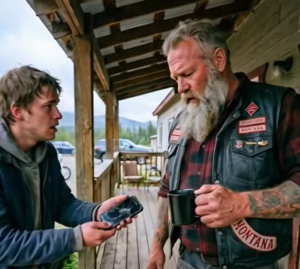
On the rain-slicked wooden porch of the Montana clubhouse with my shattered phone in my trembling hands
“Wait,” I said, and my voice came out smaller than I wanted. “Before we go. You said the others.”
The old man paused at the door with the rifle slung low across his forearm and his gray head turned just enough that I could see one pale eye in the lamplight.
“Everybody in this hall knew what the ridge was,” he said quietly. “Everybody who rode with me twenty years ago. Which means everybody who rides with me now is either a son of one of them or one of them.”
“And one of them is why Eli is missing.”
“One of them is why my boy is missing,” the old man said, and the words sat in the dim room like a stone dropped into a well.
My stomach dropped with it.
“Your boy?”
He did not answer right away. He walked back to the desk, and opened the center drawer, and drew out a photograph in a cracked silver frame that he turned toward me without looking at it himself.
A young man grinned out of it, maybe twenty-two, with a crooked front tooth and the old man’s pale eyes, sitting on the tank of a motorcycle with his arms spread wide as if he were about to take off.
“Danny,” the old man said. “Danny Rourke. He went up that mountain nineteen years ago to prove he was man enough to ride with the club. Said he was going to bring back the bag from the federal job to show the brothers he could keep a secret.”
“And?”
“And he never came down. The club told me he ran. Left the state. Couldn’t face me.” His jaw worked. “I spent nineteen years hating a boy who never left that mountain.”
The coordinates in the title of the whole nightmare suddenly made terrible sense, and I put a hand over my mouth.
“The message on my phone,” I breathed. “Eli didn’t just find a drug route. He found your son.”
“He found something that’s been waiting to be found for nineteen years,” the old man said. “And somebody noticed.”
My name is Wyatt Hale, I am twenty-four years old, and I had driven a delivery truck for Mercer Lumber for three years without once wondering why the logging roads behind the sawmill had been chained off since before I was born.
Eli Brandt had been my best friend since the fourth grade, a skinny, restless kid who read every book in the town library and asked questions nobody wanted answered. He had taken a job surveying timber for the state, and last month he had called me at midnight and said, in a thin, excited voice, “Wyatt, I found a place on Black Ridge where the ground’s been dug up and put back wrong.”
Four days ago he had stopped answering his radio.
“What’s your name, son?” the old man asked.
“Wyatt.”
“I’m Gideon Rourke. Folks call me Gid.” He settled the rifle on his shoulder and held out a scarred hand. “I’m sorry I put you against the wall.”
I shook it. His palm was dry and shaking.
“Eli’s alive, Mr. Rourke,” I said. “He has to be. He left me the card so I could find him.”
“Then let’s go find him.”
We slipped out the back of the hall, through a kitchen that smelled of bacon grease and bleach, and into the wet black yard where a battered green pickup waited under a dripping cottonwood.
Gid drove without lights, one hand on the wheel and the other resting on the rifle between us, and the truck bounced and slid up a washed-out fire road with the storm hammering the windshield.
“The card,” he said, over the engine. “You didn’t look at it?”
“My phone’s broken. I couldn’t.”
“I’ve got a reader in the glove box.”
I fished out a little gray adapter, and a battered tablet wrapped in a rag, and fumbled the chip into the slot while the truck lurched beneath me.
The screen flickered.
A folder opened, and in it were forty-one photographs, each stamped with a date and a coordinate. I thumbed through them with my heart climbing into my throat.
Disturbed earth. A rusted steel box half-sunk in a ravine. A faded canvas bag stenciled with a federal seal. And near the end, a bone-white curve of something I did not want to name.
“Gid,” I said.
“Say it.”
“He found your son.”
The old man’s hands tightened on the wheel until the leather creaked, and for a long moment the only sound in the cab was the rain.
“Is he in the picture?” he whispered. “Danny. Is there a picture of him?”
“There’s a jacket.”
I turned the tablet, and showed him a photograph of a scrap of faded denim snagged on a root, with a small embroidered patch still stitched to the sleeve.
It showed a lightning bolt, and the initials D.R.
Gid made a sound I had never heard a man make, a deep dry crack in the chest like a tree splitting in winter, and he pulled the truck to a stop on the edge of the muddy track and put his forehead against the steering wheel.
I did not say anything.
I sat beside him in the roaring dark and laid my hand on his shoulder, and he let it stay.
“He had that jacket the day he left,” Gid said at last, rough and wet. “I bought it for him in Billings. He wore it to bed.”
“I’m so sorry.”
“Nineteen years, son. I cursed his name for nineteen years.”
“He didn’t run.”
“No.” He lifted his head, and his face in the dash light was lined with tears he made no attempt to hide. “He didn’t. And somebody let me think so.”
The headlights of a second vehicle swung across the trees behind us.
I saw them in the rearview mirror, two yellow eyes bobbing up the fire road a quarter mile back, and Gid saw them in the same instant and killed the engine.
“The others,” I whispered.
“The ones who noticed.” He reached under the seat and pulled out a flare gun and a canvas pouch. “Hale, how well can you run in the dark?”
“I’m a delivery driver.”
“That’s a no.”
“That’s a decent no.”
“Then you’ll learn.” He shoved the pouch into my hands. “Ammunition for the rifle, a flashlight, and a map. The ridge trail starts a half mile past the old log landing, on the left. Follow the creek bed until you see a split cedar with a red rag tied to it. Wait there.”
“And you?”
“I’ll lead them somewhere else.”
“Gid, you can’t.”
“I’ve been leading men places for forty years,” he said. “Let me do one good thing with it.”
He pushed open the door, and the rain roared in, and he vanished into the black trees with the rifle at his shoulder before I could argue.
I ran.
I ran through ferns slick as wet soap and under branches that whipped my face, with the flashlight clenched in my fist and the sound of engines growing behind me and my own breath tearing in my throat. Once I fell, and slid down a muddy bank on my belly, and lay still with my heart slamming while boots crashed past on the track above me.
A flashlight beam swept the trees.
“Check the creek!” a voice shouted.
I knew that voice.
It was Sheriff Carl Mercer, the same Mercer I had begged twice for help, who had patted my shoulder and told me that grown men sometimes disappear on purpose.
I pressed my face into the cold mud and did not breathe.
The beam crawled over my back, and stopped, and moved on.
When the footsteps had faded, I crawled out and followed the creek with my teeth chattering, and after what felt like hours I saw a split cedar standing against the sky with a strip of red flannel tied around its trunk.
I crouched beside it with the flashlight off and waited.
It was close to dawn when I heard the low, slow whistle of someone walking carefully through trees.
Three notes, rising.
It was a whistle Eli and I had used when we were ten years old, to signal that the coast was clear.
I stood up so fast that my head spun.
“Eli?” I whispered.
“Wyatt?” The voice that came back was thin and cracked, and it came from the darkness above me, up the slope where a cleft of gray rock formed a shallow cave. “Is that you? Tell me it’s you.”
I scrambled up the rocks and nearly fell into him.
He was filthy and gaunt, with a wild tangle of dark hair and a swollen purple bruise along one side of his face, and his left arm was bound to his chest with strips of a torn flannel shirt. But his eyes were Eli’s eyes, bright and sharp and fierce, and when he saw me, they filled.
“You got the card,” he said.
“I got the card.”
“I didn’t know if you would. I was hiding up here for four days. They found my truck and I had to run.” He gripped my shoulders with his good hand. “I carved it into the phone case when I put it in your truck, because I figured you were the only person in the world who’d actually look.”
“You idiot,” I said, and my voice broke. “You absolute idiot. I thought you were dead.”
“I almost was.”
“Who hurt you?”
“The sheriff’s deputy,” Eli said. “Burke. He was waiting at the dig site. I fell down the ravine getting away.” He winced. “Wyatt, I found the box. I found Danny Rourke. And I found the lockbox from the federal job, and it’s full of ledgers, names, everything. It’s evidence of the whole ring, and the sheriff is in it.”
“I know.”
“You know?”
“I just got a tour of the sheriff’s boots.” I hugged him, carefully, mindful of the arm. “Come on. We’re going to get you down this mountain.”
“Wyatt,” he said quietly, in my ear. “I’m not leaving without the box.”
I pulled back and looked at him.
He lifted the tail of his jacket, and there, strapped to his back with a length of baling twine, was a rusted steel lockbox the size of a bread loaf.
“I carried it up here,” he said. “I’ve been carrying it for four days.”
I started to laugh, a thin, helpless, hiccuping laugh, and he laughed with me, and we sat together in the wet gray cave while the dawn began to break through the pines.
Then the first shot cracked across the ridge.
It came from below, flat and echoing, and a second followed it, and a third, and I knew in my bones whose rifle it was.
“Gid,” I whispered.
“Who?”
“Danny’s father.”
We ran.
We came down the slope in a stumbling scramble with the box clattering against Eli’s spine, through the mist and the dripping cedars, toward the sound of gunfire in the hollow below. The sky had gone the color of pearl, and the rain had thinned to a cold gray drizzle, and I could see figures moving among the trees, five of them, six, with flashlights.
Gid stood in the middle of a small clearing with his back against a boulder and his rifle at his shoulder.
Around him, in a loose ring, stood the sheriff and four men in tan uniforms, their weapons trained on him from every side.
“Put it down, Gideon,” Sheriff Mercer called, almost gently. “It’s over. We know about the card. We know what’s on it. Give it to me and nobody has to get hurt.”
“Carl,” Gid said, and his voice carried through the mist like a bell. “You sat at my table. You ate my Christmas ham. You told me my son ran off because he was ashamed.”
“I said what had to be said.”
“You buried him.”
“Gideon.” Mercer’s face hardened. “The boy was going to turn state’s evidence. He found the stash early, and he panicked, and he threatened to take it all to the feds. You know what happens to boys who do that.”
“He was twenty-two years old.”
“He was a liability.”
The words hung in the cold air.
I felt Eli’s hand clamp on my arm and squeezed it back, and we crouched together behind a stand of ferns, close enough to see the old man’s face.
It was not angry.
It was something worse, something calm and quiet and endlessly tired.
“I know what he was,” Gid said. “He was my son.”
“Drop the rifle.”
“No.”
“Gideon, I will shoot you.”
“I know you will.” The old man smiled, a thin and terrible smile. “But you should know that the card isn’t on me. And the box isn’t here. And forty-one photographs have already been sent to the state attorney general, and the U.S. Marshals, and a reporter from the Billings Gazette.”
Mercer went rigid.
“You’re lying.”
“Check your phone, Carl.”
The sheriff’s hand dropped to his pocket, and he pulled out a cell phone and stared at the glowing screen, and his face changed like a dropped plate.
“How?” he whispered.
“My friend’s tablet has a modem,” Gid said. “The boy sent them from the truck. I told him to. Seven minutes ago.”
I realized, with a lurch, that I had been holding the tablet for the entire drive up the mountain, thumbing through photographs, and that Gid had asked me to press the little arrow at the top right of the screen before he left.
I had thought it was a map function.
“Wyatt,” Eli breathed. “What did you do?”
“I have no idea,” I whispered.
Mercer raised his pistol.
He was not going to wait. I saw it in the set of his shoulders, the swallow in his throat, the flat desperate panic of a man whose whole life was dissolving in his hands. He aimed at Gid’s chest and curled his finger around the trigger.
I did not decide to move.
I was simply up, out of the ferns and running into the clearing, shouting at the top of my lungs, with Eli’s cry behind me and the steel box swinging against his back.
“Sheriff! Stop! I’m Wyatt Hale, and I have a federal marshal on the radio!”
It was a lie, and it was the worst lie anyone has ever told.
But Mercer’s head snapped toward me, and his barrel wavered, and in that half second a thunderous roar rolled down the slope from the east.
Helicopters.
Two of them, black and low, bursting over the ridge in the gray dawn with their searchlights blazing white through the mist and the voice of a loudspeaker ringing out across the pines.
“Federal agents! Drop your weapons! You are surrounded!”
I had not known helicopters could be so beautiful.
Mercer’s men threw down their guns like children dropping hot coals. The sheriff stood for a heartbeat with his pistol half raised and his mouth open, and then his arm sagged, and the weapon slid out of his fingers and fell in the mud.
Agents in dark windbreakers poured down the slope on ropes and on foot, shouting orders, cuffing wrists. A broad woman with a gray braid and a Marshals vest strode across the clearing with a pistol in one hand and a bullhorn in the other.
“Carl Mercer,” she called. “I’m Deputy Marshal Rosa Delgado. You’re under arrest for conspiracy, obstruction, kidnapping, and the murder of Daniel Rourke. Face down in the mud, please.”
Mercer sank to his knees.
He looked, in that moment, like what he was, a small and frightened man in a ridiculous hat.
Gid had not moved.
He stood with the rifle still raised and his finger still on the trigger, staring at the sheriff, and I saw the muscles in his forearm quiver.
“Gid,” I said softly, stepping up beside him. “Gideon. It’s done.”
“He killed my boy.”
“I know.”
“He ate at my table.”
“I know.”
“I could do it now,” the old man whispered. “I could put him in the ground right here.”
“You could.” I laid my hand on the barrel and pressed it gently downward. “But Danny wouldn’t want you to be that man. He’d want you to be the one who carried the truth down the mountain.”
Gid’s eyes closed.
For a long moment he stood there, a huge, stooped, broken old giant, with the dawn breaking pink over his gray head and the rain dripping off his beard.
Then the rifle slid from his hands, and I caught it, and he put his face in his palms and wept.
They found Danny that afternoon.
It took a federal forensics team six hours of careful digging in the mud of Black Ridge, with Gid standing at the edge of the pit in a borrowed yellow slicker, never moving, never speaking. At four o’clock, a young technician with a trowel looked up and nodded gravely.
They brought him up in a white sheet, so small and light that two men could carry him.
Gid stepped forward and laid a trembling hand on the shroud.
“Hello, son,” he whispered. “I’ve been looking for you.”
Nobody on that mountain made a sound.
The trial took eleven months.
Carl Mercer pleaded guilty to eight counts including first-degree murder and received life without parole. His deputies took plea deals and testified, and the whole sprawling web of the old federal job unraveled in the testimony, a dozen aging bikers, two county commissioners, a banker, and a retired judge who had signed the paperwork that kept the evidence buried.
Eli testified for three days with his arm in a sling and his voice steady. He told the court about the ground that had been dug up and put back wrong, and the bones, and the rusted box.
When the prosecutor asked what had driven him to keep going, he looked across the gallery at a white-bearded old man in the front row.
“Somebody’s son was under that ground,” he said. “It seemed to me somebody ought to come looking.”
Gid nodded, once, and wiped his eyes.
They buried Danny Rourke on a bright October morning at the little cemetery on the hill above the clubhouse, beside his mother, under a granite stone that read, simply, DANIEL ROURKE. HE CAME HOME.
Forty bikers stood in a ring around the grave in clean leather vests with their helmets in their hands. Eli and I stood at the back, side by side, in borrowed suits that didn’t quite fit.
Gid said a few words.
He said them slowly, in his deep rough voice, with the wind lifting his white hair.
“My son was a brave boy,” he said. “Braver than I knew. He went up a mountain to prove himself to men who weren’t worth it, and he died keeping a secret that should never have been kept. And for nineteen years I was too proud, and too angry, and too afraid to ask the question that would have brought him home.”
He looked down at the stone.
“Don’t be like me,” he said. “Ask the question.”
He knelt, and laid a worn lightning-bolt patch on the new earth, the one Eli had found snagged on a root, and he stayed there a long time.
After the funeral the club did something nobody expected.
They voted, in the old hall under the elk head, with a hundred candles burning along the walls, to dissolve.
Not in shame, but in decision. They sold the compound and the trucks and the old Harleys, and they poured the money into a trust that Gid and Eli and I spent the whole winter setting up.
We called it the Danny Rourke Fund.
It paid for search-and-rescue teams in rural counties, and legal aid for families of missing persons, and a free hotline staffed by volunteers who would answer the phone at three in the morning and say, I believe you. We’ll look.
Eli ran it.
He had a desk in a converted storefront on Main Street, with a cracked window and a coffee maker that wheezed, and he worked sixteen-hour days with a wild-eyed happiness I had not seen in him since fourth grade. In the first year the fund found nine missing people alive and brought four more home to their families.
Gid came by every morning with a thermos and a bag of donuts and a long list of complaints about the coffee.
He had sold his ranch house and moved into a small cabin at the edge of town, with a porch that faced the mountains, and he sat there each evening with a pipe and a battered paperback and the old photograph of his son in its cracked silver frame.
I visited on Sundays.
We would sit on the porch together while the light slid gold down the slopes of Black Ridge, and he would tell me stories about Danny, the crooked tooth, the stolen motorcycle, the time he had ridden a horse into the barbershop on a dare.
“He’d have liked you,” Gid said, one evening in November, when the first snow was drifting down.
“I like him already.”
“You didn’t give up on that boy Eli.” The old man took a long pull on his pipe. “Everybody else gave up. The sheriff, the town, half the county. But you drove a delivery truck up a logging road in a storm with a broken phone and a dead man’s chip.”
“I was scared the whole time.”
“That’s what brave is.”
I laughed, softly, and looked out at the dark shape of the mountain, silvered now with new snow.
“Gid,” I said. “Do you ever think about it? How close we came? If Eli hadn’t carved those words, if I hadn’t walked into that hall—”
“Every night,” he said. “And every night I thank whoever’s up there that you did.”
He set down his pipe and looked at me, with the light from the window falling across his lined, gentle face.
“You know, I never had a second son,” he said. “I always thought one was all a man could hope for, and I lost him. But I’ve been thinking lately that the world doesn’t always work in subtraction.”
“What does it work in?”
“Odd arithmetic,” Gid said, and smiled. “Sometimes you lose one and find two.”
My throat closed.
I could not answer.
I reached over and took his scarred, weathered hand, and he held mine in both of his, and we sat together in the cold clean silence while the snow came down over the porch and the mountains and the long, quiet road.
In spring, the three of us rode up to Black Ridge together.
Not on motorcycles, but on old borrowed horses from a neighbor’s barn, plodding up the rutted fire road in the thin green light of April with the creek rushing loud beside us and the new leaves unfurling pale as butterfly wings.
At the top, in a clearing among the cedars where the ground had once been dug up and put back wrong, someone had planted a young apple tree.
It was small, no taller than my waist, with a slender trunk and a cluster of white blossoms just beginning to open.
A plain wooden marker stood beside it.
FOR DANNY. THE GROUND REMEMBERS.
Gid dismounted slowly, with a grunt, and stood before it with his hat in his hands.
The wind moved through the cedars, soft and warm, smelling of damp earth and new growth, and a single white petal drifted down and landed on his shoulder.
“It’ll bear fruit in four years,” Eli said quietly. “The nursery said so.”
“Four years,” Gid murmured. “I’ll be eighty.”
“You’ll be eighty and complaining about the coffee.”
“I’ll be eighty and eating an apple,” the old man said, and laughed, a full, rich laugh that rolled out over the ridge and made a pair of jays burst up from the cedars.
I stood beside him in the dappled sunlight and looked out across the endless blue ridges rolling away to the horizon, one behind the next, soft as breath.
I thought of a rain-slicked porch and a shattered phone and a man who had called me a coward.
I thought of how a message scratched in plastic had crossed twenty years and found the one person who could finally read it.
“Gid,” I said.
“Yes, son?”
“Thank you for letting me in.”
He turned, and put one heavy arm around my shoulders and the other around Eli’s, and drew us both against him.
“Thank you for knocking,” he said.
We stood together beneath the blossoming tree while the sun climbed, and below us in the valley the town went on with its morning, smoke rising from chimneys, a truck rumbling down the highway, a church bell ringing the hour.
Nothing was hidden anymore.
The mountain had given up its secret, and the secret had given us each other, and the long dark winter of nineteen years had finally, quietly, turned to spring.