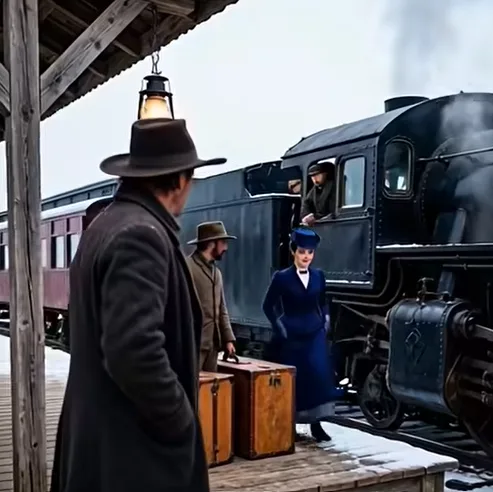
On the freezing Montana train platform in my tailored blue Philadelphia wool suit
The door gave on the third kick and winter came in with three men.
The first wore a city coat that had never learned snow. The second held a scattergun like a man who enjoyed furniture. The third I knew. Detective Alden Crowe. Philadelphia. The smile he used in courtrooms when he had already decided you were luggage.
“Miss Vale,” Crowe said, as if my real name were a warrant.
“And Mr. Hayes. How convenient. One collar, two bounties.”
Colter did not lower the revolver.
“You’re on my boards.”
“Boards can be purchased. So can widows. So can catalog brides who sew aliases into their hems.”
I stayed in the shadow of Colter’s shoulder, blue wool suddenly loud in a room built for hide and iron.
“I am not his purchase.”
“No,” Crowe agreed.
“You are evidence that walked to the depot in a tailored suit. Your uncle paid for the return. Hayes here is the extra coin. Dead or walking. The paper does not specify manners.”
Colter’s mouth barely moved.
“How many in the yard.”
“Enough,” Crowe said.
It was a lie. Men who bring enough do not talk so much.
Colter fired once into the ceiling lamp chain. The room went to firelight and shapes. I dropped behind the table. Bread hit the floor. Stew slopped across pine. The scattergun roared and took a chunk of the mantel that had never done anyone harm.
Colter’s second shot put the scattergun man on his knees, screaming about fingers. The city coat dove back toward the door and found Colter’s boot instead. Crowe was quicker. He had always been quicker in hallways.
He grabbed my arm.
“End of the pastoral, Naomi.”
I had not given Colter that name. Hearing it in this kitchen made the hearth look like a trap I had built myself.
Colter’s barrel found Crowe’s knee without finding me. Crowe folded, cursing God and Montana in the same breath. I wrenched free and put the cast-iron pot lid against his temple with more education than elegance. He went slack enough.
“Cellar,” Colter said.
“Now.”
The cellar door was in the floor beside the stove, a square of darker wood I had mistaken for a stain. We dropped into cold and potatoes and the smell of packed earth. Colter barred it with a beam that had waited years for a night like this.
Above us boots, a groan, Crowe’s voice trying to stay official through pain.
“Hayes. The girl is a federal witness who ran. You harbor her, you hang beside her uncle’s enemies. Open the door.”
Colter’s face in the slit of lantern light was all edges.
“Talk fast,” he whispered.
“True name.”
“Naomi Vale. My father held a shipping concern. He testified against a Philadelphia dock syndicate and died of a fall that could not find stairs. My uncle kept the company and the syndicate kept my uncle. I was scheduled to sign papers that would have made me a quiet widow of a living man. I bought a catalog name and a train.”
“And me.”
“Your letter said loneliness and a clean past. The Pinkerton circular in Crowe’s coat said rustling and a dead partner in Cheyenne. We both advertised ghosts.”
Colter’s jaw worked.
“The partner was my brother. He was not dead until the same dock money decided Montana hides were a good place to wash eastern cargo. I burned a barn that was a warehouse and the circular called it theft. There is a bounty because I lived.”
Above us something heavy dragged.
“They will fire the house,” I said.
“They will try. Snow roof. Wet wood. They are city. We have minutes, not mercies.”
He moved a crate. Behind it, a short rifle and a box of shells that had been oiled for a different winter. He put the revolver in my hand without asking if Philadelphia taught trigger.
“You ever.”
“I learned after the fall that was not stairs.”
“Good. Stairs lie. Guns less often.”
We came up through the back root hatch into a wind that sandpapered the teeth. The yard was moon and drift and two horses that were not Colter’s. Crowe’s remaining man was at the front door with a can that smelled like the wrong kind of future.
Colter’s rifle cracked. The can dropped unlit. The man ran for the depot direction and found only fence.
Crowe came out on one knee and a snarl, city pistol up.
“Naomi. Your uncle will forgive a marriage. He will not forgive a file.”
“There is a file?” Colter asked without looking away from the sight.
“In my trunk,” I said.
“Micro copies of the dock ledgers. That is why the suit. Wool hides paper better than calico.”
Crowe laughed once, a dry stick breaking.
“Then I only need the trunk.”
Colter shot the pistol out of a narrative Crowe had liked. Not kind. Not fatal. Montana arithmetic.
I walked into the open because hiding had ended at the platform when he spat in the snow and I had still climbed into his wagon.
“You do not get the trunk,” I said.
“You get a marshal when the pass opens. You get a doctor for the knee. You get the news that Vale ledgers are already duplicated with a territorial judge who does not drink with dock men.”
That last was a lie I had arranged to become true at the next town if I lived. Some lies are scaffolding.
Colter’s voice came low behind me.
“On your face, Crowe. Fingers wide. The other one too, if he still has them.”
They obeyed the way wounded pride obeys a barrel.
We bound them in the barn with rope that had known calves. The third man we found in a drift, cursing less bravely without an audience. Colter did not parade them. He left a lantern and a blanket because even eastern bastards freeze, and frozen corpses complicate judges.
Inside, the hearth still worked. The table was a mess of stew and splinters. My blue suit was ruined in ways Philadelphia would call tragic and Montana called information.
Colter set the rifle across the pegs and looked at me as if measuring a fence.
“Sarah Miller cooked and milked and broke loneliness.”
“Sarah Miller did not exist. I can cook. I can learn a cow. Loneliness I brought with me in a trunk.”
“And a bounty.”
“And you had one waiting. The letters were not the only forgeries on this range.”
He poured coffee that had gone bitter on the stove and did not apologize for it.
“Why my advertisement.”
“Because it was far and because the wording sounded like a man who hated rooms with too many mirrors. I needed land without docks. I did not need a husband who believed a catalog. That part I will answer for if we live through the thaw.”
He drank.
“I wanted a woman who would not flinch at empty. I got a witness. Worse bargain. Honest, though, once the door came off.”
The night stretched. We took watches. I sat in the chair by the boarded inner face of the ruined door and listened to Crowe swear at rats that were only wind. Colter slept in pieces with his hat over his eyes like a man who had practiced distrust until it was a skill.
Near dawn he said, without lifting the hat,
“The week.”
“What.”
“I said you would not last a week. That was the letter I wrote in my head on the platform. I may have to rewrite it.”
“Rewrite it after the marshal,” I said.
“Compliments before handcuffs are just another catalog.”
He made a sound that might have been a laugh if it had been given more wood.
The pass opened two days later under a sky the color of tin. Rowan—the territorial marshal who knew Colter’s circular and did not love it—listened to both bounties, both ledgers, both lies. He took Crowe. He took the dock copies from the lining of my ruined jacket. He looked at Colter a long time.
“Cheyenne wants you for a barn. Philadelphia wants her for a signature she did not write. I want a statement and a spring without extra graves. You will both sit in my town until the wires answer. If you run, I will not spit in the snow. I will shoot.”
“We will sit,” I said.
Colter nodded once.
“I have cows that do not care about Philadelphia.”
Town was a handful of roofs and a jail that leaked. We were not locked in the same sentence. That would have been a ballad. We were locked in adjoining facts. I gave Vale. He gave Cheyenne. The wires ticked. Uncle’s name appeared beside Orellana money I had already met in other lives, in other dresses, in other stories the world keeps reprinting. The dock syndicate flinched. Uncle discovered travel. Crowe discovered that a knee and a failed fire do not impress a territorial jury.
On the fifth evening Rowan let us speak across a table that was not Colter’s.
“There is no catalog now,” I said.
“There is a ranch that still needs hands and a woman who still needs ground that does not belong to an uncle. I will not pretend the letters were holy. I will not go back east to be signed like a bill of lading.”
Colter’s hands were flat on the wood.
“I will not pretend I wanted a society dame. I wanted a witness I did not know I was advertising for. You can stay through calving without a preacher if you can stand a man who spat on a platform. If you cannot, the depot runs both ways when the snow allows.”
“I can stand the spit,” I said.
“I am less sure you can stand a Vale at your table who will not become Sarah because it is convenient.”
“Then stay Naomi. Cows do not read catalogs.”
It was not a proposal. It was a truce with chores attached. In Montana that is how most true things arrive.
Spring thawed the yard and the last of Crowe’s blood in the barn dust. The circular on Colter narrowed to a barn that a judge reclassified as arson of a warehouse, which is a crime with a different appetite. My uncle’s indictment traveled farther than his affection ever had. I signed nothing in Philadelphia. I signed a territorial statement and, later, a brand book that listed Vale beside Hayes on the same page without forcing them into one lie.
We rebuilt the door with thicker oak. The table still showed the stew stain. We left it. Some maps should stay on the furniture.
On a morning of mud and honest light I stood on the platform of a smaller errand train and watched Colter load fence wire. He did not look me up and down with disgust. He looked at the sky and then at me and jerked his chin at the wagon, which in his language was a hand offered late and without theater.
“This ain’t Philadelphia,” he said, almost the old line, minus the sneer.
“I am well aware,” I said, and climbed up without waiting to be fragile.
The peaks stayed jagged. The wind still bit. Survival was not a week to be survived for his verdict. It was wire, ledgers, a hearth, and two people who had lied on paper and then told the truth when the door came off the hinges.
The lesson sat in the clatter of iron wheels on a road that was no longer an empty graveyard.
Catalogs sell loneliness in tidy sentences.
Wastelands sell it in weather.
A suit does not make a woman helpless and a spit does not make a man sovereign.
Bounties can ride the same wagon as a marriage that was never a marriage.
The brutal secret that brings two liars to a depot is not fate. It is the same rotten money wearing different coats, east and west.
You last the week by refusing to be the name on the letter.
You last the year by becoming the name you will answer to when the next boot hits the door.
I watched the homestead come into view, timber and smoke and a corral that needed work. Colter did not say I would fail. I did not say I had already won. We unloaded the wire together, and the snowmelt ran off the roof like a sentence that had finally found the right verb.