My older brother sneered and shoved my chest for warning him about a dark SUV stalking my teenage sister
I pressed my face closer to the cracked glass, the cold metal of the door biting into my forehead. My father stood under the fluorescent light as if five years had been nothing more than a long shift he had finally finished. The industrial accident had been reported in the local paper with a grainy photo of twisted scaffolding and a closed casket. We had buried an empty box because the company said the body was unrecoverable. Now he was sliding an envelope across a folding table while my sister sat three feet away with rope around her wrists and a strip of tape half-peeled from her mouth.
The man in the suit opened the briefcase and counted without looking up. “This covers the interest,” he said. “The principal is still short. Your boy was clear on the terms.”
My father did not glance at the chair. “Ray delivered the collateral on time. The rest will be wired by morning. You have my word.”
“Your word put us in a position where we had to collect in public,” the suit answered. “The girl saw faces. That changes the math.”
I pulled back from the glass before my breathing fogged it. The notebook in my pocket listed dates and amounts beside her name, but it had not listed this. Ray had sold her to settle his own debts. Our father had apparently spent five years making sure those debts could be settled this way. I moved along the wall until I found a service door whose lock had already been forced. The smell inside was river mud, diesel, and the sweet chemical reek of whatever they used to keep the containers sealed.
I stayed low between two rows of stacked crates. From here I could see the suit’s two men flanking the chair and the third man still by the open SUV door outside. My sister’s eyes were open. She was watching the table, not the shadows. I wanted to signal her and could not risk it. A length of pipe lay against the nearest crate. I took it because empty hands felt worse than a bad weapon.
The suit closed the briefcase. “We move her tonight. The buyer does not wait on family negotiations.”
My father finally turned his head toward the chair. The look on his face was not the one I had carried for five years. It was the look of a man checking a piece of equipment for damage before shipping. “She stays until the wire clears,” he said. “That was the arrangement with Ray.”
“Ray is not here,” the suit said. “And arrangements change when the collateral starts making noise in the street.”
I stepped out from the crates with the pipe held low. The two men by the chair moved first. One drew a pistol. The other reached for my sister’s arm as if she were already cargo. My father saw me and went still in a way that told me he had expected someone, just not this soon.
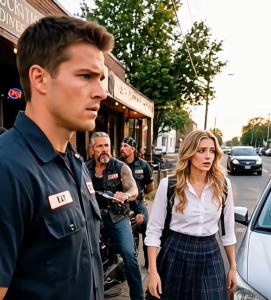
“Put it down,” he said. His voice was the same one that used to call us in from the yard. “You don’t understand what you’re walking into.”
“I understand you let them take her,” I said. “I understand Ray watched. Put the gun away or I start shouting loud enough for the dock security camera to matter.”
The suit studied me the way he had studied the briefcase. “This is the other one. The one who keeps notebooks.” He nodded at the man with the pistol. “We can do this clean or we can do it with both of them in the containers. Your choice.”
My sister made a sound behind the tape. I kept my eyes on the pistol. “The notebook already left with someone else,” I lied. “Dates, amounts, this address. If we don’t walk out, it goes to the state police and the port authority at the same time. You can shoot me. You can’t shoot the copies.”
It was a thin lie. The notebook was still in my pocket. But the suit hesitated, and in that half-second my father moved. He did not go for the gun. He went for the folding table and flipped it hard enough to send the envelope and the papers into the air. The man with the pistol tracked the motion. I swung the pipe at his wrist. The shot went into the corrugated wall. My sister kicked the chair sideways and the second man lost his grip on her arm.
Ray’s motorcycle roared into the loading dock before anyone recovered. He came through the open bay with the headlight on, skidded, and put the bike between the suit and the chair. For a moment I thought he had changed his mind. Then I saw the second pistol in his hand, pointed not at the suit but at the space between me and our father.
“Everybody stays exactly where they are,” Ray said. His voice was steady. The cigarette was gone. “The wire is already moving. Nobody needs to die over a timing problem.”
“You sold her,” I said again, because the words still did not fit in my mouth.
“I bought us six months,” Ray answered. “Dad’s been running freight through this dock since before the accident story. The syndicate doesn’t forgive late payments. They take inventory. She was inventory the second I missed the drop. I was trying to get her back before they moved her. You running in here with a pipe just made that harder.”
My father straightened. Blood from a split knuckle dripped onto the scattered papers. “Both of you shut up and listen. The buyer is already on the water. If this shipment is short, they burn the whole route and everyone attached to it. That includes the house. That includes every person who ever took a dollar from the accounts I kept open under other names. You want to save her, you help me finish the transfer. Then we all walk.”
My sister had worked the tape loose enough to speak. Her voice was small and furious. “You told me you were working nights at the depot. You told me the insurance was still processing. I waited for you to come home.”
The suit had recovered his briefcase. One of his men was holding his wrist and swearing. The other had his gun up again, but Ray’s headlight made a clean shot difficult. Outside, the river kept slapping the pilings. I could hear a boat engine idling somewhere beyond the containers.
“There is no clean walk,” I said. “You already decided what she was worth. I’m not helping you finish it.”
Ray looked at me for the first time since the street. Something in his face cracked and then sealed again. “Then you’re both dead by morning, and she still ships. At least my way she has a chance after the money clears.”
I threw the pipe at the overhead light. The bulb burst. In the sudden dark the suit’s men fired at the sound. Ray’s bike headlight swung wildly as he dove. I went for the chair, got my hands on the ropes, and cut them with the box cutter I had taken from the pickup’s glove box hours earlier without knowing why I kept it. My sister was on her feet before the second shot. We ran for the side door I had used. Behind us my father was shouting my name in the voice that used to mean dinner.
We made it to the pickup. I did not look back to see whether Ray was following or aiming. The engine turned over on the second try. My sister crouched on the floorboard with her arms around her knees, breathing in short bursts. I drove without headlights until we cleared the industrial gate, then cut them on and took the long way out of town, past the closed diner, past the brick storefronts, onto the county road that led to the truck stop where long-haul drivers still used pay phones.
At the stop I bought two coffees and a prepaid phone with the cash I had kept in the glove box for emergencies that had never looked like this. My sister sat in the corner booth and would not let go of the notebook once I handed it to her. She read the last page twice.
“He wrote the warehouse address the day before yesterday,” she said. “He knew.”
“Dad’s been alive the whole time,” I said. “Ray’s been paying him with pieces of us.”
She was quiet for a long moment. The truck stop fluorescent lights made everything look thinner. “What do we do?”
“We don’t go home. We call the number on the back of the state police card I took from the diner counter last month. We give them the notebook, the address, and the description of the suit. Then we stay where there are cameras and witnesses until someone official shows up who isn’t on their payroll.”
She nodded. Her hands were still shaking, but she dialed. While she talked I watched the lot. No dark SUV. No motorcycle. Just semis idling and a driver arguing with the coffee machine. When she hung up she slid the phone back to me.
“They said stay put. Twenty minutes.”
We waited forty. A plain sedan finally pulled in. The woman who got out showed a badge and did not ask us to get into the car until she had photographed the notebook pages and called the warehouse address in herself. She listened to the short version without interrupting. When I finished she looked at my sister, then at me.
“Your brother and your father are both going to say you misunderstood a business dispute,” she said. “The notebook helps. The rope marks help more. If you are willing to repeat this in a recorded interview and stay available, we can move on the dock tonight. If you disappear, they will write it as a family argument that got out of hand and the case dies.”
My sister touched the red line the rope had left on her wrist. “I’m not disappearing.”
We gave the statement in a small room at the nearest barracks. By the time we finished, the radio on the desk was already carrying traffic about the warehouse. Shots fired. Two in custody. One motorcycle found in the river. No names yet. I did not ask whether the motorcycle had a rider. The agent told us not to go back to the house. She arranged a motel room under a different name and left an officer in the lot.
In the motel my sister showered until the hot water ran out. I sat on the second bed with the notebook open to the page that had her name on it and tried to remember the last ordinary day we had all been in the same kitchen. I could not find one. Ray had been short on money for months. Our father had been a story we told so we would not have to say the word abandoned. The SUV had been the first time the story and the money occupied the same street.
She came out in the motel robe and sat on the edge of the bed. “Do you think Ray was telling the truth? That he was trying to get me back?”
“I think he wanted both things,” I said. “To keep you from shipping and to keep himself from being the one who paid. He ran out of time and picked the version that let him light a cigarette.”
She was quiet. Then she said, “Dad looked at me like I was a number.”
“Yeah.”
We did not turn the television on. In the morning the agent returned with coffee and the news that three men had been arrested at the dock, that a fourth had been pulled from the river with a bullet in his shoulder, and that a search of the containers had produced two other girls who were now in the hospital. Ray was the one in the river. He was alive. Our father had not been in the warehouse when the team arrived. The suit was in custody and already asking for a lawyer.
“Your brother is claiming he was forced,” the agent said. “Your father is still missing. If either of them contacts you, you call me before you answer. Do you understand?”
We understood. The motel room had a view of the parking lot and a lock that worked. My sister slept for most of the day. I sat by the window and watched every car that slowed near the entrance. None of them was the SUV. None of them was a motorcycle.
Two days later Ray called the prepaid phone from a hospital bed. His voice was thick with painkillers. “They said you talked,” he said. “They’re going to bury me for the rest of it.”
“You put her in the chair,” I said.
“I was trying to buy her out. Dad set the terms years ago. I just couldn’t keep up.” He coughed. “If you tell them I cooperated from the start, I might see daylight before I’m forty.”
“I’m not lying for you.”
He was silent long enough that I thought the call had dropped. Then he said, “She okay?”
“She’s alive. No thanks to the cigarette.”
He hung up. I did not call back.
Our father never called. The agent told us later that a passport in one of his old aliases had been used at a border crossing two hundred miles south. The accounts he had kept open were frozen. The route through the dock was shut down. It was not the whole syndicate. It was enough that the warehouse stayed empty and the two other girls went home to people who had been looking for them.
We did not go back to the house on Main Street. The agent helped us file the paperwork that let my sister finish the school year from a different district. I took a job at a garage that paid in checks and did not ask why I flinched at dark SUVs. Ray took a plea that named the suit and the buyer’s boat and left our father’s name out of the allocution. He wrote one letter from the facility. It said he was sorry the timing had been wrong. I sent it back unopened.
On the first anniversary of the night at the warehouse my sister and I drove past the old diner. The black motorcycle was gone. The brick wall where Ray had shoved me was still there. She rolled the window down and let the air move through the cab. Neither of us spoke for a while.
“I used to think if I just warned him fast enough he would fix it,” she said. “Like the problem was that he didn’t see the car.”
“He saw it,” I said. “He was waiting for it to finish.”
She nodded. “Next time I see a car that doesn’t belong, I’m not waiting for anyone else to agree with me.”
We kept driving. The lesson was not that family always protects you. It was that some people will trade the people they claim to love for one more month of not being the one who pays, and the only reliable answer is to move before the door of the vehicle opens. I had screamed her name and cut the ropes and stayed in the room with the cameras. It had not given us our father back or made Ray into someone else. It had kept her out of the container. On the worst nights that was still the only arithmetic that mattered.