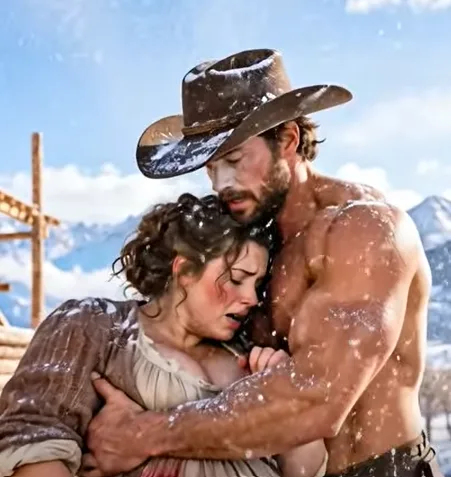
My husband’s arrogant refusal to touch me made no sense until a shirtless cowboy caught my collapsing body and whispered that the baby
The key bit into my palm, and for a moment I could not tell whether the cold in my chest came from the wind or from his words.
“Sterile,” I whispered.
“Caleb, what are you saying? I am nine months along, and the child is Julian’s.”
“Of course it is,” Caleb said at once, and his hand tightened around mine.
“I said it badly, Lydia, because the pain was in my throat and the words came out crooked.”
“Hear the rest before you judge me.”
A contraction took me then, a long, rolling wave that bent me double on the furs, and the carriage driver cursed and whipped the horses toward the lodge.
“Breathe,” Caleb said, and he knelt on the floor of the carriage with his coat wrapped around my shoulders and his own bare skin blue with cold.
“You will freeze,” I gasped.
“I have frozen before,” he said.
“I have never been so afraid, and fear keeps a man warm.”
Arthur’s cabin was only a quarter mile away, and Caleb had no intention of taking me there, so the driver turned the horses up a narrow track through the pines toward the old line shack.
It was a squat log building that Julian and I had once used for picnics, with a stone hearth and a sagging cot, and the smell of cedar and old smoke rolled out to meet us as Caleb carried me through the door.
He laid me on the cot, and a lanky young deputy named Eli stirred up the fire, and a gray-haired woman in a federal coat swept in behind them with a leather bag and a calm, commanding face.
“I am Special Agent Ruth Calloway,” she said, unbuckling the bag.
“I am also the mother of four, Mrs. Hale, so you may stop looking at me as though I am a stranger.”
“Mrs. Hale,” I repeated, because it was my name, and yet it sounded like it belonged to someone who had died.
“You are not a widow,” said Calloway, and she met my eyes steadily.
“I would have preferred to say that after the baby, but the baby appears to have other plans.”
The room swam, and I clutched the quilt.
“Julian,” I said.
“Alive,” said Caleb, kneeling beside the cot.
“He is alive, Lydia, and I swear on my mother’s grave that I will bring him to you before the child is a day old.”
I do not remember all of what followed.
I remember the fire roaring, and Calloway’s hands, firm and warm, and Caleb’s voice murmuring in my ear that I was braver than any man he had ever known.
I remember the long, hard hours, and the wind howling against the shutters, and my own voice crying out for my husband.
And I remember, near midnight, a thin, furious wail rising through the smoky air, and Calloway laughing aloud and lifting a small red creature into the firelight.
“A girl,” she said.
“A fine, loud, healthy girl, with a great deal to say about the temperature.”
She laid her on my chest, wrapped in a flannel shirt that smelled of woodsmoke, and I looked down into a tiny, crumpled face with a fuzz of dark hair, and the whole world went quiet.
“Hello,” I whispered.
“Hello, my darling, I am your mother.”
Tears ran down my temples into my hair, and I felt Caleb’s hand settle gently on the cot beside my head.
He did not touch the baby, and he did not speak, but when I looked up, his eyes were wet, and his face was open as a door.
“She has Julian’s chin,” he said hoarsely.
“She has your temper,” I said.
He laughed, a cracked, wondering sound, and bowed his head.
In the gray hour before dawn, when the baby slept and the fire had burned down to embers, Caleb finally told me the whole truth.
He sat on an overturned crate beside the cot with his shirt on at last, a borrowed flannel stretched tight across his shoulders, and he spoke in a low, even voice so as not to wake us.
“My mother was a cook at your father’s ranch,” he said.
“She raised Julian and me in the same kitchen, though we had different fathers, and your father Edmund treated us both as sons.”
“Julian was the brother of my heart,” he said.
“He was clever and gentle and bookish, and he laughed at my clumsy fists and taught me to read by candlelight.”
“When he married you, I was the happiest man in the territory.”
I smiled in the dark, because I remembered Caleb at our wedding, towering and awkward in a borrowed suit, weeping into a handkerchief.
“Then your father fell ill,” Caleb continued, and his voice darkened.
“Edmund called me to his bedside the week before he died, and he gave me a leather folder and a task.”
“He said that Arthur had been bleeding the estate for years, and that Arthur wanted the land patents, and that if Julian and you had a child, that child would inherit everything and put an end to Arthur’s hopes.”
“So he hired me, Lydia, not to father anything, as I so stupidly said, but to guard the heir.”
“He wrote it plainly in the contract, and I have the paper still.”
“To guard the heir of the Hale estate with my life until the child comes of age.”
I stared at him, and a startled laugh burst out of me, and I pressed my hand over my mouth to keep from waking the baby.
“You said the only man my father hired to father his heir,” I whispered.
“I said it with a bullet in the air and a woman bleeding in my arms,” said Caleb miserably.
“I meant to say, to guard.”
“Guard and father are not the same word, Caleb.”
“I am aware,” he said, and he put his face in his hands.
“I have been aware for six hours, and I have never wanted so badly to crawl under a floorboard.”
I laughed until I wept, and the baby stirred and mewled, and Caleb lifted his head and grinned in spite of himself.
“And the sterility records?” I asked, when I could breathe.
His smile faded.
“Arthur’s work,” he said.
“He knew that a child would end his claim, so he bribed a doctor in Helena to forge a record stating that Julian could never have children.”
“He meant to produce it in court after the birth and call you an adulteress, and take the child as a ward of the estate.”
“The real records are in the iron box,” Caleb said.
“Julian’s own physician, signed and sealed, proving that he is perfectly capable of fathering a dozen children, and a letter from your father naming the child as heir.”
“That is why I gave you the key.”
I looked down at the sleeping face against my breast, and a fierce, protective rage rose in me, hot and clean.
“He wanted to take her,” I said.
“He wanted to take her from me.”
“He will not,” said Caleb.
“I swear it.”
Agent Calloway came in from the cold with snow on her hat and a pot of coffee, and she set it on the hearth and looked at us with a grave, tired smile.
“We have recovered the box,” she said.
“Eli and two deputies went under the cabin floor at first light, and everything is intact.”
“And Arthur?” I asked.
“In the county jail, shouting about his rights,” said Calloway.
“But the real news is the one I have been saving, because I wanted you to rest first.”
She crouched beside the cot, and her hands, I noticed, were not quite steady.
“Last night, after the arrest, Arthur’s foreman broke down and told us where he had taken your husband,” she said.
“Julian was not killed in the landslide, Mrs. Hale.”
“He was injured, and Arthur’s men carried him to an abandoned mine shaft in the northern hills, where they have kept him alive for six months as a bargaining chip, in case the courts ever required a signature.”
My breath caught, and my arms tightened around the baby.
“He is alive,” I said.
“He is alive and weak, and he was found an hour ago by a team of marshals, wrapped in a filthy blanket and asking for you,” said Calloway.
“They are bringing him down the mountain by sled.”
I do not remember making a sound.
I remember Caleb’s face, which crumpled all at once, and the way he turned his head so that I would not see, and the broken sob that escaped him anyway.
“Julian,” he whispered.
“Oh, my brother.”
They brought him to the line shack at midday, on a wooden sled drawn by two stout mules, under a low gold sun that had finally broken through the clouds.
I heard the jingle of harness and the murmur of voices, and I struggled up on the cot with the baby in my arms and my hair hanging loose around my face.
The door opened, and cold light flooded the room, and a tall, gaunt figure stepped over the threshold, leaning on a deputy’s shoulder.
He was thinner than I remembered, with a ragged beard and hollow cheeks, and his dark hair had gone white at the temples.
But his eyes were the same warm brown I had fallen in love with across a crowded church supper, and they found my face and filled with tears.
“Lydia,” he said, and his voice was a rasp.
“My Lydia.”
I do not know how I crossed the room, but I was suddenly in his arms with the baby between us, and he was holding both of us so tightly that I could feel his heart hammering like a trapped bird.
“I thought you were dead,” I sobbed into his neck.
“I buried your ring.”
“I thought I would never see you again,” he said, over and over, with his lips against my hair.
“I thought of you every hour, every day, in the dark, and I swore that if I lived, I would never waste another moment.”
He drew back, and his gaze dropped to the small bundle in my arms, and the whole of his gaunt face softened into wonder.
“Is this?” he whispered.
“This is your daughter,” I said.
“She was born last night, in a snowstorm, and she is already very angry about it.”
He put out one trembling finger, and the baby, in her sleep, curled her tiny hand around it, and Julian made a sound that I will carry to my grave.
“She is perfect,” he said.
“She is the most perfect thing in all the world.”
“She needs a name,” I said.
“I could not choose without you.”
He looked at me, and at the baby, and over my shoulder at Caleb, who stood against the wall with his hat crushed in both hands and tears running openly down his face.
“Come here, brother,” Julian said, and his voice cracked.
Caleb crossed the floor in three strides, and Julian caught him around the neck with one arm, and the two of them clung together while the baby squirmed between us.
“You kept your promise,” Julian said into his shoulder.
“You always keep your promises, you stubborn ox.”
“I nearly broke it,” Caleb said hoarsely.
“I was late, and she was bleeding, and I did not know whether I could save her.”
“You did,” said Julian.
“You saved them both, and I will owe you for it all my life.”
“You owe me nothing,” said Caleb.
“You gave me a family when I had none, Julian, and I would have walked through fire for it.”
I stood between them, and my husband’s arm lay around my shoulders and Caleb’s hand rested on my shoulder blade, and I felt the three of us settle into something warm and whole.
We named the baby Eleanor Rose, after Julian’s mother and the wild roses that grew along our fence, and Caleb stood godfather in the little white church in the valley the following spring.
But before the christening came the trial.
It was held in the territorial courthouse in early March, a big stone building with a clock tower and tall frosted windows, and the whole valley turned out to watch.
Arthur Vance sat at the defense table in a rumpled gray suit, with two lawyers from Denver whispering urgently at his elbows.
He had aged ten years since the night on the scaffold, and his bluster was gone, and he stared at the table with hollow, bloodshot eyes.
I sat in the front row with Eleanor in my arms, wrapped in a blue shawl, and Julian beside me with his hand clasped in mine and his cane propped against the bench.
Caleb sat on my other side in a clean black suit with his hair slicked flat, and when I glanced at him, he gave me a small, steady nod.
The prosecutor, a calm, silver-haired man named Mr. Okafor, laid out the case across five days.
He called the doctor from Helena, who had forged the sterility records and who confessed in a trembling voice that Arthur had paid him two thousand dollars.
He called the foreman who had kept Julian in the mine, a hulking, sullen man who wept as he described the six months of darkness.
He read my father’s letter aloud, in a voice so gentle and clear that half the courtroom was in tears before he finished.
“My daughter-in-law is a good and brave woman,” the letter said, “and her child will be the best thing this estate has ever held.”
“Let no man take from her what is hers.”
I heard a sob behind me, and turned to see old Mrs. Pruitt from the mercantile weeping into her handkerchief.
On the sixth day, Mr. Okafor called me to the stand.
I handed Eleanor to Caleb, who took her as though she were made of spun glass, and I walked up to the witness box with my heart pounding and my hands cold.
I swore the oath, and I looked out at the sea of faces, and I found Julian’s eyes at the front of the room.
He smiled, small and certain, and I took a deep breath.
I told them about the hammer and the scaffold and the winter wind, and the way Arthur had called down from the warm cabin that I would not eat if I did not work.
I told them about the ring in the mud and the false grave, and the long months of believing myself a widow.
I told them about the night my daughter was born, and the young deputy who had stoked the fire, and the old agent who had caught her in her flannel shirt.
When the defense attorney rose to cross-examine me, he was a lean, hawk-faced man with a thin smile.
“Mrs. Hale,” he said, “is it not true that you were in a state of extreme emotional distress when you made these claims, and that your testimony might be unreliable?”
“I was in labor, sir, at the time,” I said evenly.
“I would not recommend it as a state of mind for filing legal documents, but I assure you that my memory is clear.”
“I remember the date, the hour, and the license number of the carriage.”
“Would you like me to recite them?”
A ripple of laughter ran through the gallery, and the judge, a stern old woman in spectacles, pressed her lips together to hide a smile.
“That will not be necessary, Mrs. Hale,” said the lawyer, flushing, and he sat down without another question.
The jury deliberated for six hours.
When they filed back in, the foreman, a stooped old rancher with a white beard, held the verdict with a hand that shook.
“On the charge of kidnapping, guilty.”
“On the charge of conspiracy to commit murder, guilty.”
“On the charge of fraud and forgery, guilty.”
“On the charge of unlawful imprisonment, guilty.”
Arthur did not move.
He sat with his gaze fixed on the table, and his lawyers bowed their heads, and the judge pronounced a sentence of life in the territorial penitentiary.
A great sigh swept the courtroom, and then a low murmur, and then, to my astonishment, a slow, steady clap that spread from the back row to the front until the whole room thundered.
Arthur raised his head as the bailiffs led him past our bench, and for the first time, I saw something human in his face.
“Lydia,” he said, in a cracked whisper.
“I did not want it to be this way.”
“You chose it, Uncle,” I said quietly.
“Every day, for years, you chose it.”
He lowered his eyes and did not answer, and the heavy door closed behind him with a final, echoing thud.
Outside, the March sun poured over the courthouse steps, and the melting snow dripped from the eaves in a hundred bright streams.
Neighbors crowded around us, ranchers and shopkeepers and farm wives, pressing our hands and weeping and laughing.
An old woman in a black bonnet kissed the baby’s forehead and whispered a blessing in Swedish, and a little boy tugged at Julian’s coat to ask if it was true that he had lived in a cave.
“It was a mine,” said Julian gravely, kneeling to his level.
“And it was very dark, and I was very lonely, but I thought about a girl with a laugh like a bell, and it kept me warm.”
The boy considered this with enormous solemnity and then nodded.
“That is a good reason to live,” he said.
“It is the best one,” said Julian, and he looked up at me with eyes shining.
We went home to the estate that week, the four of us in the big wagon, with the baby asleep in a basket of quilts and the road shining with meltwater.
Arthur had let the old house fall into disrepair, and the porch sagged, and the garden lay trampled and gray.
But the stone chimneys still stood tall, and the windows glinted in the sun, and when Julian lifted me down from the wagon and carried me over the threshold, I laughed and cried at once.
“Put me down, you foolish man, you are barely strong enough to walk,” I scolded.
“I have waited six months to carry my wife into this house,” said Julian.
“If I collapse, you may all feel free to mock me for years.”
He did not collapse, and he set me down in the front hall with a kiss so tender that Caleb, standing in the doorway with the baby, coughed pointedly and turned away.
The valley came to help that spring.
They arrived with ladders and paintbrushes and covered dishes, a hundred neighbors who had known my father, and by April the roof was mended, the porch rebuilt, and the garden dug and planted with rows of beans and peas and a whole fence line of wild roses.
Julian, still thin but growing stronger by the week, took charge of the books, and for the first time in a decade the estate accounts were honest, every figure and every signature plain on the page.
Caleb took charge of the horses and the timber, and I rose every dawn to find him already in the yard, whistling through his teeth and splitting wood with an easy, rhythmic swing.
We opened the lodge that summer, the same lodge whose scaffolding I had once climbed in the snow, and we turned it into a school and a gathering hall.
It had a high, sunny ceiling and a great stone hearth and long pine tables, and I taught the valley’s children to read in the mornings while Julian taught them sums in the afternoons.
We hired widows and orphans and old soldiers to run the kitchen and the stables, and we paid every one of them double what Arthur ever had.
Above the door we hung a hand-painted sign that read, All Are Warm Here.
One evening in June, when the roses had burst into riotous bloom along the fence and the fireflies were rising from the long grass, I found Caleb sitting alone on the porch step.
He had the baby in his lap, now three months old and round-cheeked, and she was gnawing contentedly on his thumb while he told her a long, solemn story about a bear who learned to bake bread.
I sat down beside him and leaned my head against his shoulder.
“You are very good at that,” I said.
“She has no taste in literature,” said Caleb.
“She falls asleep at the exciting parts.”
“She is three months old.”
“She is a young woman of strong opinions,” he said, and I laughed.
We watched the sun go down behind the western hills, streaking the sky with orange and rose, and a soft breeze stirred the scent of roses across the yard.
“Lydia,” he said at last, and his voice was low.
“I need to say something, and I would like you to let me finish.”
I nodded.
“Six months ago, I thought that I had failed,” he said.
“I thought that I had let you climb that scaffold, and nearly lost you both, and that I was unworthy of the promise I made to my brother.”
“But I have come to understand that I did not fail, because I was there at the end, and I caught you.”
“That is what a guard is for,” he said.
“And a brother, and a friend.”
“I am not asking for anything, I am only saying that I have found, in this house, with the two of you and this small, angry person, the first real home I have ever had.”
My eyes stung, and I took his big, scarred hand in both of mine.
“Caleb Hale,” I said, “you are a member of this family, and you have been since the day Julian taught you to read by candlelight.”
“You are Eleanor’s godfather, and my brother, and the finest man I know, and there is a place at this table for you as long as there is a table.”
He bent his head, and his shoulders shook, and the baby patted his cheek with one tiny fist as though to console him.
Behind us, the screen door creaked, and Julian came out onto the porch with a tray of lemonade and a plate of shortbread, and he stopped when he saw our faces.
“Is everything all right?” he asked.
“Everything is perfect,” I said.
He set down the tray and sat on Caleb’s other side, and put an arm around his brother’s broad back, and for a long moment we sat in silence, three people and one sleeping baby on a sagging porch step.
“I used to lie in that mine,” Julian said quietly, “and imagine this exact moment.”
“I thought of the porch and the roses and the two of you, and I told myself that if I could only hold the picture in my mind, I could survive.”
“And now?” I asked.
“Now I am in the picture,” he said, and he smiled, and his eyes were wet.
“And it is better than I dreamed.”
The first star blinked awake above the ridge, small and silver, and the fireflies lifted in drifting constellations from the grass.
Eleanor stirred in Caleb’s arms and opened her dark eyes and looked up at the sky, and then at the three of us, as though deciding that we would do.
Years passed, golden and unhurried.
Eleanor grew into a tall, laughing girl with Julian’s chin and my stubborn mouth, and two brothers followed, a sturdy boy named Edmund after my father and a wild-haired imp named Thomas who could climb anything.
Caleb never married, though half the valley tried to introduce him to their nieces, and he always shook his head with a quiet smile and said that he had all the family he could handle.
He lived in the little cottage by the creek, and every evening he came up to the big house for supper and told the children stories until they fell asleep on the rug.
The school grew until we had three rooms and four teachers, and children rode in from three counties to learn at our long pine tables.
Every winter, on the anniversary of the night of the scaffold, we gathered in the great hall, the whole valley together, and ate a feast of roast venison and fresh bread and berry pies.
Every year, Julian stood at the head of the table and raised a cup, and told the story of the six months in the dark, and the voice that had called him home.
“To the ones who held on,” he would say.
“And to the ones who came for us.”
And every year, Caleb would duck his head and stare at his plate, and Eleanor, who sat beside him, would slip her small hand into his big one under the table.
On a bright April afternoon, many years later, I stood on the porch of the old house and watched Eleanor, now eighteen, ride out through the gate on a black mare, her braid flying behind her.
She was going to the territorial college in the autumn, to study law, because she said she wanted to stand in courtrooms and speak for people who had been silenced.
Julian came up beside me and slipped his arm around my waist, and I leaned against him and felt the steady beat of his heart.
“She looks like you,” he said.
“She looks like her uncle,” I said, and nodded toward the yard, where Caleb stood at the fence with his hat pushed back and his hand raised in salute.
Eleanor lifted her own hand in answer, and pressed her heels to the mare, and vanished down the road in a cloud of golden dust.
“Do you ever think about it?” Julian asked softly.
“The mine, the scaffold, the snow?”
“Sometimes,” I said.
“And do you know what I remember most?”
“What?”
“The warmth of Caleb’s coat around my shoulders, and your voice calling my name, and the sound of a baby’s first cry in a smoky little cabin,” I said.
“I remember that even in the darkest hour, somebody came.”
He kissed my temple, and I closed my eyes and let the spring sun warm my face.
The garden bloomed below us, rows of roses and beans and sunflowers nodding in the breeze, and children’s laughter drifted from the school across the creek.
Far down the road, the dust settled over the valley, and the long white road shone empty and golden in the afternoon light.
“We are home,” I whispered.
“We are home,” said Julian, and he held me close, and together we watched the light spill over the land that we had saved.