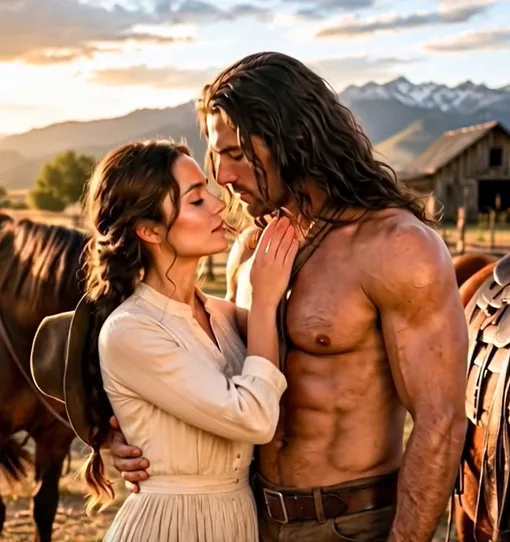
My husband publicly shoved me against the wooden corral in front of our ranch hands, sneering that a penniless bride had no right touching his prized horses
“Put the box down, Clara,” Jack said, and the Winchester did not waver by so much as a hair.
I lowered the iron box into the frozen dirt between my knees and kept both hands where he could see them, because three years of planning had taught me that a steady body can buy more time than a clever tongue.
“How long have you been behind me?” I asked.
“Since you slipped past the corral. You walk like your grandfather.” His voice was flat and tired, with none of the arrogant sneer he had worn in front of the ranch hands. “He used to cross the north pasture the same way, light on the heels, as if the ground might hear him.”
The words went through me like cold water.
“You never met my grandfather.”
“No,” Jack said. “But I’ve read every letter he ever wrote.”
The moon slid free of a cloud and poured silver across the ruined cabin, and for the first time I saw his face clearly. The scar along his jaw stood out white. His dark eyes were wet.
“Get up slowly,” he said. “Bring the box. We’re going to talk, and then you can decide whether to forgive me or put me in the ground.”
My name is Clara Delgado Whitaker, I am twenty-four years old, and I had come to Cedar Creek Ranch carrying a forged marriage license, a dead man’s grudge, and a land grant sewn into a mirror. I had not come expecting my husband to know my name before I told it to him.
We sat on the broken hearthstone, the rifle laid across his knees now with the barrel pointed at the sky. He did not take his eyes off me.
“Eight years ago,” Jack began, “my father was the man who foreclosed on your grandfather’s land.”
“I know.”
“You don’t know the rest.” He stared at the dark pines. “Silas Rourke was not my father by blood. He bought me out of an orphanage in Cheyenne when I was nine and raised me to be his shadow. I learned his ledgers before I learned my letters. And when I was seventeen, I found the real tax records in his safe and understood what he had done.”
“You understood it and kept silent.”
“I understood it and was afraid.” Jack’s jaw tightened. “He was the most dangerous man in three territories. He had a sheriff, a judge, and a hundred guns. I told myself I’d wait until I was strong enough.”
“And when you were?”
“He died of a fever four years ago, and left me the ranch.” A bitter laugh scraped out of him. “I inherited a valley soaked in a stolen family’s blood. I wrote to your grandfather’s lawyer in Santa Fe within the week, to confess. The letters came back unopened. I kept writing for three years.”
“My grandfather died before those letters could reach him,” I said slowly.
“I learned that too late.”
My throat ached. “Then why marry me? Why pay my father’s debts? Why humiliate me in front of your men?”
Jack closed his eyes.
“Because Silas Rourke’s friends are still alive, Clara. The judge, the land agent, the sheriff’s brother. They’ve watched this ranch since the old man died, waiting for a Delgado to come looking. When the lawyer in Helena filed a claim this morning, I knew someone had finally moved. And I knew those men would be watching the house tonight, listening for any sign that I was soft.”
“The corral,” I whispered. “The sneering.”
“Every word was for them.” His voice cracked. “There were two riders on the ridge above the corral, with a spyglass. I saw the glint. I’d have cut out my tongue before I said those things to you, if I’d had any other way to make them believe I despised you.”
I stared at him.
For three months I had memorized every cold look and cruel word, feeding the fire of my purpose with them. And now the whole structure was tilting, because a man who had wounded me with his mouth was weeping in the moonlight.
“You kissed me,” I said stupidly.
“I couldn’t help that part.”
A laugh broke out of me, small and wet and furious. “You are the worst liar I have ever met.”
“I know. It’s why the plan nearly failed.” He wiped his face with his sleeve. “Open the box.”
I knelt and unlatched the rusted iron lid.
Inside, wrapped in oilcloth, lay a thick sheaf of tax records, a hand-drawn survey map, and a small leather diary stamped with my grandfather’s initials. I lifted it with shaking fingers and read the first line.
If this is found by one of my blood, know that I never stopped loving this valley, or you.
My eyes blurred.
“There is more,” Jack said gently. “On the last page.”
I turned to it.
It was a letter, written in a wavering hand, and it was addressed to a boy.
To the orphan boy Silas Rourke took from Cheyenne, it began. I have watched you from my porch since you were ten, and I have seen what kind of man you are. You carry water to my horses when no one is looking. You left a basket of flour on my step the winter my wife died. If the day ever comes that you learn what was done to me, I do not want you to carry my grudge. I want you to carry the truth, and put it in the hands of someone who can use it.
I looked up.
“He knew about you.”
“He knew,” Jack said, and the words came out in a ragged whisper. “I found that diary the day Silas died, hidden in the barn loft where your grandfather’s old hired man had left it. I have read that letter every night for four years.”
We sat in silence while the wind combed the pine boughs.
“The riders on the ridge,” I said at last. “What do they want?”
“The deed, and you, and me, in that order.” Jack stood and offered his hand. “They won’t wait for the judge. They’ll come tonight.”
“Then we should not be here.”
“No.” His mouth tilted in a grim half smile. “But we should not be running either.”
He explained his plan on the ride down the mountain, in low, rapid sentences, with my bay mare’s hooves muffled in the frost.
There were nine of Rourke’s old allies, he said, men who had grown fat on the stolen valley. Judge Amos Pell. Land agent Gideon Cray. A brace of hired gunmen. If they could be drawn into the open, in front of witnesses, with the documents in hand, the circuit judge arriving in three days would have no choice but to see.
“We need them to show their hand,” Jack said. “We need them to try to take the grant by force.”
“With me as bait.”
“With us both as bait.”
“Jack.” I turned in the saddle. “I’m not afraid of the risk. I’m afraid you’ll be the one to pay for it.”
“I’ve been paying for it for years.”
“That’s not an answer.”
He looked at me, and in the gray light before dawn I saw everything he had hidden behind the sneer, the loneliness, the stubborn tenderness, the exhaustion of a man who had carried someone else’s sin like a stone in his chest.
“Clara,” he said quietly. “When this is finished, I’ll sign the whole ranch over to you. Every acre. I don’t want a single fence post that was bought with your family’s ruin.”
“Don’t say that now.”
“Why not?”
“Because I want you to say it when I can tell you that I don’t want you to leave.”
His horse stopped beneath him.
For a long moment neither of us moved, and the mist drifted between us and the first pale light touched the tips of the mountains.
“I’m not leaving,” he said.
“Good,” I said, and my voice shook. “Then we have a plan to make.”
They came the next night, at midnight, in a long single file along the creek road with their lanterns shuttered.
Jack and I stood on the front porch of the ranch house with the doors flung wide and every lamp in the house burning, so that the whole place glowed like a ship at sea. On a table in the front hall, in plain view through the open door, lay the iron box and the Spanish land grant, spread out beneath a lantern.
I wore my mother’s green dress.
Judge Amos Pell rode in first, a tall, stooped man with a white goatee and a black coat, and behind him came Gideon Cray in a gray derby, and seven riders with rifles across their saddles.
They reined in at the foot of the steps.
“Mr. Rourke,” said the judge, in his reedy courtroom voice. “I regret the hour. But I understand that your wife has been concealing certain documents.”
“My wife has been concealing nothing,” Jack said. “She has been keeping them in a mirror.”
Pell’s eyes narrowed.
“May we see them?”
“You may look from where you stand.”
Gideon Cray swung down, mounted the steps with a greedy glitter in his eyes, and peered through the open door at the parchment glowing on the table. I watched his face go through three expressions in a single breath, disbelief, hunger, and a kind of sick joy.
“It’s real,” he breathed. “Amos, it’s real.”
“Then take it,” said the judge.
The riders dismounted.
“Gentlemen,” Jack said, loudly, and he stepped forward with both hands raised. “Before you do, I want you to remember that you’re standing on a porch with forty witnesses.”
Pell frowned. “Forty?”
Jack lifted one hand and made a single sharp gesture toward the dark.
All at once, along the fence line, from the barn roof, from the bunkhouse windows, from behind every haystack and water trough on the property, lanterns flared to life.
Dozens of them.
Behind them, with rifles at their shoulders and coats pulled tight against the cold, stood my husband’s ranch hands, the neighbors from the valley, the shopkeepers from town, and an old man in a black frock coat whom I knew at once from his portrait in every county courthouse in the territory.
Circuit Judge Marcus Hale, three days early, with his spectacles glinting in the lamplight and a look on his face like a thundercloud.
“Judge Pell,” he said, in a voice that rolled across the yard. “Mr. Cray. I understand you’ve come to commit a robbery on my docket.”
The riders dropped their rifles as though the metal had burned them.
Gideon Cray made a strangled sound and bolted for his horse, and two of the ranch hands tackled him in the dust before he reached the stirrup. Pell stood frozen on the lowest step with his white goatee quivering and his mouth working.
“This is a trap,” he whispered.
“It is,” said Jack. “And you walked into it on your own legs.”
Circuit Judge Hale came forward with a lantern in one hand and a stack of papers in the other, and he climbed the steps and stood very close to the man he had once called a colleague.
“Amos,” he said quietly. “Forty years I trusted you. I am sorrier than I can say.”
Pell’s shoulders sagged, and for a moment I saw a small, old, frightened man beneath the black coat.
They led him away in irons, with Cray and the seven hired gunmen following in a sullen line, and the lanterns bobbed after them down the creek road until the darkness closed over the light.
I stood on the porch and let out a long, shuddering breath.
It was finished.
A hand found mine in the dark, rough and warm and shaking, and I held on to it with all my strength.
The hearing lasted two days.
Judge Hale heard every document, every witness, every shred of evidence, and on the afternoon of the second day, in a crowded hall in Helena with the whole valley packed shoulder to shoulder on the benches, he rapped his gavel and cleared his throat.
“This court finds,” he said, “that the 1840 Spanish grant to the family of Don Ignacio Delgado is valid and has never been legally extinguished. The foreclosure of 1869 is hereby declared fraudulent and void. The lands of the Cedar Creek valley are restored in full to the heirs of Ignacio Delgado, namely, his granddaughter, Clara Delgado Whitaker.”
The courtroom erupted.
I did not hear it.
I heard only a strange high ringing in my ears, and I felt Jack’s hand clamp around mine on the bench beside me, and I saw, through a haze of tears, the faces of old ranchers who had been robbed by Silas Rourke for forty years, openly weeping into their hats.
Hale rapped for order and went on.
“The court further notes that Mr. Jack Rourke voluntarily came forward with evidence against the estate of his adoptive father, at considerable personal peril. In recognition, the court awards him a full pardon for any complicity under the law.”
Jack bowed his head.
For a long time he did not move.
When he finally lifted his face, there was no sneer on it, no mask, nothing between us but the plain, open, helpless look of a man who has been set down after carrying something enormous.
“Clara,” he whispered.
“Yes?”
“I’d like to give you something.”
He reached into his coat and drew out a small folded paper, and pressed it into my palm.
It was a deed.
Not for the valley, which was already mine. It was for the half-acre where a ruined cabin stood beneath the northern pines, along with a single line of handwriting at the bottom.
Not purchased. Returned.
I held the paper against my heart.
“I rebuilt the fireplace last autumn,” Jack said, very low. “In case you wanted to come home.”
We held the first dance in the spring, in the big barn at Cedar Creek, with garlands of wild lupine strung along the rafters and a fiddler perched on a hay bale.
Every family in the valley came.
Old Silas Boone brought his seven grandchildren. The ranch hands scrubbed their faces and wore their best shirts. Circuit Judge Hale, retired now, sat in a corner with a glass of cider and a look of deep contentment, tapping his foot to the reel.
I wore my mother’s green dress again.
Jack stood beside the barn door in a clean white shirt and a borrowed tie, looking like a man about to be sentenced.
“I can’t dance,” he muttered, as I approached.
“I know.”
“I’ll step on your feet.”
“I’m aware.”
“Clara.”
“Jack.” I took both his hands. “You spent three months pretending to be cruel, to protect me. You can spend one night being clumsy.”
He let out a helpless laugh and led me onto the floor.
He stepped on my feet four times, apologized profusely, and each time I laughed harder, until the whole barn was watching and cheering, and the fiddler struck up a slow, aching waltz that made the rafters hum.
We danced under the lupines with our foreheads together.
“I never told you what I wanted,” Jack murmured.
“What?”
“I wanted to be a man your grandfather would have been proud to leave this valley to.”
“He was,” I whispered. “He wrote it. Don’t you remember?”
“I remember.”
“Then believe it.”
He did not answer.
He only held me closer, and I felt his heart beating steady and strong against my own, and we turned slowly in the lamplight while the valley sang around us.
Later, when the music had faded and the last guest had gone home and the lanterns burned low, we walked together up the northern trail beneath a sky packed with stars.
The old cabin stood at the top of the ridge, with a new roof of cedar shakes and a fresh stone chimney, smoke curling from it in a thin silver ribbon. Someone had planted a row of tomatoes along the porch, and a swing hung from the rafters on two new ropes.
We sat on the swing together and watched the moon climb over the mountains.
“Clara,” Jack said, after a while.
“Yes?”
“Do you forgive me?”
I thought about it, honestly, the way my grandfather would have wanted.
I thought about the corral, and the sneer, and the long cold weeks of silence. I thought about the diary in the iron box and the letter to a boy, and the half-acre deed folded in my pocket.
“Yes,” I said. “I forgave you the moment you told me about the spyglass. I only needed a little time to tell you.”
“Take all the time you want.”
“I intend to.”
He smiled, and I leaned my head on his shoulder, and we rocked slowly in the warm spring dark with the whole valley spread out below us, silver and green and entirely free.
Somewhere far down the slope, a horse whinnied, and a dog barked once, and a light winked on in a farmhouse window.
The land was ours, and the truth was out in the open, and the long shadow of a stolen century had finally been lifted from the grass.
I closed my eyes and listened to the wind in the pines, soft as a blessing, and I could have sworn it carried my grandfather’s voice, saying what he had written in the last line of his diary.
Welcome home, my child.