My fiancé rode away with another woman was agonizing, but his cold parting words about my worthless family made no sense
“…daughter, Caleb, because the day Helen learns who her father truly was, they will come for her too.”
The words swam in the firelight, and I read them three times before I understood that my mother’s hand had written them, the same looping hand that had signed every birthday card of my childhood.
My mother had died of a fever when I was nine, or so Uncle Arthur had always told me, and I had stood beside a small white coffin and thrown a handful of roses onto it.
“Caleb,” I whispered, and the letter trembled in my fingers.
“What does this mean? Why would my mother write to you the night she died?”
He did not answer at once, and in the dancing light I saw his jaw work and his broad shoulders bow, as though he were lifting a weight he had set down only for a moment.
“Because she did not die that night, Helen,” he said quietly.
“She vanished, and I was the one who helped her.”
The room tilted, and I clutched the blanket to keep from falling.
A tall woman in a gray federal coat stepped away from the group of agents and approached us, her badge catching the glow of the fire.
She had silver-streaked auburn hair and tired green eyes, and she removed her hat with a gentleness that told me she was about to say something difficult.
“Miss Hartwell, I am Special Agent Ruth Calloway of the Treasury investigations office,” she said.
“I have spent six years building the case against your uncle, and I should have come to you sooner.”
“Please,” I said, and my voice cracked, “somebody tell me the truth, all of it, before I lose my mind.”
Caleb pulled the stool closer and sat with his elbows on his knees, and Agent Calloway took the chair beside him.
“Your father, Thomas Hartwell, was the territorial auditor,” Caleb began.
“He found that Arthur and Julian’s father were skimming government money meant for the railroad, and he gathered proof for nearly two years.”
“The night he was killed, he was driving to meet Agent Calloway’s predecessor with the ledgers in his coat.”
“They cut his brakes on the mountain pass,” Calloway said.
“But your mother, Eleanor, had seen it coming, and she had already hidden copies of the ledgers where nobody would look.”
“Where?” I asked.
“In you,” Caleb said, and a faint, sad smile touched his mouth.
“In the lining of the little wool coat you wore that winter, and in the spine of a storybook she gave you.”
My hand flew to my mouth, because I remembered the book, a battered blue volume of fairy tales with a gold fox on the cover.
“It is in my trunk,” I breathed.
“It is in the carriage,” said Calloway.
“Or it was.”
Caleb’s eyes flashed.
“I pulled your trunk out of the river before I pulled you,” he said.
“It is in the barn, wrapped in oilcloth, and I think the pages are dry.”
I laughed, a wild, tearful sound, and Caleb laughed too, and the tension in the room cracked like river ice in spring.
They brought the trunk in, and I knelt on the hearthrug and drew out the little blue book with trembling fingers.
The gold fox had worn away to a faint shimmer, but when I pressed the spine, I felt the stiffness of folded paper hidden beneath the cloth.
Caleb handed me his pocketknife, and I slit the binding with great care, and a thin sheaf of pages slid into my lap.
They were my father’s ledgers, copied in my mother’s neat hand, and on the last page was a note.
My darling Helen, it read.
If you are reading this, you are grown, and brave, and the truth has found you at last.
I did not leave you willingly, and I have thought of you every single day.
Caleb will tell you where to find me.
I read the last line again, and my heart began to pound so hard that I felt it in my throat.
“Where to find her?” I whispered.
“She is alive?”
Caleb lifted his eyes to mine, and they were wet.
“She is alive, Helen,” he said.
“She has been living under another name in a mountain town two days’ ride from here, because if Arthur had learned that she survived, he would have hunted her down.”
“I wanted to tell you a hundred times,” he said.
“But every time I tried, I imagined you smiling at Julian across a dinner table, and I knew that one careless look would have killed you both.”
I looked at him, at the man who had stood at the edge of my life for ten years, and everything I had misunderstood fell into place.
The timber crew that always seemed to appear when my uncle’s men grew rough, the firewood that was left at my door in winter, the quiet figure on the ridge at every picnic and funeral.
“It was you,” I said.
“The whole time.”
“I made a promise to your father,” Caleb said simply.
“And somewhere along the way, I stopped keeping it for him and started keeping it for you.”
My cheeks burned, and he looked away, and Agent Calloway coughed discreetly and rose to speak to her men.
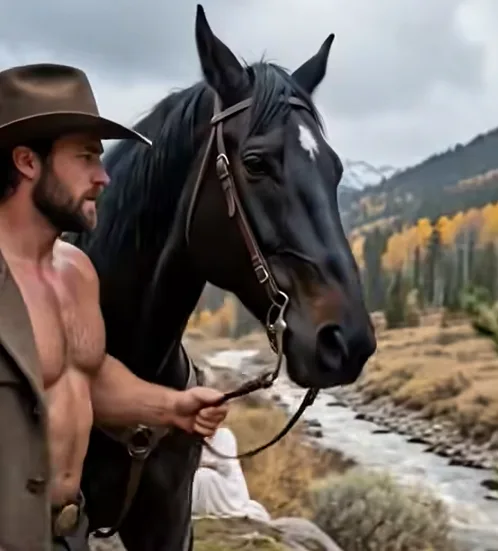
We rode out at dawn, Caleb and I on the black stallion and Agent Calloway and four marshals following behind, under a sky scrubbed clean by the storm.
The valley steamed in the early light, and every pine and boulder shone as though newly made.
We climbed for two days through high meadows spangled with late asters and along ridges where the wind sang in the rocks.
At night we camped beneath the stars, and Caleb sat by the fire sharpening a stick with his knife while I watched the sparks drift upward.
“What was she like?” I asked once.
“My mother, when you knew her.”
He thought for a long time.
“She sang while she worked,” he said.
“Old Scottish ballads, badly, and she laughed at herself for it.”
“She gave me a coat the winter I was nineteen and starving, and she never once made me feel like I was taking charity.”
“She would have liked you,” he added softly.
“She would have said you had your father’s stubborn chin.”
I touched my chin, and he smiled, and the firelight softened the weathered lines of his face.
On the third morning, we came over a last ridge and looked down on a small village of gray roofs nestled around a clear blue lake.
Smoke curled from a dozen chimneys, and a church bell tolled eight o’clock, and the whole scene looked so peaceful that I could hardly believe it held the answer to ten years of grief.
“Which house?” I asked, and my voice shook.
“The one with the yellow door,” Caleb said, pointing to a cottage at the water’s edge with a garden full of marigolds.
I do not remember descending the hill.
I only remember standing at a little wooden gate with my hand on the latch, and the smell of woodsmoke and baking bread, and a woman kneeling in the garden with a trowel in her hand and a straw hat on her head.
She was thinner than I remembered, and her dark hair was threaded with gray, but when she looked up and the sun fell across her face, I knew her.
“Mama,” I said.
The trowel dropped into the soil.
She rose slowly, as if in a dream, and pressed her dirty hands against her mouth, and her eyes, the same gray-green as mine, filled and overflowed.
“Helen,” she whispered.
“Oh, my Helen.”
I do not know which of us moved first.
I only know that the gate swung open and we crashed together in the middle of the marigolds, and she wrapped me in arms that smelled of earth and lavender, and we sank to our knees in the garden, weeping.
“I thought you were dead,” I sobbed.
“I stood at your grave, Mama, I threw roses.”
“I know, my darling, I know,” she said, over and over, stroking my wet hair.
“I watched from the trees, and it broke my heart in two.”
“I wanted to run to you, and Caleb held me back, and I have never forgiven myself, and I have never regretted that he did.”
Behind us, Caleb stood at the gate with his hat in his hands and his face turned politely toward the lake, though I saw his shoulders shake.
Agent Calloway and the marshals waited quietly on the road, and not one of them spoke.
When at last we drew apart, my mother held my face between her palms and looked at me for a long, long time.
“You are so beautiful,” she said.
“You are so like him, and so like me, and so entirely yourself.”
“Come inside,” she added, wiping her eyes with a dusty sleeve.
“I have a kettle on, and ten years to catch up on, and I made too much bread this morning, as though some part of me knew.”
We sat in her little kitchen with the window open to the lake, and she told me everything, with Caleb and Calloway adding quiet corrections.
She had been the one to find the first evidence of the fraud, a discrepancy in a freight account that my father brushed off until she showed him it was not a mistake.
Together they had built the case, night after night by lamplight, while Arthur sat at their dinner table asking after my health.
“The night your father died, I knew that I was next,” she said.
“Caleb found me at the edge of the property, and he put me on a horse and hid me in a hunter’s shack for three weeks.”
“Then Agent Calloway’s office arranged for a death certificate, a funeral, and a new name.”
“They told me that it would be a year, perhaps two,” she said, and her voice wavered.
“It became ten, because Arthur’s friends in the capital kept burying the case.”
“I should have fought harder,” said Calloway quietly.
“I was a young investigator, and I did not know whom to trust, and I am more sorry than I can say.”
My mother reached across the table and took her hand.
“You never stopped,” she said.
“That is why we are all here.”
We stayed in the village for a week, and it was the happiest week I could remember.
My mother taught me to knead the bread the way her mother had, and I sat on the dock with my feet in the cold lake while Caleb mended her fence and pretended not to listen to our laughter.
In the evenings, we sat on the porch with mugs of cider, and my mother hummed the old ballads, badly, and I understood at last why Caleb had smiled when he spoke of her singing.
On the last night, she found me alone at the edge of the water with the moon silvering the ripples.
“He loves you, you know,” she said, sitting beside me on the dock.
“Caleb?” I said, and my face went hot.
“He has loved you since you were fifteen and fell out of an apple tree and told him that you meant to do it,” she said, laughing softly.
“He told me once that he had never seen anyone so determined to be unafraid.”
“He never said anything,” I murmured.
“Because he thought that a man who had lied to you for ten years had no right to ask for anything,” said my mother.
“But I think that he is wrong, and I think that you know it.”
I looked back at the cottage, where a lamp glowed in the window and a tall figure sat on the step with his hat beside him, staring at the stars.
My heart turned over, and I knew that she was right.
I walked up the path and sat beside him, and neither of us said anything for a while.
“I owe you everything,” I said at last.
“You owe me nothing,” he said.
“You owe yourself a good life, Helen, and that is all I ever wanted.”
“And what do you want?” I asked.
He turned his head, and his blue eyes met mine in the dark, and I saw the whole ten years in them, the patience and the loneliness and the quiet, stubborn hope.
“I want to stop watching from the ridge,” he said hoarsely.
“I want to stand beside you, if you will let me, in the daylight, where everyone can see.”
I took his rough hand in both of mine, and I held it against my heart.
“Then stand here,” I said.
“And never go back to the ridge again.”
He kissed me beneath the stars, gently, as though I might break, and then not gently at all, and the lake lapped at the dock and the night wind carried the scent of marigolds.
The trial was held in the spring in the red brick courthouse at the territorial capital, and it was the largest the valley had ever seen.
Uncle Arthur and Julian sat at the defense table in rumpled suits, flanked by lawyers who whispered frantically while the prosecutor laid out the ledgers one page at a time.
My mother testified first, in a plain blue dress, with her chin high and her voice clear, and when she described the night she watched my father’s carriage pass for the last time, a woman in the gallery began to weep.
Then I took the stand with my father’s ledgers in front of me, and I read the numbers aloud, every date and payment and forged signature, until the jury sat motionless.
The defense attorney rose to cross-examine me, a smooth man with an oily smile.
“Miss Hartwell,” he said, “is it not true that you are a grieving young woman, and that grief can distort memory?”
“It can,” I said.
“But numbers do not grieve, sir, and these are my father’s numbers, in my mother’s hand, and every one of them matches a bank record that your client cannot explain.”
“Shall I read the next page?”
He opened his mouth and closed it again, and the judge struck her gavel gently, as though to cover a smile.
The jury was out for three hours.
When they returned, the foreman, a stooped old farmer with a white beard, read the verdict in a voice that shook.
“On the charge of murder, guilty.
“On the charge of conspiracy, guilty.
“On the charge of fraud against the territory, guilty.”
Arthur sat very still, and Julian began to shout, and the marshals took them both by the arms and led them out through the side door.
At the last moment, Arthur turned and looked at me, and I saw that all the cleverness had drained from his face, leaving only an old, frightened man.
“Helen,” he said.
“I am sorry.”
“I know,” I said, because I could think of nothing else, and I found that I felt only a great, quiet tiredness, like the end of a long journey.
Outside, a crowd of neighbors was waiting on the courthouse steps, ranchers and shopkeepers and wives in Sunday bonnets, and they parted before us in a respectful hush.
An old man took off his hat and said that he had known my father, and that Thomas Hartwell had once carried his sick wife ten miles through snow.
A small girl pressed a bunch of wildflowers into my mother’s hands, and she wept without shame.
We went home to the Hartwell estate that week, the three of us together in Caleb’s wagon, with the stallion tied behind.
The big house stood at the end of the long drive with its shutters flung open, and the old oaks were just coming into leaf, green as new coins.
Arthur had let it fall into disrepair, but the bones were sound, and within a month, half the valley had come with ladders and paintbrushes and covered dishes.
We scrubbed the floors, mended the roof, and planted a rose garden along the front walk, my mother kneeling in the soil with her straw hat and her hands black with earth, humming a Scottish tune.
I hung my father’s portrait over the mantel, and beneath it, in a small frame, I placed the blue book of fairy tales with its worn gold fox.
Caleb built a long pine table for the dining room, and on the first night we sat at it, my mother at one end and I at the other, and Agent Calloway, who had come to visit and stayed for supper, laughed until she cried at Caleb’s attempt at carving a roast.
We opened the estate to the valley that summer.
I turned the old stable into a school, because I remembered how many children had been kept from learning when the timber money dried up, and my mother taught reading in the mornings while Caleb took the older boys out to the forest to learn the craft of the sawyer.
We paid fair wages and planted two saplings for every tree we cut, and by autumn the valley hummed with a hopeful, honest industry that it had not known in a generation.
On a golden evening in October, with the maples blazing and the first geese crying overhead, Caleb asked me to walk with him to the river.
We stood on the very bank where he had pulled me from the water, and the stones glittered in the low sun, and the current murmured past with a gentle, forgiving sound.
“I have something for you,” he said, and he drew a small box from his shirt pocket.
Inside lay a ring of plain gold set with a tiny blue stone, the color of a river in sunshine.
“It was my mother’s,” he said.
“She said that it should go to the woman who made me feel as though I had come home.”
“Helen Hartwell, I have been a coward for ten years, and a liar by silence, and I do not intend to be either of those things any longer.”
“Will you marry me?”
I looked at the ring, and at the man who had waited on the ridge, and the river wind lifted my hair, and I laughed with tears running down my face.
“I told you,” I said, “never to go back to the ridge.”
“Is that a yes?” he asked, and his voice cracked.
“It is a yes,” I said.
“It is every yes I have.”
He slid the ring onto my finger, and it fit as though it had been waiting, and he lifted me off my feet and spun me in a circle while the geese wheeled over the water.
We were married in November, in the front parlor of the great house, with a fire roaring in the grate and snow beginning to fall past the windows.
My mother wore lavender silk and wept from the first note of the fiddle, and Agent Calloway stood as Caleb’s witness in her gray coat with a sprig of holly pinned to the lapel.
I walked down the aisle on my mother’s arm, because I could think of no one else in all the world who had earned it more, and Caleb waited at the end with his hands trembling and his eyes shining.
“You look like the first morning of spring,” he whispered.
“You look like a man who is about to cry,” I whispered back.
“I intend to,” he said, and he did, and so did everyone else.
When the preacher pronounced us husband and wife, the whole house rang with cheers, and the snow fell soft and silent over the valley as though blessing the day.
The years that followed were good ones.
The school grew, and the estate flourished, and a daughter came to us in the third spring, a black-haired girl with Caleb’s blue eyes and my mother’s laugh, whom we named Eleanor.
My mother held her in the rose garden on the day she was born, humming the old ballads, and the baby stared up at her as if she recognized the song.
Two sons followed, wild and sunburned, who spent their summers fishing the river and their winters begging Caleb for stories of the stallion that had carried their mother out of the storm.
On a bright afternoon many years later, I stood at the edge of the river with my daughter, now ten, and she skipped a flat stone across the glittering water.
“Mama,” she said, “is it true that Papa found you here?”
“It is true,” I said.
“I was cold and frightened, and I thought that I had lost everything, and a stranger took my hand.”
“Was he scary?” she asked, with wide eyes.
“Terribly,” I said, and smiled.
“He was big and quiet and he never said what he meant, but he was the kindest man I have ever known.”
She considered this solemnly and then skipped another stone.
Up the bank, I could see the house with its smoking chimneys and its garden of roses, and my mother on the porch with a cup of tea, and Caleb coming down the path with a boy on each shoulder, laughing.
He reached me and set the boys down, and he slipped his arm around my waist, and I leaned my head against his chest and felt the steady drum of his heart.
“What are you thinking?” he asked.
“That I was swept away by a river once,” I said, “and it carried me home.”
He kissed the top of my head, and the water sang over the stones, and the evening light turned the whole valley to gold.
“We are home,” I whispered.
“We are home,” he answered, and together we walked up the green hill toward the light.