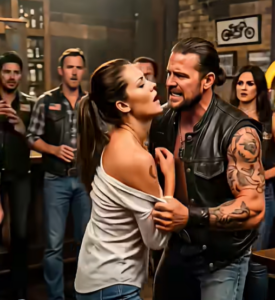
My enraged biker husband violently ripped my shirt open to expose a hidden pendant, I endured the gasps of the surrounding crowd under his vicious, sneering accusation of adultery
The chime was small and bright, like a doorbell in a house where nobody was supposed to be home.
Miller’s eyes flicked to the screen in my hand, and that single flick was the only mistake I had ever seen him make in three years.
“What was that?” he asked, and the pressure of the barrel against my temple eased by the width of a coin.
“That,” I said, and my voice came out steadier than my knees, “was the sound of every ledger, text log, and informant file in that drive arriving in four hundred inboxes.”
“You’re bluffing.”
“Check your phone, Agent Miller.”
He did not want to.
I watched him hold out against it for two long breaths, with the rain dripping from his hair and the wind combing through the black pines, and then his free hand slid into his coat and came out with a glowing screen.
I saw the color leave his face by the light of it.
“Who?” he whispered.
“The Inspector General’s office. The Justice Department’s oversight board. Two senators who hate each other. Eleven reporters. And a woman named Dana Whitfield, who has been waiting eighteen months for someone to hand her your name.”
“Whitfield is a desk clerk.”
“Whitfield is the deputy inspector general,” I said. “You never looked at her badge, because you never thought a woman who brought you coffee could take your life apart.”
His jaw worked, and the gun trembled against my skin, and for the first time that night I understood that a frightened man is far more dangerous than a cruel one.
“I should put a bullet in you right now,” he said.
“You could,” I agreed. “But the upload has already happened, and the only thing it’s waiting for now is a reason to add one more name to the list.”
“Which name?”
“Mine,” I said. “The woman you murdered on a mountain road, with a federal weapon, forty minutes after she gave you her location.”
I tilted my head toward my collar, where the tiny black button sewn behind the silver pendant had been blinking green since I’d left the tavern.
“It’s live, Miller,” I said softly. “It’s been live since the Dusty Spur. Everything you said, every word, is sitting on a server in Washington.”
He stared at the button, and then at me, and I watched the whole confident machinery of his face come apart one gear at a time.
“You wired yourself,” he breathed.
“My brother taught me to listen for liars,” I said. “He said they always talk too much when they think they’ve won.”
Miller made a low, ugly sound and raised the gun to strike me, and I closed my eyes and braced for the pain.
It never came.
Instead there was a sound like a freight train in the trees, a great rolling growl that rose from the valley and swelled until it shook the pine needles loose from the branches.
Engines.
Dozens of them.
I opened my eyes, and the whole forest below the ridge was lit from underneath, a river of white headlights climbing the switchbacks of the mountain road in a long, thundering line.
“What is that?” Miller said, and the gun wavered.
“That,” I said, and I could not keep the wonder out of my voice, “is the Iron Covenant Motorcycle Club.”
I had not called them.
I had not dared to hope for them.
But I knew the sound of my husband’s chopper from a mile away, the particular deep stutter of its engine, and it rode at the head of the column like a bell in a storm.
Miller turned toward the noise, and in that half second I did the only thing my brother had ever taught me to do when a man had a gun to my head.
I dropped.
I let my knees go and threw my full weight straight down, and the barrel scraped across my scalp and went off with a bang that turned the whole night white.
The bullet tore bark from the pine behind me.
Then somebody hit Miller from the side like a thrown boulder, and the two of them went crashing down the slope in a tangle of limbs and leather, and I lay in the wet ferns with my ears ringing and my heart trying to climb out through my throat.
“Chloe!”
It was Jax’s voice.
It was Jax’s voice, raw and cracked and nothing like the venomous growl I had heard in the tavern, and when I pushed myself up on my elbows I saw him sitting astride the federal agent in the mud, one huge tattooed fist cocked back, his chest heaving.
“Don’t,” I called. “Jax, don’t. We need him alive.”
His fist hung in the air, shaking.
He looked up at me, and in the glow of forty headlights I saw his face, wet with rain and something else, something that looked terrifyingly like fear.
“I thought he’d killed you,” he said. “I heard the shot, and I thought…”
“I’m here,” I said. “I’m all right.”
He let go of Miller’s collar as though it had burned him, and Miller, dazed and bleeding from the mouth, tried to crawl away through the ferns and found six pairs of heavy boots planted in his path.
“Evening, Agent,” said a gravelly voice, and old Tuck Randall, the club’s gray-bearded road captain, stepped out of the dark with a tire iron resting casually against his shoulder. “I’d stay down if I were you.”
Miller stayed down.
Jax crossed the clearing in four strides and dropped to his knees in front of me, and for a moment he only stared, as though I might vanish if he blinked.
Then he reached out, with enormous gentleness, and drew my torn shirt together over my collarbone.
“I’m sorry,” he said, and his voice broke apart on the word. “I’m so sorry, Chloe. God, what I did to you in that bar. What I said.”
“You were being played.”
“I was being a fool.” His hands were trembling against my shoulders. “I should have known. I should have known you’d never. I put my hands on you in front of the whole club, and you took it, and you walked out the door and drove straight into a trap meant to save me.”
“How did you know?”
He pulled something from the pocket of his leather vest and held it up in the headlights.
It was a small, scuffed silver military tag on a broken chain, the twin of the one around my neck.
“It was in the bottom of my own gear bag,” Jax said hoarsely. “I found it ten minutes after you left. Matthew put it there, the night before he died. I never looked, because I never opened that bag.”
He turned it over, and the lamplight caught a line of tiny engraved letters.
I read them upside down, and my hand flew to my mouth.
If found, tell Jax I kept my promise.
“What promise?” I whispered.
“The one we made in Kandahar.” A tear slid down his scarred cheek and vanished into his beard. “We were in the same unit, Chloe. Before the club, before any of it. He pulled me out of a burning truck, and I swore that if I ever got home, I’d build something worth coming home to. And he swore he’d watch my back until the day he died.”
“He did,” I said.
“He did.” Jax closed his fist around the tag. “And I called his sister a liar for carrying his gift.”
I leaned forward and pressed my forehead against his, and we stayed there in the wet and the dark, two people who had both lost the same man, while forty engines idled around us like a congregation holding its breath.
When I could finally speak, I said, “There’s something about Matthew I still have to tell you.”
“Tell me.”
“Not here.” I wiped my eyes. “Not until we’ve finished what he started.”
The Inspector General’s convoy reached the ridge at one in the morning, six black SUVs and an ambulance, with Dana Whitfield stepping out of the lead vehicle in a rain-spattered trench coat and a face as grim as a judge’s.
She was a small, fierce woman in her fifties, with graying red hair and spectacles she had pushed up into it, and she crossed the clearing like a woman who had waited a very long time to arrive.
“Mrs. Hale,” she said, and she shook my hand with both of hers. “I have never been so glad to be woken by a notification in my life.”
“Chloe,” I said. “Please.”
“Chloe.” She smiled. “You’ve done what four task forces could not. Every file in that upload checks out. Every informant, every wire transfer, every phony case number. Forty-one agents are being arrested across six states as we speak.”
“And the club?” Jax asked, standing at my shoulder with his hand resting at the small of my back.
Whitfield looked at him for a long moment.
“Mr. Hale,” she said. “You were framed for the murder of a Bureau informant named Danny Ruiz four years ago. The evidence against you was fabricated by Agent Miller and his associates to keep you under their thumb, because a man with a murder charge hanging over him does what he’s told.”
Jax’s face went very still.
“I never touched Danny,” he said.
“I know.” She held out a folder. “Here is the signed order vacating your warrant. It was approved by a federal magistrate ninety minutes ago.”
He took it with shaking hands, and read it by the light of the headlamps, and I watched four years of dread drain out of the muscles of his face.
“The whole time,” he said. “The whole time I thought one day they’d come for me, and that the only way to survive was to keep my head down and do what the club president said.”
“Dutch Calloway used that fear,” Whitfield said quietly. “He’s the real head of the ring, Mr. Hale. He’s been running the pipeline for eight years, and he handed Miller your name to keep you pliable.”
“Dutch,” Tuck growled, and a wave of angry whispers ran through the gathered bikers. “Dutch Calloway, who’s been sitting at our table every Sunday for ten years.”
“He’s at the Dusty Spur right now,” Whitfield said. “With my agents. We’re making the arrest at one-thirty.”
Jax looked at me.
“I want to be there,” he said.
“So do I,” I said.
Whitfield sighed, took off her glasses, and rubbed the bridge of her nose.
“I suppose I owe you that much,” she said. “But you will both stay behind my agents, and you will not touch him.”
“Wouldn’t dream of it,” said Tuck, tapping the tire iron against his palm.
The Dusty Spur looked like a different place at one-thirty in the morning, with its neon sign dead and its doors propped open and a ring of federal vehicles parked in the gravel lot with their lights silently turning.
Inside, a dozen club members sat at the long tables with their hands flat on the wood and their faces slack with disbelief, guarded by agents in dark windbreakers.
At the center booth, where Jax had sat mocking me only hours before, a heavyset man in a leather vest sat alone with a glass of untouched whiskey in front of him.
Dutch Calloway was sixty years old, with a snowy beard and soft, kind blue eyes that had fooled a hundred men into trusting him, and when he saw us come through the door, he smiled.
“There she is,” he said warmly. “The prodigal daughter.”
“Dutch,” I said.
“I always thought you were the smartest of the lot,” he said, lifting his glass in a mock toast. “Smarter than Matthew, and he was no fool. Though I’ll admit I never expected a wire in a pendant.”
“You killed my brother,” I said.
“I did what was necessary,” Dutch replied, and he set the glass down and folded his hands. “Your brother was an idealist. He found my books, and instead of coming to me like a man, he went to the Bureau. A weaker man would’ve let it pass. Matthew had to be a hero.”
Jax made a low sound in his throat, and I put a hand on his arm.
“He’s trying to make you angry,” I murmured.
“It’s working,” Jax muttered.
“Mr. Calloway,” said Whitfield, stepping forward with a pair of handcuffs, “you are under arrest for conspiracy, racketeering, the murder of Daniel Ruiz, the attempted murder of Chloe Hale, and the murder of Matthew Carter.”
Dutch’s smile did not change.
“That last one,” he said, “I wouldn’t be so sure about.”
The room went very quiet.
I felt the blood stop in my veins.
“What did you say?” I whispered.
“I said,” Dutch repeated, with a lazy, cruel patience, “that Matthew’s death has always been rather difficult to prove. Because my men did put him in that truck. And my men did push that truck off Harlan Bridge. But when the divers went down the next morning, there was no body in the cab.”
The floor tilted beneath my boots.
“Somebody pulled him out,” Dutch said. “Somebody with a great deal of training and a very good reason to keep quiet. I’ve been looking for that somebody for three years, and I never found a trace.”
I stared at him, and then, slowly, I turned my head and looked at Dana Whitfield.
She was not looking at Dutch.
She was looking at me, with a strange, careful tenderness, and she had gone very still, the way a person does when they are about to say something they have rehearsed in the dark a hundred times.
“Chloe,” she said. “I think it’s time.”
“Time for what?”
“For the part of the story I couldn’t tell you,” Whitfield said. “Because if I had, you would have gone looking for him, and Dutch would have followed you straight to his door.”
“Looking for who?” I breathed.
Her mouth trembled.
“Your brother,” she said. “Matthew is alive.”
I do not remember sitting down.
I remember a hand beneath my elbow, and the smell of whiskey and old wood, and Jax’s voice saying my name over and over from very far away, and a ringing white silence in my head that seemed to go on forever.
“No,” I said. “No, I buried him. I stood at the grave.”
“You buried an empty box,” Whitfield said gently. “I’m so sorry. We had to make it look real.”
“He’s alive?”
“He is.” She knelt in front of me, and her eyes were wet. “He was in a coma for four months, in a federal facility under a false name. He had a collapsed lung and a fractured skull, and the doctors didn’t think he’d walk again. But he did. And for two years he’s been working with my office from the inside, feeding us everything he could, while his sister carried a drive that he’d taught her how to hide.”
“He knew about the pendant,” I said slowly.
“He gave it to you.”
“He told me to wear it. He said it was for luck.”
“It was,” Whitfield said. “It was the best luck either of you could have had.”
A sound came out of me, half laugh and half sob, and I put both hands over my face and bent forward until my forehead touched my knees.
Three years.
Three years of lying awake in an empty bed, of talking to a headstone, of washing the same grease-stained shirt because it was the last thing he had ever touched.
Three years of grief I could not now, in all honesty, call wasted.
“Where is he?” I managed.
“Outside,” Whitfield said. “In the last car of the convoy. He asked me not to bring him in until I was sure you were safe.”
I was on my feet before she finished the sentence.
I ran through the bar, past the agents and the stunned bikers and the old blue pool table, and shoved open the doors, and the cold air hit my face like a slap.
The last SUV sat at the edge of the gravel lot with its dome light glowing.
The door opened, and a man stepped out.
He was thinner than I remembered, and he walked with a slight limp, and there was a pale seam of scar tissue running along his hairline.
But he had our father’s shoulders, and our mother’s crooked grin, and the same unruly brown cowlick that had defied every comb since he was nine years old.
“Hey, Chlo,” Matthew said.
I could not run.
My legs would not do it.
I stood frozen in the gravel with my hands pressed to my mouth, and he came toward me, one slow step at a time, as though approaching a skittish horse.
“I’m sorry,” he said. “I’m so sorry I couldn’t tell you. I wanted to every single day.”
“You’re real,” I said stupidly.
“Last time I checked.”
“You’re really real.”
“Pinch me,” he offered. “I won’t complain.”
I crossed the last few feet in a stumble and threw myself into his arms, and he caught me, and I felt his ribs and his heartbeat and the whole warm, solid, impossible truth of him.
We cried like children, the two of us, standing in the middle of a gravel parking lot with the police lights turning red and blue across our faces and half a motorcycle club watching from the porch.
“I thought you were dead,” I sobbed into his shoulder. “I thought I’d killed you. I thought if I’d just told someone about the drive sooner…”
“Hey.” He drew back and held my face in his scarred hands. “Hey. Look at me. You did exactly what I asked you to do, and you did it better than I could have. You carried it for three years. You never faltered.”
“I faltered every day.”
“And you carried it anyway. That’s what brave is.”
I laughed, wetly, because I’d heard the same words from his lips when I was nine and afraid of the dark.
Behind him, a tall figure had stepped quietly out of the shadows beside the SUV, hat in his hands, face wrecked with a joy so naked that I almost looked away.
“Matthew,” Jax said, and the word cracked like ice.
Matthew turned, and the two of them stared at each other across ten years and three thousand miles of dust.
“Captain,” Matthew said softly. “You look terrible.”
“You look dead.”
“I got better.”
Jax gave a ragged, choking laugh, and then he crossed the lot in two strides and wrapped both arms around my brother and lifted him clean off his feet, and the two of them stood there swaying in the headlights like a pair of drunken bears.
I will never forget the sound of Jax Hale, president of the Iron Covenant, weeping on a gravel road at two in the morning with his face buried in my brother’s neck.
“I got your tag,” he kept saying. “I got your tag, I got your tag.”
“I know,” Matthew said, laughing and crying together. “I know you did, you big idiot.”
Behind them, a line of bikers had come down off the porch and gathered at a respectful distance, gruff old men in worn leather with their hats in their hands, and one by one I saw them wiping their eyes with their sleeves.
Even Tuck, who had once told me that he hadn’t cried since the Carter administration, turned his back and blew his nose with a sound like a foghorn.
The trial of Dutch Calloway and his associates began in January, and it lasted nine months.
It was the largest federal corruption case in a generation, and it filled the evening news every night for a season, a vast, tangled web of informants and agents and bought judges that stretched across six states and four decades.
Dutch took the stand in his own defense for two days, serene and smiling, and the jury watched him the way people watch a snake in a glass cage, with horror and a strange, helpless fascination.
Matthew testified for eleven days.
He sat in the witness box in a plain gray suit with his hands folded and his voice level, and he walked the court through every secret he had ever uncovered, every betrayal, every body, every dollar.
When the prosecutor asked him how he had survived, he paused, and glanced at the gallery, and found me in the front row with Jax’s hand wrapped around mine.
“My sister,” he said. “She kept me alive. Every night I lay in that hospital bed, I knew she was out there carrying what I’d asked her to carry, and I wasn’t allowed to tell her she was doing it right. I think that was the hardest part.”
I could not see him through the tears.
Dutch Calloway was convicted on forty-four counts and sentenced to three consecutive life terms, and when the foreman read the last verdict, he turned slowly in the defendant’s chair and looked at Jax.
“I made you,” he said, in a low, cold voice. “Everything you are, I made.”
“No,” said Jax, rising from his seat, and the courtroom hushed. “You tried to. But a man’s not made by the people who use him. He’s made by the people who show up for him. And mine showed up on a mountain road at midnight with their headlights on.”
He turned and offered me his arm, and I took it, and we walked out together through a corridor of bikers standing at silent attention, forty men and women in clean leather vests holding their helmets over their hearts.
Agent Miller took a plea for forty years and testified against nineteen colleagues, and the whole rotten pipeline that had fed on the border for a generation collapsed in a single dazzling autumn.
Dana Whitfield was promoted to inspector general in November, in a quiet ceremony in a government office that smelled of coffee and carpet cleaner, and she invited Matthew and me to stand beside her while the oath was read.
“This case belongs to the two of you,” she told us afterward, pressing a framed commendation into my hands. “I only held the door.”
“Held it for three years,” Matthew said.
“Well.” She smiled, pushing her spectacles up into her gray-red hair. “Doors are heavier than they look.”
Winter fell on the mountains, and the snow came down thick and soft over the old Iron Covenant clubhouse, and one Sunday in February the whole club gathered in the great stone hall for a meeting that had been long delayed.
Jax stood at the head of the long table with his hands braced against the wood, and the room fell quiet.
“Brothers,” he said. “Sisters. I’ve been your president for six years, and for four of them I was a coward.”
Nobody spoke.
“I took Dutch’s orders because I was afraid of a murder charge,” Jax continued, and his voice was steady, though his hands were not. “I let him run the club’s business in the dark. I looked the other way, and I called it loyalty. And I nearly lost my wife and my brother in the process.”
“You didn’t know,” Tuck said gruffly.
“I should have.” He drew a breath. “So I’m stepping down.”
A shocked murmur ran around the table.
“I won’t ask you to forgive me, but I’ll ask you to vote on one thing before I go.” He turned, and held out a hand toward me. “The Iron Covenant should be a club that fixes bikes, and rides on Sundays, and watches out for its own. That’s all. No pipelines. No shadows. A clean charter, with a clean president, and a vote at the table for every member.”
“And who’s the president?” asked a voice from the back.
Jax smiled, and it was the first time in a year that I had seen the old warm crooked grin come back into his face.
“I nominate Tuck Randall,” he said. “Because he’s the only man in this room who’s never told a lie, and he cried like a baby when Matthew came back from the dead.”
“I did not cry,” Tuck said.
“You wept,” said forty voices at once, and the stone hall rang with laughter.
They voted in the afternoon, and Tuck won unanimously, and he accepted the gavel with a gruffness that failed to hide the shaking of his hands.
“First order of business,” he announced, clearing his throat. “I’ve got a letter here from a lady who wants to join the club. Two ladies, actually. One’s an electrician and one’s a mechanic.”
I looked up, startled.
“You can’t join a motorcycle club without a motorcycle,” Tuck said sternly, “so there’s a certain matter of a gift.”
A door opened at the back of the hall, and two of the younger members wheeled in a gleaming little black Harley with a red ribbon tied around its handlebars.
A card was taped to the seat, in my brother’s blocky handwriting.
For my sister, who rode through the dark and never looked back. Welcome home. Love, M.
I could not speak.
I pressed both hands against my mouth and stood there, and Jax’s arm came around my waist, and for a long time the whole hall stood and clapped, a slow, rolling thunder of leather gloves and boots.
It was not until spring that the three of us finally stood on Harlan Bridge together.
The river ran fast and brown beneath us, swollen with snowmelt, and the air smelled of wet earth and new leaves, and the mountains rose blue and enormous against a cloudless sky.
Matthew leaned his elbows on the cold iron railing, and stared at the water for a long time.
“This is where they pushed me,” he said.
“You don’t have to be here,” I said.
“I want to be.” He turned and smiled, small and tired and entirely at peace. “I’ve been a ghost for three years, Chlo. I think I need to stand somewhere that proves I’m not.”
Jax took off his leather vest and draped it around my shoulders against the wind, and reached into his pocket, and took out both silver tags on their broken chains.
“I had the links repaired,” he said.
He fastened one around my neck, and held the other out to Matthew, and my brother took it with a trembling hand.
“We’re done carrying other people’s secrets,” Jax said. “From now on, we just carry each other.”
“Corny,” Matthew said, with a watery grin.
“True,” said Jax.
“Both,” I said, and they laughed, and I laughed, and the river laughed along below us, bright and fast and entirely unafraid.
That summer, on a Sunday, at the end of a long line of gleaming motorcycles, Jax Hale and I stood in front of an old stone church at the edge of town and said our vows again.
I wore a plain white dress with leather boots, and my brother walked me down the aisle with his hand in mine and our mother’s crooked grin on his face.
Jax cried before I reached the altar.
So did Tuck, and Whitfield, and the old priest, and most of the congregation, and when the ceremony ended and the doors swung open onto the sunlit steps, a hundred motorcycles roared to life in the road outside, an anthem of engines rolling up into the open blue sky.
We rode away that afternoon with tin cans clattering behind the bikes and the whole club following in a gleaming river of chrome, down the long mountain road toward the valley, past the place where the trap had been set.
There were no black sedans waiting there now.
There was only the road, golden and wide and empty, running down toward a green and shining country where nobody was following us anymore.
I leaned my cheek against my husband’s broad back, and closed my eyes, and felt the warm wind pouring over us both.
My brother rode beside us on his own bike, his hair streaming, his scarred face lifted to the sun.
And I understood, finally, what the silver pendant had been for all along.
It had never been a key to a conspiracy, or a weapon, or a secret.
It had only been a promise, passed from a brother to a sister across the dark, that someone would always be waiting at the far end of the road.
And someone had been.