My chapter president spat on the floor and dismissed her as a hysterical liar
The silver watch ticked in my palm like a small, stubborn heart.
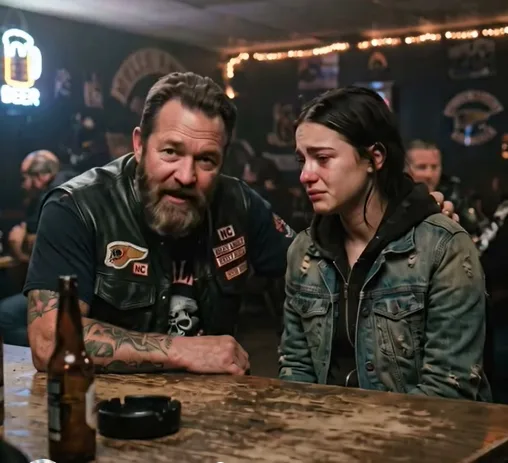
Around me the clubhouse had become a stage of overturned chairs and shattered glass, with federal agents calling out names and reading rights in flat, tired voices.
I closed the lid over my father’s smiling face and stood very still, because I had learned long ago that the body will hold up almost anything as long as the mind refuses to look at it.
“Sir?” said a woman in a navy windbreaker, appearing at my elbow with a clipboard. “Marcus Doyle? I’m Special Agent Lena Okafor. I need you to come with me.”
“Am I under arrest?”
“Not yet,” she said, with a small tight smile. “That depends on the next hour.”
They put me in the back of an unmarked sedan with the girl, and a medic who smelled of peppermint gum checked her bruises through the open door while rain began to tick against the roof.
She sat with the blanket pulled up to her chin, and she did not look at me for the first ten minutes.
“What’s your name?” I asked at last.
“Wren,” she said. “Wren Calloway.”
My breath caught, because I knew that surname the way you know the shape of an old scar.
“Calloway,” I repeated. “Tom Calloway was the chapter president before Hank. He disappeared in the Pinecrest woods twenty years ago.”
“He was my father.”
“He taught me to ride,” I said, and my voice failed me. “I was thirteen. He put me on a battered Sportster in a gravel lot and told me the secret was to look where you wanted to go, not where you were afraid to land.”
Wren turned her face toward me then, and I saw him in it, the stubborn jaw, the gray steady eyes.
“He used to say that to me too,” she whispered. “Before.”
“You were three.”
“I remember it anyway.”
Okafor slid into the front seat and twisted around to face us, her dark braid swinging over one shoulder.
“Let’s talk about what you both walked into tonight,” she said. “Ms. Calloway has been working with my office for fourteen months. She found Hank’s old ledger in a storage unit in Billings, and she volunteered to wear the wire.”
“Volunteered,” Wren said dryly. “You make it sound like a bake sale.”
“I make it sound like what it was. Brave.” Okafor turned to me. “Mr. Doyle, I owe you an apology. We did not know you would be in that room. We did not know who you were.”
“Who am I?” I asked.
She hesitated, then handed me a thin gray folder.
“Page three,” she said.
I opened it under the dome light.
It was a photograph of my father, Raymond Doyle, standing in a gravel lot beside a younger Hank, both of them grinning, both wearing the heavy gold ring that marked the president of the Iron Skull.
Below it, in a typed caption, were the words that made my stomach drop through the floor of the car.
Raymond Doyle, founder and national president, directed the Montana chapter’s trafficking operations until his death from cancer in 2009.
“He died of cancer,” I said. “I held his hand.”
“He did die of cancer,” Okafor said gently. “But the cancer was the only honest thing about him.”
“I don’t believe you.”
“I wouldn’t either.”
She leaned back and let me sit with it.
The rain came down harder, and somewhere behind us another car door slammed, and Wren reached across the seat and, without a word, put her small cold hand over mine.
“I’m sorry,” she said. “I didn’t know it would be you. When Agent Okafor showed me the club’s roster, your name was just a name. I didn’t know it would feel like this.”
“Like what?”
“Like watching someone find out their house is on fire from inside.”
I laughed, a short, broken sound.
“That’s about right,” I said.
They took our statements until dawn.
By the time the sky behind the field office had paled to the color of dishwater, I had told Okafor everything I remembered of my father, the cedar-and-cigarette smell of his jacket, the Sunday pancakes, the way he had taught me to fix a carburetor and to never lie to a woman.
I told her he had never hit me.
I told her he had never raised his voice.
I told her that the last thing he had said to me, in a hospital bed with the morphine drip clicking, was, “Be better than I was, Marcus.”
“Did you ever wonder what he meant?” Okafor asked.
“Every day since,” I said.
“Now you know.”
“Now I know.”
She set down her pen and studied me with an expression I could not read.
“Mr. Doyle, you’re not the only person in that clubhouse who didn’t know the truth. There are thirty-one members of the Iron Skull Montana chapter, and my assessment is that twenty-six of them are decent men who joined for the bikes and the brotherhood and never touched the dirty business.”
“Hank ran it from the inside.”
“Hank ran it with four lieutenants, who are all in custody. But there’s one more name in that ledger that we haven’t found.” She tapped the file. “A man identified only as the Treasurer. He’s been moving money for twenty years. He’s the one who gave Hank his orders after your father died.”
“Who is he?”
“We don’t know. But Wren thinks she does.”
I looked at the girl, who sat curled in an armchair at the corner of the room with a cup of cocoa balanced on her knee.
“Say it,” Okafor said gently.
Wren drew a breath.
“My mother’s brother,” she said. “My uncle Desmond Calloway. He was the one who raised me after my father vanished. He was the one who told me my father had run off with another woman.”
“And you believe he’s the Treasurer?”
“I found a key in his study when I was sixteen,” Wren said. “It opened a locker in Billings. Inside was every book Hank ever kept, with my father’s name written on the first page in my uncle’s handwriting.”
“Written how?”
“As a debt,” she said quietly. “Paid in full.”
The room went very still.
“He killed his own brother-in-law,” I said slowly. “Then he raised the man’s daughter in the same house.”
“For eighteen years,” Wren said. “He tucked me in at night. He taught me to swim. He took me to my high school graduation and cried in the front row.”
Her voice cracked, and she set down the cocoa with both hands.
“That’s the part I can’t forgive,” she said. “That he was kind.”
I crossed the room and sat on the arm of her chair, which was the only thing I could think of to do, and she leaned against my shoulder like a tired child.
We stayed that way for a long time.
Okafor’s plan was simple, and it frightened me more than a loaded gun.
Desmond Calloway did not know his niece had gone to the Iron Skull. He did not know the raid had happened, or that Hank was in custody. He believed Wren was at her college dormitory in Missoula, studying for midterms, and that the club was safe behind its usual walls of silence.
“He calls her every Sunday night,” Okafor said. “At eight o’clock. We want her to answer.”
“And say what?” Wren asked.
“That she’s coming home for the weekend. That she’s found something about her father she wants to talk about. That she’s afraid, and needs him.”
Wren’s face had gone gray, but her chin lifted.
“He’ll know I’m lying.”
“He’ll know you’re frightened,” Okafor said. “That’s different. Men like your uncle don’t doubt a frightened woman. They like her.”
I watched Wren turn the plan over in her mind like a stone, weighing it, testing its edges.
“I’ll do it,” she said at last. “On one condition.”
“Name it.”
“Marcus comes with me.”
I blinked. “I’m not federal. I’m not trained. I’d only get in the way.”
“You’re the son of the man who founded the club,” Wren said. “My uncle has been afraid of that name his whole life. If you’re standing beside me when he opens the door, he’ll make a mistake.”
Okafor looked at me.
“It’s your choice, Mr. Doyle,” she said. “But I’ll tell you honestly, I think she’s right.”
I looked at the gray rain streaking the window, and at the small, fierce young woman beside me, and at the watch in my pocket whose lid I had not opened again.
“All right,” I said.
Sunday evening came cold and clear.
Desmond Calloway’s farmhouse stood at the end of a long gravel road in the foothills outside Hamilton, a white two-story place with green shutters and a wraparound porch, the kind of home that appears on the covers of church cookbooks.
A porch light burned, yellow and welcoming, and smoke rose from the chimney in a lazy gray thread.
Eleven federal vehicles waited in the trees half a mile back, with agents on foot in the darkness all around the property, and a wire taped beneath Wren’s sweater, and another under my shirt.
We walked up the porch steps side by side.
My heart was hammering so loudly that I was certain the microphone would pick it up.
Wren knocked twice, a pattern I guessed was a family code, and the door swung open before the second knock had finished.
Desmond was a big, soft-faced man in his late fifties, with a cardigan the color of oatmeal and silver hair combed neatly across his forehead.
He wore reading glasses on a chain, and there was flour on his sleeve.
“Wren, sweetheart,” he said, and his whole face lit up. “You didn’t say you’d be here so early. I’m just finishing the pie.”
“Hi, Uncle Des,” Wren said, and her voice shook only a little. “I brought a friend.”
His gaze slid to me, and I watched the warmth freeze on his face, as though someone had pressed pause.
“Marcus Doyle,” he said softly. “My God. You look just like your father.”
“So I’m told.”
“Come in. Please. Both of you. It’s freezing.”
He stepped aside, and we entered a warm, bright kitchen that smelled of cinnamon and coffee, with copper pots hanging from a rack and a vase of dried wildflowers on the windowsill.
It was a very good set.
I had to admire it, in a bleak sort of way, the care with which a monster had furnished his cage.
“Sit,” Desmond said. “I’ll get plates.”
“We’re not hungry,” Wren said.
“Nonsense. Everyone’s hungry for pie.”
“Uncle Des.” She did not sit. “I found something in the storage unit in Billings.”
His hands went still on the pie server.
“What storage unit?”
“The one with the ledgers,” Wren said. “The one with my father’s name on the first page.”
The kitchen clock ticked.
Desmond set down the pie server, slowly, and wiped his hands on a dishtowel, and when he turned to face us, the oatmeal-colored warmth had drained out of him like water through sand.
“I see,” he said.
“Did you kill him?” Wren whispered.
Desmond looked at her for a long time, and in his pale blue eyes I saw something that was not quite guilt and not quite love, a terrible muddled thing in between.
“Tom Calloway was going to destroy this family,” he said. “He found the books. He was going to go to the FBI. He’d have put me in prison, and your mother in the ground from shame, and you in foster care.”
“So you killed him.”
“I stopped him.” His voice cracked. “I did what had to be done. And then I took you in, Wren. I raised you. I loved you like my own.”
“You raised me in my father’s blood.”
“I raised you in a home!” he cried, and for the first time the mask slipped, and I saw the man beneath it, red-faced and wild-eyed and desperately afraid. “I gave you everything. Everything! Doesn’t that count for anything?”
“It counts,” Wren said, and tears were running down her face. “That’s why it hurts.”
A footstep creaked on the back porch.
Desmond’s eyes flicked toward it, and I felt the whole room draw taut like a bowstring.
“You brought them,” he whispered. “You wore a wire. You came into my house with a wire.”
“I did.”
“After everything.” His hand dropped to the drawer beside the stove, and in the same instant I stepped between them and said, as quietly as I could, “Don’t.”
“Marcus,” he said, almost kindly. “Son. Your father was my best friend. I loved him. You know that.”
“I know,” I said. “And I know what he did, and what you did, and I know there’s nothing in that drawer that can fix it.”
“There’s a gun,” he said.
“I know.”
“I could use it.”
“You could,” I said. “And you’d die in your own kitchen with a pie in the oven and your niece watching. Or you could put your hands on the counter and walk out that door, and she could tell her own children someday that you stopped.”
For a long, long moment I thought I had misjudged him.
His hand trembled over the drawer handle, and his jaw worked, and a single tear slipped down the side of his nose and fell onto the linoleum.
Then he took his hand away.
He laid both palms flat on the counter, and bowed his head, and said, in a small old voice that I will hear until I die, “I’m so tired.”
The agents came through the back door in a quiet wave, and Desmond Calloway did not resist.
He let them cuff him gently, and as they led him past Wren, he stopped and looked at her.
“The pie’s in the oven,” he said. “Take it out before it burns.”
It was such a small, absurd, human thing to say that Wren began to laugh, and then to sob, and I put my arms around her and held her while the agents filed out and the kitchen filled with the smell of baking cinnamon and the slow ticking of an old clock.
The trials took a year.
Hank Dumont was convicted of murder, kidnapping, and trafficking, and sentenced to life without parole. His four lieutenants received sentences of thirty to fifty years. Desmond Calloway pleaded guilty to the murder of his brother-in-law and to eighteen years of financial crimes, and he sat in the courtroom with his reading glasses on and his hands folded, answering every question in a gentle, exhausted voice.
When the judge asked if he had anything to say, he turned in his chair and looked straight at Wren.
“I’m sorry,” he said. “I know it isn’t enough.”
“It isn’t,” Wren said, from the gallery, quietly. “But I heard you.”
He nodded, and the bailiffs led him away.
Twenty-six members of the Iron Skull chapter, men I had known most of my life, testified for the prosecution, and every one of them told the same story of a brotherhood slowly poisoned by a handful of men at the top.
And my father’s name, in the end, came out in that courtroom, as Okafor had known it would.
I sat in the second row and listened to the prosecutor read the list of his crimes into the record, the shipments, the payoffs, the dead.
I did not flinch.
I had already done my grieving in a gray room at the field office, over a cup of cold coffee, and I had come out the other side with a clear and quiet resolve.
When it was over, Okafor found me on the courthouse steps in the late afternoon light.
“How are you?” she asked.
“Strange,” I said. “Like I’ve been carrying a suitcase for thirty years and someone finally told me what’s in it.”
“And?”
“And I’m putting it down.”
She smiled, and offered her hand, and I took it.
“The Iron Skull’s charter has been revoked,” she said. “The clubhouse is going to auction.”
“I’d like to buy it.”
She raised her eyebrows. “Mr. Doyle?”
“Twenty-six good men have no place to go,” I said. “And Hank and my father never owned that building. They stole it with other people’s money. I think it’s time it was used for something honest.”
“What did you have in mind?”
I looked out over the courthouse lawn, where the first yellow leaves of autumn were tumbling across the grass.
“A garage,” I said. “A place for kids who don’t have anywhere else to be after school. Where somebody who knows engines can teach them how to fix things, and to look where they want to go.”
Okafor was silent for a moment.
“Your father would be appalled,” she said.
“He was appalled by a lot of things,” I said. “He’d have gotten over it.”
The clubhouse sold in October, and I bought it with my entire savings and a loan that Wren cosigned without being asked.
We spent all winter on it.
We tore down the neon signs and the sticky wooden bar and carried out forty years of tobacco-stained furniture in a long line of pickup trucks, and in their place we hung bright clean shelves, and a row of workbenches, and a big hand-painted sign over the door.
CALLOWAY & DOYLE AUTO ACADEMY.
Wren painted every letter herself, with her tongue between her teeth and a smear of blue across her cheek.
On opening day in March, the garage was packed with children, thirty-seven of them, kids from the foster system and the group homes, in oversized coveralls and mismatched boots, clutching wrenches they didn’t yet know how to hold.
I stood at the front with my hands in my pockets and my heart in my throat.
“Okay,” I said. “Who here has ever fixed an engine?”
Nobody raised a hand.
“Good,” I said. “Neither had I, once. My father taught me, and he wasn’t a good man, but he was a very good teacher, and that’s a thing I can keep.”
A small boy in the front row, maybe nine years old, with a gap in his teeth and a baseball cap pulled low, looked up at me with enormous brown eyes.
“Is it hard?” he asked.
“Sometimes,” I said. “But here’s the secret. Look where you want to go, not where you’re afraid to land.”
He thought about this very seriously.
“That’s not about engines,” he said.
“No,” I said, and smiled. “It isn’t.”
Wren caught my eye across the room, and she was smiling too, her gray eyes bright and wet, and in her hands she held a small silver pocket watch that I had given her the week before.
She had opened the lid, and she was looking at the portrait inside, the two men grinning in a long-ago gravel lot.
I had meant to throw it away.
But she had asked to keep it, and I had understood, as I looked at her face, that some objects are not meant to be buried or burned, only carried, until they weigh a little less each day.
That summer, we rode out together to the old Pinecrest woods, the two of us on a pair of old Sportsters, with the wind in our faces and the mountains rising blue against the sky.
We found the place where Tom Calloway had been buried, a quiet clearing among the ponderosa pines, with a flat gray stone and a ring of wild lupine nodding in the breeze.
Wren knelt beside the stone and laid her palm against it.
“Hi, Dad,” she said. “I brought someone.”
I took off my helmet and knelt beside her.
“Tom,” I said, and my voice was thick. “You taught me to ride. I never got to say thank you.”
The wind moved through the pines, soft and warm and smelling of sap and sunlight, and somewhere above us a hawk cried once and wheeled away.
“It’s all right now,” Wren whispered. “We got them. We got every one.”
We sat there for a long time, side by side in the dappled shade, two people who had been lied to by the same family and had found each other at the end of it.
Eventually Wren took my hand.
“Marcus,” she said.
“Yes?”
“I was afraid you’d hate me. For bringing it all out. For taking your father away.”
“You didn’t take him,” I said. “He was already gone. He just left me the bill.”
She laughed, a small bright sound, and leaned her head on my shoulder.
“Thank you for looking at the bill,” she said.
“Thank you for handing it to me.”
We rode home in the long gold light of evening, down winding mountain roads lined with fireweed and aspen, and the engines hummed beneath us like a steady heartbeat.
At the edge of town, the garage stood waiting, its windows glowing, its big new sign bright against the darkening sky, and from inside came the clatter of tools and the sound of children laughing.
I parked the bike and sat for a moment with the engine ticking as it cooled.
I thought of the man who had lied to me for thirty years, and the man who had loved me anyway, and I understood that they had been one and the same, and that I did not have to choose.
I would carry his teaching and leave his sins.
That was all a son could do.
Wren climbed off her bike and looked back at me over her shoulder, her face lit orange by the sunset.
“Coming?” she called.
I took the silver watch out of my pocket, where I had been carrying it since the day she gave it back, and I opened the lid one last time.
My father smiled up at me from the faded photograph, young and handsome and entirely unaware of what he would become.
“Be better than I was,” I whispered, and I closed the lid, and tucked the watch away.
Then I swung off the bike, and I walked into the warm light of the garage with a girl I had known for less than two years and loved like a sister, and a roomful of children waiting to be taught.
The war I had thought I started had ended before it began.
In its place was something quieter, and stronger, and entirely our own, a family built from the wreckage of a lie, and held together by the simple, stubborn courage to look where we wanted to go.