My burning SUV in the middle of a desolate desert highway while barely conscious and bleeding from a brutal crash
He smiled at the mesquite as if the bushes had always been on his payroll.
“Stay low,” the man beside me repeated, but the words had already expired. My father lifted a hand, not in surrender to the sirens, in greeting to the dark.
“Come out, Claire. You were never a very good passenger.”
The rescuer’s jaw went tight.
“He knows your cover name.”
“He gave me the cover name. I just didn’t know it was a leash.”
Federal light pooled across the gravel. Strike vehicles boxed the sedan. Syndicate men did the math and raised empty hands that had been full an hour ago. My father did not raise his. He looked at the cluster of brush and waited, patient as a ledger.
I pressed my palm to the seam in the dress. The drive was a hard rectangle against bruised ribs. A year of abandoned properties and shell invoices lived in that seam. So did the accident that was not supposed to leave a witness who could still count.
The rescuer—his name on the briefing had been Cole Mercer, task force, not a random saint—chambered nothing. He had already called it in. He put his mouth near my ear.
“If you walk out, you walk with the drive visible in your hand. If you stay, he plays the wounded father for the cameras.”
“He smiled.”
“That’s the play.”
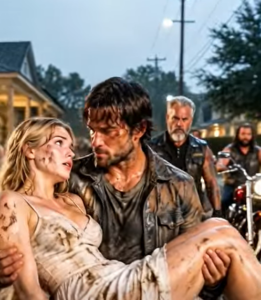
I opened the door into heat that smelled of creosote and burnt rubber still clinging to my hair. Cole stayed at my shoulder. My father watched me limp into the light like a man watching a stock ticker hit the number he bought.
“You’re bleeding on a federal dress,” he said.
“You’re standing on a federal driveway.”
Agents moved in layers. A woman with a megaphone told everyone to kneel. Syndicate knees hit gravel. My father remained upright until two agents made posture a non-choice. Even then he kept his eyes on the seam of my dress.
“Claire Harper,” an agent recited, using the name on my wrecked SUV’s registration.
“Special Agent Claire Voss,” I said.
“Forensic accounting. The Harper identity is closed as of the fire.”
My father’s smile thinned to something almost proud.
“I told them you’d finish the year. You always did like balancing other people’s books.”
Cole spoke without looking at him.
“Daniel Voss. You are under arrest for conspiracy, laundering, and the attempted murder of a federal officer.”
“Attempted,” my father repeated, tasting the word.
“The highway was supposed to be complete. Faulty brake line. Desert does the rest. She always insisted on driving herself. Stubborn.”
The sirens made a ring and then lowered into idling. Heat shimmered. I felt the crash again in pieces: the shove of the wheel, the sky turning, the dress tearing on the column, the thought that if I blacked out the lining would still testify.
“You signed the properties,” I said.
“The ones I flagged as dormant. You were the beneficial owner behind three LLCs I traced to a notary who died of a convenient stroke. You used my childhood address as a mail drop in year one so the pattern would look like a daughter’s error if anyone asked.”
“I used what the work required.”
“The work was supposed to be a crash I didn’t walk away from.”
An agent cut the lining with trauma shears while a medic protested about ribs. The drive dropped into an evidence bag with a sound too small for what it held. My father’s gaze followed it the way other men follow a pulse.
“You sewed it yourself,” he said.
“I learned from the same woman who taught you to keep two sets of books. Difference is she stopped. You promoted the second set to a religion.”
They walked him to a vehicle that did not care about sedans or sunsets. He paused, cuffs catching the last red light.
“Mercer pulled you out because I told him where the wreck would be. He thinks that makes him clean. Ask him who authorized the delay on your extraction last spring.”
Cole did not flinch. I did, once, then put it away for a room with a recorder.
“Get in the truck,” Cole said to me.
“Not with you.”
“Then with Ruiz. But you are not standing in this driveway until you fall down and give him a photograph.”
I got in with Ruiz. The desert slid past, less endless when you were no longer the only moving thing that knew the truth.
At the field office they scanned the drive while a doctor wrapped my ribs and pretended not to hear accountants cry in another register. The files opened like a confession that had been waiting for a competent reader: layering through scrap yards, desert parcels, a church fund, a judge’s campaign, and a holding company whose managing member was a trust in my mother’s maiden name. Mother had been dead eleven years. The trust had not attended the funeral.
Ruiz sat on the edge of a desk.
“Your father ran the ring. Mercer was inside as transport. We used him to get you off the highway alive. The delay last spring was real. So was his call tonight. Both can be true. That is the ugly kind of true.”
“Did he know the crash was scheduled?”
“He knew a window. He did not know which mile marker until the smoke.”
I looked at my hands. Grease from the wreck. Blood. Thread from the lining.
“Put it in the file. All of it. I am tired of families that edit.”
They let me see Cole through glass before interviews stacked. He looked like a man who had carried a burning stranger and then been named in the stranger’s childhood.
I picked up the handset.
“Did you know he was my father when you lifted me out?”
“I knew Daniel Voss had a daughter on the books. I knew the books were dirty. I did not know you had sewn a drive into a dress. I thought I was saving an asset. I was also saving a trap he built with your face.”
“Why smile at the bushes.”
“Because he taught you where to hide when you were small. He assumed the lesson still paid him rent.”
I hung up before gratitude and fury braided into something I would have to unpick on a stand.
Night in the office was fluorescent and honest. I wrote the crash. Brake line. Staged. Hard drive intact. Father on the gravel. Smile. I wrote the year of properties. I wrote the moment I said my dad will want to meet you and meant a different man than the one who arrived.
In the morning the cartel-facing names began to fold. Laundering is a coward’s architecture; it collapses when one load-bearing lie is named in public. Officials discovered ethics. A judge recused from his own future. The abandoned parcels sprouted notices like desert flowers that had been waiting for water that was actually ink.
Daniel Voss asked for a meeting with his daughter. I went with counsel and a recorder and ribs that still clicked when I breathed too deep.
He looked smaller without a highway to stage.
“You were the best I trained.”
“You trained me to find you.”
“I trained you to survive rooms that eat numbers. The crash was to keep the drive from a grand jury, not to keep you from a life. I misread your stubbornness. That is the only apology I have that is not a legal strategy.”
“Keep it. I will use the ledgers.”
He nodded as if I had passed a test he no longer administered.
“Mercer will try to be your story’s hero. Do not give him the whole page. Heroes who know the mile marker of your death are just employees with better timing.”
“I already wrote him as a man with soot on his face and a delay in his file. That is the whole page he gets from me.”
They took him back. I walked into heat that did not care about betrayal. Cole waited by a government sedan like a question I had not authorized.
“You leaving the desert?” he asked.
“After the debrief. After the drive is copied until it can’t die in a fire. After I stand in the lot where the SUV melted and make sure the report uses the word homicide next to accident so no clerk gets poetic.”
“I can drive you.”
“You can stay in your lane, Mercer. I have had enough men steering me off the pavement.”
He accepted that like a sentence. Good.
I went back to the highway at noon because noon has no romance. The wreck had been hauled. Black scars on sand. Glass like salt. I stood where strong arms had lifted me and felt nothing holy. Rescue is not absolution. Extraction is not kinship. A father can smile at your hiding place because he built the game.
Ruiz joined me with water and a silence that was professional.
“You did the year. The ring is open. You don’t owe the desert another rib.”
“I owe the files a clean chain. Then I owe myself a job that does not sew evidence to my body.”
“We can do ordinary fraud for a while. People steal pensions. Nobody has to burn.”
“Ordinary sounds like a language I still remember.”
Wind moved the mesquite. Somewhere a coyote refused to care about task forces. I took a last look at the empty road that had been asked to finish me and had failed because a man with soot followed a window he should never have been given—and because a woman in a torn dress refused to let numbers die with her.
The lesson did not need a sunset, though the sky offered one anyway. Family is not a safehouse. A ride away from fire is not a vow. Money cleaned through empty land still smells like the people it bought. And the person who pulls you from a burning SUV may be part of the machine that scheduled the sparks. Count anyway. Sew the truth where a crash cannot reach it. Walk into the light with the drive in a bag, not in your skin. When a father smiles at the place he taught you to hide, do not hide. Stand, name the ledgers, and let the sirens do the only honest work left in the clearing.
I got into Ruiz’s truck without looking at the sedan-shaped absence in the driveway of a safehouse that had never been safe. The highway ran forward, ordinary and long. My ribs hurt. The books, at last, were going to balance in a room that did not belong to him.