My abusive husband publicly threw my warm stew into the snow and demanded I pack my bags
The silence after the handcuffs clicked was so complete that I could hear the snow whispering against the window glass.
Arthur lay sprawled across the dining table with his cheek pressed into a puddle of cooling broth, and for the first time in three years, he looked small.
“You can’t do this,” he rasped, spitting a bit of carrot from his lips.
“This is my house, my land, and she is my wife, and no federal badge can change that.”
“The land was never yours, Mr. Whitlock,” Marshal Vance said evenly, hauling him upright by the collar.
“And as for the wife, I believe a judge in Cheyenne will have a few things to say about that.”
He steered Arthur toward the kitchen chair nearest the stove and pushed him down into it, and Arthur glared at me with such naked hatred that I took one step back.
Vance noticed, and without a word he shifted his broad shoulders so that his body stood between us like a wall.
“You don’t have to look at him, ma’am,” he said quietly.
“Not tonight, and not ever again, if you don’t want to.”
“I want to,” I said, and my voice surprised me by how steady it sounded.
“I have spent three years looking at the floor whenever he walked into a room, and I would like to look at him now.”
Vance studied my face for a long moment, and then he gave one small nod and stepped aside.
I walked slowly around the table, and I stood in front of my husband with my hands folded in my stained apron.
He was a thick, florid man of forty-five, with whiskey-reddened cheeks and small, pale eyes, and I wondered how I had ever been so afraid of him.
“Where is my brother, Arthur?” I asked.
He sneered and turned his face toward the wall.
“I want you to say it out loud,” I said.
“I already know, because you wrote it down in your own hand, but I want to hear it from your mouth.”
“Go to hell, Clara.”
“Perhaps,” I answered, “but you’ll get there first.”
Vance let out a soft breath that sounded very much like a laugh.
He pulled a folded paper from inside his coat and set it on the table beside the overturned pot, and I recognized the heavy cream stock and the red wax seal at once.
“That is a federal warrant for the arrest of Arthur Whitlock,” he said, “on charges of murder, conspiracy, bribery of a public official, and smuggling of untaxed gold across territorial lines.”
“There are two more men in the saloon who will be keeping him company in the Cheyenne jail before the week is out.”
“My deputies picked them up twenty minutes ago, and I believe the circuit judge is already sitting in a cell with a very bad headache.”
Arthur’s head snapped around.
“Judge Pruett?” he whispered.
“Judge Pruett has been talking since noon,” Vance said mildly.
“It turns out he is far more afraid of the gallows than he ever was of you.”
The last of the bluster drained out of Arthur like water from a cracked jug, and he slumped in the chair with his bound hands dangling behind him.
For a long minute, nobody spoke.
The stove ticked, and the wind pressed against the shutters, and a single log shifted and sent a small shower of sparks up the flue.
Then the front door opened again, and two men in heavy gray coats stepped inside, stamping snow from their boots, and Vance gave them a short, businesslike nod.
“Deputies Harlow and Quinn,” he said to me.
“They will see to it that Mr. Whitlock spends his night somewhere cold and uncomfortable.”
The deputies hauled Arthur to his feet, and he went with them without a struggle, his shoulders hunched and his head low.
At the door, he twisted around one last time, and his lips drew back from his teeth.
“You’ll be nothing without me, Clara,” he spat.
“You were a nobody when I found you, and you’ll be a nobody when I’m gone.”
I did not flinch, and I did not answer.
I only walked to the doorway and held the door wide, and the winter wind swept in and carried his voice away into the dark.
When the sound of boots and hooves had faded down the road, I closed the door and leaned my forehead against the cold, rough wood.
My knees began to shake, and then my hands, and then my whole body, in great shuddering waves that I could not stop.
“Clara,” Vance said gently, and I felt a warm hand settle on my shoulder.
“It’s all right, you can let go now.”
“I don’t know how,” I whispered.
“I have been holding on for so long that I’ve forgotten what it feels like to be anything else.”
“Then you’ll learn,” he said.
“Slowly, and in your own time, and I will be here as long as it takes.”
I turned around, and the tears I had swallowed for three years finally broke loose.
I cried until my ribs ached and my throat burned, and I did not care that a stranger was watching, because he did not look away and he did not look uncomfortable.
He only guided me to a chair, set a cup of water in my hands, and sat down across from me with his hat resting on his knee, patient as the mountains.
When the storm inside me at last began to ease, I wiped my face on my apron and let out a long, shaky breath.
“I’m sorry,” I said.
“Please don’t be,” Vance answered.
“Do you know how long I have waited to see someone cry for a good reason?”
“I have spent eleven years watching people cry out of fear, and it is a beautiful thing to watch someone cry because the fear is finally over.”
I laughed weakly, and he smiled, a slow, warm smile that crinkled the corners of his blue eyes and changed his whole stern face.
“Your name is Vance,” I said.
“What is your first name, Marshal?”
“Elias,” he said.
“Elias Vance, of Laramie, originally, though I’ve lived out of a saddlebag for most of my adult life.”
“And you were here for three weeks, pretending to be a drifter, just to protect me,” I said, shaking my head.
“I fixed your stable door and ate your cooking,” he said with a shrug.
“It was the best assignment of my career.”
I looked at the overturned pot and the spreading brown stain on the table, and a thought struck me, small and absurd.
“Your supper is ruined,” I said.
“I promised you a bowl.”
“Clara,” he said gravely, “I would very much like to hear you say something other than an apology tonight.”
“Then I will say I’m hungry,” I admitted, “because I haven’t had a proper meal since breakfast, and Arthur threw my stew in the snow.”
“That, ma’am, is the most sensible thing anyone has said in this house all evening,” Elias said, and he stood and rolled up his sleeves.
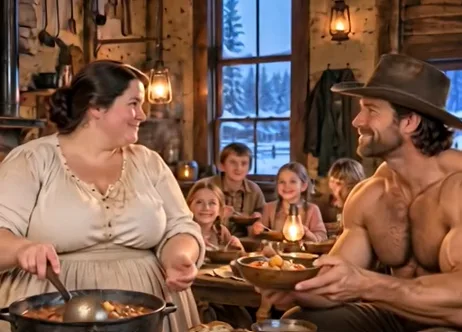
He found the last of the cellar potatoes, a heel of bread, and a wedge of hard cheese, and he fried them together in the cast-iron skillet with a pinch of salt.
It was the worst-looking dinner I had ever seen, and it was the most wonderful thing I had ever tasted.
We ate side by side at the scarred table with the wind rattling the windows, and for the first time in my married life, I did not listen for footsteps.
In the morning, the storm had passed, and the world outside was a sheet of untouched white beneath a pale, rosy sky.
I woke in the narrow bed in the back room, and for one confused moment I thought I was still in my old life, and my heart began to race.
Then I smelled coffee and wood smoke, and I remembered, and the fear slid away like a coat I no longer needed.
I dressed quickly and found Elias in the kitchen, kneeling at the hearth with a poker in his hand, coaxing the fire back to life.
“Good morning,” he said.
“I hope I didn’t wake you.”
“I haven’t slept past dawn in three years,” I said.
“I believe I slept until almost seven.”
“That sounds like progress,” he said, grinning, and he handed me a tin cup of coffee so strong that it nearly stood up on its own.
I sat at the table and wrapped my hands around the warm cup, and I watched the sunlight creep across the floor.
“What happens now?” I asked.
Elias sat across from me and rested his forearms on the table.
“Now there is a trial, and it will be long and unpleasant,” he said.
“I will need you to testify, and I will need the ledger, and I will need you to be braver than anyone should ever have to be.”
“And after that?” I asked.
“After that, the court will decide what happens to the Whitlock property,” he said.
“But I have read the original deed, Clara, and I believe you’ll be surprised.”
“I know all about the deed,” I said, and my voice hardened a little.
“Arthur told me the land was his, and that my father signed it over to him in payment of a debt.”
“Your father signed no such thing,” Elias said.
“The signature was forged, and the debt never existed, and the original deed is sitting in a locked drawer at the territorial land office with your family’s name on it.”
I stared at him.
“The land is mine?” I whispered.
“The land is yours, the water rights are yours, and the mineral rights beneath it are yours, too,” he said.
“It was always yours, from the day your father died, and Arthur has been stealing from you ever since.”
“My father’s farm,” I breathed.
“The orchard, and the creek, and the red barn.”
“All of it,” Elias said gently.
I put down my cup, because my hands were shaking too hard to hold it, and I looked out the window at the white hills where I had once played as a child.
It had been my father’s land for forty years before Arthur Whitlock rode into town with his easy charm and his bottomless pockets, and swept a grieving, lonely girl into a marriage that was really a theft.
I had been nineteen then, and my father had been dead three months, and my brother Thomas had been the only person left in the world who loved me.
Thomas, who had asked too many questions about the gold wagons that came and went at midnight.
Thomas, whose body had been found in the upper canyon, with a story about a fall and a loose rock that nobody believed and everybody swallowed.
“They’re going to hang him, aren’t they?” I asked softly.
“That will be for the court to decide,” Elias said.
“But I will tell you that I have never seen a case stronger than the one you built, Clara.”
“You copied that ledger by candlelight, one page at a time, for months, right under his nose.”
“I have worked with detectives who could not have done what you did.”
“I wasn’t brave,” I said.
“I was only so frightened that I had nothing left to lose.”
“That,” he said, “is exactly what bravery is.”
The trial opened in Cheyenne on the first Monday of March, in a tall courthouse of yellow brick with a clock tower that struck the hours like a slow, stern drum.
The whole territory seemed to have come to see it, farmers and miners and shopkeepers and curious ladies in feathered hats, all crowded onto the narrow wooden benches.
I wore a plain gray dress and a black shawl that had belonged to my mother, and I sat beside Elias in the front row with my hands folded tightly in my lap.
Arthur sat at the defense table in a rumpled suit, flanked by two expensive lawyers from Denver, and he did not look at me once.
Judge Pruett had indeed confessed, and so had the two saloon men, and the prosecution laid out the whole sprawling scheme with the cold precision of a man dissecting a frog.
They told the jury about the claim jumping, and the bribes, and the stolen gold that had traveled in false-bottomed wagons across three territories.
Then they called me to the stand.
I stood up, and my legs felt like water, and my heart pounded so loudly that I thought the whole room must hear it.
I walked down the long aisle, and every eye followed me, and I kept my gaze fixed on the clock above the judge’s head.
I put my hand on the heavy black Bible and swore to tell the truth, and my voice came out small and thin.
Then I looked up, and in the very front row, I saw Elias.
He did not smile or nod or make any sign at all, but he sat perfectly straight with his hat on his knee and his blue eyes steady on mine, as though he were holding the other end of a rope.
I took a deep breath, and I began.
I told them about the wedding, and how quickly the charming man had turned cruel once the vows were spoken and the deed was in his pocket.
I told them about the long, cold nights alone in the cabin, and the miners who were made to eat at my table and who looked away when Arthur raised his hand.
I told them about my brother, and the night he did not come home, and the morning I stood at the edge of the canyon and understood that I was never going to see him again.
I told them about the ledger, and the candle stubs, and the apron lining I had stitched twice over to hide the pages.
When I described the evening Arthur threw my stew into the snow, a low, angry murmur rolled across the benches, and one old woman in the back said, loudly, “Shame.”
The defense attorney, a lean man with oiled hair and a smile like a knife, rose to cross-examine me.
“Mrs. Whitlock,” he said smoothly, “isn’t it true that you harbored a grudge against your husband from the day of your marriage?”
“I harbored a good deal of things, sir,” I said.
“But a grudge is what you carry when someone has done you a small wrong, and I would not use that word for what he did.”
“Isn’t it also true that the ledger you submitted as evidence was written in your own hand?” he pressed.
“Yes,” I said.
“I copied every entry from his original pages, and the original pages are in the possession of the court.”
“The handwriting in the originals belongs to my husband, and the handwriting in the copies belongs to me, and any child with eyes can tell the difference.”
A ripple of laughter passed through the room, and the judge, a stern old man with a white beard, tapped his gavel and fought to keep his mouth straight.
The lawyer’s smile faltered.
“No further questions,” he muttered, and sat down.
When I walked back up the aisle, the entire courtroom was silent, and then, quite suddenly, someone began to clap.
It was only one person at first, an old farmer in patched overalls, and then another joined him, and another, until the whole room was a storm of applause that the judge could not quiet.
I felt my face flush hot, and I lowered my head, and I almost ran the last few steps to my seat.
Elias rose as I reached him, and without a word he took my cold hand in both of his and held it tightly.
“Well done,” he said, for my ears alone.
“Well done, Clara.”
The jury deliberated for six hours.
When they returned, the foreman, a gray-haired storekeeper with spectacles, read the verdict in a clear, ringing voice that carried to the very back of the courtroom.
“On the charge of murder in the first degree, guilty.”
“On the charge of conspiracy, guilty.”
“On the charge of bribery, guilty.”
“On the charge of fraud and forgery of a land deed, guilty.”
Arthur did not move, and his lawyers stared at the table, and the judge pronounced the sentence in a grave and heavy voice.
He would hang at the territorial prison in the spring, unless the governor chose to commute it to life, and I found, to my surprise, that I did not much care which.
What mattered was that he would never again stand at my kitchen table, and that Thomas’s name had been spoken in a court of law and written down as the name of a murdered man.
Outside the courthouse, a thin, cold sun had broken through the clouds, and the street was crowded with people who wanted to shake my hand.
A young woman with a baby on her hip pressed a loaf of bread into my arms, and an old man tipped his hat and told me that his own sister had once been married to a brute like Arthur.
I accepted every kindness with a dazed smile, and when at last the crowd thinned, I found myself standing on the courthouse steps with Elias, and a bag of apples, and the odd feeling that the world had grown very large.
“Where will you go?” he asked.
“Home,” I said.
“If it is truly mine, then I will go home.”
He nodded slowly, and I thought I saw something flicker in his expression, a shadow of reluctance.
“Then I will see you safely there,” he said.
We rode back into the foothills three days later in a borrowed wagon, with the winter melting into early spring all around us.
The snow had pulled back from the roads in dark, muddy patches, and the first brave crocuses were pushing up purple and gold along the fences.
Elias drove, and I sat beside him with my shawl around my shoulders, watching the mountains rise blue and gentle against the sky.
Neither of us spoke much, but the silence between us was easy, the kind that two people share when words are not needed.
At last, the wagon rounded a bend, and the red barn rose over the crest of the hill, with the orchard sprawled below it and the creek glittering silver in the sun.
“Oh,” I said, and the single syllable cracked in my throat.
“Stop, please, stop the wagon.”
Elias drew the horses to a halt, and I climbed down onto the muddy road with my skirts in my fists and stood staring at the farm.
The barn had weathered to a soft rust color, and a few of the shingles were missing from the roof, but it stood as solid and proud as it had when I was a girl.
Beyond it, the old orchard stretched in crooked rows of bare, silver-barked trees, and in the middle of it all stood the small white farmhouse where I had been born.
Arthur had never lived there.
He had stored his gold in the cellar and rented the house to strangers, and he had kept me in the cramped cabin by the road so that I would never think to look beyond its walls.
Now the windows stood empty, and the door hung half open, and a bird had made a nest in the porch eaves.
I walked slowly up the path, and every step felt like walking backward through time.
The kitchen still smelled faintly of apples, and on the doorframe, where my father had once measured me and Thomas with a carpenter’s pencil, the old marks still climbed upward in two tidy columns.
I pressed my fingertips to the last one, Thomas’s height at sixteen, the summer before he went away to work the mines.
“I miss him so much,” I whispered.
Elias had followed me quietly, and he stopped in the doorway, hat in hand.
“He would be proud of you,” he said.
“I know it is a small comfort, but I believe it.”
“It isn’t small,” I said, turning to him with wet eyes.
“It’s the largest comfort I have.”
He stepped closer, and for a moment we stood only a few inches apart in the golden dust of the old kitchen.
“Elias,” I said, “you must have other assignments waiting.”
“I do,” he said.
“There’s a telegram in my saddlebag from the Denver office, and they would like me to ride south by the end of the month.”
My heart dropped, and I tried to hide it, and I lifted my chin and nodded.
“Of course,” I said briskly.
“You’ve done more than anyone could ask, and I’m sure there are other people who need you.”
“Clara,” he said softly.
“I have not answered the telegram.”
I looked at him.
“I have been a marshal for eleven years,” he said slowly, as though each word cost him something.
“I’ve slept in barns and ditches and boxcars, and I’ve never once had a place to put a chair.”
“I told myself that was the price of the work, and that a man who chased justice had no business wanting a porch.”
“And then I spent three weeks at your table, and I found that I had been lying to myself.”
My pulse fluttered in my throat.
“I do not want to rush you,” he continued.
“You’ve been through a great deal, and you owe me nothing, and I would never ask you to trade one man’s claim on you for another’s.”
“But if you would permit it, I should like to stay, for a while, and fix whatever needs fixing.”
“I can mend a roof, and I can plant an orchard, and I’m told I’m a passable cook if the potatoes hold out.”
A laugh bubbled up through the tears that had gathered in my throat.
“You are a terrible cook,” I said.
“The worst I have ever met.”
“Then you’ll have to teach me,” he said, and he smiled.
I crossed the little space between us, and I rested my palm against his sleeve, and I felt the warmth of him through the worn cloth.
“I should like that,” I said.
“Very much.”
We began the work that very week.
Elias resigned his commission, a decision he made with surprisingly little fuss, and he wrote a long, courteous letter to the Denver office and sealed it with a daub of candle wax.
He mended the roof first, climbing the barn rafters with a hammer in his teeth while I stood below and held the ladder and scolded him for being reckless.
The neighbors came by in twos and threes, bringing hammers and saws and covered dishes, and by April the porch had been rebuilt and the windows glazed and the kitchen scrubbed from floor to ceiling.
I found my mother’s old rocking chair in the barn loft, wrapped in a moth-eaten quilt, and I carried it down myself and set it on the porch in the sun.
The orchard woke slowly, one tentative blossom at a time, until the whole hillside was a cloud of pale pink, and the air was so sweet that I could hardly bear to breathe.
I stood among the trees one evening with my apron full of kindling, and Elias came up beside me carrying a bucket and a ragged straw hat.
“I read in a book that you’re supposed to prune the dead wood in spring,” he said.
“I did, and now I’m afraid I’ve pruned the live wood too.”
I looked at the tree he had attacked, and it looked a bit like a startled hedgehog.
“Oh, Elias,” I said, and I burst out laughing.
“What have you done to that poor tree?”
“I’m a man of the law, not a man of the orchard,” he said with great dignity, and I laughed so hard that I had to sit down in the grass.
He sat beside me, and he was laughing too, and the sun slid down the western hills in a long wash of amber.
When our laughter faded, he reached out and took my hand, tentatively, as if asking a question.
“Clara,” he said.
“I’m not a fast man with words, but I think I have been falling in love with you since the first night you handed me that bowl of stew.”
My heart stopped, and then began again, hard and fast and light.
“I think I fell sooner,” I confessed.
“I think it was the stable door.”
He looked at me in astonishment.
“The stable door?”
“You fixed it without being asked,” I said, smiling.
“You did not make a speech about it, and you did not wait for me to thank you, and I thought, there is a man who does a kind thing because it is kind.”
“I had forgotten that such men existed.”
He lifted my hand and pressed his lips to my knuckles, rough and warm and reverent, and I felt the last of the old winter finally melt out of my bones.
We were married in June, in the orchard, beneath the same trees where my father had once taught me to climb.
Half the county came, and the pastor from the little white church read the vows in a cheerful voice, and a fiddler from the nearest town played a reel that set every boot in the grass tapping.
I wore my mother’s cream-colored dress, which Elias had spent a month persuading the town seamstress to alter, and a crown of apple blossoms that a neighbor’s little girl had woven for me.
I walked down the grassy aisle alone, and I did not mind, because I could feel my father and my brother walking beside me in the warm summer wind.
At the end of the aisle, Elias stood waiting in a borrowed black coat, with tears already standing in his eyes.
“You look like sunrise,” he whispered when I reached him.
“You look like a man who is about to cry in front of everyone,” I whispered back.
“I intend to,” he said, “and I will not apologize.”
We said our vows with clasped hands, and when the pastor pronounced us husband and wife, the whole orchard erupted in cheers.
The reception lasted until the stars came out, with long tables heaped with fried chicken and apple pie and a wedding cake that leaned slightly to the left.
Deputies Harlow and Quinn danced with the neighbor ladies, and the old farmer who had started the applause in the courtroom made a long and rambling toast that left everyone in tears.
Late in the evening, when the fiddles had softened to a slow waltz, Elias led me out onto the grass beneath the lanterns and drew me gently into his arms.
“Mrs. Vance,” he murmured against my hair.
“I like the sound of that.”
“I like the sound of it too,” I said, and I rested my cheek against his shoulder.
“Do you know, for three years I thought a name was something that was done to you.”
“I thought it was a brand, a mark of ownership, and I never thought I would be glad to carry one.”
“Names are only as good as the people who give them,” he said.
“I hope that mine can be a good one.”
“It already is,” I said.
The years turned slowly and sweetly, like the pages of a book that one never wants to finish.
The orchard flourished, and our apples won ribbons at the county fair three years running, and a traveler once told me that he had crossed half the territory just to taste a slice of my pie.
We had a daughter in the third winter, a small, loud, red-faced baby with Elias’s blue eyes and my stubborn chin, and we named her Annabel, after my mother.
Two years later came a son with a thatch of dark hair and a laugh like a bell, and we named him Thomas, and I wept for a full hour on the morning he was born.
I taught them both to read at the kitchen table, and Elias taught them to ride, and on long summer evenings we all sat on the porch while the fireflies rose from the orchard and the crickets sang in the grass.
Sometimes, when the children were asleep, Elias and I sat together in the rocking chair, my head against his shoulder, and we talked about the old days in quiet voices.
“Do you ever think about that night?” he asked once.
“The night of the stew?”
“Sometimes,” I said.
“I used to think of it as the worst night of my life, the night he humiliated me in front of a stranger.”
“And now?”
“Now I think of it as the night I was finally seen,” I said.
“You sat at my table, and you looked at me, and you said that I was a fine cook, and you meant it.”
“For the first time in three years, someone saw me as a person.”
He was silent for a long moment, and then he drew me closer, and his voice came very softly in the dark.
“I always saw you, Clara,” he said.
“I just had to wait for you to see yourself.”
Years later, on a bright autumn afternoon when Annabel was nearly grown, I stood at the kitchen stove with my sleeves rolled up and a pot of beef and root vegetable stew simmering before me.
The smell rose warm and rich into the rafters, and sunlight streamed through the windows and gilded the old scarred table, which Elias had refused to replace no matter how many times I begged him.
A knock sounded at the door, and I wiped my hands on my apron and opened it to find a gaunt young woman in a threadbare coat, with a small boy clinging to her skirt.
Her cheek was bruised, a faint yellow-green shadow beneath her left eye, and her gaze darted past my shoulder as though she expected someone to come up behind her.
“Please, ma’am,” she said in a hoarse, trembling voice, “I was told that you might have work, or a bit of food, and I will not ask for anything more.”
I looked at her, and at the frightened little boy, and at the shadow of old fear in her face, and I understood her more completely than I could ever have said.
“Come in,” I said gently.
“You’re safe here, and you’re welcome at my table.”
I led her into the warm kitchen and sat her down in the chair nearest the stove, and I ladled a generous bowl of stew and set it in front of her with a thick slice of bread.
She stared at it as though she could not believe it was real.
“How much?” she whispered.
“Nothing,” I said.
“Not a penny, not a nickel, and not a single word of thanks.”
Her eyes filled, and she picked up the spoon with a trembling hand, and the little boy climbed into her lap and ate from her bowl.
I stood by the stove and watched them, and a quiet joy settled over me, deep and sure and unhurried.
Behind me, the back door opened, and Elias stepped inside with a basket of apples on his hip and a smear of dirt across his forehead.
He paused when he saw the woman and the child, and then he looked at me, and I gave him the smallest nod.
He set down the basket and took off his hat, and he crossed to the table and spoke to the woman in the same low, gentle voice that he had once used on me.
“Ma’am,” he said, “my name is Elias Vance, and this is my wife, Clara, and I want you to know that nobody in this house will hurt you.”
“Whatever you need, whatever you’re running from, you will not face it alone.”
The woman covered her face with her free hand and began to cry, great silent tears that ran down between her fingers.
I knelt beside her chair and took her other hand, and I held it firmly in mine.
“I know,” I said softly.
“I know exactly how it feels, and I promise you that it ends.”
Later that evening, after the woman and her son had been settled in the little room above the kitchen, I stepped out onto the porch and sat in my mother’s rocking chair.
The sun was sinking behind the orchard in a blaze of crimson and gold, and the long shadows of the apple trees stretched across the grass like gentle arms.
Elias came out and sat on the step beside me, and Annabel and young Thomas tumbled out after him, arguing cheerfully about whose turn it was to feed the horses.
I watched them all, my husband and my children and the red barn glowing in the evening light, and I thought of the girl I had been, standing in a cold kitchen with a ladle in her shaking hand.
I wished that I could reach back through the years and lay a hand on her shoulder.
I would tell her that the night would end, and that the snow would melt, and that one day she would stand in a warm kitchen of her own, giving away stew to anyone who was hungry.
I would tell her that she was never a nobody, and that she had never been alone, and that the bravest thing she would ever do was simply to survive until morning.
Elias reached up and took my hand, and the children’s laughter rose and fell across the darkening yard.
The first star appeared above the orchard, small and bright and steady.
And I leaned back in my mother’s chair, listening to the soft creak of the wood and the soft sound of my family’s voices, and I smiled at the sky.
“We’re home,” I whispered.
“We’re finally, truly home.”