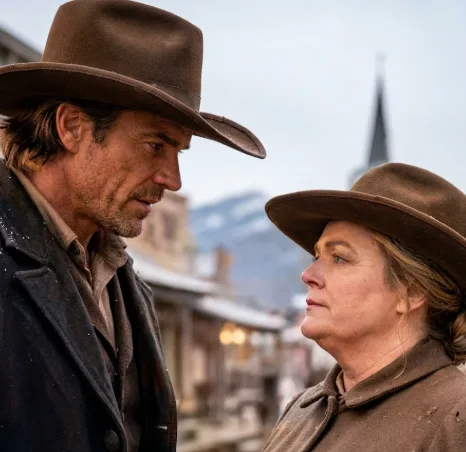
Mr. Boone stared down at me with cold, unyielding suspicion before offering to take the heavy wooden crate
For several minutes, neither of us moved. The letter trembled between Mr. Boone’s fingers, its edges yellowed with age and stained by something darker than dirt. Outside, the wind swept through the pine trees, rattling the cabin windows as though someone were trying to get inside. I stared at the blood-stained ledger. My wife, Eleanor, had been missing for eleven months. I had searched every settlement between our little farm in Colorado and the frozen mining towns of the northern mountains. I had questioned railway workers, visited hospitals, and offered every dollar I possessed to anyone who could tell me where she had gone. Everywhere, I received the same answer. She had left willingly. She had grown tired of her husband. She had wanted a different life. But Eleanor had never been the sort of woman who disappeared without saying goodbye.
Even when we argued, she left a note beside my coffee cup before going to bed. Now, as I watched Mr. Boone struggle to breathe through his grief, I understood that the lies had been carefully constructed to make us blame ourselves instead of the people who had stolen our wives. “Read it aloud,” I whispered. He looked at me. “I don’t think you understand what you’re asking.” “Then help me understand.” He lowered his gaze to the paper. “My dearest Samuel,” he began, his voice roughening around the name. “If this letter reaches you, it means I have failed to escape them. Please do not believe that I abandoned you. I fought to return home, but they have taken my freedom and threatened the lives of everyone I love.”
Mr. Boone stopped. His shoulders shook once before he forced himself to continue. “They intend to send me north on the railway before the first snowfall. They say the company needs women who can read, keep accounts, and maintain the households of its senior officers. I have heard other women crying behind the locked doors. Some have been here for months. Others have vanished after refusing to cooperate.” He pressed his lips together. “The men responsible include Sheriff Gideon Vale, Judge Nathaniel Cross, and a railway director named Everett Shaw. They have promised the council a fortune in exchange for silence. If you come looking for me, do not trust anyone who wears a badge or carries an official seal.” The final lines were written in a hurried, slanted hand. “I have hidden the original records beneath the old chapel floor. Samuel, if you ever find them, remember that a truth buried beneath the ground is not a truth destroyed. It is only waiting for someone brave enough to uncover it.” The letter ended there. I sat back on my heels, feeling as though the floor had opened beneath me. “Eleanor knew,” I murmured. “She knew what they were doing.” Mr. Boone folded the paper with extraordinary care. “She knew enough to become dangerous.” He walked to the window and looked toward the distant town.
“My wife, Margaret, was a schoolteacher. She came here three years ago to help establish a school for the children of railway workers. Within a month, she was gone. The sheriff told me she’d taken money from the school fund and fled with a married man.” His voice hardened. “I believed him for exactly six days. Then I found a piece of her handwriting inside a shipment crate. It contained a single sentence: Samuel, don’t let them sell the mountain.” I looked at the ledger. “Why didn’t you go to the authorities?” “Because the authorities were the men named in the letter.” He turned away from the window. “I spent three years collecting rumors, scraps of correspondence, and names. Every time I got close to the truth, someone threatened me. My barn burned. My horses were poisoned. A man I trusted was found dead beside the river.” He stared at the chest. “I thought I needed more evidence. I never imagined the evidence would arrive on my doorstep in the hands of a woman who had traveled forty miles through a blizzard.” I tightened my grip on the edge of the trunk.
“Then we find Eleanor and Margaret.” Boone studied me with the grave expression of a man who had watched hope destroy people as often as despair. “If they’re still alive.” “They are.” “You cannot know that.” “No,” I said, forcing myself to meet his eyes. “But neither can you know they’re dead.” For the first time that evening, he had no answer. We worked through the night. The ledger contained forty-seven names, twelve coded payments, and a series of dates corresponding to departures of railway trains. Beside several entries were small marks resembling crosses. At first, I assumed they indicated completed transactions. Then I noticed that the crosses appeared only beside the names of women who had disappeared permanently. My stomach turned. “What does this mean?” I asked. Boone leaned over my shoulder.
“Those are the women the company transferred beyond the territory.” “Transferred where?” He traced a finger down the page until he reached a handwritten note in the margin. “North Fork Receiving Station. Private railway property.” I searched the other papers until I found a map folded into the bottom of the chest. A red line ran from our mountain town toward a remote stretch of country beyond the northern pass. Beside it, someone had written three words. No public records. “The railway is hiding them,” I said. “Or hiding what happened to them.” Boone opened another envelope and found a list of scheduled shipments. The next private train was due to leave the station in two days. At the bottom of the page was a name that made my blood run cold. Eleanor Palmer. Beside it stood a date from eleven months earlier and a second notation: Witness retained. I clutched the paper so tightly that it crumpled in my hands.
“She’s alive.” Boone’s expression changed as he examined the entry. “If this record is genuine, she was still alive when the shipment was registered.” “Then we leave at dawn.” “No.” I stared at him. “No?” “We don’t ride into a guarded railway station carrying a ledger that could hang half the town. We need to know how many men are there, who commands them, and whether the women are being moved before we can reach them.” “My wife has been imprisoned for eleven months!” “And if you charge in tomorrow, you may give them a reason to make sure she never comes home.” His words struck harder than I expected because I knew he was right. I had spent eleven months imagining the moment I would find Eleanor. In those dreams, I always arrived in time. I always opened the door, took her into my arms, and brought her home. I had never imagined standing outside a locked building, knowing that one reckless decision could cost her life.
“What do we do?” I asked.
Boone pulled a chair toward the fire. “First, we find out who in this town still has a conscience.” By sunrise, we had our first lead. An elderly seamstress named Ruth Bell lived above a closed bakery on the edge of town. Boone had once helped repair her roof after a storm, and she had quietly passed him information about the railway whenever she could. We left the cabin separately, traveling through the forest before entering town from opposite directions. Ruth opened the door only a crack. When she saw me, her eyes widened. “You’re Clara Palmer.” I nodded. She glanced down the street. “Get inside. Quickly.” Her apartment smelled of lavender, old wood, and freshly brewed tea. Curtains covered every window, and a loaded shotgun rested beside the stove. “I made Eleanor’s coat,” she said without preamble.
“The blue wool one she wore when she disappeared.” My throat tightened. “Where is she?” Ruth pressed her hands together. “Three weeks after she arrived, I saw her being escorted into the railway office. She was pale and frightened, but she wasn’t injured. She recognized me through the window and mouthed something.” “What?” Ruth’s eyes filled with tears. “Chapel.” Boone and I exchanged a glance. “The old chapel,” I whispered. Ruth nodded. “It was abandoned after the mining accident. The railway bought the surrounding land, but the chapel itself was never properly transferred. Margaret Boone used to visit it when she was teaching the workers’ children.”
“Do you know what Eleanor hid there?” “No. But I know what happened to the last man who went looking.” She crossed the room and lifted a loose floorboard beneath the window. From the hollow beneath it, she retrieved a small envelope. “I was supposed to give this to your wife if she ever escaped.” Inside was a photograph of Eleanor standing beside Margaret. They were outside a stone building I recognized immediately as the old chapel. On the back, Eleanor had written a date and a short message. When the church bell rings, look beneath the third stone. I stared at the photograph until the letters blurred. “Why didn’t you tell anyone?” Ruth’s expression became fierce. “Because the sheriff hanged my brother for stealing a sack of flour when he was twelve. He was innocent. I’ve spent the rest of my life learning what happens to people who speak when powerful men want silence.” She looked directly at me. “But I’m old now, Clara. And I am tired of being afraid.” For the first time, I understood that courage did not always arrive with a rifle or a grand speech. Sometimes it was an old woman opening her door when every instinct told her to keep it locked. We left before the sheriff’s patrol passed the bakery. The chapel stood half a mile beyond the last row of houses, its stone walls darkened by years of snow and neglect.
The roof had partially collapsed, and weeds grew between the cracked steps. Boone carried a lantern while I searched the floor. We found the third stone beneath the remains of the altar. Together, we lifted it. Beneath it lay a tin box wrapped in oilcloth. Inside were copies of land deeds, railway contracts, and letters signed by Everett Shaw. Several documents showed that the railway company had secretly acquired land through threats and fraudulent purchases. Others described payments to local officials for supplying women to private railway compounds. But the most important discovery was a small notebook written in Margaret’s handwriting. It contained the names of twenty-three women. Beside each name was a location. And beneath the final entry was a sentence that made my hands go cold.
The women are being moved tomorrow night. Anyone who tries to rescue them will be blamed for the fire. A floorboard groaned behind us. Boone turned sharply, drawing his revolver. A man stood in the chapel doorway, his face hidden beneath the brim of a black hat. “Put the gun down, Samuel.” Boone went rigid. I recognized the voice from the stories Ruth had told us. Sheriff Gideon Vale. Two armed deputies stepped out from behind him. “You’ve been a difficult man to keep quiet,” Vale said. “And you’ve brought company.” Boone positioned himself between the sheriff and me. “Let her go.” Vale laughed. “You’re still pretending this is about your wife? It stopped being about Margaret the moment she discovered the accounts.” He stepped inside. “Hand over the notebook, and I might allow you both to leave town.”
I slipped the notebook beneath my coat. “You’ve already taken our families,” I said. “What more do you want?” Vale’s expression turned ugly. “Order.” “No,” I replied. “You want obedience.” His smile vanished. He nodded to the deputies. They seized Boone first, striking him across the face with a rifle butt. He fell against the altar, but when one of them reached for me, he surged forward and knocked the man to the ground. “Run, Clara!” I hesitated. “Go!” I bolted through a broken side entrance as a gunshot shattered the chapel window. I ran through the snow, clutching Margaret’s notebook beneath my coat. Behind me, voices echoed through the trees. I did not stop until I reached Ruth’s bakery. She opened the door, took one look at my face, and pulled me inside. “Where’s Samuel?” “Arrested.”
Her mouth tightened. “Then we have no time.” She led me into the cellar, where a narrow passage connected the bakery to an old drainage tunnel beneath the street. I had no idea such a passage existed. “Where does it lead?” “To the telegraph office.” I stared at her. “Why would a bakery have a tunnel to the telegraph office?” “Because this building belonged to the first telegraph operator in town. He built it during the winter of 1868, when the river flooded and cut off the main road.” She handed me a small canvas satchel. “Take the notebook. Send a message to the state marshal. Tell him to bring federal railway inspectors and a physician. Tell him women are being held at North Fork under false contracts.”
“What about Samuel?” Ruth lifted the shotgun. “I’ll get him out.” I caught her arm. “You can’t fight the sheriff alone.” “I’m not alone anymore, am I?” She looked at me with a sadness that had hardened into determination. “Go, Clara. Your wife is waiting.” I reached the telegraph office just before dusk. The operator, a thin young man named Peter, nearly fainted when I laid Margaret’s notebook on his desk. “I can’t send that,” he whispered. “Vale checks every outgoing message.” “Then send one he won’t understand.” I opened the ledger and found the railway’s coded payment schedule. The names and numbers had once concealed the company’s crimes. Now they provided the key to exposing them. I dictated a message to the state marshal using the railway’s own code, followed by a plain statement identifying the North Fork station and requesting immediate intervention. Peter’s hands shook as he tapped the key. When he finished, he looked at me. “If they find out I helped you, they’ll destroy my life.” I placed both hands on the desk. “Perhaps. But if you say nothing, they’ll keep destroying other people’s lives.” He swallowed and nodded. Then the telegraph clicked again. A reply arrived.
MARSHAL DEPARTING. HOLD POSITION. DO NOT ENGAGE. For the first time in eleven months, I felt hope strong enough to overcome my fear. But the message could not bring Eleanor home by itself. I still had to reach North Fork. That night, I stole a horse from the livery stable and rode toward the railway compound. Snow fell heavily over the pass, hiding the tracks and muffling the sound of my approach. I reached the station shortly before midnight and dismounted behind a line of freight cars. Beyond the platform stood a long brick building surrounded by a wooden fence. Armed guards patrolled its perimeter. A steam locomotive waited on the tracks, its lamps shining through the snow. I heard a woman crying. Then another. I moved toward a narrow window at the back of the building. Through the glass, I saw rows of wooden beds and a dozen women sitting silently beneath dim lamps. Some were young. Others looked old enough to be my mother. Several wore the blue coats issued to railway employees. And then I saw her. Eleanor sat near the far wall, her hair shorter than I remembered and her face thinner, but unmistakably hers. For a moment, I could not breathe.
I pressed my hand against the cold glass. “Eleanor.” She lifted her head. Her eyes moved across the room, searching. Then she saw me. She sprang to her feet so quickly that the chair behind her fell over. “Clara?” I nodded, tears streaming down my face. She ran toward the window, but a guard caught her arm and dragged her back. I nearly shouted. Instead, I forced myself to step away. If I rushed the building now, we would both be killed. I had come to rescue her, but I could not let my desperation become the weapon that destroyed her. I circled the compound until I found a small service gate. A rusted chain secured it, and beyond it stood a shed containing coal and maintenance tools. Inside the shed, I discovered a railway timetable and a stack of transfer orders. The women were scheduled to leave at one o’clock.
Less than an hour remained. Then I heard footsteps. “You’re a long way from home, Miss Palmer.” Everett Shaw stood in the doorway, dressed in an immaculate gray suit. He was a slender man with silver hair and a smile that seemed permanently attached to his face. Behind him stood two guards. “I wondered how long it would take you to find her.” I stepped backward. “Where are you sending them?” “To places where their talents will be appreciated.” “Against their will?” “Women are often happier when someone makes decisions for them.” His smile widened. “You should have stayed home, Clara. Your wife was offered a respectable position. She refused to accept her obligations, and now you’ve made yourself part of the problem.” I stared at him. “You imprisoned innocent women.” “We provided employment.” “You forged contracts.” “We facilitated agreements.” “You stole their lives.” For the first time, the smile faded. “Words are remarkably cheap, Miss Palmer. That is why men like me employ lawyers, while people like you make accusations.” He extended his hand. “Give me the notebook.” I held it against my chest. “No.” He sighed. “Then you leave me no choice.” The guards advanced. A whistle sounded from the railway platform. Then another. A third whistle followed, long and piercing, echoing through the mountain valley. Shaw turned toward the sound. Lights appeared beyond the fence. A line of riders emerged from the snow, carrying lanterns and displaying official badges. At their head rode the state marshal. “Everett Shaw!” he shouted. “Stand where you are!” For one glorious second, I thought it was over. Then a gunshot rang out from the building. The guards scattered. Shaw seized me by the collar and dragged me toward the locomotive. “You’re coming with me!” I fought him, but he was stronger than I expected. He pulled a pistol from beneath his coat and pressed it against my ribs. “Tell them to stand down!” I looked toward the approaching riders. The marshal had dismounted. Several men were moving toward the main building, while others rushed to secure the train. I knew what would happen if Shaw reached the locomotive. He would escape. And Eleanor would be left behind. So I did the only thing I could think of. I drove my heel into his foot and threw my weight backward. He stumbled, releasing me for half a second. I seized his wrist and twisted with every ounce of strength I possessed. The pistol fell into the snow. Shaw struck me across the face, and I crashed against the side of the locomotive. Pain exploded through my cheek. He reached for the gun. Before he could grasp it, another figure emerged from the darkness. Samuel Boone. His face was bruised, his coat torn, and one arm hung stiffly at his side. But he was standing. He kicked the pistol beneath the train and leveled his revolver at Shaw. “Don’t move.” Shaw froze. “Boone. This is a misunderstanding.” “No,” Samuel said. “It’s the end of one.” The marshal’s men seized Shaw and the remaining guards. Inside the building, they broke the locks on the doors and escorted the women into the snow. I ran toward Eleanor. She was standing on the platform, wrapped in a blanket, trembling so violently that she could barely keep her balance. For one terrible moment, we simply stared at each other. Then she whispered my name. I crossed the distance between us and pulled her into my arms. She clung to me, burying her face against my shoulder as the sobs finally came. “I thought you wouldn’t find me,” she cried. “I looked everywhere.” “I knew you would.” I held her tighter. “I should have found you sooner.” She pulled back and touched my face. “No, Clara. You came when you could. You never stopped looking.” I kissed her forehead. Behind us, Samuel stood beside Margaret, who had emerged from the building holding his coat in both hands. For three years, he had imagined their reunion. Now that it had finally arrived, he seemed unable to move. Margaret took one step toward him. “Samuel?” He lowered his revolver. Then he walked to her and held her as if the world might steal her away again. The railway compound was dismantled over the following weeks. Everett Shaw was arrested alongside Sheriff Vale and several senior railway officials. The ledger, Margaret’s notebook, and the recovered contracts exposed a network of bribery, forced labor, and illegal land transfers stretching across three territories. The state authorities established a commission to identify the missing women and reunite them with their families. Some had been held for years. Others had lost everything they once knew. Not every story ended happily. Several women had died before the rescue, and others had no homes left to return to. Their names were recorded, their families notified, and their cases investigated rather than erased from public memory. The guilty men were tried, and many were imprisoned. But justice was slower than I had hoped. It required testimony, patience, and the difficult work of rebuilding lives that could never be returned exactly as they had been. Eleanor came home with me in the spring. For months, she woke screaming in the middle of the night. Sometimes she could not bear to hear a train whistle. Sometimes she sat by the window for hours, afraid that a stranger might come to take her away again. I learned that rescuing someone did not mean their suffering disappeared. Love could offer safety, but it could not demand that healing happen on a schedule. So I stayed. I listened when she wanted to speak, and I sat beside her when words were too difficult. We rebuilt our little house one room at a time, planting flowers beneath the windows and replacing the broken fence around the garden. Samuel and Margaret settled on their restored land near the mountains. Ruth helped establish a refuge for women escaping forced labor and domestic abuse, while Peter became a witness in the railway trials. Years later, when the old chapel was finally repaired, the town gathered for its reopening. The church bell rang for the first time in decades. Its sound traveled across the valley, rising above the pines and echoing through the mountain passes. I stood beside Eleanor, holding her hand as the last note faded. “What are you thinking about?” she asked. I looked toward Samuel and Margaret, who stood together near the chapel door. Ruth was laughing with a group of children, and Peter was helping an elderly woman climb the steps. “I’m thinking about how many people knew something was wrong,” I said, “but believed they were too powerless to change it.” Eleanor squeezed my hand. “And how many people finally chose to speak.” I nodded. The wooden chest that had brought me to the mountains was displayed inside the chapel. Its iron lock had been removed, and the lid stood open, revealing the letters and records that had helped expose the truth. Beside it was a simple plaque bearing the names of the missing women. At the bottom were words Eleanor had chosen herself. No person is property. No silence is consent. No life is beyond the reach of justice. As I read them, I thought of the forty miles I had traveled through the snow, carrying a chest so heavy that my arms had nearly given way. I had believed the weight came from the papers inside. Now I understood that I had also been carrying fear, grief, and the terrible belief that I was responsible for saving everyone alone. I had not saved Eleanor by strength alone. Samuel had refused to surrender his search. Ruth had risked her life to speak. Peter had sent the message that brought the marshal. The women inside North Fork had endured, remembered, and helped investigators identify the men who had harmed them. No single person had accomplished what all of them achieved together. And that became the lesson I carried for the rest of my life. Evil often survives not because it is invincible, but because it convinces ordinary people that resisting it is useless, dangerous, or someone else’s responsibility. The powerful may control buildings, money, weapons, and official records. But they cannot hold the truth forever when people refuse to let one another stand alone. As the congregation entered the chapel, Eleanor leaned her head against my shoulder. “Do you ever wish you had never opened that chest?” she asked. I considered the question carefully. I remembered the fear, the violence, the long nights, and the people we had lost along the way. Then I looked at the names on the plaque. “No,” I said. “I only wish we had known sooner that we didn’t have to be afraid alone.” The bell rang again. And this time, nobody in the valley mistook its sound for a warning. It was a promise that those who had once been silenced would never again be forgotten.