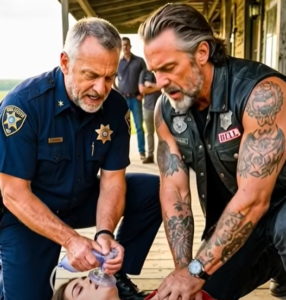
Lying unconscious on the sun-baked wooden boardwalk while the town’s corrupt sheriff and a notorious outlaw desperately tried to revive
As the flashing red and blue lights painted the dusty street, I reached into my pocket and felt the outline of the second drive I had taped inside the lining the night before. The first one was already with the agent who had met me at the county line. This one was the copy I had made in case the car did not survive the turn. My ribs protested when I sat straighter. The oxygen mask lay on the boards beside Sheriff Miller’s knee. He was still kneeling, hands now cuffed behind him, the badge he had used as a prop catching the sun.
The lead investigator—Harlan, according to the name tape—crouched so we were level. “Chloe Vance,” he said. “We have the mirror from the highway drop. We need the sequence: where you copied the ledgers, who saw you leave the house, whether Miller or the man on the ground knew the second location. His lawyer will claim the drive was altered after the crash. The faster we lock it, the smaller that claim becomes.”
I told him. The ledgers had been in my father’s old evidence box, the one the sheriff’s office had returned to the house with half the tabs missing. I had copied them onto the first drive at the kitchen table, then made the second while the kettle boiled. The car that hit me had been waiting at the edge of town, lights off, the same plate I had photographed two days earlier outside the syndicate’s garage. I had not seen the driver’s face. I had seen the sheriff’s personal truck parked a block away with the engine running.
Harlan nodded to an agent who was already photographing the boardwalk, the mask, the scuff marks where the biker’s boots had planted. “We’ll take the second drive into evidence here. You’ll give the formal statement at the clinic after they check the ribs. If Miller or his partner ask you anything else before we move you, the answer is that you’re invoking. Do you understand?”
“I understand.”
They helped me to a gurney. The crowd had thinned to the people who could not look away and the people who were already calculating what they would say later. Miller did not speak again. The biker was still swearing into the boards. At the clinic a doctor confirmed two cracked ribs, a concussion watch, and no internal bleeding. Harlan waited outside the curtain while I repeated the sequence on a recorder. When I finished he bagged the second drive and told me the first had already matched the file hashes. The confession my father had drafted—never signed, but dated and detailed—was in both copies. It named Miller’s cut of the smuggling route and the night the syndicate had decided a chief investigator was more useful as a crash statistic than as a witness.
I slept in the clinic because they wanted observation and because the house was still being searched. In the morning the lawyer Harlan’s office had contacted met me with coffee and a list. The murder count on my father’s crash would be reopened. The attempted murder on the boardwalk would be charged separately. Miller’s financials were already flagged. The biker’s vest had contained a phone with a text from Miller that said “she has the box.” The text was timestamped twenty minutes before the car hit me.
“You can go home tomorrow if the scan is clear,” the lawyer said. “You should not stay there alone until the initial appearances are done. We have a hotel the service uses. Or you can stay with the agent who took the first drive. Your choice.”
I chose the hotel. The house could wait. The scans were clear enough. At the hotel I slept and woke and slept again. Harlan called once to say Miller had stopped talking and the biker had started. The biker named the driver of the car and the garage where the plate had been switched. The driver was picked up at a truck stop forty miles south, still wearing the same boots. None of it returned the three months. All of it made the staged crash harder to call an accident.
Miller’s first appearance was the next afternoon. I watched from the back because the lawyer said the record sometimes noted who was present. He looked smaller without the porch and the crowd. His counsel argued that the rescue had been genuine and the drive had been planted by a grieving daughter. The judge set bail at a number Miller could not meet and scheduled the preliminary hearing. The biker’s hearing followed. He did not look at the gallery. His hands were cuffed in front. The network that had pressed on my sternum was already arguing with itself about who would talk next.
I went back to the house on the third day. The evidence seals were on the door and the box was gone. A deputy waited to walk me through and confirm nothing else had been taken. The kitchen table still held the kettle. I sat long enough to drink water and then locked the door behind me. The hotel was quieter. Harlan’s updates arrived by text: the driver had confirmed the order came from Miller; the offshore numbers matched two seizures from the previous year; the confession’s details aligned with the crash report’s unexplained gaps. I answered only when a question was attached. The rest I let sit.
The preliminary hearings bound both men over. The driver’s statement was enough to add the syndicate’s garage to the warrant list. Agents found three more phones and a ledger that used the same account numbers as the drive. One of the phones contained a photo of my father’s car the night before the original crash, taken from the same block where Miller’s truck had idled. I identified the background because I had stood there myself the week after the funeral, looking for anything the report had missed. The photo was timestamped. The report was not.
Trial dates were set for winter. I testified once in a pretrial hearing about the copy process and the plate. Cross-examination suggested I had motive to lie. The hash values and the driver’s plea made the suggestion costly. Miller did not testify. The biker took a deal that named the remaining route and left Miller as the local hand. Sentencing for both was continued until after the new year. I did not attend the later proceedings. The lawyer sent summaries. I read them at the kitchen table with the kettle on and the door locked.
In the spring I went back to the boardwalk because the boards had been replaced and I wanted to see the new grain. The porch was empty. The sunlight was ordinary. I did not stay long. The lesson that remained was not that a public rescue could be trusted. Miller and the biker had needed me breathing so they could ask about the drive before the sirens arrived. The lesson was that a second copy, made while the kettle boiled and carried where they did not think to check, could outlast the performance. I had made the copy. The agents had done the rest. What remained was the house, the locked door, and the decision to treat every new question about the files as something that went to Harlan before it went to the porch. I walked back to the car, checked the mirrors once, and drove home with the windows up. The evidence had held. The quieter work could hold with it. That was the ending the drives had earned.
The quieter work held for a month. I returned to the house, kept the door locked, and answered Harlan’s texts when they carried questions. The kettle stayed on the stove. The second drive’s evidence bag number was written on a card in the drawer so I would not have to remember it. Neighbors brought food twice and then stopped when I thanked them and did not invite them in. The street looked the same. The mirrors did not.
Harlan’s next call was not a question. “Miller’s brother has been sitting outside the district attorney’s office,” he said. “He hasn’t approached anyone. He has a phone and a camera. If he moves to your street, you will get a text before he arrives. Do not engage. The preliminary conditions already prohibit contact. A conversation makes the prohibition harder to enforce.”
“Understood.”
The text arrived on a Tuesday evening. I stayed in the kitchen with the lights low and watched the camera feed from the doorbell I had installed the week I came home. The brother’s car slowed, stopped two houses down, and idled. He did not get out. After eleven minutes he drove on. I sent the clip. Harlan replied that a deputy would make a welfare check on the brother’s address and that the stop would be logged. The logging was the point. Presence without approach was still a record.
The following week the driver who had taken the plea asked, through his lawyer, to speak with me. Harlan relayed the request and the advice: decline. Any statement the driver wanted could be taken by the agents. A personal conversation would be filmed by someone and offered later as context. I declined. The driver’s lawyer filed a motion claiming the refusal showed bias. The motion was denied in a single paragraph. I read the paragraph at the kitchen table and then filed it with the others.
Spring advanced. The boardwalk repairs were finished and the town held a small reopening that I did not attend. A reporter called the house phone and left a message asking for comment on the “rescue.” I did not return the call. The lawyer sent a short note confirming that silence remained the better record. I kept the note. At night I checked the doorbell feed before I slept. Most nights it showed only the street and the occasional cat. Once it showed the brother’s car again, farther down, lights off. The deputy who rolled past ten minutes later found the car empty and the brother walking back from the corner store with a bag. The bag contained milk and nothing else. The stop was still logged.
Miller’s sentencing was set for June. The lawyer said I could submit a written statement and did not need to appear. I wrote four sentences: the crash, the boardwalk, the drive, the fact that the pulse they had checked was the one they had endangered. I did not send it. The lawyer sent a revised version that removed the adjective and kept the sequence. The revised version was enough. Miller received the years the guidelines allowed. The biker’s sentence followed a week later and named the remaining route in the allocution. The brother’s car did not appear on the feed again. Harlan texted that the brother had been advised, in person, that further presence near the house or the office would be treated as a violation. The advice was witnessed. The witnessing was the point.
I went back to work in July, part-time, at the county clerk’s office where the most dangerous item was a misfiled deed. The supervisor knew the name and did not ask for the story. I reconciled old entries, ate lunch at my desk, and drove home by the same two routes in alternating order. The kettle still worked. The doorbell camera still recorded. On the anniversary of the boardwalk I walked the new boards once, early, before the shops opened. The grain was even. The sunlight was ordinary. I did not stay. The lesson that had settled into routine was the one that required the least performance: a calculated rescue needs the victim breathing and the crowd watching, and both can be answered by a second copy made in a kitchen and a record that continues after the sirens stop. I had made the copy. The agents had kept the record. What remained was the locked door, the logged stops, and the decision to treat every new idle engine as data instead of dialogue. I checked the feed, set the alarm, and let the street stay a street. That was the installment the files had left room for, and it was the one I could repeat.