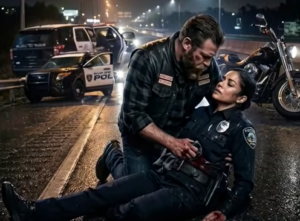
Lying completely broken and bleeding on the slick asphalt of a midnight highway under a jagged flash of lightning while a burly biker cradled my battered police uniform in his arm
The detective, Hale, kept his eyes on the chart instead of the door. “A second ledger,” he said. “Not the shipping logs you copied. Your father’s. It was logged out of the precinct safe the week he died and logged back in last night under the captain’s code. The pages do not match the file we buried at the funeral. Someone has been keeping the original, and someone else just tried to put a cleaner copy in its place.”
The monitor spiked again. A nurse came in, frowned at the numbers, and turned the alarm down without telling me I was fine. I was not fine. My brother had been the club’s dead. My father had been the department’s accident. I had spent three years undercover believing those were two stories. Hale had just made them one.
The biker’s hand stayed on mine. Up close he was less legend than fatigue: beard wet at the ends, a split knuckle, the vest folded as if it still belonged to a man who could not wear it. “Name’s Cal,” he said. “Your brother called me that. The highway was not a rescue I planned. I was following the van that followed you. The captain’s detail shot when you braked. I packed the wound because I have packed worse, and because I promised Eli I would not leave you on the road the way they left him in a ditch.”
“Eli did not die in a ditch,” I said. The official line had been a bar fight the club started.
“Eli died with a ledger page in his boot,” Cal said. “Your father’s page. He was bringing it to you. The captain’s people got there first and called it colors. I have been carrying the grudge. You have been carrying the badge. Last night the grudge was faster.”
Hale set a photocopy on the blanket, careful of the IV. My father’s hand. Dates of seized weapons. Serial numbers that reappeared on a street buy two weeks later. A margin note: If I am the accident, give this to Reyes, not to the captain. The cleaner copy Hale described had no margin. The original had been afraid of its own building.
“The lockbox,” I said. “I told him on the road. Federal. The indictment draft, the routes, the captain’s voice on a warehouse mic. If he sent a van, he sent someone for the box.”
“The box is intact,” Hale said. “Solano’s people took it at 1 a.m. The captain is suspended, not caged. Suspension is a hallway. He is still walking it. The data drop buys a warrant. It does not buy a night without a second team.”
Cal looked at the doorway. “Then she does not stay in a room with a window on the lot.”
They moved me before dawn, service elevator, rain still arguing with the roof. Solano met us in the garage, smaller than her file, sling on one arm from a different war she did not explain. She looked at Cal as a variable and at me as a witness who had bled on camera.
“Your father filed a complaint the month before the accident,” she said. “It was marked unfounded by the captain’s predecessor, who now consults for the same broker moving the seized rifles. The syndicate is not a club. The club was the coat. You were sent undercover to watch the coat so you would not watch the closet.”
“I watched the logs,” I said.
“You watched late. Eli watched earlier. We are done being late.”
The safehouse was a ranger cabin off the county map, wood smoke, one road in. Cal refused the couch and took the porch. I slept in pieces and woke to Hale with coffee and a face that had chosen a worse fact.
“The cleaner copy was not the captain’s only plant,” he said. “There is a line in it that names you as the officer who signed the reissue. Forged. If it reaches a friendly judge before the original does, the indictment becomes your van.”
“Then the original walks in first,” I said.
We did not get the quiet version. The broker’s cars took the fire road at noon, two of them, men who still had department radios because suspension does not collect every handset. Cal’s bike was a barricade they had not priced. He put one car in the ditch and took a round through the shoulder for the trouble. I fired from the cabin window with Hale’s spare until Solano’s team, late by four minutes and angry about it, closed the road. The broker was not in the cars. A lieutenant was. He talked before the towel staunched Cal’s arm.
The captain was at the county strip, coat on, pilot nervous. We arrived with the original ledger in Hale’s case and my father’s margin visible through the plastic. He saw me on my feet and saw the story fail. His hand moved. Solano shot the pavement in front of his shoe and the hand stopped. They cuffed him beside the wheel. He did not ask about Eli. That silence was a kind of plea, and it did not travel.
The hearings took the winter. I said the serial numbers until they belonged to the room. Cal said Eli’s boot and would not name the club’s other debts. Hale said the safe. The forged line with my signature died next to the margin note. The captain took years. The broker took a border and then a cell. Some rifles stayed missing. Missing is not the same as protected.
I did not put the undercover name back on. I kept the badge and the habit of a second copy. Cal did not join the department and did not ask me to join the club. On the anniversary of the highway he stood at the mile marker with the vest still folded.
“Your brother made me promise a person, not a patch,” he said.
“My father made the margin promise a daughter, not a building,” I said. “I can keep both without pretending they are the same family.”
The lesson was not that the outlaw was the truer badge. It was that a calculated execution needs one official accident, and a life continues when the page in the boot and the page in the lockbox arrive in the same room before the cleaner copy does. I had trusted the closet’s owners. I would not again. The road was only weather. The ledger was in more than one hand. That was the ending I could stand on, sore, awake, and no longer waiting for a captain to tell me which blood was random.
The anniversary at the mile marker should have been a closed road. Cal had the vest folded. I had the badge and the second-copy habit. The captain had years. Weather was only weather. I let myself stand there long enough to believe the ledger had finished its work.
Hale’s call came before we reached the cars. “The predecessor,” he said. “The one who marked your father’s complaint unfounded. He is not consulting anymore. He is in the records room with a retired credential and a box. Solano says the box is the missing serials. I say a man does not revisit a funeral file unless the funeral can still be edited.”
We went in through the garage, not the lobby. The predecessor’s name was Dunn. He had the soft face of a man who had been called sir for too long. The box at his feet was stenciled with my father’s case number. Inside, the street-buy logs Eli had died carrying, and a fresh sheet that named Cal as the buyer. The sheet was good. It was also an hour old. The toner smell had not left it.
“You are suspended from this building,” I said.
“I am a citizen with a memory,” Dunn said. “The club moved the rifles. Your captain was a convenient throat. You were a convenient daughter. I am putting the throat where it belongs.”
Cal did not step closer. “Eli’s boot did not name me. You are late to a lie.”
Solano came down the stacks with two agents and no interest in memory. Dunn’s credential was already flagged. The fresh sheet died next to the toner receipt from a shop two blocks away, timestamped, dull, decisive. He had hoped the anniversary would put us on the highway and the box in the cabinet before anyone smelled the page. He had not priced Hale’s habit of checking the room on days the dead were mentioned.
They walked him out past the photograph of Harlow that another unit had hung, and past nothing of Eli’s, which I corrected before dusk. A copy of the boot page went into the supplemental. Not a shrine. A page. Dunn’s consulting firm lost its quiet contract. The missing serials did not all return. The ones in the box did, and a range officer who had signed them out under training lost his key.
Cal waited in the lot. “You keep adding rooms,” he said.
“You told me not to bring totals,” I said. “I brought a toner smell. That is the size of it.”
“Then stop at the size. Your brother did not ask me to build you a war. He asked me not to leave you on the road. You are off the road.”
I looked at the entrance where captains had learned to flinch. “I am off that road. I am not off the cabinet. If a retired credential can still edit a funeral, the funeral is not filed.”
He accepted that the way he accepted weather. No patch. No speech. A nod that was not a truce with the building and not a break with the promise.
In the weeks after, the work was small and mean and necessary. A clerk who had helped Dunn with the cabinet took a plea and spelled three more names. Solano put them in a chart. Ruiz, still in the quieter unit across town, called to say the chart matched a pallet we had opened months ago. I sent him the toner receipt. He sent back a photocopy in his hand so the chain would show two pulses. We did not celebrate. We logged.
On the morning Dunn’s plea was entered I went back to the mile marker alone. The vest was not there. The blood was not there. A department cone marked a crack in the asphalt, ordinary, almost rude. I set nothing on the ground. I said my father’s margin and Eli’s name once, not as a vow to hunt forever, but as a refusal to let either become an accident again.
The remaining part was not another ambush. It was the cabinet, the toner, the second hand. A calculated execution fails when the cleaner page arrives after the original, and when the daughter stops trusting the man who offers to file the funeral. I drove back to the desk, made the copy, and left the cone where it was. The road could keep its crack. The file would keep its names. That was the end I could live inside.