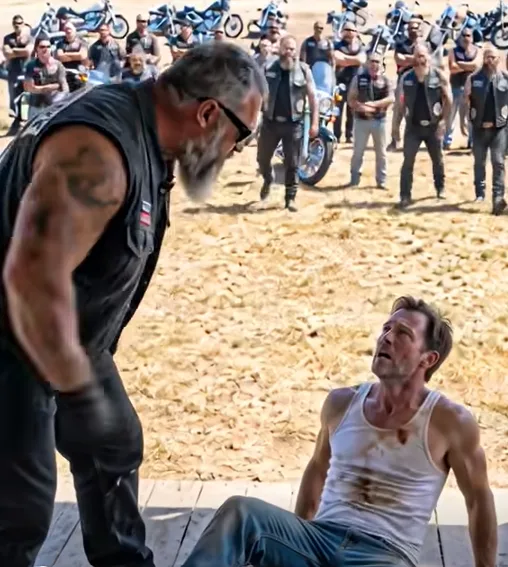
Knocked onto the wooden porch of our desert clubhouse while my ruthless motorcycle club president backhanded my face and screamed that I was a rat
I read the line four times, and each time the desert wind snatched at the parchment as though it wanted to carry the words away before they could finish destroying me.
Your mother ordered him to.
My mother had died when I was six, in a hospital bed in Tucson, with a rosary wound through her fingers and my father’s head bowed against her hand.
I knew that, because I had been there, standing on a plastic chair so I could see over the rail.
“Mr. Cole?” said the federal supervisor, a broad woman in a tan windbreaker with a gray braid down her back. “You’ve gone white. Sit down before you fall off this porch.”
“My name is Ethan Mercer,” I said, and my voice came out thin and strange. “Cole is the name Vance gave me when I patched in.”
“Mercer,” she repeated gently. “I’m Special Agent Dolores Quinn. I’ve been reading your reports for six weeks, Ethan. I know exactly who you are.”
I handed her the note with fingers that would not stay still.
She read it, and her eyebrows rose, and then she did something I did not expect.
She smiled, sadly, the way a person smiles at a child who has just found a locked door.
“Come with me,” she said. “I think the next hour is going to matter more than the last ten years.”
They sat me in the back of an armored truck with a bottle of water and a medic who cleaned the blood off my chin with cool, quick hands.
Through the open door I watched them march the seventy brothers out into the sun, hands zip-tied, boots dragging, men I had eaten with and ridden beside and buried friends with.
Some of them looked at me, and their faces were ugly with hatred.
Others looked at the ground.
A few, a very few, met my eyes and gave a small, tight nod, the nod of men who had always suspected the club was rotten and had been too afraid to say so.
Vance rode past in the back of a black SUV, his gray beard matted with dust, his eyes fixed straight ahead.
He did not look at me once.
“Your father’s safe deposit box held three items,” Quinn said, sliding onto the bench beside me. “The note you’ve read, a cassette tape, and a photograph. We pulled the box yesterday on a warrant. I wanted you to have the note first, in your own time, before the rest.”
“Why would he write that?” I whispered. “My mother died of cancer.”
“Your mother,” Quinn said carefully, “was named Annalise Mercer. Is that right?”
“Yes.”
“Ethan, Annalise Mercer is alive.”
The desert tilted.
I felt the medic’s hand steady my shoulder, heard someone calling for more water, and I stared at Quinn’s tired, kind, certain face and could not make the words arrange themselves into anything that was true.
“I buried her,” I said. “I watched them lower the casket.”
“You watched them lower a casket,” Quinn said. “Your father arranged it. Let me play you the tape.”
She pulled a battered cassette recorder from her bag and set it on the bench between us.
The tape hissed, and then a voice came out of the little speaker, and I had not heard it in ten years, and I knew it so completely that every hair on my arms stood on end.
“Ethan,” my father said. “If you’re hearing this, then Vance has finally done what I always feared he would, and I’m sorry. I’m sorry for all of it.”
I put both hands over my mouth.
“I’m recording this in the back room, with the door locked and a gun on the table,” he went on, calm and tired. “Vance is coming at midnight. He thinks I’m going to hand the club’s books to the federal prosecutor, and he’s right. But he thinks I’m doing it to save my own skin, and that isn’t why.”
The tape crackled.
“Six years ago your mother found out what this club really was. She found the ledgers, the shipments, the names of the girls we moved across the border. She was a nurse, Ethan, a good one, and she couldn’t live with it. She said she’d go to the police.”
My heart stopped.
“I begged her not to,” my father said. “I was a coward. I told her it would destroy us, destroy you, and she said that some things deserved to be destroyed. And then Vance found out.”
His voice cracked.
“He came to the house one night and told me I had one choice. Silence her, or he’d do it himself, and he’d do it slowly. I thought of a way to save her. A terrible, stupid way. I called an old friend in the Bureau and we staged her death.”
“No,” I breathed.
“She went into witness protection. She had to leave you, my son. She had to leave you in my hands, because Vance was watching you, and if she’d taken you with her he’d have known.” My father’s breath hitched. “She cried for three days. She begged me to let her take you. I said no. I said you’d be safer here.”
I could not feel my hands.
“So when Vance says your mother ordered him to kill me,” my father said, “he is lying, or he’s telling you what he believes. Because the last thing your mother did before she disappeared was make Vance promise never to hurt me. He swore. And the day he breaks that promise is the day he tells you she asked for it.”
The tape went quiet.
“I love you, Ethan,” my father said softly. “You were the best thing I ever did. Find your mother. She’s in a little town called Silver Creek, Montana, and she’s been waiting for you for ten years.”
The tape clicked and stopped.
For a long time, nobody in the truck spoke.
“Vance lied,” I said at last, and my voice shook. “On the porch, he said she ordered it. That was just another way to hurt me.”
“We think so,” Quinn said. “He has had ten years to build the story that would hold you to him. A dead mother, a dead father, a debt of gratitude. A man alone with nothing but his captor’s kindness.”
“He raised me.”
“He kept you,” she said. “There’s a difference.”
I laughed, a wild broken sound, and then the laugh turned into something else, and I folded forward with my elbows on my knees and wept into my hands while the desert wind rattled the canvas flap.
Quinn did not touch me.
She only sat beside me, solid and quiet, until the worst of it had passed.
“There’s a photograph,” she said at last. “Do you want to see it?”
I nodded.
She handed it to me, a small square Polaroid, creased and faded, a young woman with dark curly hair standing in front of a yellow farmhouse with her hand shading her eyes against the sun.
She was smiling, but it was a crooked, wounded smile, the smile of someone saying goodbye.
On the back, in my father’s blocky handwriting, were five words.
Silver Creek. Waiting. Go home.
We left at dawn.
Quinn drove, because she said I was in no shape to, and we headed north through the long gold plains of Arizona and into the red cliffs of Utah, past empty gas stations and shuttered diners and signs that promised nothing for forty miles.
I did not sleep.
I watched the road slide under us, and I tried to imagine what I would say.
Hello, Mom, I thought. Sorry I’m late.
By the second night, we had crossed into Idaho, and Quinn pulled into a motel parking lot and cut the engine.
“You should eat something,” she said.
“I’m not hungry.”
“That wasn’t a request.”
She bought me a cheeseburger at the diner next door, and I ate half of it before my stomach rebelled, and she pushed a glass of milk across the table without a word, and I drank that too.
“May I ask you something?” I said.
“Go ahead.”
“Why did you believe me? Six weeks ago. A biker with a rap sheet and a patch on his back walks into your office and says he wants to wear a wire against the man who raised him. Why didn’t you laugh?”
Quinn turned her coffee cup in her fingers.
“Because I read your file,” she said. “All of it. And I saw a seventeen-year-old boy who took a plea bargain for a crime he didn’t commit so a friend wouldn’t go to prison. I saw a man who stopped a hit on a rival’s daughter. I saw someone who kept doing small, quiet, decent things inside a place that rewarded the opposite.”
“Anybody would have.”
“No,” she said. “Almost nobody would have.”
I looked at the table.
“Your father put you in that club to keep you alive,” she said. “But he also, I think, put you there because he knew what you’d do with it. He knew the kind of man you’d become.”
Something tightened in my chest.
“I wish I’d known him better,” I said.
“You knew him enough to carry his name into a federal office.” She smiled. “That’s not nothing.”
We reached Silver Creek on the fourth morning.
It was a small town at the foot of the Rockies, a single main street of weathered brick storefronts, a church with a white steeple, a feed store, a post office, and a diner with a hand-painted sign that said ROSIE’S in faded blue.
Snow lay in thin patches along the gutters.
The air smelled of pine smoke and cold river water, and the mountains rose behind the town in enormous blue-white ranks, so clear and close that I felt I could have touched them.
“The address is 14 Larkspur Lane,” Quinn said, turning down a gravel road that ran along a frozen creek. “It’s at the end. You want me to wait in the car?”
“Please.”
“Take as long as you need.”
I climbed out with my knees shaking.
The farmhouse was yellow, exactly as it had been in the photograph, with a wide porch and a green door and a row of window boxes sleeping under a dusting of snow.
Smoke curled from the chimney in a thin gray thread.
A clothesline ran across the side yard, and a woman in a faded blue coat was hanging a white sheet on it, her back to me, her dark hair threaded with silver and tied in a loose braid.
I stopped at the edge of the yard.
I could not move.
Ten years of grief and fury and longing stood in my throat like a stone, and I opened my mouth, and nothing came out.
She turned to reach for a clothespin, and she saw me.
The clothespin fell from her fingers into the snow.
For a long moment she only stood there, one hand pressed against her mouth, and I saw her eyes go wide and wet and enormously dark, the same dark eyes I saw every morning in the mirror.
“Ethan?” she whispered.
“Hi, Mom,” I said.
She made a sound I had never heard a human being make, a cry that came from somewhere beneath language, and then she was running, running through the snow in her old boots with her braid flying behind her, and I dropped to my knees in the yard and she hit me like a wave.
She wrapped her arms around my head and rocked me, and she was saying my name over and over, and I was saying hers, and the cold bright morning dissolved into a blur of warmth and tears and the smell of lavender and woodsmoke and clean laundry.
“I’m sorry,” she was sobbing. “I’m so sorry, I’m so sorry, I wanted to come, they wouldn’t let me, I tried, oh God, I tried.”
“I know.”
“I wrote you every year. Every birthday. I never sent them. I kept them all.” She pulled back to look at my face, and her hands shook against my cheeks. “Look at you. You’re a man. You’re so tall. You’ve got your father’s jaw.”
“I got your eyes.”
“You did.” She laughed, tearfully, and kissed my forehead. “You got my eyes, and you got his heart, and I’m so proud of you I could burst.”
I put my face in her shoulder and cried like a child, and she held me, and the snow melted slowly into the knees of my jeans.
Quinn, at the edge of the yard, turned her back and examined a fencepost with great concentration.
That evening my mother cooked, in a warm kitchen with copper pots hanging on the wall and a kettle singing on the stove, and I sat at the scarred wooden table with my hands wrapped around a mug of tea and watched her move.
She moved the way I remembered, quick and economical, humming under her breath.
“You still hum,” I said.
“Do I?” She glanced over her shoulder. “Your father used to say I hummed in my sleep.”
“He kept a picture of you.”
“Did he?” She smiled, and her eyes filled. “He said he’d burned them all.”
“He lied.”
“He was always a terrible liar,” my mother said softly. “It’s why I loved him.”
She set a bowl of stew in front of me, and a hunk of bread, and sat down across the table with her chin in her hand and just looked at me, the way you look at a thing you thought was gone forever and keep half expecting to vanish.
“Tell me everything,” she said. “From the beginning. I want every year.”
So I told her.
I told her about the clubhouse, and the first time I rode a Harley, and the winter I broke my wrist and Vance carried me to the hospital in his arms. I told her about the friends I had made and the friends I had buried. I told her about the six weeks in the federal office, and the wire, and the porch.
I told her what Vance had said.
Her face went very still.
“He told you I ordered it,” she said.
“He did.”
“Ethan.” She reached across the table and gripped my hand. “On my life, on yours, on everything that matters to me, I never asked that man to hurt your father. I begged him not to. I made him swear on his own mother’s grave.”
“I know. Dad said so on the tape.”
“Then why would you doubt it for a second?”
“Because I didn’t know what to believe,” I said, and my voice cracked. “I didn’t know whether you were a ghost or a villain or a saint. I only knew you’d left.”
She flinched, and I regretted the words at once.
“Mom, I didn’t mean—”
“No.” She held up a hand. “You’re right. I did leave. I did it for a good reason, and I would do it again to keep you alive, but I left, and that’s the truth, and you have a right to be angry.”
“I’m not angry.”
“You are, a little.”
“Maybe a little,” I admitted.
“Good,” she said fiercely. “Be angry. Be as angry as you like. I’ll be here, every day, for as long as it takes, and when you’re finished being angry I’ll still be here.”
I looked at her, at the lines around her eyes and the silver in her hair and the stubborn tremble in her chin, and something inside me, a tight cold knot that had been there since I was sixteen, slowly began to loosen.
“Okay,” I said.
“Okay?”
“Okay. I’d like that.”
She burst into tears, and laughed, and wiped her face on her apron, and said, “Eat your stew before it gets cold.”
The trial of Vance and his lieutenants began in March, in a federal courthouse in Phoenix, and it ran for four months.
I testified for six days.
My mother came with me, and sat in the front row in a gray wool dress with her hands clasped in her lap, and every time I looked up from the witness box she was there, steady as a lighthouse.
Vance sat at the defense table in a county-issue suit, thinner now, his gray beard trimmed, his eyes hollow.
He did not look at me until the third day, when the prosecutor played the recording from the porch, the whole of it, his voice rolling out over the silent courtroom.
So I put a bullet in his head in the back room of this very clubhouse.
Someone in the gallery gasped.
Vance closed his eyes.
When the tape ended, the prosecutor asked me quietly whether I had anything to add.
I looked at the man who had raised me, the man who had taught me to ride and to shoot and to fight, the man who had held me on the night my father was buried and told me everything would be all right.
“Yes,” I said. “I want him to know something.”
The judge nodded.
I turned to face Vance directly.
“You told me my father was weak,” I said. “I think about that a lot. I think about what it takes to walk into a room with a gun on the table and a recorder in your hand and tell the truth anyway. He did that. He did it for my mother, and for me, and for every girl in those ledgers.”
Vance’s jaw trembled.
“You called that weakness. But I’ve known strong men my whole life, and I’ve known cowards, and I know the difference now.” I took a breath. “I forgive you, Vance. Not because you deserve it. Because I don’t want to carry you anymore.”
The courtroom was silent.
For a moment I thought he would not respond.
Then his shoulders began to shake, slowly, silently, and he put his face in his cuffed hands, and an old man’s sobbing filled the quiet.
Vance received two life sentences.
His lieutenants received between thirty and fifty years.
The sixty-one members who testified for the prosecution received reduced terms, and a handful of the youngest, boys who had joined at sixteen and never known anything else, were released on probation into the custody of a federal program.
It was Quinn’s idea, and Quinn’s fight, and she won it by a single vote on a review board in Washington.
I was in the courthouse parking lot when she told me, leaning against a pillar in the hot Arizona sun.
“You might consider thanking me,” she said, with a small grin.
“Thank you.”
“You might consider running the program.”
I blinked. “What?”
“A halfway house,” Quinn said. “For the boys. Somewhere in the mountains, away from all this. A place to learn a trade, to learn how to be people. Your mother mentioned she owns a few acres in Silver Creek.”
“She owns a farm with a very large barn.”
“I’ve seen the barn.”
“You’ve been to my mother’s house?”
“Twice.” Quinn shrugged. “She makes a very good stew.”
I laughed, and shook my head, and stood there in the white light of the Arizona noon with my heart too full to hold.
The first boys arrived in September.
There were eleven of them, thin and wary and carrying everything they owned in plastic grocery bags, and they stood in the yard of the yellow farmhouse looking at the mountains as though they had never seen a mountain before.
My mother met them on the porch with a plate of cinnamon rolls.
“Welcome,” she said. “I’m Annalise. This is my son, Ethan. You’ll have a bed, three meals, and a chore list on the refrigerator. Nobody here will hit you, or lie to you, or tell you what you are. Any questions?”
A skinny, freckled boy in the back raised his hand.
“Is it true you were dead?” he asked.
“For a while,” my mother said calmly. “I got better.”
The boys stared at her, and then, one by one, they began to grin.
That winter, we converted the big barn into a workshop, with benches and tools and a woodstove, and I taught them to fix engines. Quinn, who had taken a leave from the Bureau, taught them to read contracts and balance a checkbook. My mother taught them to cook, and to sew a button, and to write a thank-you letter, and every night at dinner she made each one of them say one thing they were grateful for.
At first they said things like “food” and “not being hit.”
By spring they were saying things like “the way the creek sounds” and “when Mrs. Mercer hums.”
She had never stopped humming.
On the first anniversary of the porch, I drove out alone to the little cemetery on the hill above Silver Creek, where we had moved my father’s remains the previous summer.
The stone was plain gray granite, engraved with a single line beneath his name.
Daniel Mercer. He told the truth.
The wind moved through the pines, cold and clean and smelling of snowmelt, and the mountains stood blue and silent in the distance.
I knelt in the grass and laid my hand against the stone.
“Hi, Dad,” I said. “I found her.”
The wind sighed, and somewhere above me a hawk cried and wheeled across the sky.
“She’s good. She’s really good. She hums all the time. She sends her love.” My voice broke. “I wanted to say thank you. For the tape. For the photograph. For everything you did to keep us both alive.”
I wiped my face with my sleeve.
“I’m okay now,” I whispered. “We both are. You can rest.”
I stayed there for a long time, until the sun slipped low behind the peaks and the whole valley turned to amber, and then I stood, and brushed the grass from my knees, and walked back down the hill toward the yellow house with its lit windows and its smoke curling up into the evening.
My mother stood on the porch with a blanket around her shoulders, watching me come.
Behind her, through the open door, I could hear the clatter of dishes and the laughter of eleven boys arguing about whose turn it was to wash.
“Did you tell him?” she asked, when I reached the steps.
“I told him.”
“What did he say?”
“Nothing.” I smiled. “But I think he heard.”
She wrapped the blanket around both of us, and we stood together on the porch while the last light bled out of the sky and the first stars came out over the mountains, small and bright and very far away.
“Ethan?” she said.
“Yes, Mom?”
“I used to look at those stars every night,” she said softly. “I’d pick one and tell it good night and ask it to tell you.”
“I think it worked,” I said. “I think I heard you.”
She laughed, and leaned her head against my shoulder, and from inside the house a boy’s voice called out, “Mrs. Mercer! The stew’s burning!”
“It is not!” she called back, and hurried inside, humming.
I stayed on the porch a moment longer, breathing in the cold sweet smell of pine and woodsmoke and home.
Once I had believed that a family was the men who rode beside you and swore oaths in blood.
I knew better now.
A family was whoever kept the porch light burning, and waited, and never stopped, and when you finally came up the road, opened the door and said, in a voice that had been rehearsing for ten years, “Come in. You’re home.”