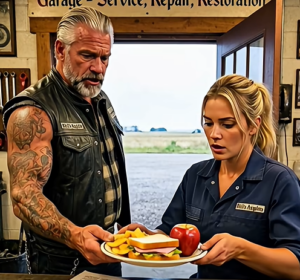
Kneeling on the grease-stained concrete floor of a motorcycle repair shop while my father barked cruel orders and forced me to drop my tools
The red and blue lights slid across the shattered glass and then pulled away, leaving the garage quieter than it had been in months. I stayed behind the workbench until the sound of the SUVs faded down the gravel road. The notebook in my hand was small, the leather cracked at the spine, the pages filled with my father’s tight block print. The first line was a date six months back, the day my brother Eli stopped answering his phone. Under it he had written: They will say I did it. The receipts are in the floor. Do not open the box until the marshals have the warrant. Then take the car.
I opened it anyway. The locked steel box under the tool-room floorboards had already told me the shipments were real. This notebook told me which deputy had signed the false chain-of-custody forms and which club prospect had been paid to swear he saw my father arguing with Eli the night the boy disappeared. The last page was an address two counties over and a single sentence: If they take me, the buyer still expects the Thursday load. Ruiz has the second copy of the ledger. He will not answer a number he does not know.
Ruiz was the sergeant who had stood in the shadows with the others and said nothing while my father ordered me out. I had thought he was one of the men watching to make sure I left. The notebook said he had been the one who drove Eli’s last known route and brought the bike back with the license plate removed.
I took my mother’s car because the notebook told me to. The tank was full. A prepaid phone sat in the glove box with one number already entered. I drove until the garage lights were gone and the highway opened into the dark stretch between towns. At a rest area I pulled over and called the number. It rang twice.
“You have the notebook,” Ruiz said. He did not ask who I was.
“They took him. Marshals. He told me not to come back.”
“He told you right. The Thursday load is still on the board. If it rolls, the buyer will know the shop is burned and he will clean every name attached to the last six months. That includes you.”
“Where is Eli?”
Ruiz was quiet long enough that I heard wind across his phone. “The same place the guns were supposed to go. A quarry past the county line. They kept him alive until he gave them the combination to the floor box. He didn’t have it. Your father changed it the week before. They shot him anyway and left the bike on the highway so the report would read like a club debt.”
I closed my eyes. The fluorescent lights of the rest area hummed. “The marshals have the ledgers I found. They don’t have the quarry.”
“They will if you stay where you are and let me bring them the second copy. Do not drive back. Do not call the shop phone. There is a diner at mile marker forty-eight. Booth by the window. One hour.”
I went. The diner was nearly empty. Ruiz arrived without his cut, in a plain jacket, and sat with his back to the wall. He slid a manila envelope across the table. Inside were photographs of the quarry gate, a fuel receipt with a partial plate, and a voice memo of Logan—no, not Logan; the buyer’s courier—telling someone the Miller girl was still a problem if she kept asking about her brother.
“Your father has been feeding the marshals pieces for four months,” Ruiz said. “Enough to keep them interested, not enough to move before the buyer’s people noticed. Tonight they moved because the broken glass made it look like a raid instead of a tip. He wanted you on the other side of the state line when that happened.”
“He could have told me.”
“He tried. You kept coming back with a wrench. He figured the only way you would leave was if he made you hate the door.”
We sat with the coffee neither of us drank. Outside, a semi idled. Ruiz checked his phone and stood. “Marshals are at the quarry now. They want you at the field office in the morning to confirm the handwriting. After that you can see him. He won’t be charged with Eli. The frame was thin once the second ledger showed up.”
I drove the rest of the night in pieces, sleeping an hour in the car at another rest area, then continuing when the sky grayed. At the field office they took the notebook, photographed every page, and sat me in a room with a camera and a woman who did not smile. I told her about the floor box, the newspaper under the glass, the sandwich he had slid across the counter so the men would hear him fire me. She asked whether I had known about the guns. I said I had known my brother was gone and my father was afraid. That was the size of it.
They let me see him in the afternoon. He was in a holding cell that smelled of concrete and coffee. The cuffs were off. He looked smaller without the shop lights and the audience of vests. When I sat down he studied my face as if checking for damage.
“You opened the box early,” he said.
“You hid a notebook that told me to.”
He nodded. The desperation I had seen at the counter was gone, replaced by the ordinary exhaustion of a man who had been awake too long. “Eli found the first shipment by accident. He thought he could photograph the crates and walk away. They followed him home. I told him to leave the state. He went to the quarry instead because he wanted a plate number. Ruiz got there twenty minutes late.”
“The marshals said you won’t be charged with him.”
“I’ll be charged with what I moved before I started writing it down. That’s fair. The rest of it was trying to keep you from standing where he stood.” He rubbed a thumb across the scar on his knuckle. “The shop is yours if you want it. Or sell it. Either way, don’t let anyone tell you the debt was yours.”
I visited twice more before they moved him. The quarry search recovered enough to match the serials in the ledger and a single shell casing that carried a print from the courier. The courier was arrested at a truck stop in the next state. Two of the men who had stood in the garage the day my father ordered me out were picked up on the old warrants the marshals had been sitting on. Ruiz testified in a closed session and then disappeared into whatever arrangement kept people alive after they turned. I did not ask where.
The shop stayed closed for three weeks. When I reopened it I changed the locks and hired a part-time mechanic who had never worn a cut. Customers came back slowly. Some asked about my father. I told them the truth that fit on a work order: he was cooperating, the frame had failed, the brother was gone. The ones who wanted a longer story stopped asking.
On the morning the plea was entered I drove to the quarry because the agent had said the scene was released. The gate was open. Tire tracks still cut the dirt. I stood where the photographs said the bike had been and did not try to imagine the rest. My father had spent six months making himself the loudest, cruelest voice in the garage so I would walk out before the SUVs arrived. It had worked. It had also cost Eli the twenty minutes Ruiz needed. Both things were true. I could hate the method and still use the time it bought.
I drove back to the shop as the light went. The notebook was in evidence. The floor box was empty. The newspaper under the glass was the same one that had named my father. I left it there. When the next customer rolled a bike in for a carburetor I wiped my hands, picked up the wrench, and started the job. The lesson was not that protection always looks like kindness. Sometimes it looks like a door slammed and a plate slid across a counter while men with guns wait outside. The work was to recognize which version you were seeing before the glass broke, and to leave while the leaving could still matter. I had left. He had stayed long enough to put the second ledger where Ruiz could find it. Eli had not been given the same door. I kept the shop lights on past closing anyway, in case someone else arrived with a wrench and a question the room was not yet ready to answer.
The lights stayed on past closing for three nights before anyone used them. On the fourth a bike rolled in just after nine, headlight cutting the bay, engine ticking as it cooled. The rider killed it and sat with his hands on the bars until I stepped out from the office with the wrench still in my fist. He was young, no cut, a duffel strapped behind the seat. When he pulled the helmet off I saw the split lip and the way he kept his weight on the left leg.
“Ruiz said you don’t ask names if the work is cash,” he said. “Front brake’s gone. I can pay.”
I looked at the empty road behind him, then at the camera I had mounted above the door. “Roll it in. Leave the duffel on the bench where I can see it.”
He did. The brake line had been cut clean, not worn. While I measured the replacement he stood with his back to the wall and watched the lot. Halfway through the job he said, “They told me the Miller shop was closed. Then they told me it wasn’t. I figured the second version was the one that still had tools.”
“Who is they?”
“People who used to run Thursday loads. They’re looking for anyone who touched the quarry paperwork. Ruiz is gone. Your father’s deal doesn’t cover strangers who show up with cut lines.” He nodded at the duffel. “There’s a phone in there. It rang twice on the way in. I didn’t answer.”
I finished the brake, bled it, and tested the lever. The phone was a cheap flip model. The missed calls were from a number with no name. I set it on the bench and did not open it. “You can leave it. Or you can take it and keep riding. Either way, don’t come back tomorrow. The camera keeps a week of footage. If someone asks, you bought a line and left.”
He paid in twenties, swung a leg over, and was gone before the taillight reached the highway. I locked the duffel in the floor compartment that used to hold the steel box and called the agent who had my number. She told me not to touch the phone again and sent a pair of deputies who treated the shop like a scene they had already visited. They took the duffel. They did not take the camera card. In the morning the agent called back and said the number belonged to a courier who had skipped his plea date. He had been looking for a mechanic who would not log the plate. He had found three before he found me. Two of them were now answering questions in rooms without windows.
I kept the shop open. The part-time mechanic asked once about the deputies and then stopped asking when I raised his hourly rate. Customers still came. A woman with a touring bike wanted the forks rebuilt and talked about her son who had stopped calling. I listened and torque-wrenched the clamps and did not offer the parallel. At night I checked the camera before I killed the lights. Most nights it showed only the road and the occasional semi. Once it showed a dark SUV that slowed, idled for thirty seconds, and moved on. I sent the clip. The agent said they already had the plate from a toll camera farther north. The driver was the cousin of one of the men who had stood in the garage the day my father ordered me out. He had not been arrested yet because the warrants were still being stacked.
My father called from the facility on a monitored line. His voice was thinner. “They told me someone came to the shop.”
“I fixed a brake and called it in. He’s in custody.”
“Good. Don’t start keeping strays. The ones who cut lines are bait. They want to see whether you still answer the door after dark.” He paused. “Eli’s bike is still in impound. If you want it, the paperwork is ready. If you don’t, they scrap it in sixty days.”
I did not want the bike. I drove to the impound anyway because leaving it felt like agreeing with the report that had called the quarry a club debt. The bike was there, front end twisted, plate already gone. I signed the release, trailered it back, and pushed it into the corner of the bay under a tarp. The part-time mechanic looked at the shape and said nothing. I told him it was evidence that had been released and that we did not touch it. He nodded and went back to a carburetor.
Two weeks later the agent arrived in person with a folder. The cousin had been picked up. In his phone were photos of the shop door, the camera, and the hours posted on the window. There was also a text thread with a number that traced to a lawyer who had once represented the buyer. The thread stopped the day the cousin was arrested. The last message was a single word: Wait.
“They’re not done measuring you,” the agent said. “Your father’s cooperation bought the big names. It did not buy every cousin with a camera and a grudge. If you want a different town, we can help with that. If you stay, the camera stays, the lights stay on a timer, and you call before you open the door after eight.”
“I’ll stay,” I said. “The tools are here. The customers know the address. Moving just gives them a new door to watch.”
She left the folder. I read it once and locked it in the office safe with the old newspaper. That night I set the lights on the timer and sat in the office with the monitor split between the bay and the lot. Nothing moved until just before midnight. A figure crossed the edge of the frame, paused at the tarp that covered Eli’s bike, and then left the way he had come. The face never turned toward the camera. The walk was careful, weight shifted off one leg. I called it in. The deputies found footprints and a fresh cigarette butt. The print on the butt matched the courier who had skipped his plea date and then been arrested at a different shop. He had made bail that afternoon. He was back in custody by morning, bail revoked.
I went out to the bay at dawn and pulled the tarp off the bike. Nothing had been taken. A single socket wrench I had left on the seat was now on the floor, aligned with the front tire as if someone had checked whether the wheel still turned. I picked it up, put it back on the bench, and covered the bike again. The part-time mechanic arrived at eight and saw the tarp. “Still not touching it?” he asked.
“Still not,” I said. “But if anyone asks for a job after dark, the answer is no, and you call me before you call anyone else.”
He agreed. We worked through a ordinary Tuesday. A clutch cable. A set of tires. A woman who paid cash and asked whether we still did patches. I told her we did mechanical work only. She left without arguing. When the bay was empty I sat at the desk and wrote the day into the log the way my father used to, times and parts and nothing else. At the bottom I added one line he would have recognized: Door stays locked after eight. Camera stays on. Bike stays covered.
The remaining danger was not a raid or a speech. It was the slow return of people who had learned the shop’s hours and wanted to know whether the daughter still opened the door when the legitimate customers were gone. I intended to keep answering that question the same way. Lights on a timer. Wrench in hand for the work that belonged on a ticket. Everything else went to the agent before it went to the floor. My father had used cruelty to buy me an exit. I was using a locked door and a camera to buy the shop a chance to stay a shop. Eli’s bike under the tarp was the cost that did not get refunded. I could live with the cost. I could not live with pretending the door was only a door. So I checked the monitor one more time, set the alarm, and left the log open on the desk where the next person who tried the handle would see, if they got that far, that the hours were real and the exceptions were not.