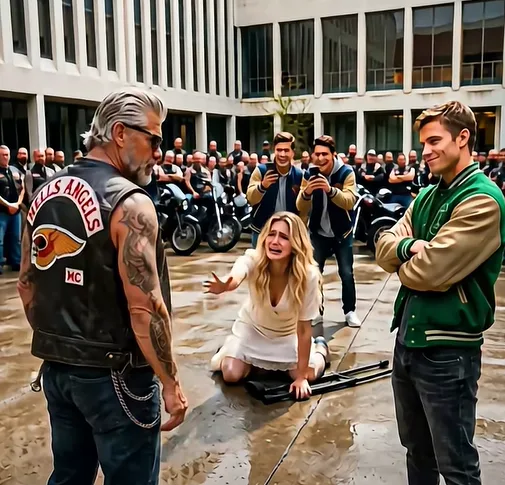
Kneeling in the freezing rain on the concrete courtyard outside the university administration building
The wind tore at my wet dress, and I pressed my cheek against the cold, scarred leather of my father’s vest, listening to the engine thunder through his ribs like a second heartbeat.
Behind us, fifty motorcycles filled the highway with white light, and the university shrank to a smear of gold in the rain.
“Where are we going?” I shouted.
“Somewhere warm!” Jaxson shouted back. “Then somewhere honest!”
My name is Clara Whitfield, I am twenty years old, and until twenty minutes earlier I had believed my father was a stranger who had left a baby on a church step.
The clubhouse stood at the end of a gravel road outside town, a long brick building with a corrugated roof, a neon sign that read IRON CORSAIRS, and a porch crowded with potted geraniums, which struck me as the strangest thing I had ever seen.
“Geraniums?” I said, as he lifted me off the bike like I weighed nothing.
“Your grandmother’s,” he said gruffly. “She told me a house isn’t a home until something is growing in it.”
“Grandmother?”
“She’s inside. She has been waiting twenty years, and she made soup.”
My knees nearly gave out.
He carried me through the door, past two dozen men in leather who stood in a respectful hush with their helmets in their hands, and set me down in a big warm kitchen that smelled of garlic and thyme and woodsmoke.
A tiny woman with silver hair and a lavender cardigan stood at the stove with a wooden spoon, and she turned around, and every bit of color left her face.
“Clara,” she whispered.
She had my chin, and my eyes, and my crooked left eyebrow.
“Grandma?” I said.
She dropped the spoon.
I do not remember crossing the kitchen. I remember her arms, thin and fierce, and her hands cupping my face, and her tears falling on my forehead as she kept saying, “My girl, my girl, my girl.”
Jaxson stood in the doorway with his arms folded and his jaw working, and big hot tears ran straight down into his beard without his making any attempt to hide them.
They put me in a chair by the stove with a blanket and a bowl of soup, and a medic named Doc, a gentle gray-bearded biker with spectacles, wrapped my scraped palms and examined my leg with careful fingers.
“Same old injury,” he said quietly. “Somebody did this to you on purpose. Last winter?”
“A car,” I said. “On the campus road. Nobody ever found the driver.”
“Somebody did,” Jaxson said, and his voice went flat and cold. “Tyler’s father’s driver. We’ve known since Tuesday.”
“Tuesday?”
He crouched in front of me, big and scarred, with the firelight in his pale eyes.
“Little angel, I have to tell you everything, and I have to do it before I lose my nerve. Will you listen?”
I nodded.
“Twenty-one years ago, I was a mechanic in this town. Your mother, Rose, was a nurse. We were not married, but we were happy. The night you were born, a man named Senator Harlan Pryce came to the hospital.”
“Tyler’s father.”
“He was a county prosecutor then. He had a problem. Your mother had seen him sign off on falsified evidence that sent an innocent man to prison, and she was going to testify.” His throat worked. “He couldn’t touch her. So he went after me. Planted a stolen shipment in my garage, bought a witness, and had me sentenced to eighteen years.”
“Eighteen years,” I breathed.
“Your mother was terrified. She gave you to her cousin and his wife, good people, the Whitfields, and she hid. She thought if Pryce believed the baby was gone, he’d leave her alone.”
“Where is she?”
His face crumpled.
“She died when you were four,” he said. “Pneumonia. In a boarding house in Ohio, using a false name. I wasn’t there. I didn’t know until I got out.”
I put my hands over my mouth.
Grandma came to stand behind me and laid her hands on my shoulders, and I leaned back against her as the grief rolled over me, enormous and old and clean.
“I got out three years ago,” Jaxson said, wiping his face with his wrist. “I found out where you were. I watched you from a distance for two years, at your school, at your swim meets. I was a coward. I thought, she has a good family, a good life. I’ll only ruin it.”
“Then Tyler happened.”
“Then Tyler happened.” His eyes blazed. “I found out the Pryce boy had been assigned to get close to you. Pryce had learned you were my daughter. He wanted to keep you scared and broken so you’d never ask questions about your mother.”
“And the crutches?”
“A message. For me.”
The fire popped in the grate.
I sat very still, and a strange calm settled over me, the kind that comes when the worst thing finally has a name.
“What do we do?” I asked.
Jaxson blinked.
“Daddy,” I said, and the word came out easy and natural, as if I had been saying it all my life. “What do we do about Senator Pryce?”
A slow, proud smile spread across his scarred face.
“You’ve got your mother’s spine,” he said.
“Tell me.”
“We don’t hurt him,” he said. “Hurting him is what he’d expect. He’s been waiting twenty years for me to do something he could use. We’re going to do something far worse.”
“What?”
“We’re going to tell the truth,” Jaxson said, “very, very loudly.”
It took nine days.
Doc, who turned out to be a retired court reporter, had kept every transcript from my father’s old trial in a trunk. Grandma had saved every letter my mother ever wrote. A quiet biker named Moses, a former bookkeeper, spent six nights tracing Pryce’s campaign accounts, and a lanky, freckled club prospect named Dewey, who had a gift for computers, found the recording.
It was an old audio file, buried in the senator’s own archive, a conversation from the night my mother vanished.
“She’s seen the files,” said a younger Pryce, smooth and certain. “She’ll talk. The mechanic goes down for the shipment. The nurse goes nowhere.”
“And the baby?” asked a second voice.
“Placed. Nobody will connect it.”
I listened to it in the clubhouse at midnight, with a blanket around my shoulders and my grandmother’s hand in mine, and when it ended nobody spoke for a very long time.
“That’s your mother’s death warrant,” Jaxson said quietly. “On tape.”
“Then we play it.”
“Where?”
I thought of a courtyard full of cameras and cruel laughter and fifty students with their phones raised.
“Where he’s most afraid,” I said. “In front of everyone.”
Senator Pryce was scheduled to speak at the university’s centennial gala on the last Saturday of the month, in the grand hall, with the governor, three hundred donors, and a live television feed.
Tyler would be at his side in a navy blazer, a loyal son.
We did not storm the building.
I walked in the front door at seven o’clock in a plain green dress and my hospital crutches, on the arm of an elderly woman in a lavender cardigan, past security guards who had been told to expect me, because the university’s dean, a nervous, honest man named Whitaker, had read the evidence Doc delivered to his house at dawn.
The room fell silent.
I walked down the long aisle with my crutches clicking on the marble, and Tyler saw me, and the color drained from his face.
Senator Pryce stood at the podium, a silver-haired man in a tuxedo with a famous smile, and for one second the smile faltered.
“Ms. Whitfield,” he said smoothly. “What a surprise. I trust you’ve recovered.”
“I’m recovering,” I said. “It’s a process.”
“We’re in the middle of a program.”
“I know. I’d like to add to it.”
I stopped at the foot of the stage.
“Senator, twenty-one years ago my mother was a nurse named Rose Callaway. She saw you falsify evidence in the case against an innocent man. A week later she was driven into hiding, and my father went to prison for a crime he didn’t commit.”
A murmur ran through the hall.
“This is absurd,” Pryce said. “Dean Whitaker, remove this young woman.”
“I would like you to listen to something first,” I said, and nodded at the back of the room.
Dewey, in a borrowed suit, pressed a button.
The sound system crackled.
“She’s seen the files. She’ll talk. The mechanic goes down for the shipment. The nurse goes nowhere.”
Pryce’s own voice, young and smooth and cold, rolled across three hundred silent faces and a live television camera.
He lunged for the podium.
Before he could reach anything, the great double doors at the back of the hall swung open, and Jaxson walked in alone, in a clean black jacket over his leather vest, his hands open and empty at his sides, with fifty bikers standing in perfect silence on the steps behind him.
“Harlan,” he said, in a voice that carried to the rafters. “It’s been a long time.”
The governor stood up slowly in the front row.
“Senator Pryce,” he said, “I think you’d better come with me.”
Two state troopers, who had been waiting in the lobby for twenty minutes at the dean’s request, moved in on either side.
Pryce looked at me, and at my father, and at the cameras, and for the first time in his life he had nothing to say.
Tyler stood beside the podium, shaking.
He looked at me, and I looked at him, and I felt no anger at all.
“I didn’t know about the accident,” he whispered. “Clara, I swear. He told me it was a prank. I never wanted you hurt.”
“You broke my crutches in the rain.”
“I know.”
“You laughed.”
“I know.” His eyes filled. “I’m so sorry. I’ll say anything. I’ll testify.”
“Then do,” I said quietly. “That’s the only apology that counts.”
He nodded, and he did.
The trial lasted four months.
Pryce was convicted of conspiracy, evidence tampering, obstruction of justice, and accessory to the death of Rose Callaway, and sentenced to forty years. His driver, a hulking man named Burke, pleaded guilty to the hit-and-run and named everyone who had paid him. Tyler testified for three days, in a plain gray suit, and received probation and two thousand hours of community service. I never forgave him, exactly. But I stopped carrying him, which turned out to be nearly the same.
My father’s conviction was vacated on a rainy Tuesday in March, in a small courtroom with a flag and a worn oak bench.
“Mr. Hayes,” the judge said, a stern woman with silver spectacles. “This court has no way to return eighteen years. But it can say, on the record, that you were innocent, and that the state of this county is sorry.”
Jaxson stood very straight, in a borrowed suit, with my grandmother’s hand in his, and for a long moment he could not speak.
“Thank you, Your Honor,” he said at last, hoarsely. “That’s more than I expected.”
“It is the least you are owed.”
When we walked out of the courthouse, the steps were lined with bikers, two hundred of them, in clean leather, helmets held over their hearts, and a long, rolling cheer went up that startled a flock of pigeons off the roof.
My father stopped on the top step, and looked at them, and then at me.
“Little angel,” he said.
“Yes, Daddy?”
“I never thought I’d get to say this out loud. But I’m proud to be your father.”
I threw my arms around him in front of the whole town, and he lifted me clean off the ground, crutches and all, and the crowd roared.
We spent the spring remodeling the clubhouse.
Grandma insisted on curtains. Doc built a bookshelf. Moses, the bookkeeper, ran the finances with terrifying competence, and Dewey turned the old storage room into a computer lab for neighborhood kids. By May, the Iron Corsairs had a new charter, drafted by my father on a legal pad at the kitchen table, and printed in bold on the first page.
We protect people who cannot protect themselves.
We opened the doors every Saturday morning to anyone who needed help, a repair, a ride, a meal, a lawyer. A frightened teenager with a black eye came in one week, and a widow with a broken furnace came the next, and by summer there was a line on the porch every weekend, among the geraniums.
I went back to the university in the fall.
I walked across the courtyard on a pair of lighter crutches, in the warm golden light, past the spot where I had once knelt in the rain, and I stopped there, in front of a small bronze plaque the dean had quietly installed.
For Rose Callaway. She told the truth.
I laid a bouquet of red geraniums beneath it.
“Hi, Mom,” I whispered. “I met him. He’s wonderful. He’s very loud, and he cries at commercials, and he’s already ruined three of Grandma’s casseroles trying to help.”
A breeze moved through the oaks, warm and sweet, and the leaves rustled like soft applause.
“I’m okay,” I said. “I’m really okay. I have a family.”
I stood there a while longer, and then I turned and walked on across the courtyard toward my classes.
At the edge of the quad, a long row of motorcycles was lined up along the curb, gleaming in the sun, and a big man in a leather vest was leaning against the nearest one with his arms folded and a bunch of grocery-store flowers in his fist.
“Hey, little angel!” he bellowed, across a hundred astonished students. “Need a ride home?”
Every head on the quad turned.
I could have been embarrassed.
Instead I grinned, and lifted my crutch in the air, and shouted back at the top of my lungs, “Always!”
He laughed, and the whole street heard it, a deep, warm, rolling sound, the sound of a man who had finally come home.
I crossed the grass to him, and he settled a helmet on my head and fastened the strap with careful, clumsy fingers, and I climbed on behind him and wrapped my arms around his broad leather back.
The engine rumbled to life beneath us, steady and strong.
“Where to?” he asked.
“Home,” I said.
He kicked the bike into gear, and we pulled out into the golden afternoon, with fifty engines roaring behind us like a promise, past the fountain and the library and the green and shining hills, toward a brick clubhouse with geraniums on the porch and a pot of soup on the stove.
I rested my cheek against his vest, and closed my eyes, and for the first time in my whole life I did not feel like a girl who had been left behind.
I felt like a daughter who had been found.