It is pouring rain, while clutching a heavy leather bag and listening to the rugged rancher tell me I was too large for love
The rain had stopped by midnight, but the danger had only begun. I waited until the ranch hands had settled into the bunkhouse before slipping into the pantry and retrieving my leather bag. My fingers trembled as I opened its brass clasp, revealing the oilskin-wrapped papers hidden beneath a false lining. Inside were land deeds, forged contracts, account ledgers, and a small black notebook filled with names. Some belonged to respectable businessmen. Others belonged to the sheriff, the county judge, and men who had made their fortunes by stealing land from widows, immigrants, and families too poor to defend themselves.
At the center of it all was a name I had learned to hate. Silas Blackwood. The wealthiest man in the territory. The man who had ordered my father’s murder. I had spent three weeks traveling under a false name, sleeping in stagecoach stations and hiding whenever armed riders appeared on the road. I had watched my father’s ranch burn from a hillside, unable to return for his body because Blackwood’s men were waiting for me. Before he died, my father had pressed this bag into my hands. “Whatever happens, Clara, don’t let them take it,” he had whispered. “These papers belong to the people they’ve robbed.” Then he had gripped my wrist with surprising strength.
“And don’t trust a man simply because he offers you protection. Trust what he is willing to sacrifice.” Those were his final words. Now, standing in the dim pantry of a ranch belonging to a man who had insulted me before I had even crossed his threshold, I wondered whether I had made a terrible mistake. A floorboard creaked behind me. I spun around, clutching the bag against my chest. The rancher stood in the doorway, a revolver resting loosely in his right hand. “What are you doing with that?” My mouth went dry. “Looking for flour.” His eyes moved from my face to the leather bag. “At midnight?” “I couldn’t sleep.” “Funny. Neither could I.” He stepped inside and closed the door behind him. For several seconds, neither of us spoke. His face was half-hidden in shadow, but I could see the suspicion hardening his features. “Open the bag, Clara.” My heart seemed to stop. I had never told him my real name. He noticed my expression and lowered the revolver slightly. “Your travel papers say your name is Eleanor Hayes. The letter from the employment agent says the same thing. Yet yesterday, while you were unloading supplies, you answered to Clara when one of the horses spooked.” I swallowed. “It was my mother’s name.” “Was it?” “Yes.” He studied me for a long moment. “You’re a terrible liar.”
“And you’re a terrible host.” Something flickered in his eyes. It might have been amusement, but it disappeared before I could be certain. “Open it.” “No.” His jaw tightened. “You are standing in my house, carrying a bag you guard more fiercely than your own life. Three men rode past my eastern fence this afternoon asking whether a woman had taken work here. They described your height, your hair, and a scar on your left wrist.” I instinctively covered the pale mark beneath my sleeve. His expression changed. “Whatever you’re running from, it’s already found you.” I looked at the papers, then at the man standing between me and the door. “My father was murdered.” The words escaped before I could stop them. The rancher went completely still. “Who?” “Silas Blackwood.” For the first time since I had met him, the coldness left his face. What remained was something darker. He holstered his revolver. “Show me the papers.” I hesitated.
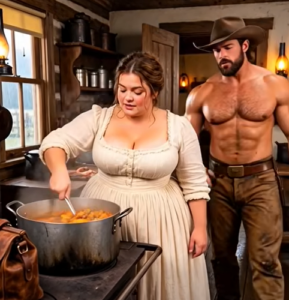
“If I do, you’ll have to decide whether you believe me.” “I’ve already decided that someone is hunting you. That’s enough for tonight.” He pulled a chair away from the pantry wall and sat down. “Now tell me everything.” So I did. I told him about the night Blackwood’s men arrived at our ranch with a fraudulent foreclosure notice. I told him how my father had refused to surrender the land that had belonged to our family for three generations. I described the gunshots, the fire, and the last time I saw my father standing in the doorway with a rifle in his hands. I told him how I had escaped through a window with the leather bag, carrying the only evidence that could prove Blackwood had stolen hundreds of thousands of acres through bribery and forgery. When I finished, the rancher remained silent. Then he asked a question that made my blood run cold. “Did Blackwood sign the original transfer of your father’s land?” “Yes.”
“With his own hand?” “Yes. His signature is in the ledger.” The rancher leaned forward. “Then your father wasn’t the only man he murdered.” I stared at him. “What do you mean?” He rose and crossed to the window, looking toward the dark silhouettes of the distant mountains. “My name is Daniel Mercer. Fifteen years ago, my father owned the largest cattle operation in this valley. Blackwood wanted his grazing rights and the water that ran through our property. When my father refused to sell, the sheriff accused him of rustling his own cattle.” Daniel’s voice became quieter. “They hanged him before we could appeal.” I could not speak. “My mother died the following winter. The bank took our house. I spent ten years working for other ranchers before I could afford this place.”
He turned toward me. “I bought it with money earned honestly, one miserable day at a time. And every year since, I’ve watched Blackwood expand his empire by taking what belonged to people who couldn’t fight back.” “Why haven’t you stopped him?” “Because every witness who stood against him either disappeared or changed their story. Because the sheriff works for him. Because the judge owes him money. And because a man with a rifle can be dangerous, but a man who controls the law can be nearly impossible to touch.” He glanced at the bag. “Until now.” For the first time, I understood why he had looked at me with such suspicion when I arrived. He had not been looking at a helpless stranger. He had been looking at a threat to the only life he had managed to build. “Will you help me?” I asked. Daniel studied me. “Tomorrow morning, we’ll find out whether those papers are worth dying for.” He started toward the door, then paused. “And Clara?” I looked up. “You’re not too large for love.” My face burned. He continued before I could respond.
“But you deserve better than a man who makes you prove you’re useful before he treats you like a human being.” Then he left me alone in the pantry. I sat down slowly, unable to decide whether I wanted to cry or throw something at his head. Perhaps both. By sunrise, we had a plan. Daniel summoned his most trusted ranch hands: Thomas, a former army scout with a damaged knee; Joseph, a quiet blacksmith who could read contracts better than most lawyers; and young Samuel, whose father had lost his farm to Blackwood the previous spring. I expected them to laugh when Daniel explained that a woman hired to cook their meals possessed evidence capable of destroying the most powerful man in the territory. Instead, Thomas removed his hat. “My sister lost her house to that bastard,” he said.
“Tell me where to stand.” One by one, the others agreed. I spread the documents across the kitchen table, explaining the forged deeds and the coded entries in the black notebook. Joseph recognized several names and identified a series of payments made to the county clerk. Thomas found a reference to a missing rancher who had supposedly sold his land weeks after his disappearance. The deeper we looked, the worse it became. Blackwood had not merely stolen land. He had built an entire system designed to make theft appear legal. And according to the notebook, he intended to complete the largest transfer of property in the territory at a public auction scheduled for the following afternoon. Dozens of families would lose their homes unless someone intervened. “We take these papers to the state marshal,” I said. Daniel shook his head.
“The nearest marshal is two days away. Blackwood’s men control the telegraph office, and the sheriff will know about our plans before we reach the county line.” “Then we expose him at the auction.” “That’s exactly what he expects us to do if we’re foolish enough to confront him.” I met his gaze. “My father died because he refused to surrender. I will not let his death become another forgotten story.” Daniel held my eyes for a long moment. Then he nodded. “All right. But we do this intelligently.” That afternoon, he rode to town alone to learn how many men Blackwood had stationed around the courthouse. He returned after dark with a split lip, a torn sleeve, and blood on his collar. I ran to meet him in the yard. “What happened?” “Three men asked me to deliver a message.” “What message?” He looked toward the ranch house. “They know you’re here.” My stomach tightened. “How?” “Someone recognized you at the supply store. Blackwood has offered five hundred dollars for your return and another five hundred for the bag.” I stared at him. “Then I should leave.”
“No.” “Daniel, they’ll burn this ranch to the ground.” “They’ll have to get through me first.” “You cannot fight every man in the territory!” “No,” he said sharply. “But I can choose which man I refuse to run from.” His anger silenced me. For one brief moment, I saw the boy he must have been when his father was taken away, standing powerless while powerful men decided what his family’s future would be. I reached for his hand. He looked down at our joined fingers as if he had forgotten that comfort was something people could offer without demanding payment. “I’m sorry,” I whispered. “For what?” “For bringing this to your door.” He gently withdrew his hand, but not before his thumb brushed across my knuckles. “You didn’t bring Blackwood here, Clara. He was here long before you arrived.” That night, we prepared for the confrontation. The documents were copied by hand, with separate sets hidden in the saddlebags of three different riders. Thomas would take one set toward the northern settlement. Joseph would carry another to a church elder known for sheltering families threatened by the sheriff. I would take the original ledger to the courthouse. Daniel insisted on accompanying me. “You don’t have to,” I told him. “I know.” “Then why are you coming?” He tightened the strap on his saddle.
“Because I spent fifteen years telling myself that surviving was the same as winning.” He looked at me. “I’m tired of surviving.” We reached town shortly before noon the next day. The courthouse square was crowded with ranchers, merchants, hired gunmen, and families clutching the last belongings they had not already lost. Blackwood stood on the courthouse steps in a tailored black coat, smiling as though he were hosting a celebration rather than presiding over the destruction of dozens of lives. Beside him stood Sheriff Harlan, a broad man with a silver star pinned to his chest. When Blackwood saw me, his smile widened. “Well, well. The little thief has come home.”
A murmur spread through the crowd. Daniel moved half a step in front of me. Blackwood laughed. “Mercer. Still playing the hero? I thought your father’s hanging would have taught you the cost of interfering in other men’s business.” Daniel’s hands curled into fists. I touched his arm. Not yet. I stepped forward. “My name is Clara Bennett. My father was Elias Bennett, and he was murdered because he refused to surrender his land to you.” Blackwood’s smile did not falter. “Your father was a criminal who died resisting lawful authorities.” “Then you won’t mind seeing the documents that prove otherwise.” I opened the leather bag. The sheriff drew his revolver. “That’s enough. You’re under arrest for theft and the possession of stolen property.” The crowd stirred uneasily. I had expected this. I had prepared for it. But I had not prepared for Blackwood to step down from the courthouse stairs and whisper into my ear.
“Give me the ledger, and I’ll let you leave this town alive.” I looked at him. “You killed my father.” “Your father made a foolish choice.” “You stole his land.” “I purchased it.” “With a forged signature.” His expression hardened. For the first time, his confidence cracked. I turned toward the crowd and raised my voice. “The ledger contains payments made to Sheriff Harlan, the county clerk, and Judge Whitmore. It records the names of families whose signatures were forged and the dates when their homes were seized. It even contains payments made to men who disappeared after refusing to cooperate.” Blackwood snapped his fingers. Two gunmen stepped forward. “Take her!” Daniel moved immediately, knocking the first man’s arm aside as a gunshot exploded into the air. Chaos erupted. People screamed and scattered. Horses reared against their reins. The sheriff shouted orders, but no one could hear him over the sudden thunder of gunfire. Daniel shoved me behind the courthouse’s stone pillar. “Stay down!” A bullet struck the wood above us. I clutched the ledger beneath my coat, my heart pounding so violently that I could barely breathe. Across the square, Thomas appeared beside the blacksmith’s wagon, waving a folded paper.
“Copies!” he shouted. “We’ve got copies!” Joseph emerged from the crowd with two ranchers who had once lost their land to Blackwood. Behind them came a dozen more men and women, each carrying a deed, a letter, or a sworn statement they had been too frightened to show anyone before. The people Blackwood had spent years dividing were finally standing together. Then Sheriff Harlan seized me by the arm. “You’re coming with me.” I struggled, but his grip was iron. He dragged me toward the courthouse entrance, where Blackwood waited with an outstretched hand. “Give me the book, Clara.” I held it tighter. He leaned closer. “You think these people care about you? They care about their homes. The moment this is over, they’ll go back to their farms, and you’ll be nothing more than a dead woman’s daughter who caused trouble.” For a heartbeat, his words found their mark. I remembered the years of being mocked for my size, the strangers who had looked through me as if I were an inconvenience, the men who had treated my worth as something determined by my usefulness. Perhaps he was right. Perhaps I was alone. Then I heard Daniel’s voice. “Clara!” He stood several yards away, blood running from a cut above his eyebrow. His revolver was pointed at the ground, his empty hand raised. “Look at me,” he said. I did. “You don’t have to prove your worth to that man.” Something inside me settled. I looked back at Blackwood. “No,” I said. “I don’t.” With all my strength, I twisted free of the sheriff’s grip and threw the ledger onto the courthouse steps. “Read it!” I shouted. For a moment, nobody moved. Then Joseph snatched it up and began reading the names aloud. The first was a widow whose husband had supposedly sold their farm two days after his burial. The second was an immigrant family whose land had been seized under a contract written in a language they could not understand. The third was Daniel’s father. At the sound of his father’s name, Daniel went pale. Joseph continued. He read the dates, the amounts, the forged signatures, and the payments to the sheriff. Each revelation brought another voice from the crowd, another witness stepping forward, another frightened person finally finding the courage to speak. Blackwood tried to escape through the courthouse doors. Thomas blocked his path. “You’ve been running this valley for years,” Thomas said. “Seems only fair you should wait your turn.” Blackwood drew his pistol. Before he could fire, a shot rang out from the courthouse balcony. Everyone froze. The man standing above us was Judge Whitmore. He lowered his smoking revolver, and for one terrible second, I thought he had killed someone. Instead, his weapon was pointed at Blackwood’s feet. “Put the gun down, Silas.” Blackwood stared up at him. “You owe me everything.” “I owe you nothing.” The judge descended the stairs, his face gray with shame. “My signature is on those contracts,” he announced. “I approved the transfers. I accepted the payments. I told myself the people we dispossessed would never have the means to challenge us.” He looked at the families gathered in the square. “I was wrong.” Sheriff Harlan attempted to flee, but two ranchers seized him before he reached his horse. Blackwood stood surrounded, his immaculate coat dusted with mud, his polished boots planted among the papers that had destroyed his empire. “You cannot do this to me,” he snarled. “I own half this territory!” “No,” I said quietly. “You stole half this territory. There’s a difference.” His eyes met mine, filled with a hatred so pure that it should have frightened me. But I no longer felt small beneath his gaze. By sunset, the town had changed. The sheriff was locked inside the jail he had used to silence his enemies. Judge Whitmore had agreed to testify, and the copied ledgers were on their way to state authorities. Blackwood and his hired gunmen were held under guard while the surviving witnesses gave their statements. It would take months, perhaps years, to recover every stolen acre. Some families would never get back what they had lost. But the silence had been broken. For the first time, the people of the valley had evidence, witnesses, and one another. When Daniel and I returned to the ranch, the sky was clear. He dismounted slowly, favoring his injured shoulder. I helped him inside and cleaned the blood from his face. “You should have stayed behind the pillar,” he muttered. “You should have stopped getting shot.” “I wasn’t shot.” “Would you prefer I congratulate you on your excellent self-control?” A laugh escaped him, low and unexpected. It was the first time I had heard him laugh without bitterness. When I finished bandaging his shoulder, he caught my hand. “Clara, I owe you an apology.” I raised an eyebrow. “For what? The cooking, the insults, or the part where you treated me like a suspicious package delivered to your doorstep?” “All of it.” He looked down at our hands. “When you arrived, I saw a woman who needed a job, and I decided that gave me the right to judge her. I thought I was protecting myself from trouble. The truth is, I had become so afraid of losing what little I had that I’d forgotten how to welcome anything good.” His voice roughened. “You deserved kindness before you ever proved you could cook. You deserved respect before you showed me those papers. And you deserved to be seen as a woman, not a burden.” I felt tears prick the corners of my eyes. For years, I had imagined that if someone ever apologized for the cruelty I had endured, I would demand an explanation. I would ask why they had thought themselves entitled to hurt me. Instead, I found myself grateful that he had learned to ask the questions himself. “I forgive you,” I said. “But don’t mistake forgiveness for permission to do it again.” His mouth curved into a small smile. “I wouldn’t dare.” Spring arrived slowly in the valley. The trials began before the snow had completely melted. Blackwood was convicted of conspiracy, fraud, bribery, and ordering the murder of several landowners. Sheriff Harlan lost his badge and was sentenced for his part in the crimes. Judge Whitmore resigned and testified against the men who had once been his closest allies. The stolen properties were reviewed, and many were returned to their rightful owners. My father’s ranch was among them. I visited the land on a bright morning in April. The charred remains of our house still stood against the hillside, but wildflowers had begun growing through the ashes. I knelt and placed my hand on the earth. “I’m sorry it took so long, Papa,” I whispered. A warm breeze moved through the grass. For the first time since his death, I could remember his face without seeing the fire behind it. I had come to the valley seeking justice, believing that the leather bag was the only thing that could save me. Yet as I stood on the land my father had loved, I understood that the papers had only opened the door. What truly changed everything was the courage of ordinary people who had finally decided they would no longer face their fear alone. I sold a portion of the ranch to fund a legal office where families could challenge fraudulent land claims without paying fees they could not afford. The rest became a working farm, and I hired people who had lost their livelihoods to Blackwood’s schemes. Daniel helped me rebuild the house. He never asked me to make myself smaller to fit his expectations, and I never asked him to pretend that his scars did not exist. We argued over fences, crops, and the proper way to prepare biscuits. He learned that I could handle a stubborn horse as well as any man, while I discovered that his silence was not always anger. Sometimes, it was simply the peace of a man who no longer needed to stand guard against the entire world. One evening, months after the trial, we sat together on the porch as the sun sank behind the mountains. Daniel placed a small wooden box beside me. Inside was a simple silver ring. My breath caught. “I know I made a poor first impression,” he said. “That is an extraordinary understatement.” He smiled. “I won’t promise you an easy life, Clara. I can’t promise there won’t be storms, or that I’ll always know what to say. But I can promise never to make you earn the right to be loved. If you choose me, I want you beside me, not behind me. Not because you need protecting, and not because I need someone to fill an empty house, but because we make each other stronger.” I looked at the ring, then at the man who had once told me to cook for him as though my value could be measured by a meal. “Are you asking me to marry you?” “I am.” “Then I have one condition.” He straightened. “Name it.” “You will never again tell a woman that she is too large for love.” His expression softened. “Never.” I slipped the ring onto my finger. “Then yes.” He kissed me beneath the open sky, and for the first time in my life, I did not wonder whether I was worthy of being held. I simply allowed myself to be loved. Years later, people would tell the story of how a rancher’s cook brought down the most powerful criminal in the territory. Some would say it was the leather bag that saved the valley. Others would credit Daniel’s courage, the judge’s confession, or the people who stood together in the courthouse square. But I knew the truth. The bag held evidence, not magic. The courage had always belonged to the people. And love, real love, had never been a prize awarded to those who were beautiful enough, thin enough, useful enough, or brave enough to deserve it. It was something we gave freely when we learned to see one another as human beings. My father had died believing that justice was worth fighting for, even when the odds were impossible. Daniel had spent fifteen years believing that survival was all a man could hope for. And I had arrived in the valley believing that my body made me less deserving of tenderness. We were all wrong in different ways. The truth was that dignity did not come from wealth, appearance, strength, or the approval of powerful men. It came from refusing to let cruelty define us, and from standing beside those who had been taught to believe they stood alone. The valley was never perfect again. But its people learned to question authority, to protect their neighbors, and to remember that a community is only as strong as its willingness to defend the most vulnerable among them. And every time a frightened woman arrived at our door seeking work, Daniel welcomed her with a warm meal and a chair beside the fire. He never asked what she could offer before asking whether she was hungry. As for me, I kept the old leather bag. Not because I needed to remember the men who had tried to destroy us, but because I wanted to remember the woman who had carried it through the rain, believing she had nothing left to offer the world. She had been wrong. She had always been enough.