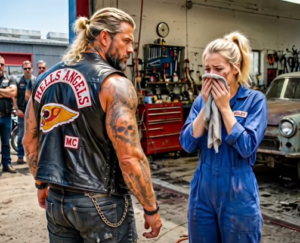
Inside my father’s auto garage, tossing a grease-stained rag in my face while sneering that a helpless woman couldn’t protect a ruined shop
The wrench felt heavier in my hand than it ever had in my father’s, and I stood on the gravel drive listening to the engine of the last federal cruiser fade into the dark until all I could hear was the wind combing through the pines.
“Miss Carter,” the lead agent said behind me, and I turned to find him holding open the door of his sedan with the patient look of a man who had given this speech before. “Agent Marcus Hale. I’d like to move you somewhere safe tonight.”
“Where is safe?” I asked, and my voice came out dry and rough, scraped hollow by three weeks of grief and one terrible afternoon.
“A place we keep for witnesses. Three hours north. Nobody there knows your name.”
“Everybody here knows my name,” I said, and I looked back at the garage, at the cracked sign over the bay door that still read CARTER & SON in my father’s faded red paint. “He painted that the year I was born. He told me the ‘and Son’ would have to be ‘and Daughter’ someday, and he laughed so hard he nearly fell off the ladder.”
Hale said nothing, and I was grateful for it.
“I’ll pack a bag,” I told him. “Give me ten minutes.”
“Five,” he said gently. “And Miss Carter, don’t turn on any lights you don’t need.”
I walked back into the ruined garage with the wrench still in my fist, past the overturned toolboxes and the shattered glass glittering like spilled sugar under the moon, and I climbed the narrow wooden stairs to the apartment above the shop where I had lived my whole life.
The kitchen smelled of cold coffee and old toast, and my father’s reading glasses still sat folded on the windowsill beside a half-finished crossword.
Seven across, he had written in pencil. Four letters. Loyal friend.
I stared at the empty squares for a long time, and then I picked up the pencil and filled in the word that fit, because I could not think of anything else to do with my hands.
DOGS.
A laugh broke out of me, small and wet and wrong, and then my knees folded and I sat down on the linoleum floor with my back against the cabinets and cried the way I had not let myself cry in front of Axel.
It lasted perhaps two minutes.
Then I wiped my face on my coverall sleeve, stood up, and went to my bedroom to pack, and that was when I noticed the thing I had missed for three weeks.
My father’s toolbox, the red Craftsman with the dented lid, was sitting on my bed.
I had not put it there.
My pulse jumped, and I eased the wrench up to shoulder height and looked at the window, the closet, the shadows in the corners, and found nothing but the quiet gray dark.
I stepped toward the bed and lifted the lid with the tip of the wrench.
Inside lay the usual tangle of sockets and screwdrivers, and on top of them, folded small, was a piece of yellow shop paper covered in my father’s blocky handwriting.
If you are reading this, kiddo, then I’m either late getting home or I’m gone, it said. Either way, don’t trust the ledger. It’s only half the truth. The other half is in the car.
My breath stopped.
The date at the top was the morning of the day he died.
I read it again, and then I read the last line three more times. The other half is in the car.
The car.
My father had owned exactly one car he loved, a 1969 Ford Falcon he had been restoring for eleven years in the back bay under a canvas tarp, the one thing in the entire garage that Axel’s men had never been able to find because I had moved it to the neighbor’s barn the night the break-ins began.
I grabbed my jacket, jammed the note into my pocket, and ran down the stairs two at a time.
“Agent Hale,” I called, bursting out onto the drive. “I need to make a stop before we go.”
He raised an eyebrow. “Miss Carter, I don’t think—”
“Ten minutes. Two miles. It’s my father’s last message, and I think it’s the thing that finishes this.”
He looked at my face for a long moment, and then he looked at the dark road, and I watched him weigh a lifetime of procedure against whatever he saw in my eyes.
“Get in,” he said. “I’m driving.”
The Hendersons’ barn stood at the end of a dirt lane half a mile off the county road, a sagging red structure with a rusted weathervane shaped like a rooster, and old Mr. Henderson had left the side door unlatched for me the way he had said he would.
Hale parked behind a stand of walnut trees and killed the engine, and the two of us walked the last hundred yards in silence with a flashlight dimmed to a ghost.
Inside, the barn smelled of hay and horse and dust, and in the far corner, beneath a canvas tarp patched with duct tape, crouched the shape of my father’s Falcon.
I pulled the tarp back with both hands, and a sob caught in my throat all over again.
She was beautiful.
Candy-apple red, chrome gleaming even in the dim light, the white leather seats stitched by hand during the long winter evenings when my father hummed old country songs and pretended I wasn’t watching.
“The other half is in the car,” Hale murmured, reading the note over my shoulder. “Where would he hide it?”
“He hid everything in the same three places,” I said, and I wiped my eyes and made myself think like the woman who had grown up beside him. “The glove box, under the dash, or in the spare tire well.”
We searched for twenty minutes, Hale on his back beneath the chassis with a flashlight between his teeth, me with my arm shoved up to the shoulder behind the dashboard, and we found nothing but dust and a single rusted bolt.
Frustration climbed my throat like bile, and I slammed the heel of my hand against the steering wheel.
The horn did not sound.
Instead there was a soft metallic click, and a small panel in the center of the wheel popped open an inch.
We both froze.
“Well,” Hale said slowly, sliding out from under the car and wiping his hands on his trousers. “That’s new.”
I pried the panel the rest of the way open with my thumbnail, and nestled in the hollow beneath it, wrapped in a scrap of oily chamois, lay a tiny black memory stick and a folded square of paper.
My hands shook as I unfolded it.
Riley, it said, in my father’s careful pencil. The ledger shows what Axel did. This shows who he did it for. Take it to Judge Alma Brennan and no one else. Not the sheriff. Not the DA. Not the feds, unless she says so. I love you more than every engine I ever fixed. Dad.
I read the last line aloud, and my voice cracked on the word love.
“Not the feds,” Hale said quietly, and I looked up and saw the expression on his face change, something hardening and cooling behind his polite agent’s calm.
“He wrote that,” I said. “He doesn’t mean you.”
“No,” Hale said. “He doesn’t mean me.”
But he had taken one small step back, and his right hand had drifted toward his hip, and I felt a cold finger of doubt trace down my spine.
“Agent Hale,” I said carefully. “How did the Organized Crime Task Force get to my garage so fast?”
“You sent them the ledger two hours before—”
“I sent it to a general tip line. A public email address. No one reads those for days.” My heart began to pound. “Nobody knew the raid was happening except me. And you were already parked at the bottom of my driveway.”
“Riley,” he said, and for the first time he used my name, soft and sad.
The flashlight beam steadied on his face, and I saw the truth in the shape of his mouth before he spoke it.
“I’m sorry,” he said. “I really am. Your father was a decent man.”
My hand closed around the wrench.
“You work for him,” I whispered. “The man who owns the syndicate.”
“I work for the man who pays better than the Bureau,” Hale said, and he drew a compact pistol from beneath his jacket with the weary movements of someone doing a chore he had long ago stopped enjoying. “Hand me the stick, please. And the ledger scans. Then I’ll drive you somewhere quiet, and it will all be very painless.”
“Painless,” I repeated. “Like the hit-and-run?”
“That wasn’t me.” His eyes flickered. “That was Axel. I told him to wait. He never could wait.”
“And Axel’s in a cell tonight because you needed a clean arrest to look like a hero,” I said slowly. “You were going to take the ledger out of evidence the moment I handed it over.”
“Smart girl,” Hale said. “Your father was smart too. It didn’t save him.”
I looked at the memory stick in my palm, and then at the gun, and then at the old Falcon sitting between us, red and shining in the lantern light.
My father had always said a good mechanic knows exactly where every part of an engine can fail.
“It’s not the only copy,” I said.
Hale smiled thinly. “Of course it isn’t. We’ll find the others.”
“No. I mean the stick.” I held it up between two fingers. “It’s a decoy, Agent Hale. A cheap dummy my father put in the wheel so that anyone who followed his trail would think they’d won.”
His smile faltered. “You’re bluffing.”
“Look at the label.”
He glanced down for just one second, and a second was all I needed.
I swung the wrench with every ounce of strength in my shoulders, not at his head, but at the hand holding the pistol, and I heard the crack of metal against bone, and Hale screamed as the gun spun away across the barn floor and skittered under a stack of hay bales.
He lunged for me with his good hand, roaring, and I ducked and slammed my shoulder into his ribs and we both crashed into the side of the Falcon with a boom that rattled the rafters.
“You little—” he gasped, catching my collar and hauling me up, and I drove my knee into his stomach and felt the breath leave him in a rush.
“Riley!” a new voice shouted, and a blinding white spotlight flooded the barn from the doorway.
Hale froze with his fist raised.
“Let her go, Marcus,” said a gravelly voice, and into the light stepped old Mr. Henderson in his flannel pajamas, a double-barreled shotgun braced against his shoulder and his white mustache bristling like a ruffled cat. “I don’t care much for men who point guns at my neighbors’ kids.”
Behind him came three more figures in the glare of the lantern, a lean woman in a gray judicial robe thrown hastily over a sweater, and two uniformed state troopers with their pistols leveled at Hale’s chest.
“Judge Brennan?” I gasped.
“Riley Carter,” the woman said, and her stern, tired face softened. “Your father called me the night before he died. He told me if anything happened to him, you’d bring me the truth, and that I should be ready to catch you when you did.”
“I didn’t know,” I stammered. “I didn’t know how to reach you. The note only said your name.”
“It did what he wanted it to do,” she said. “It got you to someone who could be trusted before you ran into the wrong someone.”
Hale spat blood into the hay and glared at her with open hatred. “You can’t prove anything, Alma.”
“I don’t need to prove it tonight, Marcus,” Judge Brennan said calmly. “I only need to hold you until the real federal team arrives. I called them from the Hendersons’ kitchen twenty minutes ago, and I assure you they are not on your payroll.”
The troopers moved in and cuffed him, and he sagged between them like a man who had finally run out of road.
I stood in the middle of the barn with my hands shaking and my lungs burning, and then I started to laugh, a wild, helpless sound, and Mr. Henderson lowered his shotgun and put a gnarled hand on my shoulder.
“You did good, Riley,” he said gruffly. “Your pa would’ve been proud.”
“Thank you for hiding the car,” I whispered.
“Hiding it? Girl, I’ve been hiding things from the Iron Brotherhood for thirty years. This was the easiest job I ever had.”
Judge Brennan stooped and retrieved the little black memory stick from the floor, where it had fallen in the scuffle, and she turned it over in her fingers with an odd, thoughtful expression.
“A decoy,” she said.
“Was it?” I asked, and my own voice surprised me. “I made that up. I didn’t know whether it was real or not.”
Her eyebrows rose, and then, slowly, she smiled.
“Let’s find out.”
We went back to the Hendersons’ kitchen, an old, warm room smelling of coffee and cinnamon, and Mrs. Henderson set out cups and a plate of oatmeal cookies while the judge fitted the stick into a battered laptop on the table.
I sat very still with my hands wrapped around a mug I did not drink from, and I watched the screen flicker and fill with a single folder.
Inside were forty-three files.
Photographs, spreadsheets, scanned letters, audio recordings, every one of them dated, every one of them labeled in my father’s neat block capitals.
The first recording was twelve minutes long, and when Judge Brennan pressed play, a deep, familiar voice filled the kitchen, and every hair on my arms stood up.
“This is Walter Carter, speaking on the fourth of March,” my father said, steady and calm, with the faint tick of a wall clock behind him. “If anyone is hearing this, I am dead, and the man who ordered it is Governor Elliot Rayne.”
Mrs. Henderson gasped and dropped her cookie plate.
I did not move.
“The governor,” Judge Brennan breathed.
“Axel is a lieutenant,” my father’s recorded voice continued. “Marcus Hale is a paid informant. But the money, the orders, the whole machine, it all runs back to the governor’s mansion. Every dollar laundered through my shop for five years went to fund his campaigns and his friends. I tried to walk away, and I knew it would cost me my life, and I am sorry, Riley, I am so sorry, for everything I’m leaving you.”
I pressed my fist against my mouth and listened to my dead father confess every secret he had ever kept, and the tears ran down my face without a sound.
At the end of the recording there was a long pause, and then his voice dropped to something softer, a voice I had known since I was a baby on his lap in the front seat of a pickup truck.
“Kiddo, if you’re listening to this, I want you to hear one more thing. I did not tell you any of this because I wanted you safe. But I should have trusted you, because you are the bravest, smartest, most stubborn person I have ever known, and you are going to finish what I couldn’t. Fix that sign for me. Make it and Daughter. And then go live your life.”
The recording ended.
The kitchen was silent except for the ticking of the clock and the soft sound of Mrs. Henderson weeping into her apron.
Judge Brennan removed her glasses and rubbed her eyes with a trembling hand. “Riley,” she said finally. “I have been on the bench for twenty-two years, and I have never heard anything like that. Your father just handed us the head of the snake.”
“Then let’s cut it off,” I said.
The federal team arrived at dawn, forty agents this time, real ones, led by a steel-haired woman named Director Priscilla Vance, who shook my hand with a grip like a vise and listened to all forty-three files in the Hendersons’ kitchen without blinking once.
When the last recording ended, she stood, buttoned her coat, and said only four words.
“Get me the governor.”
They arrested Elliot Rayne at eight o’clock that morning on the steps of the state capitol, in front of three television cameras and a crowd of schoolchildren on a field trip, and the footage of him being led away in handcuffs with his silk tie askew ran on every news channel in the country by noon.
I watched it on the Hendersons’ old television with a plate of eggs growing cold in my lap, and I felt oddly nothing, not triumph, not joy, only a great, slow, settling quiet, as if a house that had been shaking for three weeks had finally come to rest.
“How do you feel?” Mrs. Henderson asked gently, sitting down beside me.
“Tired,” I said. “And a little bit light.”
“That sounds about right.”
“Is it supposed to hurt this much when it’s over?”
She patted my knee with a work-roughened hand. “Honey, it hurts because you loved him. Nothing in the world has ever taken that away. It only gets easier to carry.”
The trials took the better part of a year, and I testified at every one of them, sitting in the witness box in a plain blue dress with my father’s old wrench resting in my lap, a gift from the judge who had said it was the only evidence she would ever allow in her courtroom that was also a good-luck charm.
Axel Brandt received life without parole for the murder of Walter Carter, and when the verdict was read he looked across the gallery and found my eyes, and the hatred in his face had been replaced by something small and frightened that I had not expected.
“I told you,” he whispered as the bailiffs led him away. “I told you everyone sells eventually.”
“Not everyone,” I said, so quietly that only he could hear. “Not us.”
Marcus Hale took a plea and testified against the governor in exchange for twenty-five years, and Governor Elliot Rayne, once the most powerful man in the state, was convicted on thirty-one counts of racketeering, conspiracy, and murder, and sentenced to the remainder of his natural life.
Forty-one other men and women went down with him, judges, deputies, county officials, and every one of them had once looked me in the eye across the counter of my father’s shop and told me they were sorry for my loss.
When the last sentence was read, I walked out of the courthouse into a cold, clean December afternoon, and for the first time in a year I stood on the steps and let the snow fall on my face.
I went home to Carter & Son that evening, and the garage was exactly as I had left it, the shattered glass swept into corners, the toolboxes still overturned, the windows boarded over with plywood.
I stood in the open bay door for a long time looking at the wreckage, and then I rolled up my sleeves.
It took us all winter.
Mr. Henderson came with his truck and his tools, and Mrs. Henderson came with casseroles, and Judge Brennan came on weekends in old jeans and paint-splattered boots to scrub the walls and tell terrible jokes about the Supreme Court.
Neighbors I had barely spoken to my whole life showed up with ladders and paintbrushes and bags of nails, and men who had once been too afraid to look at my father’s shop now lined up to carry in new glass and new lumber and new, gleaming tools.
By March the garage was whole again, the concrete scrubbed clean, the bays lined with fresh shelves, the old classic cars pushed back into their places like soldiers coming home from a war.
And in the center of the back bay, restored at last to a showroom shine, sat my father’s candy-apple red Falcon with a small hand-lettered tag tied to the mirror.
For Riley. Drive it like you stole it. Love, Dad.
I had found the tag two weeks earlier, folded inside the glove box under a pile of fuel receipts, and I had read it fifty times and not once without crying.
On the first Saturday of April, I stood on a ladder in front of the garage with a can of red paint and a small brush, the same brush my father had used the year I was born.
A crowd had gathered on the gravel below, the Hendersons, Judge Brennan, half the town, and the retired sheriff who had finally been brought out of the wilderness to serve again, all of them standing in the warm spring sunshine with their faces turned up toward the faded sign.
I took a deep breath, dipped the brush, and began to paint.
It took twenty minutes.
When I climbed down and stepped back into the crowd, the sign read in bright, fresh letters across the weathered boards, CARTER & DAUGHTER, and a sound went up from the crowd that was half cheer and half sob.
Mr. Henderson blew his nose into a handkerchief the size of a dinner napkin, and Mrs. Henderson hugged me from behind, and Judge Brennan wiped her eyes and muttered something about allergies.
I looked up at those new red letters glowing against the blue April sky, and I felt something warm and enormous rise in my chest, something I had not felt since before the hit-and-run, before the break-ins, before the long dark night.
It was not victory, and it was not revenge.
It was simply the feeling of coming home to a place that was finally, truly mine.
That evening, after the crowd had gone and the sky had faded to rose and violet, I opened the garage door and rolled the old Falcon out into the last of the light.
The engine caught on the first turn of the key, a deep, throaty rumble that shook the gravel beneath my boots, and I sat for a moment with both hands on the wheel, listening to it breathe.
My father’s reading glasses were tucked into the visor above my head, where I had put them the day I found them.
I slid them down and settled them on my nose, and the whole world swam into soft blurry gold, and I laughed out loud.
“Okay, Dad,” I whispered, and I put the car in gear. “Let’s go for a ride.”
I pulled out onto the county road with the windows down and the radio playing an old country song, the same one he used to hum in the long winter evenings, and the sun slid low behind the mountains and set the whole valley on fire.
The Falcon purred beneath me like a living thing.
The wind poured through the cab, warm and sweet and smelling of cut grass, and for the first time in a very long time I was not afraid of the dark ahead.
Behind me, on the old weathered boards of the garage, the new red letters glowed in the dying light, a promise painted by a daughter to the father who had loved her enough to leave her the truth.
And as the road unrolled gold and endless before me, I finally understood what he had been trying to tell me all along.
A shop can be burned, and a man can be killed, and a name can be dragged through the mud.
But what you build with love, and what you leave to the people who carry your name, is the one thing in the world that cannot be taken away.