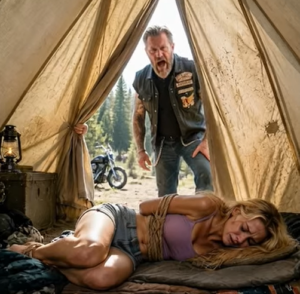
Inside my canvas tent in the middle of the desert camp and roared down at me while I was tied hand and foot, demanding to know how long I had been held captive
The audio file played for eleven seconds, and in those eleven seconds the whole desert seemed to stop breathing.
“Move the product at midnight, Marcus, and make sure the Carter children are not found alive,” the voice said, calm and low and unmistakably warm, the same voice that had once sung me to sleep with a lullaby about a river and a silver boat.
My brother’s bandaged hand closed around my wrist so tightly that the bones ground together.
“That’s not her,” Eli whispered, and his face had gone the color of wet ash. “Nova, that can’t be her. We buried her. We stood at the grave.”
“We buried a closed casket,” I said, and my own voice sounded like it was coming from the bottom of a well. “Nobody saw her body.”
The medic wrapping Eli’s shoulder paused, glanced at our faces, and quietly stepped back, as if grief were a thing that could be caught.
Federal marshals moved around us in the smoking trailer, bagging servers, photographing Vance’s body, calling out serial numbers, and none of them seemed to notice that the world had just cracked in half under our boots.
I replayed the file with a shaking thumb.
Move the product at midnight. Make sure the Carter children are not found alive.
There was a faint sound behind the words, a tick, tick, tick, and I realized it was a clock, an old pendulum clock with a slightly crooked beat.
I knew that clock.
It had hung in the kitchen of our farmhouse in Montana for my entire childhood, and my father had never fixed it, because he said a house needed one thing that was a little bit wrong to feel like home.
“Eli,” I breathed. “The clock. She’s recording from the farmhouse.”
“The farmhouse burned down.”
“Did it?” I held up the phone. “Or did we only believe that because a man in a suit told us so?”
He stared at me, and I watched the same thought arrive in his eyes that had just arrived in mine, a thought so large and so terrible that neither of us could hold it alone.
“Vance told us,” Eli said slowly. “He brought us the news. He signed the death certificates.”
“And he told us Dad was a traitor.”
“And he told us Mom was gone.”
My knees nearly gave out, and I caught the edge of a server rack and stood there with my forehead against the warm metal while the room tilted around me.
Everything I believed about my family had been built by a liar, and I had been standing in his house for ten years.
“Commander,” I said, and I turned to the tall woman in the navy jacket who had barked the orders. “I need to know where this signal came from.”
She looked at me for a long, measuring second. She had gray eyes and a scar through one eyebrow, and the badge on her chest read S. ADEYEMI, FBI.
“The ping came off a satellite receiver on Vance’s pocket drive,” she said. “Same drive you copied from, I’d guess. Why?”
“Because that audio was recorded recently,” I said. “Last few days. And I need to find the room it was recorded in.”
“Miss Carter, you’ve had a very long day—”
“Commander Adeyemi,” Eli said, rising to stand beside me with blood soaking through his bandage, “my sister and I just spent ten years believing our parents were dead. If you tell us to go sit in an ambulance, I promise you we will walk out of this camp and find the answer ourselves.”
Adeyemi studied us, and something in her stern face shifted, a small softening, as if she were remembering a day when someone had told her to sit down and she had refused.
“Get me the drive,” she said to a young technician. “Run the audio. Isolate the background. I want every sound in that file.”
The technician, a gangly kid with headphones around his neck, plugged the drive into a laptop and bent over it, and the rest of us waited in the sour smoke while the minutes dragged.
“Got something,” he said at last. “There’s a train whistle at second seven. Low, then high, two-tone. That’s a Doppler shift, so it’s passing close. Then at second nine a church bell, single toll.”
“A train and a church,” Adeyemi said. “That narrows it to about ten thousand towns.”
“Not if the whistle’s the Great Northern line,” I said, and the words came out before I knew I was going to say them. “Two-tone horns, old locomotives, they still run a tourist train past Larch Hollow in the summer. We used to wave at it from the porch.”
Eli looked at me with wide eyes.
“Larch Hollow,” he said. “Mom’s sister’s place. Aunt Judith’s cabin. It’s four miles from our old farm.”
“The cabin where nobody’s lived since the funeral,” I said.
Adeyemi was already moving.
“Helicopter in ten,” she called to her team. “Two tactical units, one medic, one negotiator. We’re going to a cabin in Montana, and I want everyone to understand that this is a rescue and an arrest in the same breath, and I won’t have anyone shooting a woman who may have been a victim.”
“Or a villain,” a young marshal muttered.
“Or both,” Adeyemi said. “People are rarely only one thing.”
We flew north through the afternoon and into a dusky violet evening, the rotors drumming in our chests, the desert giving way to scrub and then to dark mountains and then, finally, to the rolling emerald forests of home.
Eli sat beside me with his good hand wrapped in mine and said nothing for most of the flight.
“If she’s alive,” he said at last, over the roar of the engines, “I don’t know whether I want to hug her or scream at her.”
“Maybe both,” I said.
“Maybe I’ll do it in that order.”
“Maybe she’ll deserve it in that order.”
He laughed, a cracked, tired sound, and leaned his head against my shoulder, and for a moment we were children again, huddled in the back of our father’s pickup under a blanket, watching stars go by.
Larch Hollow rose out of the dark like a half-remembered dream, a single church steeple and a scatter of porch lights and a long silver ribbon of river.
Adeyemi’s team set down in a hay field a mile from the cabin, and we moved through the dripping pines on foot, thirty shadows in black, boots whispering over wet needles.
The cabin sat at the end of a dirt lane, small and square and dark, with smoke rising from the chimney in a thin, steady thread.
Someone was home.
My heart slammed against my ribs, and I felt Eli’s fingers tighten on mine.
“Nova, Eli, you stay back,” Adeyemi whispered. “This is as far as civilians go.”
“Commander,” I whispered, “please.”
She looked from me to Eli and back again, and I saw her calculate the risks, the regulations, the lawsuits, and then I saw her set all of it down.
“You stay behind me,” she said. “Every step. If I say get down, you hit the dirt. No arguments.”
“Yes, ma’am.”
The team fanned out, two units to the rear, two to the sides, and Adeyemi led us up the porch steps with her pistol low and her face set in stone.
Through the front window I could see the glow of a fire and the outline of a woman sitting in a rocking chair with her back to the glass, a gray shawl around her shoulders, her silver-streaked hair coiled at her neck.
My mother had never had gray in her hair.
But the shape of her shoulders, the tilt of her head, the way her hand rested on the arm of the chair, all of it was so painfully, perfectly familiar that I had to bite my lip until I tasted blood.
Adeyemi knocked once on the door with the heel of her hand.
“FBI,” she called, loud and calm. “Ma’am, we’re coming in. Please keep your hands where we can see them.”
The rocking chair stopped.
For a long, long moment, nothing moved in the cabin at all, and then the woman said, in a voice that struck through my chest like a bell, “It’s open, Commander. I’ve been expecting you for ten years.”
Adeyemi pushed the door wide, and we all stepped into a small room that smelled of woodsmoke, lavender, and old books.
The woman rose slowly from her chair, hands lifted, and turned around.
It was my mother.
She was thinner than I remembered, and there were lines around her eyes that hadn’t been there when I was fifteen, but the eyes themselves were the same deep brown, and they filled with tears the instant they found my face.
“Nova,” she whispered. “Eli. Oh, my babies.”
I could not move.
Ten years of grief and fury and longing rose in me all at once, a wave so enormous that I could not tell which part of it was love.
“You’re alive,” Eli said, in a voice that was almost a growl. “You’ve been alive this whole time.”
“Yes.”
“We buried you.”
“I know.” Tears spilled down her cheeks, and she did not wipe them away. “I was there. I watched from the tree line. I watched you both throw a handful of dirt on an empty box, and it was the worst moment of my life, and I would do it again to keep you alive.”
“Keep us alive?” The words burst out of me like a shout. “Mom, you ordered us dead! I heard it! ‘Make sure the Carter children are not found alive!’ That was your voice!”
“It was,” she said quietly. “And it was a lie, and I need you to let me explain before you decide what to do with me. I will not ask for more than that.”
Adeyemi had not lowered her weapon. “Mrs. Carter, you are under suspicion of conspiracy to commit murder. I am obligated to take you into custody.”
“I know, Commander. I would like to give you a statement first. Everything I’m about to say is on tape.” She nodded toward an old cassette recorder on the table, its little red light glowing. “And on a second recorder in the kitchen. And a third in the bedroom. I’ve been preparing for this day for a very long time.”
Adeyemi lowered the gun by an inch.
“Talk,” she said.
My mother sat down slowly, and she gestured for us to sit too, and after a moment, Eli and I perched on the edge of a faded quilted sofa like children called to the principal’s office.
“Ten years ago,” she began, “your father discovered that Special Agent Gerald Vance was laundering cartel money through a federal informant program. He was a records clerk with the Bureau, a small man in a small office, and he stumbled onto a spreadsheet he was never supposed to see.”
“Ghost,” Eli said. “The call sign.”
“Your father was never a biker. That was Vance’s invention, a story to make him look like a criminal.” She smiled faintly. “Cal Carter was a bookkeeper. He couldn’t ride a bicycle without falling off.”
I let out a startled, wet laugh.
“He went to his supervisor, and the supervisor was in Vance’s pocket, and that same night men came to our house with gasoline.” Her voice dropped. “He got me out through the cellar. He told me to take you both to the neighbors, and he went back for the files.”
“The fire,” Eli whispered.
“I never saw him come out.” Her hands twisted in her lap. “I thought he was dead. For six years I thought he was dead. Vance told the world we had all died in that fire, and he arranged the funeral, and he took custody of the case.”
“You were at the funeral,” I said. “You said you were in the trees.”
“Because I was on the run, Nova. Because if Vance found out I had escaped, he would have hunted all three of us.” She wiped her eyes. “I hid you with the neighbors, and then, when I understood how deep the rot went, I slipped away and let Vance believe the whole family had burned.”
“You left us,” Eli said, and now his voice shook. “You let us grow up in foster care.”
“I did.” Her face crumpled. “It is the worst thing I have ever done, and there is no excuse that is large enough. I told myself it was safer. I told myself I could watch over you from far away until I found a way to take Vance down.”
“And the audio?” I asked. “The order?”
My mother drew a long breath. “Three days ago I found out that Vance had located my safe house. He was going to find the two of you next. I realized the only way to keep you alive was to make him believe that I was still working for him.”
“You recorded a fake order,” Adeyemi said slowly.
“I called his private line and told him I had changed my mind. I said I would help him finish what he started, if he would only call off his dogs. I begged him for a chance to prove my loyalty. And then I recorded the call and left it on a pocket drive in a dead drop, where I knew his people would find it.” She looked at me. “I needed you to hear it.”
“Why?”
“Because I needed you to come here.”
A silence fell over the cabin so deep that I heard the logs shifting in the fireplace.
“You wanted us to find you,” I said.
“I wanted you to find me alive, and safe, and in the company of the Federal Bureau of Investigation, before Vance’s last man found me dead.” She reached for my hands, and I let her take them. “Nova, I am so sorry. I would have walked through fire to protect you. I would have walked through fire to see you. But I did not know how.”
I looked at her hands, small and wrinkled and trembling, and I remembered them braiding my hair on a porch swing, and I felt something in my chest give way like ice on a spring river.
“You’re not allowed to leave again,” I said.
“Never,” she whispered.
Eli made a sound that was half laughter and half sob, and then he dropped to his knees in front of her and she pulled him into her arms, and I leaned in and wrapped myself around both of them, and for the first time in ten years the three of us were together in a single warm embrace.
Adeyemi lowered her pistol, and quietly holstered it, and turned to look out the window to give us our moment.
We stayed like that for a very long time.
“Now,” my mother said eventually, pulling back and wiping our faces with the corner of her shawl, “I believe there is a matter of your father.”
“Dad’s dead,” Eli said.
“Is he?” She smiled, and it was a sly, secret, wonderful smile that I recognized from my childhood birthday mornings. “Commander, you’ll want to make a call to the Billings county jail.”
Adeyemi’s eyebrows climbed. “Mrs. Carter?”
“Four years ago I found him, Commander. He had been living under a false name in a federal protective facility, a prisoner of Vance’s, held as a bargaining chip. He escaped, and he turned himself in to the Billings sheriff, and he has been sitting in a protective custody cell ever since, waiting for the world to be safe enough for him to speak.”
“And you’ve known all this time?” Eli breathed.
“I wrote him a letter every week,” she said. “He wrote me back. We didn’t dare put our real names on them.”
“Mom.” I stared at her. “You mean we could have…”
“I wanted to bring you both to him as soon as it was safe, and not one hour before,” she said. “I would not risk losing one more person.”
I laughed, and I cried, and I laughed again, and I thought my heart might simply burst.
It took six hours and four federal judges to get him out of that jail.
The helicopter landed on the county sheriff’s lawn at three in the morning, and a heavyset deputy walked out of the front doors with a tall, stooped, gray-haired man in a county orange jumpsuit, blinking in the glare of the floodlights like a man who had been underground too long.
My father had always been big, and he was smaller now, shrunken by years of fear and waiting, but when he lifted his head and saw the three of us standing in the grass, his whole body straightened as if someone had pulled a string.
“Cal,” my mother said softly.
“Annie,” my father whispered.
They crossed the grass toward each other like sleepwalkers, and when they met, he lifted her clean off her feet and held her against his chest with his face buried in her hair, and his shoulders shook.
“Dad,” Eli said, and his voice cracked in half.
My father turned, and he saw us, and the sound that came out of him was something I will never forget, a low, ragged, wordless cry that was the sound of a decade finally being let go.
He opened one arm, and then the other, and my brother and I ran into them.
We stood in the middle of the sheriff’s lawn, four people wrapped together in a single knot of arms, and the sun began to rise over the Montana hills, pouring gold across the grass.
“You’re all so tall,” Dad said, and he laughed, and he cried. “When did you get so tall?”
“You missed it,” I said. “You missed all of it.”
“I know. I know I did. And I’m going to spend the rest of my life making up for every single day.”
“You can start with breakfast,” Eli said.
“Breakfast,” Dad said reverently, as though it were a holy word. “I haven’t had a real breakfast in ten years.”
The trial of Gerald Vance’s network began that winter, and it lasted five months, and it was the largest corruption prosecution in the history of the Bureau.
My father took the stand for eleven days, the quiet bookkeeper at the center of the storm, and when he finished, the entire gallery stood and applauded, and the judge let them.
The surviving members of the cartel ring went down one by one, thirty-seven of them in total, and the biker gang that Vance had used as a front turned state’s evidence en masse.
The gang’s leader, the grizzled man who had cut my ropes, walked into the federal courthouse on the second day of the trial and asked to testify.
His name, I learned, was Dalton Reese, and he stood in the witness box with his big scarred hands folded and told the court every secret of Vance’s scheme, and when the prosecutor asked why he had come forward, he glanced across the room and found my eyes.
“A girl once told me the name of her father,” he said. “And I realized I’d been the pawn in a game that killed a good man’s family. I wanted to make it right.”
He received eight years instead of thirty for his cooperation, and when he came out of the courthouse in handcuffs, I walked to the rail and held out my hand.
He looked at it for a moment, and then he shook it with a grip like an old leather glove.
“You’ve got your father’s nerve,” he rumbled. “I always said Ghost was the smartest man I never met.”
“He’s right over there,” I said, pointing. “You can meet him if you want.”
Dalton looked across the room at my father, and my father looked at him, and the two of them nodded to each other, two tired men from opposite ends of the same long story.
Spring came to Larch Hollow that year with wildflowers on the hills and the tourist train whistling past the porch, and we moved back into the farmhouse that had burned, which the Bureau had quietly rebuilt on the old foundation, plank by plank, with the crooked pendulum clock hanging in the kitchen again.
My father had found it in a salvage yard in Missoula and carried it home in his arms like a baby.
“A house needs one thing that’s a little bit wrong,” he told me, hanging it on its old nail, “to feel like home.”
I laughed until I cried, and then I cried until I laughed, and he held me with one arm while he adjusted the clock with the other.
In June, Eli married a nurse named Priya he had met in the hospital where his shoulder healed, and my mother sewed the dress, and my father walked them both down the aisle in a suit too big for him, weeping openly.
I stood beside my brother as his best man, because he insisted, in a borrowed tuxedo with a sunflower in the lapel, and when the preacher asked who gave this woman to this man, the whole church laughed as I stepped forward and said, “Her family does, and so does ours.”
Afterward, we danced on the farmhouse lawn under strings of paper lanterns, the four of us and a hundred neighbors and one tired old biker named Dalton, out on parole and wearing a clean shirt, who danced with my mother to a waltz and told her she was the bravest woman he had ever met.
Late that night, when the guests had drifted away and the lanterns burned low and the fiddle had fallen silent, I sat on the porch swing with my father, listening to the crickets.
“Dad?” I said.
“Mm?”
“Do you ever think about the years we lost?”
He was quiet for a moment, and the swing creaked gently beneath us.
“Every day,” he said. “But I don’t think about them the way I used to. I used to think of them as a debt, something I owed you that I could never repay. Now I think of them as a long winter.”
“A winter?”
“A very long, very cold winter,” he said, smiling. “And I’m sitting on the porch with my family on the first warm night of spring. And it turns out that makes the spring a great deal sweeter.”
I leaned my head on his shoulder and closed my eyes.
Inside the farmhouse the old pendulum clock ticked in the kitchen, a little crooked, a little off beat, a small imperfect heart keeping time for a family that had been broken and put back together.
Out on the hills the tourist train whistled low and high, two-tone and long, and I lifted my hand and waved at it from the porch, the way we used to when we were children.
Somewhere in the dark, I like to think, a ghost finally laid down his burden, and smiled, and went home.