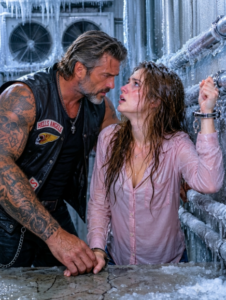
Inside a terrifying industrial freezer while a brutal biker glared down at my soaked clothes, accusing me of theft
The first thing I noticed in the thin gray light was that my hands had stopped shaking.
For two days they had trembled so badly that I could not hold a coffee cup, and now, standing on the ranger station porch with the snow settling softly on my shoulders, they were still and warm inside Jackson’s leather vest.
Behind us, agents were hauling Marcus out through the splintered doorway with his balaclava hanging from his neck and his face the color of old candle wax.
He did not look at Jackson.
He looked at me, with a flat, strange expression I could not read, and then the agents turned him toward the helicopter and the whirling snow swallowed him.
“Miss Hartley?” said a woman’s voice at my elbow.
She was tall and broad-shouldered, in a navy parka with FBI stitched across the chest, and she had the lined, patient face of someone who had spent twenty years being the calmest person in every room she entered.
“Special Agent Denise Okafor,” she said, and offered a gloved hand. “I’ve been reading your messages since Tuesday night.”
“You answered them,” I said.
“I answered the ones that wouldn’t get you killed.”
I laughed, a thin cracked sound, and she smiled back, and for a moment we were just two tired women on a porch at the edge of the world.
“The data you uploaded is a gift,” Okafor said. “Marcus Dunn’s offshore routing, the falsified maintenance logs, the chemical leak cover-up at the Pinecrest plant. We have been trying to tie those together for three years.”
“Pinecrest,” I said slowly, and the word dropped through me like a stone.
“You know it?”
“My family worked there.”
Okafor’s smile faded. “Miss Hartley, I think you and I need to sit down with a very large pot of coffee.”
Jackson shifted beside me, and I felt his eyes on my face.
“Chloe,” he said quietly. “You told me in the freezer that you were trying to save my men. You never told me why.”
I looked out at the white mountains, rosy now at the edges where the sun was finally pushing through.
“Because nobody saved mine,” I said.
The ranger station’s kitchen was small and warm, with a woodstove ticking in the corner and a pot of coffee that Okafor had commandeered from somewhere and set bubbling on the burner.
I wrapped both hands around a chipped mug and watched the steam curl, and Jackson sat across from me with his massive forearms resting on the table, and neither of them rushed me.
“Seven years ago,” I began, “I was seventeen, and my father was a maintenance supervisor at the Pinecrest cold storage plant outside Billings.”
My voice wobbled, and I steadied it.
“He found a leak in the ammonia line. Not a small one. Something that had been seeping for months behind a wall panel, and someone had signed off on the repairs without ever sending a crew.”
“Falsified records,” Okafor said.
“He took the logs to the plant manager. The plant manager told him to forget what he’d seen.” I swallowed. “He didn’t forget. He made copies. He was going to take them to the state inspector on a Monday morning.”
“And on Sunday night?” Jackson asked softly.
“There was a fire.” The words came out flat and dull, the way they always did when I said them aloud. “A fire in our house. My mother, my father, and my little brother Eli. He was nine.”
Jackson’s big hand closed slowly into a fist on the table.
“I was at a sleepover,” I said. “That’s the only reason I’m alive. I came home to a police tape and a chimney standing in the ashes, and the fire marshal said it was faulty wiring.”
“It was not faulty wiring,” Okafor said gently.
“No.” I looked up at her. “I spent six years learning that. I got a job at the county records office, because I wanted to read every document that crossed that desk. I found the same plant manager’s name on three other incident reports. Same pattern. Same falsified logs.”
“And Marcus?”
“Marcus Dunn was the plant’s regional security contractor,” I said. “And two years ago he started riding with the Ashfall Riders.”
Jackson went very still.
“He joined your club to use it,” I said. “He needed a legitimate-looking organization to move money through, and a president whose name he could pin things on if the feds ever got close.”
“He told me his brother was killed in a plant accident,” Jackson said hoarsely. “That’s why he wanted in. He said he wanted a family.”
“He killed my family,” I said. “And then he borrowed yours.”
The silence in the kitchen was so deep that I could hear the snow sliding off the roof.
Jackson pushed back his chair and walked to the window, and stood with his broad back to us and his hands braced on the sill.
“I gave him a patch,” he said, in a voice scraped raw. “I stood him up in front of forty men and said he was my brother. I gave him a key to the clubhouse. I gave him the combination to the safe.”
“Jackson,” I said.
“I almost hurt you.” He did not turn. “In that freezer. I had my hands on you, I had you against that wall, and I called you a thief. If you hadn’t had the nerve to keep talking…”
“I knew you wouldn’t hurt me.”
“You didn’t know that.”
“I did,” I said, and was surprised to find it true. “Six months ago I followed your club for two weeks. I watched you pull a dead deer off the highway so kids on the school bus wouldn’t see it. I watched you carry an old woman’s groceries to her porch when you thought nobody was looking. A man like that doesn’t hurt a woman who’s telling him the truth.”
His shoulders shook, once, and he pressed the back of his hand against his mouth.
Okafor studied her coffee with great concentration.
“There’s still the matter of the plant manager,” she said after a moment, gently. “Winston Pryce. We’ve never been able to put him in a room with Marcus.”
“I can,” I said.
Both of them looked at me.
“I stole one more thing,” I said, and drew a small plastic bag from inside my boot. “From Marcus’s office, the night before the raid. It was in the false bottom of his desk drawer.”
Inside lay a cheap black cell phone with a cracked screen.
Okafor took it between two fingers as if it were made of glass.
“A burner,” she breathed.
“The only number saved in it is Pryce’s. And the voicemail folder,” I said, “has three recordings. The oldest is dated seven years ago.”
I watched the color drain from the agent’s face as she understood.
“Seven years ago,” she repeated. “The night of the fire.”
“Play it,” Jackson said, turning at last, and his eyes were red and terrible. “Please.”
Okafor looked at me.
“It’s your family,” she said. “Your decision.”
I closed my eyes.
“Play it,” I said.
She pressed the button, and the little speaker crackled, and the voice that came out of it was low and calm and chillingly familiar, because I had heard it for six years in my nightmares without ever knowing whose it was.
“The supervisor’s house is handled,” Marcus said on the recording. “Nobody left but the girl, and she’s off the property. Pryce, I’ll want my second payment by Friday.”
A second voice, older and papery, answered. “No complications?”
“None. It’ll read as wiring.”
The recording ended.
For a long moment I did not breathe.
Then something broke open in my chest, a dam I had spent seven years building, and I put my face in my hands and sobbed, great ragged tearing sobs that shook my whole body.
Jackson was beside me before I could draw a second breath.
He knelt on the plank floor and gathered me against his chest, with one huge hand cupped over the back of my head, and I clung to him and wept into his flannel shirt while the woodstove ticked and the sun climbed the window.
“I’ve got you,” he kept saying, low and steady, like a man talking to a frightened animal. “I’ve got you, Chloe. I’ve got you.”
“He was nine,” I gasped. “He was just nine.”
“I know.”
“He wanted to be a firefighter.”
“I know, sweetheart.”
“They told me nobody suffered. They told me it was smoke. I don’t know if that’s true. I never knew.”
“It is,” Okafor said quietly, and I looked up. Her own eyes were wet. “I read the coroner’s addendum last night, the one the original report buried. All three of them were gone before the fire reached the bedrooms. Carbon monoxide, in their sleep. They didn’t wake.”
I stared at her.
Something warm and enormous rose in my throat, and it was not grief, or not only grief.
It was relief, so overwhelming that it frightened me.
“They didn’t wake,” I whispered.
“No,” Okafor said.
“They weren’t afraid.”
“No.”
I folded forward again, and Jackson held me, and I cried for a long time, and when it was over I felt scraped hollow and strangely clean, like a field after a hard rain.
Winston Pryce was arrested that afternoon at his lake house outside Missoula, in a bathrobe, with a cup of tea in his hand.
He did not resist, and he did not deny it, and when Okafor played him the recording in the interview room he put his head down on the metal table and said only, “I always knew it would be a girl.”
“Why a girl?” Okafor asked.
“Because only a child who lost everything has enough patience to wait seven years,” he said.
He confessed to everything.
It took four days and eleven hours of tape, and when the last transcript was signed, the Pinecrest Cold Storage case contained forty-seven counts against nine defendants, among them two county inspectors, a state deputy commissioner, and a retired judge who had signed the fire marshal’s report.
Marcus Dunn was the last to talk.
He sat in a federal holding cell for nineteen days without saying a word, and on the twentieth he asked to see me.
I did not want to go.
Jackson told me I did not have to, and Okafor told me the same, and my own heart told me the opposite, so I went.
They gave us a small room with a table and two chairs and a window of thick glass, and Marcus sat on the far side in an orange jumpsuit with his hands cuffed in front of him.
He looked older.
The cocky grin was gone, and the lines around his eyes had sunk into pouches, and his hands, which I had once seen steady as a surgeon’s around a rifle, trembled against the steel.
“Chloe,” he said.
“Don’t say my name.”
“All right.”
We sat in silence for a time.
“I came to tell you something,” he said at last. “Not to ask forgiveness. I don’t want it. I wouldn’t know what to do with it.”
“Then why?”
“Because you have a right to know the whole thing.” He lifted his eyes. “I did not set that fire.”
My hands went cold.
“I was there,” he said. “I was told to make sure nobody was home. I drove up the lane at two in the morning, and the house was already burning. Pryce had hired a second man, a cleaner, to do the job without telling me.”
“You’re lying.”
“I’m not.” His voice cracked. “I stood in the yard and watched the windows go orange. I heard nothing. I thought nobody was inside. I thought Pryce had misled me, and that you were all at your grandmother’s or at some sleepover, and that the house would burn empty.”
“And then?”
“And then in the morning I found out.” He closed his eyes. “I found out about your parents and your brother. And I have been sick about it every single day for seven years.”
“You recorded that call.”
“I recorded it the next night. When I called Pryce and told him he’d killed a child, and that I was done.” A dry, bitter laugh escaped him. “He told me if I ever said a word, the same man would come for me.”
“So you stayed.”
“So I stayed. I took the money. I ran his errands. I told myself that by joining a motorcycle club and moving his cash, I was doing penance, or at least staying alive.” He looked at his cuffed hands. “And then I saw you, Chloe, two weeks ago, in the audience at a charity ride, with your father’s eyes, and I knew.”
The little room swam.
“I didn’t alter those logs to frame Jackson because I hated him,” Marcus said. “I did it because Pryce told me to, and because I was a coward. But I let you find the burner phone. I left the drawer unlocked.”
“You what?”
“You think a seventeen-year-old’s nightmares led you to the false bottom of my desk?” He smiled sadly. “I left it open for you. It was the only way I knew to tell the truth without saying a word.”
I could not speak.
“I deserve whatever they give me,” he said. “I’m not asking to be spared. I only wanted you to know that the man who wrote your family’s name on a death warrant also left the door open so you could walk through it.”
I rose, slowly.
“I don’t forgive you,” I said.
“I know.”
“But thank you for telling me the truth.”
He nodded, and his eyes were wet, and I turned and walked out of the room and did not look back.
Marcus Dunn pleaded guilty to conspiracy and arson and accessory to murder, and the judge, a stern woman with silver hair, sentenced him to thirty years, noting that his cooperation was the only reason it was not life.
Winston Pryce received three consecutive life terms.
The retired judge, the deputy commissioner, and the inspectors drew sentences ranging from twelve to forty years, and the Pinecrest plant was shut down and torn to the ground by a state demolition crew in a single bright March morning, while a crowd of former employees watched from a hillside and cheered.
I stood among them.
Jackson stood beside me with his arm slung around my shoulders, and as the great gray tower swayed and crumbled in a roiling cloud of dust, I felt him lean down and press his lips to my hair.
“Your dad would’ve liked that,” he murmured.
“He’d have wanted a hard hat,” I said, and he laughed.
Spring came late to Montana that year, and then all at once, a rush of green and meltwater and meadowlarks singing from every fence post.
The Ashfall Riders held a vote in April, in the old stone clubhouse by the river, with thirty-eight members crowded around a scarred oak table and the windows thrown open to the smell of mud and pine.
Jackson stood at the head of it with his hat in his hands.
“I trusted the wrong man,” he said. “I put a murderer at my right hand, and I never saw it. I don’t think I’m fit to lead a club.”
“Sit down, Jackson,” said an old biker named Barnaby, his voice rough as gravel. “We’re not here to bury you.”
“Then why?”
“We’re here to give you something.” Barnaby nodded toward the door, and it swung open.
I stood in the frame with my hands clasped, wearing my mother’s old green sweater and feeling foolish, because Jackson had told me only that the club wanted me at a meeting, and I had come expecting a thank-you.
“Chloe Hartley,” Barnaby said, rising slowly to his feet, and the whole table rose with him. “Three months ago you walked into a freezer in the middle of a blizzard because you wouldn’t let one more family burn. This club owes you a debt we can never pay. We’d like to start anyway.”
He held out a black leather vest.
On the back, in careful silver thread, was the Ashfall Riders emblem, a phoenix rising from a ring of flame.
Beneath it, stitched in smaller letters, was a single word.
ELI.
My hand flew to my mouth.
“Jackson told us about your brother,” Barnaby said gently. “We figured if he wanted to be a firefighter, he’d have wanted to ride with a phoenix.”
I could not see.
Tears blurred the whole room into a shimmering gold, and I felt Jackson’s arms close around me from behind, and heard thirty-eight voices begin, softly, to clap.
“Honorary member,” Barnaby said. “For life. If you’ll have us.”
I turned in Jackson’s arms and looked up into his weathered, wet, grinning face.
“I don’t know how to ride,” I whispered.
“I’ll teach you,” said Jackson.
“I’m terrible with machines.”
“I’ll teach you anyway.”
I laughed, and wept, and put on the vest, and it fit as though it had been made for me.
It took me all summer to learn.
I stalled the little Honda forty-one times in the first week, and Jackson stood in the gravel lot with his arms crossed and his mouth twitching, calling out gentle advice and never once laughing out loud.
By July I could manage a full lap.
By August I could take a corner without screaming.
By September I could ride the whole river road with the wind pouring through my hair and the club rumbling behind me in a long line of chrome and thunder, and I understood, for the first time in seven years, what it felt like to move forward without looking over my shoulder.
We stopped at the old Hartley place on a cool bright Sunday in October.
The chimney still stood there, black and weather-stained, rising from a field of tall golden grass, and the foundation had sunk into a rough rectangle of wildflowers.
I walked into it alone while the club waited by the road.
The grass whispered against my knees.
I stood in what had been my parents’ bedroom, and then my own, and then Eli’s, and in each one I paused and let the memory rise, my father’s tired laugh, my mother’s humming, my brother’s endless chatter about fire trucks.
At the edge of Eli’s room, half buried in the dirt, my boot struck something small and hard.
I knelt and brushed the soil away.
It was a toy fire engine, red paint blackened and blistered, one wheel gone, its tiny ladder still folded against its roof.
I held it in both hands.
“Hi, bud,” I whispered. “I found it.”
The wind moved across the field and rattled the dry seed heads, and I could have sworn I heard, very faintly, a child’s laugh.
I did not cry.
I only smiled, and slipped the little truck into the pocket of my vest, and stood up with the autumn sun warm on my face.
Behind me I heard a boot on the dry grass, and then Jackson’s arm slid around my waist.
“Ready?” he asked.
“Almost.”
I looked once more at the black chimney and the wildflowers and the long golden light slanting across the field.
“Goodbye,” I said softly. “I’m all right now. You can rest.”
Jackson did not speak.
He only held me, and we stood together in the quiet of that October afternoon until the shadows lengthened and the club began to idle its engines on the road.
We were married the following June, on the bank of the river, in the shade of a huge old cottonwood, with thirty-eight bikers in clean vests standing in a half circle and a sky the color of forget-me-nots overhead.
Okafor sat in the front row in a pale blue dress and cried openly into a handkerchief.
Barnaby gave me away, weeping noisily, and Jackson, standing at the end of the path in a black suit and a leather vest, wore the expression of a man who could not believe his luck.
“Do you, Chloe,” the old chaplain asked, “take this man?”
“I do,” I said, and my voice rang out clear across the water.
“And do you, Jackson, take this woman?”
“I’ve been trying to for a year,” said Jackson, and the whole river bank roared with laughter.
When they pronounced us married, the club let out a thunderous cheer, and a hundred doves rose from the cottonwood in a white spiraling cloud, and the engines of thirty-eight motorcycles roared to life along the road.
We rode out together that afternoon, my husband and I, on his big black chopper, with the little red fire engine tucked into my vest and my arms wrapped around his waist.
The road ran gold ahead of us through the long green valleys of Montana.
Behind us the whole club followed in a gleaming river of light, and as the wind poured over my face I closed my eyes and let the old cold finally leave me.
I thought of a freezer in the dark, and a trembling girl pressed against the frost with a flash drive in her fist and nothing left to lose.
She had believed she was alone.
She had never imagined that the man towering over her with ice in his eyes would one day carry her home.
And as the sun slid low over the mountains and the whole world turned to amber, I leaned my cheek against Jackson’s broad back and whispered the words that had taken me seven years to learn.
“I’m home.”