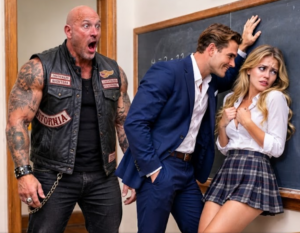
Inside a high school classroom, an imposing biker in a leather vest slammed open the wooden door and glared at us with murderous fury
The name on the screen was Elena’s.
Not a memorial page. Not a glitch in an old contact. A live handset we had buried with an empty coffin story three years ago, pinging a federal laptop on a teacher’s desk while the classroom still smelled of chalk, fear, and the sharp bite of whatever the agents had thrown through the glass.
Haley read it over my shoulder. Her tears had stopped so cleanly it frightened me more than the crying.
“Mom is alive, and she’s the one who sent them here.”
I closed the laptop before the room could turn it into a shrine.
“She sent a message. We do not know the whole machine yet.”
The lead agent took the computer without a speech. Her vest said Ruiz. Her face said she had already had this kind of morning in other towns.
“We know enough to move you. This school is a scene. Your house will be a scene the moment someone posts the vest. There is a third place.”
“What place.”
“One she does not pay for.”
They walked us out through a side hall. Students cried in clusters. A teacher counted heads with a pencil that shook. Cole Whitaker, the name the biker had worn like a debt, left on a stretcher with his wrists bound, awake enough to hate the ceiling tiles. The principal found his voice only after the leather was gone. Apologies, then. I did not collect them.
I kept Haley under my arm until the van door shut.
“Dad.”
“I am here.”
“You said Los Angeles was finished.”
“I said I left it. Leaving is not the same as finished. I was wrong to let you learn the difference in front of a chalkboard.”
She stared at her cuffs. The uniform gray had gone darker with dust from the floor.
“If Mom sent them, she wanted the account. The one you said was for college.”
“The account was never syndicate money. It was the settlement from your grandfather’s patents. Clean paper. Elena wanted it retitled into a joint trust the month before she disappeared. I refused. A week later the police called her car into a river and asked me to identify a bracelet.”
“And you believed the river.”
“I believed a grief that made me easy to aim. That part is on me. The bracelet was hers. The body was not. I did not ask the second question. I was busy building you a town that did not know the first.”
Ruiz drove without sirens. Silver Creek slid past in ordinary storefronts, suddenly thin as paper. At a service road she killed the engine behind a grain elevator that had not ground anything in a decade.
“Elena Whitaker is not a ghost,” she said.
“She has been living under a married name in Nevada, moving pieces through a club Cole runs when he is not terrifying schools. The raid you saw was ours. The message on the laptop was hers, sent to Cole’s phone, mirrored because we already had his handset in a bag. She told him to take the girl, force a signature, and leave you as the lesson. We were in the window before he finished the speech.”
Haley made a small sound. Not a sob. A door closing inside a house I could not see.
“So she did send them.”
“She sent him. We sent us. Different verbs. I need you to keep them separate or the week will eat you.”
I looked at Ruiz.
“Can she reach the account without us.”
“Not legally, and not practically. That is why the classroom. She is out of quiet proxies. Cole was the last loud one she trusted to frighten a school into silence.”
“Then we end it in a room with lights.”
“That is the offer. You testify to the debt story and the account. Haley does not have to sit in the well. She can sit behind glass. Elena will be picked up if she keeps the Nevada pattern. She has not broken it in eighteen months. People who fake deaths get superstitious about routines.”
Haley lifted her chin the way her mother used to, and the likeness hurt in a place I had boarded up.
“I want to see her face when she hears I will not sign.”
“You can want that,” I said.
“You do not have to spend it. Being right does not require a front row.”
She was quiet for a mile of gravel.
“Glass,” she said.
“Not the well.”
“Glass,” Ruiz said.
“I will put a woman with her who does not talk unless asked.”
They moved us that night to a rented house with bad art and good locks. I called the school and told the truth in the shortest sentence that would keep Haley from becoming a hallway myth. A man with an old grudge. Federal custody of the threat. Classes when she wanted them. She wanted them, then did not, then wanted the math test more than the fear. I drove her to the side door myself and waited in the lot like a man who had finally accepted that vigilance is a job, not a mood.
The first night she did not sleep. I did not pretend to. We sat at a table that was not ours and ate toast because toast does not require a story.
“Did you fight in those rings,” she asked.
“Yes.”
“For them.”
“For money that became an exit. Then the exit grew a toll. I paid the toll. I did not pay Elena’s version of it. She decided unpaid was more profitable than divorced.”
“Would you have told me if he had not come.”
“I told myself I would when you were older. That is what liars say when they love you. I am done with that sentence.”
She nodded, once, as if accepting a corrected assignment.
Elena was taken at a diner outside Reno, paying for eggs with a card in the married name. No speech. No last stand. A quiet arrest that would have insulted Cole’s sense of theater. Ruiz sent a photo so we would not feed the ghost another week. Elena looked tired. She looked like Haley around the mouth. She did not look like the river.
Haley studied the photo longer than I wanted and shorter than I feared.
“She cut her hair.”
“Yes.”
“She doesn’t look sorry.”
“Photos are bad at sorry. Court is better at records. We will take the record.”
The hearing was on a Thursday with rain that could not commit. I wore a jacket that had never seen a ring. Haley wore her own clothes, not the uniform, and sat behind glass with a woman from victim services who understood silence.
Elena saw me and tried the old softness, the one that used to end arguments about money by calling them care.
“You brought her.”
“The court brought the record. She chose the glass.”
“This is a misunderstanding about funds that were always meant for her future.”
“This is a man in a school with a vest, and a phone that was supposed to be at the bottom of a river. You can explain the misunderstanding to the judge. I am here for the parts with dates.”
She looked at the glass. Haley did not wave. That was the mercy. A wave would have been a performance. Stillness was the truth we could afford.
Cole took a plea that named Elena as the voice on the order. He described the classroom in flat words and lost the myth by lunch. Elena took longer. She named a banker, a cousin, and at the end the river story as a plan she had purchased because she wanted the account without the marriage and without the man who would not retitle it. The offshore paperwork was a forgery. My signature had been practiced from a birthday card Haley made in fourth grade. The real account stayed where I had put it, in a trust Haley could not touch until she was grown, and could not be bullied into signing before that.
After, in the corridor, Haley was quiet for a whole floor of tile.
“She looked smaller.”
“Anger is large. Rooms shrink it.”
“Do I have to forgive her.”
“No. You have to be safe. Forgiveness is a door you may never open. Safety is the lock we already changed.”
“Do you forgive her.”
“I am not there. I am at the part where I tell the truth and pay the bills and drive you to school. Forgiveness can get in line.”
She almost smiled. We ate sandwiches in a parking lot because restaurants felt like stages. She asked about Los Angeles in plain words. I answered in plain words. Debts I had paid. Fights I had left. A wife who decided a funeral was cheaper than a lawyer. No glory in it. Glory had been the lie Cole carried into a room full of teenagers.
Spring came back to Silver Creek in mud and track practice. Haley ran the four hundred and, by the third meet, did not look at the fence every lap. I learned the names of her teachers. I went to the conference and did not hide behind work. Ruiz closed the active file and sent a letter that said the threat picture was cold. I framed nothing. I put the letter in a drawer with the school calendar and a receipt for new glass at the school, which the district had already replaced without asking us to be symbols.
Elena wrote once from custody. Three pages. Care, regret, a request to see Haley “when the lawyers allow.” I read it standing at the sink. Then I asked Haley if she wanted the envelope.
“No.”
“I can keep it sealed.”
“Keep it for the lawyers. I don’t want her voice in my room.”
I did not answer Elena. Some silences are complete, and completing them is a kind of care for the person still in the house.
On the anniversary of the classroom I drove Haley past the school after hours. The windows had been replaced. The linoleum did not remember us. She got out, stood on the walk for a minute, and came back to the car.
“I don’t feel her here,” she said.
“Good.”
“I feel you in the doorway. That part I can keep.”
“Then keep it. The rest we leave on the record.”
We went home. Home was the same kitchen, the same bad lamp, a life that had been built on a foundation I had finally shown her instead of hiding under a suburb. She did her homework at the table. I fixed a hinge that had squeaked since before the vest. Ordinary sounds. I had not known how much I wanted them until the chalkboard day tried to take them.
Ruiz called once more, months later, only to say Cole had been moved and Elena had stopped writing the court. No new names. No new vests. I thanked her and went back to the hinge.
Haley graduated the year without another siren. At the ceremony she looked for me in the aisle, not for a ghost in the back row. After, we ate cheap pizza and she talked about a college that was far enough to be hers and close enough that I could still make the drive. The trust would open when the calendar said so, not when fear said so. She already understood the difference better than I had at her age.
I kept a single photograph from the old rings in a box I did not open for guests. Not a trophy. A receipt for a life I had paid to leave. When she asked to see it, I showed her, and I did not romanticize the blood. She closed the box herself.
“We’re not that,” she said.
“No.”
“We’re the doorway.”
“We’re the doorway.”
The lesson did not need iron on a hand to stay true.
A past can follow you into a school if you pretend it is only a story you survived.
A mother can be alive and still not be a safe place to stand.
Protection is not a speech between a child and a weapon. It is a second team in the window, a trust that cannot be signed in terror, a glass that lets a girl see the truth without being spent by it, and a father who stops lying about Los Angeles before someone else tells it louder.
Haley passed her exams. I made dinner. The phone did not ring with Elena’s name. Outside, Silver Creek did what small towns do when the sirens leave. It complained about the weather. It kept the lights on. It let a girl walk to the corner without a war at her back.
That was the ending we kept. Not a miracle and not a reunion. A lock, a record, a corrected story, and a morning that belonged to us again.