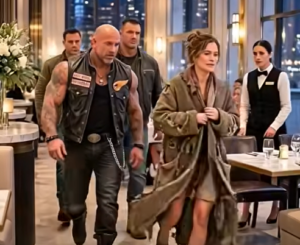
In the high-end luxury restaurant while a massive, tattooed biker leader aggressively pointed his finger and demanded that we leave our table immediately
The doors had not fully closed when the lead investigator turned back to the table. His name was Harlan. He did not holster the weapon he had not drawn. The restaurant staff were still frozen between the kitchen doors and the marble floor, and the other patrons had begun the careful business of pretending they had not watched a man in a leather vest try to reach for a gun over a plate of untouched scallops.
“The indictments are real,” Harlan said. “The timing of your nod was not in the operational plan. If you have the original drive on you, I need it before his lawyer claims the folder in the vest was planted between the appetizer and the arrest.”
I took the drive from my pocket and set it on the linen. Harlan bagged it without touching the surface. One of his people was already photographing the black leather folder that had spilled from Viktor’s vest when they took him down. The pages inside were printouts of the same transfers I had watched on the hotel-room laptop at two in the morning. Shell companies. Dates. A signature that matched the one on my brother’s plea agreement, except the plea had been signed under a different pressure.
“Your brother is still inside,” Harlan said. “The drive helps. A recorded statement from you helps more. If you are willing to repeat what you just told Viktor in a room with a camera, we can move on the remaining accounts before the overseas banks open. If you disappear into the crowd, the defense will call this a restaurant stunt and the window closes.”
“I’ll repeat it,” I said.
They took me out through the service elevator so the patrons would not have a second scene to film. In the van Harlan asked how long I had carried the drive. I told him about the courier, the hotel door, the three years of rented rooms and borrowed names. I did not tell him about the nights I had stood outside the prison fence and failed to go in. He did not ask. At the field office I sat in a room that smelled of carpet cleaner and said the names until a stenographer nodded. When I finished, Harlan set a single photograph on the table: my brother’s booking photo, three years old, the collar of a dress shirt still crisp.
“He has a hearing in eleven days,” Harlan said. “The new evidence can be attached if you sign the affidavit before morning. After that the timetable belongs to the court. You can see him once the affidavit is in. You cannot discuss the open accounts. Do you understand the limit?”
I understood. I signed. In the morning they drove me to the facility and left me in a room with a table and a camera that was not hidden. My brother came in wearing the same color he had worn in the photograph. He looked thinner. He did not sit until the officer nodded.
“They said you were in the restaurant,” he said. “They said Viktor tried to stand up.”
“He did. They sat him back down.” I kept my hands on the table where the camera could see them. “The drive has the transfers. It has the call where he tells the lawyer to backdate the loss. It has your name in the places it shouldn’t be. Harlan says the affidavit is already filed.”
My brother was quiet for a moment. Then he said, “I told them I signed because they had the firm’s accounts and my apartment key. I didn’t tell them about the drive. I didn’t know there was a drive.”
“There is now.”
He nodded. The rest of the visit was small talk that was not small: the food, the job in the laundry, the fact that our mother’s house had been sold to cover the restitution he had not owed. When the officer said time, my brother stood and looked at me the way he used to look at a balance sheet that refused to reconcile.
“If this works,” he said, “I still won’t have the three years. Don’t spend the next three trying to give them back.”
“I won’t,” I said. I was not sure it was true.
The hearing was continued twice. Viktor’s lawyer called the restaurant arrest theater and the drive a copy. The forensic report said the drive had been written once and not altered. The shell-company banker, facing his own indictment, confirmed the signature. On the morning the judge vacated the original conviction I was in the hallway because the courtroom was full. My brother walked out in clothes the lawyer had brought. He looked at the sky like a man checking whether it still operated on the same rules.
We did not go to the old firm. We went to a diner off the expressway where the coffee was bad and the booths were deep enough that no one filmed us. He ate half a sandwich and then set it down.
“Viktor’s people are still out there,” he said. “The ones who weren’t in the restaurant. Harlan says the indictments cover the main accounts. They don’t cover every cousin who thinks a vacated conviction is an invitation.”
“Harlan also said the remaining exposure is low if we stay off the financial pages and out of the old building. I can do that. I already have a room that isn’t in my name.”
“Then keep it. I’ll find work that doesn’t require a license for a while. We’ll figure the rest out without a press conference.”
We did. He took a job at a warehouse that paid by direct deposit and did not ask about gaps. I went back to the hotel long enough to collect the clothes I had left and then moved to a sublet the lawyer’s office had arranged. Once a week we met at the diner. We did not talk about the restaurant or the drive. We talked about ordinary things: a leaking faucet, a supervisor who played the radio too loud, the fact that our mother’s recipes were in a box neither of us had opened. The limit held because we both stopped at it.
On the anniversary of the original verdict I drove past the penthouse restaurant because the route was shorter and because I wanted to see whether the glass still reflected the street the same way. It did. A new sign advertised a seasonal menu. No leather vests. No flashing lights. I did not go in. At the diner my brother was already in the booth. He had ordered the coffee I actually drank.
“Harlan called,” he said. “Viktor took the plea this morning. Twenty-two years. The cousins who were named got less. The ones who weren’t named got a letter telling them the file is closed unless they open it.”
“Good.”
“Yeah.” He turned the cup once. “You don’t have to keep meeting me if the meetings feel like work.”
“They don’t,” I said. “They feel like the part that isn’t in the file.”
We finished the coffee. Outside, the expressway made its ordinary noise. The lesson was not that a public arrest could return three stolen years. Viktor had held the accounts and the story long enough to put my brother in a building with a fence. The lesson was that a drive slipped under a door only matters if someone is willing to sit at the table, show the folder, and stay in the room when the agents ask for the affidavit. I had done that. The court had done the rest. What remained was a diner booth, a warehouse paycheck, and the decision, repeated, to treat the vacated conviction as a fact instead of a wound that still required an audience. I walked my brother to his car, watched him check the mirrors the way he always had, and drove back to the sublet with the windows up and the radio off. The truth had stood in the marble room. The quieter truth could stand here. That was enough.
The diner meetings held through the first winter. My brother learned the warehouse inventory system and stopped checking the mirrors quite so often. I took a temporary contract at a records firm that needed someone who could reconcile old ledgers without asking why the dates mattered. Once a week we sat in the same booth. The coffee stayed bad. The limit stayed in place. Neither of us mentioned Viktor’s name unless Harlan’s number lit the phone.
It lit on a Thursday in March. Harlan’s voice was the same flat tone he had used in the restaurant. “One of the cousins who received the letter has been asking questions at the prison commissary,” he said. “He wants to know whether the vacated conviction came with a list of cooperating witnesses. Your brother’s name is not on any public filing. Yours is on the affidavit. If the cousin keeps asking, we will have a problem that is no longer theoretical.”
“What do you need?”
“Nothing dramatic. Vary the diner. Vary the days. If anyone you don’t recognize sits within two booths and stays longer than a meal, you text me the description and you leave. Do not confront. Do not explain. The affidavit already did the explaining.”
I told my brother in the parking lot because the booth felt suddenly small. He listened, nodded, and said he would switch his shifts so the meetings moved to mornings. We did that for two weeks. No one sat too close. No one asked for the table by the window. On the third week a man in a clean jacket ordered coffee at the counter, paid, and left without drinking it. The jacket matched the description of a driver who had worked for one of the shell companies. I texted Harlan from the car. By the time we reached the highway the driver had been stopped for an expired registration that was not expired. Harlan later said the stop was legal and the questions were limited. The driver had a photograph of the diner on his phone and no good explanation for it.
After that we stopped using the diner. We met at a park where people walked dogs and the benches faced the path. It was colder and less convenient. It was also harder to sit unnoticed for an hour with a camera. My brother brought sandwiches. I brought the ledger work I could do on paper. We talked about the faucet he had finally fixed and the supervisor who had been transferred. The cousin at the commissary stopped asking after Harlan’s people visited the facility and reminded the staff that solicitation of witness information was its own violation. The immediate pressure eased. The habit of checking the path did not.
In April the records firm offered me a permanent desk. I took it. The work was ordinary and the ordinary felt like a resource I had not budgeted for. My brother was promoted to shift lead and used the first raise to buy a used car that did not appear in any old firm registry. We celebrated with takeout on the tailgate because neither of us wanted a restaurant with marble floors. He asked, once, whether I still had the original drive. I told him it was in evidence and would stay there. He nodded and did not ask again.
The larger trouble arrived in the form of a civil suit. One of the shell-company investors who had not been indicted filed a claim alleging that the vacated conviction and the subsequent plea had destroyed the value of his shares. The claim named my brother as a defendant and me as a co-conspirator who had “orchestrated a public disruption for personal gain.” The lawyer Harlan recommended read the filing and said it was weak but expensive. We could move to dismiss. The motion would take months. In the meantime the investor’s counsel had already subpoenaed the diner’s old security footage and the hotel’s guest logs from the week the drive was delivered.
I sat in the lawyer’s office and listened to the timeline. The footage would show two people eating sandwiches. The logs would show a room registered to a name I had not used since. Neither would show the drive changing hands. The lawyer said that was the point. The suit did not need to win. It needed to make the affidavit feel costly enough that future witnesses would think twice. We authorized the motion. We also authorized a request for a protective order that would keep the hotel logs under seal. The judge granted the order and set a hearing on the dismissal for late summer.
Summer arrived with the hearing still on the calendar and a new problem in the park. A woman with a stroller began appearing on the same path at the same hour. She never approached. She never looked directly at the bench. On the fourth day my brother noticed the stroller never contained a child. We left separately. I texted Harlan the description and the fact that the stroller’s wheels were too clean for the gravel path. Harlan’s people identified her as a process server working for the investor’s counsel. The protective order already covered improper contact. The server was warned. She did not return. The sandwiches tasted the same the following week, but we moved the bench.
The dismissal hearing was short. The investor’s counsel argued that the restaurant arrest had been staged to inflate the value of a future wrongful-conviction claim. Our lawyer pointed out that no such claim had been filed, that the drive’s forensic history predated the arrest by hours, and that the affidavit had been given under penalty of perjury before any civil paper existed. The judge asked two questions, took the motion under advisement, and told both sides to expect a written order within thirty days. We walked out into heat that smelled of bus exhaust and hot concrete. My brother loosened his tie—the first one he had worn since the warehouse promoted him—and said, “If they lose, they will try something else. If they win, we appeal. Either way the park is still there.”
“Either way,” I said.
The order arrived on a Friday. The suit was dismissed with prejudice. The investor’s counsel filed a notice of appeal the same afternoon and then withdrew it the following morning after, the lawyer suspected, a conversation with an insurer who had read the forensic report. Harlan called to say the criminal file remained closed and the cousins remained quiet. He also said the process server had been reassigned to a different county. None of it felt like victory. It felt like the absence of the next invoice.
We kept the park anyway. The path was familiar. The dogs were other people’s. On the anniversary of the restaurant arrest I brought the coffee from the place near the records firm and my brother brought nothing because he had worked a double. We sat until the light changed. He said the warehouse had offered him a salaried spot in the office and he had turned it down. The floor was louder and less complicated. I told him the records firm had asked me to train two new hires on the old ledgers. I had said yes. Neither of us mentioned marble or flashing lights or the weight of a drive in a pocket.
When we stood to leave he checked the path the way he used to check mirrors, then stopped himself and laughed once, short. “Habit,” he said.
“Keep it,” I said. “Just don’t let it pick the bench.”
He nodded. We walked to the lot. The lesson that had taken the longest to settle was the smallest. A public arrest could vacate a conviction and dismiss a suit and still leave the ordinary vigilance intact. The work was not to erase the vigilance. The work was to aim it at the actual path instead of every shadow that resembled an old one. I watched him drive off, checked my own mirrors once, and took the long way back to the sublet. The file was closed. The park was open. The next meeting was already on the calendar. That was the remaining part, and it was sufficient.