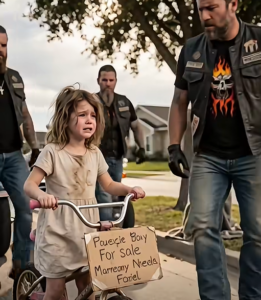
In the glaring midday sun on a suburban street while a tear-streaked six-year-old child begged me to buy her toy bicycle because her mother hadn’t eaten in days
The first cruiser stopped so close to the sedan’s bumper that its lights painted the whole street in alternating bands of red and blue.
A woman in a gray blazer stepped out of it before the engine had finished turning over, holding a federal badge in one hand and a thick accordion folder in the other.
“Special Agent Priya Raman,” she said, and her eyes went straight to the man behind the wheel. “Mr. Lawrence Whitcombe. We’ve been trying to find you for fourteen months.”
Whitcombe lowered his window another inch and put on a smile so smooth it looked laminated.
“Agent, there’s clearly been a misunderstanding. This man and his gang of thugs have been harassing my daughter.”
“Harassing her,” Raman repeated, and glanced at the little pink bicycle, the cardboard sign, the six-year-old girl hiding behind my leg with one fist knotted in my vest.
“Her name is Poppy,” I said quietly. “And she hasn’t eaten since Tuesday.”
Raman’s jaw tightened by a hair.
“Poppy Whitcombe,” she said, and her voice dropped into something gentler. “Sweetheart, is your mom at home?”
“She’s in bed,” Poppy whispered. “She’s too tired to get up. Daddy took the car and the money and the nice food, and he said Mommy was dramatic.”
Nobody on that street moved.
Even the sprinklers on the neighboring lawns seemed to hush.
I felt my brothers go still behind me, nine big men in leather who had ridden through hurricanes and funerals and the worst nights of their lives, and not one of them could look at Whitcombe’s face.
“I’ll need a medic at 41 Larkspur Court,” Raman said into her radio. “Adult female, possible malnutrition. And someone bring a child specialist, now.”
“Larkspur Court is four blocks from here,” I said. “I’ll ride her.”
“Sir, I can’t allow—”
“Agent.” I held her gaze. “She won’t get in a stranger’s car. She just met me four minutes ago, and she already knows I won’t hurt her. Let me carry the weight for the next ten minutes, and then you can have all of it.”
Raman studied me for a long, measuring moment.
“Ten minutes,” she said. “Marcus Dunn rides with me.”
“Marcus is the one who blocked his tire.”
“I noticed,” she said dryly. “It was very helpful, and I’m going to pretend I didn’t see it.”
I knelt in front of Poppy again.
“Do you want to ride on the big bike?” I asked. “It’s loud, but it’s safe. And you can hold on to my vest.”
She looked at the roaring black chopper, then at me, then at the faded pink bicycle with its training wheels.
“What about Rosie?”
“Rosie?”
“My bike.” Her lip trembled. “She’s been with me since I was three.”
Something shifted inside my chest, a hinge I hadn’t oiled in years.
“Rosie rides with us,” I said. “Hold on.”
I lifted the little bicycle by its frame and handed it to my brother Tuck, a giant bald man with a beard like a thundercloud, who took it as tenderly as a newborn and strapped it across the back of his own bike with a bungee cord.
Poppy sat in front of me on the tank, wrapped in my road jacket, with her small hands gripping the handlebars beside mine and Marcus riding at our flank like a guardian.
The engine rolled out low and quiet, the softest I had ever made it purr, and we turned up Larkspur Court at a walking pace.
The house at number 41 was a beautiful lie.
It had a white picket fence, a trimmed hedge, a brass number plate, a porch lined with potted geraniums that nobody had watered.
Inside, the curtains were drawn, and the air smelled of stale bread and old dust.
“Mommy?” Poppy called, and her small voice cracked like glass. “Mommy, it’s me. I brought a man who isn’t scary.”
A faint rustle came from upstairs.
We climbed the carpeted stairs together, Poppy’s hand tucked inside mine, and at the end of the hall a bedroom door stood slightly open.
The woman on the bed was thin as a rail.
She wore a faded nightgown, and her dark hair lay in tangles across the pillow, and her hands rested on top of the quilt like fallen leaves.
But when she saw Poppy, her whole face lit up, and for a second I saw the woman she had been before Lawrence Whitcombe had spent six years dismantling her.
“Poppy,” she breathed. “Baby, you’re not supposed to go out by yourself.”
“I know, Mommy. But I got help.”
The woman’s eyes slid to me, and to the leather and the tattoos and the beard, and I watched fear war with exhaustion in her face.
“I’m not going to hurt you, ma’am,” I said, sinking to one knee beside the bed. “My name is Dutch. I’m with a charity club out of the east side. The paramedics are coming, and there’s a federal agent downstairs who’s going to make sure Lawrence never comes through that door again.”
She stared at me, and a single tear slid down the side of her nose into her hair.
“Is it over?” she whispered. “Really?”
“It’s about to be,” I said. “I’ll stay until it is.”
The medics arrived in under two minutes, a young man and a gray-haired woman with kind, quick hands, and they started an IV in her arm while Raman stood at the bedroom door speaking softly with a woman from child services.
I sat on the floor beside Poppy with my back against the wall, and she leaned her head on my arm, and neither of us said anything for a very long time.
“Dutch?” she said at last.
“Yeah, sweetheart?”
“Did I do the thing right? With the sign?”
My throat closed.
“What do you mean?”
“Mommy told me to,” Poppy whispered. “She said if anyone ever stopped, I should show them the numbers at the bottom. She said they were special numbers, and that a person who understood them would know what to do.”
I looked up.
Across the room, on the bed, Poppy’s mother was watching me with enormous, steady, ruined eyes.
“I’m Marianne,” she said, and her voice was little more than breath. “I was a forensic accountant before I married him. I found his books six months ago, and he found me looking.”
“You wrote the routing number.”
“I taught our daughter to copy it. I was too weak to leave the house, and he kept the phone and the car keys.” A faint, fierce smile touched her cracked lips. “I thought, if one decent person in this whole neighborhood ever stopped to help a crying child, I’d have a chance.”
I let out a long, shaking breath.
“Ma’am,” I said, “that is the bravest thing I’ve ever heard.”
“Don’t say that.” Her eyes filled. “I put my baby on a street with a cardboard sign.”
“You put her where somebody could see her,” I said. “There’s a difference.”
She closed her eyes, and the tears slid out from under her lashes, and Poppy climbed onto the edge of the bed and curled against her side like a small warm cat.
Raman stepped into the room then and said, very quietly, “Mrs. Whitcombe, we have your husband in custody. We found the ledger in the trunk of his sedan, and your routing number matched every account we’ve been chasing.”
“Good,” Marianne breathed.
“But there’s something else I need to ask.” Raman glanced at me, and I knew from her face what was coming. “Mr. Dunn. When you spoke on the street, you said something about your sister.”
The room went cold.
I had said it without meaning to, a sentence that had been sitting in my throat for five years.
“Her name was Annalise,” I said. “Annalise Dunn. She was an auditor at Brightmoor Financial in the city. Twenty-eight years old, funniest person I ever knew. One night five years ago she called me, scared, and said she’d found something in the books she wasn’t supposed to see.”
Nobody spoke.
“Three days later they found her car at the bottom of Cutler’s Quarry,” I said. “The police ruled it an accident. She’d been drinking, they said. She never drank.”
“Brightmoor Financial,” Marianne whispered.
I looked at her.
“That’s where Lawrence worked before he started his own firm,” she said slowly, and her eyes widened. “I remember the name. He used to say it was the best education a man could have, working with Walter.”
“Walter?” Raman said sharply.
“Walter Hale. The managing partner.” Marianne struggled up against her pillow, and the medics frowned. “I read every ledger Lawrence kept. There’s a section, years old, marked with the initials A.D. Payments to a man named Corbin. Fifty thousand dollars.”
“A.D.,” I said, and the floor seemed to tilt under me. “Annalise Dunn.”
“Corbin was a fixer,” Raman said, in a voice I had not heard from her before. “We’ve been after a man named Elias Corbin for years. He’s the one who cleans up for Brightmoor, and for half a dozen firms like it.”
“Where is he?” I said.
“Dutch.” Raman crouched, and put one firm hand on my forearm. “I know what you want to do. I would want to do it too.”
“I won’t touch him.”
“I know you won’t, because you’re going to let me do it the right way.” She looked into my eyes. “But I need your help to do it fast.”
I looked at Poppy, small and asleep now against her mother’s ribs.
I looked at my own big scarred hands.
“Tell me what you need,” I said.
It took eleven days.
Eleven days in a federal safe house on the east side, with Marianne propped up on pillows and a steady drip of nutrient broth, translating three thousand pages of ledgers into a map of the whole filthy machine.
I did not go home.
My brothers rotated shifts on the porch, nine big men in vests and boots taking turns on a folding chair, sipping instant coffee and teaching Poppy how to play poker for pretzels.
She won every hand.
“I think she’s counting cards,” Tuck muttered.
“I’m not counting,” Poppy said, collecting her pile. “I just remember.”
“Of course you do,” Marcus said, with deep resignation. “Of course you do.”
On the twelfth morning, Raman knocked on the safe house door with a thermos in one hand and a gleam in her eye I had not seen before.
“We have him,” she said.
“Corbin?”
“Walter Hale, Elias Corbin, and the whole inner ring of Brightmoor. Warrants are going out at noon, and I’d very much like you to be in the room when they’re served.”
I thought about it.
“I’d rather be where Annalise would want me,” I said.
Raman tilted her head. “Where’s that?”
“The quarry,” I said. “I haven’t been back in five years.”
We drove out at dawn, Raman and I and Marcus, through the sleepy gray outskirts of the city, past gas stations and shuttered diners and a long curve of forest dripping with early light.
Cutler’s Quarry was just a wide hole in the earth, ringed by limestone cliffs and filled with deep green water so still it looked like polished glass.
I stood on the lip of the cliff with my hands in my pockets and my heart pounding, and I let myself remember.
Annalise, age nine, wearing a cape made from a bath towel and declaring herself Queen of the Basement.
Annalise, age sixteen, teaching me to drive her dad’s truck in a parking lot and laughing until she cried when I stalled it.
Annalise, age twenty-eight, her voice thin and quick over the phone, saying, Danny, if anything happens, look for the green notebook.
I had never found it.
Not in her apartment, not in her office, not in her car, which the police had hauled out of the water and returned to me in a crumpled, silt-stained heap.
“Dutch,” Raman said gently behind me. “Come look at this.”
She was crouching beside a cleft in the rock at the edge of the water, where a small shelf of limestone jutted out above the surface.
Marcus stood next to her holding a flashlight, and between them, wedged in a crack and wrapped in a rotted plastic bag, was a small waterlogged notebook.
It was green.
It was swollen and warped, its pages glued together by five years of damp, and I knew it before I touched it.
“How did you find this?” I whispered.
“Marianne’s ledger had a note,” Raman said. “In the margin, in Corbin’s handwriting. Stashed the girl’s book at the quarry, north shelf. We’ve had divers looking for two days.”
My hands shook so hard that Marcus had to steady the plastic bag as I lifted it.
Inside, between pages that crumbled like old bread, I could make out a few lines of precise blue ink.
Annalise’s handwriting.
If you are reading this, I am probably dead, and I am sorry for making you carry it.
I pressed my forehead against my knuckles and bent over the cold rock, and Marcus put an enormous hand on my back, and for a long time the only sound was the wind in the cottonwoods and the slow green water lapping against the stone.
“She knew,” I said hoarsely. “She knew they’d come for her, and she still wrote it all down.”
“She was brave,” Raman said.
“She was stubborn.”
“Those are usually the same thing.”
I laughed, and it broke in the middle, and I let it.
The arrests came at noon, in a flurry of federal vehicles and flashing lights on the glass and steel plaza outside Brightmoor Financial, and the evening news carried the footage of Walter Hale, silver-haired and furious, being led down the front steps in handcuffs with his tie flapping over his shoulder.
Elias Corbin did not make the news.
He was arrested at four in the morning in a motel outside Tulsa, without a shot fired, a gaunt gray man in a rumpled raincoat who looked at the agents and said only, “I wondered when it would be you.”
He confessed within the week.
He told them about the night at the quarry, the pills in the whiskey, the quiet shove from the cliff, and the little green notebook he had never had the heart to burn.
“She looked at me,” he said, in the recording that was played at his sentencing. “Right before. She wasn’t angry. She just looked at me like she felt sorry for me.”
I sat in the front row of the courtroom with my brothers on either side and my hands folded in my lap, and when the tape ended, nobody in the gallery could speak.
Corbin received life.
Walter Hale received life.
Lawrence Whitcombe, who had traded his testimony for a reduced sentence and a cell in a very different part of the country, received twenty-two years and the knowledge that his daughter would never again say his name aloud.
Fourteen other men and women went down in the following months, bankers and lawyers and a pair of city councilmen, and by autumn the whole sleek, gleaming machine had been picked apart down to its last bolt.
I should have felt triumphant.
I felt, instead, only a deep and spreading calm, like a house after the last tenant has moved out.
Marianne recovered slowly.
It took six weeks for her to walk unassisted, and four months before she gained back her full weight, and for the first three months she woke each night with a gasp, groping in the dark for a locked door that was no longer there.
Poppy, on the other hand, bloomed like a weed.
She started first grade at a small school near the clubhouse, in a red plaid jumper and a pair of scuffed purple sneakers, and by October she was the undefeated champion of the playground at tetherball, marbles, and an obscure variant of hopscotch she had invented herself.
Her teacher told Marianne that she had never met a child who could remember so much.
“She’s got her mother’s brain,” I told them both, and Marianne blushed, and Poppy proudly announced that she was going to be an accountant and a motorcycle mechanic at the same time.
In November, Marianne took a job at the east side charity, doing the books for a clinic that fed three hundred families a week.
“I never thought I’d be happy doing taxes for a food bank,” she told me, laughing, standing in the cramped back office with her hair in a ponytail and a pencil behind her ear.
“Doing the books for the people who need them most,” I said. “That’s not taxes. That’s a miracle.”
“It’s a spreadsheet,” she said. “But I’ll take it.”
On the first snow of December, I got a message from Raman.
Come to the courthouse. Bring Poppy. Bring everyone.
I didn’t ask why.
We arrived on a gray morning with the flakes drifting down in lazy spirals, nine bikers and one small girl in a puffy yellow coat, and Raman met us on the courthouse steps with a manila envelope and a smile she could no longer hide.
“The court has awarded restitution,” she said. “From the seized accounts. Every dollar Whitcombe and Brightmoor stole from the families they ruined is being returned, in full, with interest.”
“Every family?”
“Every one.” She handed the envelope to Marianne. “And yours is the first.”
Marianne opened it with trembling fingers and read the first page twice.
“This is…,” she said, and stopped.
“A lot,” said Raman.
“It’s too much.”
“It’s exactly right.”
Marianne looked at me, and at Poppy, and at the long line of leather-clad brothers standing in the snow with their hands in their pockets and their faces carefully blank.
“I want to use it for something,” she said slowly. “Not for me. For others.”
“What did you have in mind?” I asked.
She smiled, and it was the first full, easy smile I had ever seen on her face.
“A place,” she said. “A house where mothers and children can go when there isn’t anywhere else. With real food in the kitchen and no locks on the doors. And I want to put a bicycle in the front yard.”
“A bicycle?”
“A pink one,” said Poppy, tugging my sleeve. “With training wheels. For whoever needs to remember that somebody will stop.”
My eyes burned.
“Rosie,” I said hoarsely.
“Rosie,” she agreed, and I scooped her into my arms and held her against my chest while the snow came down on our heads like a blessing.
The house opened in March.
It was a rambling old farmhouse at the edge of the city with a wraparound porch and a big, drafty kitchen and a yard full of crooked apple trees, and my brothers had spent every weekend of winter repainting it a warm buttery yellow.
Above the front door, carved into a plank of reclaimed barn wood by Tuck’s enormous, gentle hands, hung a sign.
ANNALISE’S HOUSE.
I had not known he was making it.
I stood on the front walk in the thin spring sunlight, staring up at the letters, and I could not speak.
“It’s from all of us,” Tuck said gruffly, shuffling his boots. “We figured she’d have wanted a place where somebody was always home.”
“She’d have hated the fuss,” I managed.
“She’d have loved it,” Marianne said, taking my arm. “And you know it.”
I laughed, and wiped my eyes with the heel of my hand, and the whole yard of motorcycles and families and children and apple blossoms blurred into a bright green and gold.
At the center of the yard, next to the porch steps, stood the faded pink bicycle with its training wheels, polished until it gleamed, a bright new cardboard sign propped against the handlebars in Poppy’s careful capital letters.
IF YOU NEED HELP, COME IN.
I knelt in front of it, and ran my thumb along the worn pink frame, and thought of a little girl with tear-streaked cheeks standing on a hot suburban street, holding a toy and a miracle.
“Hey, Rosie,” I said softly. “You did good.”
Behind me, in the yellow kitchen, someone laughed, a woman’s laugh, warm and unguarded and entirely free, and the smell of cinnamon rolls drifted out across the porch.
I stood up, brushed the dirt from my jeans, and looked out over the long green yard, where Poppy was teaching a gap-toothed boy named Mateo to ride a bicycle with no training wheels at all.
“Faster!” she was shouting. “Don’t look down! Look where you want to go!”
The boy wobbled and swerved and then, with a shriek of astonished delight, found his balance and shot across the grass with his arms thrown wide.
My brothers whooped from the porch.
Marianne stood at the kitchen window with a dish towel over her shoulder, watching her daughter and crying and laughing at once.
And I stood in the sun with the warm wind on my face and the weight of five years finally lifted, and I understood what Annalise had been trying to tell me all along.
That the best way to honor the lost is not to chase the ones who took them, but to build a place where the next frightened child can walk through the door.
“Look where you want to go,” I whispered.
And I did.