In the freezing snow outside the glowing diner window while my cold-hearted foster father slammed the heavy oak door in my face
The Harley slowed to a crawl at the end of Birchwood Lane, and Jaxson cut the engine so quietly that the snow seemed to swallow the sound.
Behind us, eleven motorcycles rolled to a stop in a long dark line, their headlights dimmed to amber slits.
“Stay on the bike, Mila,” Jaxson murmured, his breath smoking in the air above my head.
“I want to see his face,” I whispered.
“No, little one. Not yet.”
He lifted me down and set me on my feet inside the shelter of a big black oak, still wrapped in his leather jacket, which hung past my ankles like a coat made for a giant.
Arthur’s house stood at the end of the lane, a tall white colonial with green shutters and a wreath on the door, glowing with warm golden light against the storm. From the road it looked like a Christmas card.
Nobody who drove past would have guessed what lived inside.
My name is Mila Calloway, I am eight years old, and until that night I had believed that being quiet was the same as being safe.
I had learned otherwise at a diner window, with a red neon sign buzzing over my head.
“Kane,” Jaxson said softly. “Take two men around the back. Cut the phone line, and watch the garage.”
“Already moving, boss.”
“No guns drawn. Nobody lays a finger on him. We do this clean.”
A huge red-bearded biker with a kind, battered face crouched beside me and tucked a wool scarf around my neck.
“You’re a brave one, kid,” he said.
“I’m not,” I said. “My teeth are chattering.”
“That’s just your teeth. The rest of you’s brave.”
I almost smiled.
Jaxson knelt in the snow in front of me, so that his scarred face was level with mine, and his icy eyes were not icy at all.
“Mila,” he said. “I need to ask you something, and I want you to think before you answer. The notebook. Did anyone see you write in it?”
“No.”
“Where did you find the signatures?”
“In Arthur’s desk. The bottom drawer. It has a false back.” I pulled the little red notebook from inside the jacket. “I saw him open it once when he thought I was sleeping. There’s a folder, and a gold key, and a picture of my mommy.”
His face went very still.
“A picture.”
“She’s holding me. I was a baby. She has yellow hair.” My voice shook. “Arthur says he doesn’t have any pictures. He says nobody kept any.”
Jaxson closed his eyes for a moment.
“Your mother’s name was Lena,” he said, and his voice was rough. “She laughed with her whole body. Your daddy, Tom, used to say she could make a funeral feel like a picnic.”
I stared at him.
“You knew her?”
“I rode beside your father for sixteen years. I held you when you were three days old, and you grabbed my beard and wouldn’t let go.” His mouth trembled. “I’ve missed you every day since the accident. I should have fought harder. I should have asked more questions.”
“What accident?”
He hesitated.
“The one Arthur told everyone about,” he said carefully. “A rainy night, a slick bridge, a car that went into the river.”
“I’ve been learning about that,” I said, and held up the notebook. “It wasn’t an accident.”
The snow fell between us, soft and silent.
“No,” said Jaxson. “I don’t think it was.”
He stood, and took my hand in his enormous one, and together we walked up the long snowy drive.
The porch light flickered on as we climbed the steps.
Arthur Pembrook opened the door in a cashmere sweater and a pair of slippers, a tall, smooth, pleasant-looking man with silver at his temples and a face that had never once looked guilty. He held a glass of brandy in one hand, and for a moment his expression was merely puzzled.
Then he saw me, and the leather jacket, and the line of motorcycles in the road behind us.
“Mila,” he said, in a voice like warm butter. “Thank goodness. I’ve been searching everywhere. I was so worried.”
“You locked me out,” I said.
“Sweetheart, that was a misunderstanding.”
“You said I didn’t belong to anyone.”
“I was upset.” His smile did not waver. “Mr.—I’m sorry, I don’t believe we’ve met.”
“Jaxson Reed,” said Jaxson. “I was Tom Calloway’s best friend.”
Arthur’s glass tipped, very slightly, and a few drops of brandy spilled onto the welcome mat.
“I see,” he said. “Well, I’m afraid you’ve come at a very late hour. I’d be happy to talk tomorrow, in my office. With my lawyer.”
“I’d rather talk now.”
“I’m afraid I must insist.”
“Arthur,” Jaxson said, in a voice so gentle that it was almost kind. “I have eleven men in your driveway, a federal agent in the car behind the oak tree, and a notebook with your handwriting in it. I’d think about insisting less.”
The color drained from Arthur’s face like water down a sink.
“A federal agent,” he said.
“Special Agent Priya Raman,” said a calm voice from the shadows, and a slim woman in a dark trench coat stepped into the porch light with a badge held up in one gloved hand. “Mr. Pembrook, I have a warrant for the search of your home office and your safe. May I come in?”
For a moment I thought he would slam the door.
I saw him think about it. I saw him weigh his options, and I saw something small and cold flicker behind his pleasant eyes, a cornered animal doing arithmetic.
Then he laughed.
It was a brittle, charming, terrible laugh.
“Of course,” he said. “Of course, Agent. Come in. I have nothing to hide.”
He stepped aside, and we went in.
The house was warm and beautiful and smelled of cinnamon and floor polish. There was a Christmas tree in the front hall, strung with white lights, and a fire crackling in the grate. A grandfather clock ticked in the corner.
I had lived in that house for two years, and I had never once felt at home in it.
“The study is upstairs,” Arthur said pleasantly. “Second door on the left.”
“We know,” said Agent Raman.
We climbed the carpeted stairs in a long solemn file, Jaxson and the agent and a pair of uniformed officers who had come in behind us, and I walked between them with my hand in Jaxson’s and my heart going like a drum.
The study was a dark paneled room with a leather chair and a huge mahogany desk. Behind the desk hung a framed portrait of a stern gray-bearded man in a three-piece suit.
“My grandfather,” said Arthur. “He built this house.”
“It’s a handsome house,” said Agent Raman.
“Thank you.”
“Where’s the false back in the bottom drawer?”
Arthur did not move.
“I beg your pardon?”
“The drawer on the lower left,” said the agent, and crouched beside the desk. “Mila tells me there’s a compartment behind it, and I trust Mila.”
She pressed along the wood with practiced fingers, and a thin panel slid sideways with a click.
Inside lay a thick manila folder, a small gold key, and a single faded photograph.
I gasped.
The woman in the picture was laughing, with her head thrown back and sunlight in her yellow hair, and she held a chubby baby up toward the sky. She looked like a person who had never in her life been afraid of anything.
“Mommy,” I whispered.
Jaxson’s hand tightened on mine.
Agent Raman lifted the folder and opened it on the desk, and began to turn the pages one by one, her face growing still and hard.
“Forged transfer of deed,” she read. “Forged life insurance claim. A signed receipt for a payment of forty thousand dollars to a man named Gordon Pike, dated the day before the accident.” She looked up. “Mr. Pembrook, do you know a Gordon Pike?”
“I’ve never heard of him.”
“He’s a mechanic. He was arrested in Albany last week for an unrelated charge. He’s been extremely talkative.”
Arthur’s smile finally cracked.
It did not break all at once. It slid slowly, like a mask left too long in the sun, and underneath it I saw something I had glimpsed only in the dark, on bad nights, behind my bedroom door. A flat, cold, patient hatred.
“You little rat,” he said, in a quiet voice, looking straight at me.
“Don’t,” said Jaxson.
“You were never supposed to find anything. Eight years old. Eight!”
“She was cleverer than you,” said Jaxson.
“I fed her. I clothed her. I gave her a roof.”
“You murdered her parents.”
“I did what was necessary!” Arthur’s voice cracked into a shout. “Tom Calloway was going to sell that land to a developer for four million dollars! Four million! Do you know what my family has put into this town? Do you know who built that mill, and the school, and the church? It was supposed to be mine, it was always supposed to be mine!”
The silence in the study was enormous.
“Say that again,” said Agent Raman softly.
Arthur stopped.
He looked at her, and at the little black device on the corner of her belt, a thin silver recorder with a steady red light. His mouth opened, and he looked very small.
“You were recording,” he whispered.
“Since I stepped onto your porch,” she said. “And I have four witnesses, including an eight-year-old girl who has just heard every word. Arthur Pembrook, you are under arrest for the murders of Thomas and Lena Calloway, for fraud, forgery, and conspiracy.”
The officers moved.
He did not fight them.
He stood like a statue while the cuffs clicked around his wrists, staring at the little gold key on the desk with an expression of vague, bewildered grief, like a child who had lost a favorite toy. When they led him out, he stopped in the doorway and looked back.
“Mila,” he said.
I said nothing.
“I did love you, you know. In my way.”
“No,” I said clearly. “You didn’t. You loved the land.”
He opened his mouth, and shut it, and went out.
I heard his slippers on the stairs, one slow step after another, and then the front door, and the cold wind, and the wail of a siren coming up the lane.
I stood in the study with Jaxson’s hand around mine, and my knees began to shake.
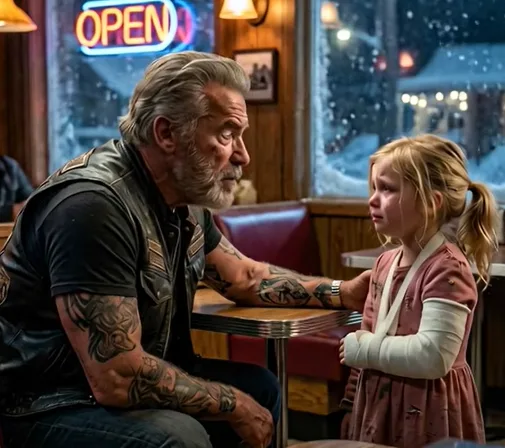
“It’s all right,” he said, very low. “It’s all right, little one. It’s over.”
“Is it?”
“It’s over.”
“I thought I’d feel different.”
“You will,” said Jaxson. “Give it time.”
He lifted me into his arms, jacket and all, and I put my face into his shoulder and cried, great shuddering sobs that shook my whole body. He held me with one big hand cradling the back of my head, and said nothing, because there was nothing in the world to say.
Agent Raman stood quietly at the desk, holding the photograph.
“Mila,” she said gently, after a long while. “Would you like to keep this?”
I looked up, with my wet face and my hair stuck to my cheeks.
She held out the picture, the laughing woman and the baby, and I took it in both hands as if it were made of glass.
“Thank you,” I whispered.
“It’s yours,” said the agent. “It always was.”
They found the rest of the evidence by dawn.
It took a team of six agents four hours to catalogue the contents of the study, the safe, the hidden compartments, and a locked cabinet in the cellar. There were letters, and receipts, and an old tape recorder holding the voice of Gordon Pike, nervous and slurring, laying out the whole sorry plan in a motel room three days before the accident.
By morning, Arthur Pembrook was a headline in every newspaper in the state.
I slept through all of it.
I slept in the back of a big black truck on a pile of motorcycle jackets, with Kane’s wool scarf around my neck and Jaxson’s coat over my shoulders, and I dreamed of a woman with yellow hair who laughed with her whole body.
When I woke, the sun was up, and the truck was parked in front of a long low clubhouse with a red door and a porch full of flower pots.
“Where are we?” I mumbled.
“Home,” said a deep voice, and I looked up.
Jaxson sat on the tailgate with a cup of coffee in his hand and a tired smile on his scarred face. Behind him, a dozen bikers lounged on the porch steps, drinking from tin mugs and watching the truck with identical anxious expressions.
“Whose home?”
“Ours.” He cleared his throat. “If you want it.”
I sat up slowly, and rubbed my eyes.
“Mila,” said Jaxson. “There’s something I need to say. I’m a rough man. I’m not a rich man. I can’t give you a big white house with a Christmas tree in the hall. But I’ve got a spare room, and a good lock on the door, and eleven brothers who’d rather die than let anything touch you.”
My throat tightened.
“The state will want to place you somewhere safe,” he went on, haltingly. “I told them I’d apply. If you’ll have me. If you don’t, I’ll understand, and I’ll find you the best family in the world.”
“Jaxson.”
“Yes?”
“Do you have a Christmas tree?”
He blinked.
“A what?”
“A Christmas tree. Arthur had one. I never got to decorate it.”
A big slow grin spread across his face.
“No,” he said. “But there’s a pine forest up the road, and Kane has an axe.”
I laughed.
It came out of me before I knew it was coming, a small, startled, bubbling sound, and every biker on that porch turned and stared at me as though I had set off fireworks.
“She laughed!” Kane bellowed. “Boys, she laughed!”
“Shut up, Kane,” said Jaxson, and wiped his eyes.
We cut the tree that afternoon.
All of us went, twelve bikers and one small girl in an oversized leather jacket, trudging through the white forest with an axe and a rope and a thermos of cocoa. The snow had stopped, and the sky was a hard clear blue, and the pine trees stood in long dark ranks with their branches heavy with frost.
I picked the crookedest one.
“That one’s ugly, kid,” said Kane.
“I like it.”
“It’s got a bald side.”
“So do you,” I said, and the whole forest rang with laughter.
They hauled it back on a toboggan and stood it up in the clubhouse window, and for the rest of the day we decorated it with everything we could find, tinsel from a dusty box in the attic, a string of lights borrowed from the diner, bottle caps, and chrome nuts and bolts, and a tiny motorcycle carved from wood that Kane produced from his vest pocket with a bashful shrug.
“I made it for my niece,” he said. “She’s too old for it now.”
“I’ll take very good care of it.”
“I know you will.”
By dusk the tree glowed gold and red and silver in the window, lopsided and glittering and absurdly beautiful. I stood in front of it with my red notebook in one hand and my mother’s photograph in the other.
“Do you like it?” Jaxson asked, from behind me.
“I love it.”
“Better than Arthur’s?”
I thought about that.
“Arthur’s was perfect,” I said slowly. “But nobody laughed when they put it up.”
Jaxson crouched beside me, and I leaned against his shoulder, and we looked at the tree together while the last light faded in the windows.
The trial came in the spring.
It lasted five weeks, and the courtroom was packed every day. I did not have to testify in person. The judge, a gentle woman with silver braids, allowed me to speak from a small quiet room with a camera, with Jaxson sitting beside me holding my hand and a stuffed rabbit named Lord Biscuit in my lap.
I told them about the bottom drawer, and the red notebook, and the night Arthur locked me out in the snow.
When I finished, the prosecutor, a kind, tired man in a rumpled suit, asked if there was anything else I wanted the court to know.
I thought for a long moment.
“Yes,” I said. “Arthur said I didn’t belong to anybody.”
“And do you?”
“I belong to Jaxson,” I said. “And Kane, and Pops, and the whole club. And I belong to my mommy and daddy, even though they’re dead. Nobody can take that away. Not even a judge.”
There was a soft, long silence in the courtroom.
Then, from somewhere near the back, I heard the sound of a man blowing his nose.
Arthur Pembrook was convicted on every count, and sentenced to two consecutive terms of life without parole. The land my parents had left me, forty acres of rolling green hill above the river, was returned to me in a trust, to be held until I turned eighteen.
I wasn’t allowed to touch it.
I didn’t mind.
I knew exactly what I wanted to do with it.
On a bright June morning, when the whole valley was soft with wildflowers and the river ran blue under a cloudless sky, Jaxson and I walked up the hill together with a picnic basket and a rolled-up blanket.
At the top there was a little stone cottage, half fallen down, with a tree growing out of the roof and a rusted swing hanging from a branch.
“This was your parents’ place,” said Jaxson. “Before the house in town. They lived here the first four years of your life.”
“I was born here.”
“You were.”
I walked slowly through the broken doorway.
The floor was thick with leaves, and the windows were empty, and sunlight lay across the stone in long gold bars. On the wall above the fireplace, someone had scratched three little lines with a nail, a tall one, a medium one, and a tiny one, and beside them three initials.
T. L. M.
“Tom. Lena. Mila,” I whispered.
“Your father did that the day you were born,” said Jaxson thickly. “I was standing right there. He said, now we’re a family.”
I put my hand against the cold stone, over the tiny third line.
“Can we fix it?” I asked.
“The cottage?”
“Yes.”
He looked around the broken room, at the leaning walls and the tree on the roof, and I watched him do the arithmetic of a man who has never in his life been afraid of hard work.
“It’ll take all summer,” he said.
“We’ve got all summer.”
“It’ll take every one of those eleven men.”
“They won’t mind.”
“They’ll complain constantly.”
“I know.”
He laughed, and ruffled my hair, and pulled me against his side.
“Then we’ll fix it,” he said.
It took until October.
They worked on weekends, in the rain and the sun, with ladders and saws and lumber hauled up the hill by pickup truck. They cleared out the tree, and patched the roof, and laid a new floor of golden pine. Kane built the window frames. Pops, who had turned out to be a surprisingly good plasterer, finished the walls. A silent biker named Moses laid the stone hearth, a stone at a time, humming under his breath.
I carried nails.
It was the most important job on the site, according to Kane, who took it very seriously and referred to me as the Foreman.
The day the cottage was finished, we held a party on the hill.
Everyone came, the club, the neighbors, the waitresses from the diner, Agent Raman in a faded denim jacket, a dozen children I had never met who ran in wild circles through the long grass. Someone had hung a string of lanterns from the old oak tree, and someone had brought a fiddle, and the whole hilltop was loud with music and laughter and the smell of roasting corn.
I stood on the porch in a new yellow dress, with my hair brushed and my mother’s photograph tucked in my pocket, and watched the dusk come down.
“Mila,” said Jaxson, coming up beside me.
“Yes?”
“I have something for you.”
He held out a small flat package wrapped in brown paper and tied with twine.
I tore it open.
Inside was a wooden plaque, hand-lettered in beautiful black paint, and I read it slowly, moving my lips.
THE CALLOWAY HOUSE. EST. 1998 BY TOM AND LENA. REBUILT BY THE FAMILY.
Below it, in smaller letters, someone had added a line.
Everybody belongs to somebody.
I could not speak.
I looked up at Jaxson, and he was crying openly, with tears running down the scars on his cheeks and into his gray beard.
“I’m not your father,” he said. “I know that. I never could be. But I’d be honored, Mila, if you’d let me be something.”
I thought about it.
I thought about a diner window, and a red neon sign, and a heavy oak door closing in my face. I thought about the cold, and the ice, and the little red notebook, and all the long nights I had lain awake believing that nobody in the world was coming.
Then I threw my arms around his neck, as far as they would go.
“You already are,” I said.
He lifted me clean off the porch and swung me around, and the lanterns blurred above us like golden stars, and somebody started to clap, and then everybody did. The fiddle struck up a wild, joyful reel, and the whole hillside rang with it.
We hung the plaque beside the door that night.
Later, when the guests had gone home and the lanterns burned low, I sat on the porch swing with a mug of cocoa and Lord Biscuit in my lap, watching the stars come out above the river.
Jaxson sat beside me, quiet.
The valley lay silver and still below us, and somewhere far off a train sang its long slow note across the dark.
“Jaxson?”
“Mm?”
“Do you think they can see us?”
He looked up at the sky, a long time.
“I think,” he said, “that your mother’s laughing right now. And your father’s telling her to hush.”
I smiled.
The swing creaked softly, back and forth, back and forth, and the porch light glowed warm and yellow above our heads.
The cold wind of that winter night was gone, and the snow, and the closed door. What was left was a small stone house on a hill, a swing that swayed in the dark, and a family built out of grief and gravel and chrome.
I leaned my head against Jaxson’s shoulder, and closed my eyes, and for the first time in my whole life, I fell asleep without being afraid.