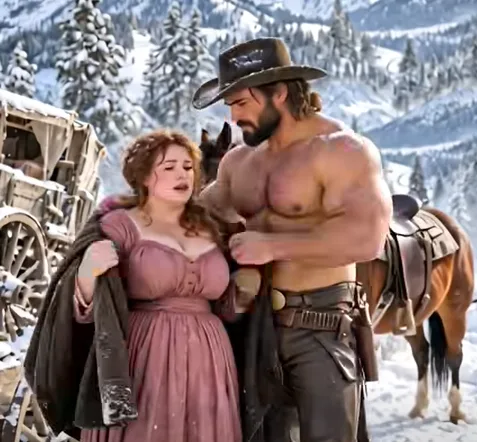
In the freezing snow near the broken wagons while my companion cruelly declared that I wouldn’t make it across the mountains
“Keep walking the horse,” I said, and the words came out lower and colder than I had ever heard my own voice.
The stallion plodded forward through the drifts, and Ethan’s back went rigid against the muzzle of the revolver.
“Clara,” he said, and his voice had changed completely, softening into the smooth, coaxing tone he had used on my father at the sickbed.
“Think about what you’re doing, little bird, you’ve never fired a gun in your life.”
“My father taught me when I was nine years old,” I said.
“He said a woman alone in the territories should know how to protect herself from men who smile too much.”
“He also said that the safest thing to do with a gun is to keep it pointed at the person who deserves it.”
Ethan said nothing, but I felt his shoulders sag a little beneath his heavy coat.
The wind screamed through the pass, and the snow came at us sideways in long white sheets, and for a while the only sound was the creak of leather and the stallion’s labored breathing.
My fingers had gone numb around the revolver’s grip, and I wondered how long I could hold it before the cold took it from me.
I could not afford to wonder.
“Now,” I said through chattering teeth, “you are going to tell me where my brother is.”
“I don’t know what you mean,” Ethan said.
“Samuel,” I said, and the name cracked in my throat like ice on a pond.
“My brother, Samuel Ashworth, who left the valley eighteen months ago to scout the western timber claims, and who stopped writing in the spring.”
“Father spent his last winter staring at the road, waiting for a letter that never came.”
“You were Samuel’s partner, Ethan, and you sat beside Father’s bed and told him that Samuel had died of fever in a mining camp.”
“I believed you,” I said.
“I believed every word, and I thanked you for your kindness.”
Ethan was silent for so long that I pressed the barrel harder against his spine.
“He’s alive,” he said at last, and the words seemed to be dragged out of him.
My heart gave a great, painful leap, and I nearly dropped the gun.
“Say that again,” I whispered.
“He’s alive, or he was last month,” Ethan said bitterly.
“He’s at the old Corliss cabin, three miles above the summit, with a broken leg that never set right and a fever he can’t shake.”
“I left him enough firewood and provisions to last until the thaw.”
“You left him there to die,” I said.
“I left him there to keep him quiet,” Ethan snapped, “until your father passed and the claims came to me.”
“It was only meant to be until spring, and then I would have had the deeds, and I would have let him go.”
“You would not,” I said.
“A man who sabotages a girl’s supplies in a mountain pass does not plan to let anyone go.”
He had no answer to that, and the silence between us grew heavy with the truth of it.
The horse stumbled in a deep drift, and for one wild instant I thought we would both pitch into the snow, but the stallion caught himself and surged forward with a snort.
“Steady,” I murmured, and I patted the animal’s frosted neck with my free hand, and I felt him calm under my touch.
“You have a gentle way with him,” Ethan said, almost to himself.
“He is the only honest creature in this whole business,” I replied.
“Take me to the cabin, Ethan, and do not try anything clever, because I have nothing left to lose and a very cold finger.”
We climbed through the white dark for what felt like hours.
The sun slid behind the peaks and the sky turned from gray to a deep bruised blue, and the cold sharpened until every breath felt like swallowing knives.
My thin pink dress had frozen stiff against my legs, and my teeth chattered so hard that I could scarcely speak, but I kept the gun steady and my eyes fixed on the back of Ethan’s neck.
I thought of my father, who had pressed my hand in his thin, dry fingers and told me that I was stronger than I knew.
I thought of Samuel as a boy, grinning at me from the top of the hayloft with a stolen apple in each fist.
I thought of the stubborn little flame of hope that had just caught light inside my chest, and I fed it like a fire in a high wind, one breath at a time.
At last, through the swirling snow, a pinprick of orange glowed ahead of us on the slope.
“There,” Ethan said hoarsely.
“That’s the cabin.”
It was a low, crooked structure of black logs, half buried in drifts, with a stone chimney leaning drunkenly against one wall and a thread of smoke curling from its top.
Someone was alive inside, because a dead fire does not smoke.
“Stop the horse,” I said.
Ethan reined in, and I slid down from the saddle with my knees buckling and the revolver still fixed on him.
“Get down,” I ordered.
“Slowly, and keep your hands where I can see them.”
He dismounted, his boots sinking to the knee in snow, and he raised both hands and turned to face me.
For the first time that day, I saw him clearly.
His handsome face had gone gray and haggard, his dark eyes were darting and uncertain, and the cruel arrogance that had hung about him like a cloak had finally slipped away.
He looked like what he was, a frightened man who had gambled everything and was about to lose.
“Clara,” he said, and his voice cracked.
“Please, I can explain.”
“You can explain to the sheriff,” I said.
“Walk to the door.”
I followed him through the drifts, my wet boots slipping and my arms trembling with the weight of the pistol.
When we reached the cabin, I rapped on the warped plank door with my knuckles, and for a moment there was no sound at all except the wind.
Then a faint, hoarse voice from inside called out, “Who’s there?”
My knees nearly gave way.
It was thinner than I remembered, and rough with fever, but I knew it as I knew my own name.
“Samuel,” I said, and the word came out as a sob.
“Samuel, it’s Clara.”
There was a long, stunned silence, and then the scrape of something heavy across the floor and a thump and a muffled curse.
“Clara?” the voice said, and it had risen to a cracked, disbelieving cry.
“Little bird, is that you?”
I put my shoulder to the door and shoved with all my strength, and it burst inward on a gust of snow.
The cabin was a single cramped room lit by a guttering fire, and on a pallet of straw and old blankets beside the hearth lay a man with a ragged beard and hollow cheeks.
His left leg was bound in splints made of kindling and strips of torn shirt, and his eyes in his gaunt face were the same warm brown as our father’s.
He had dragged himself halfway across the floor toward the door, and he lay with his arms stretched out in front of him, staring up at me as though I were a vision.
“Samuel,” I whispered, and I dropped to my knees beside him and the gun fell from my hand.
I threw my arms around his thin shoulders, and he clutched me back with a strength that surprised me, and we both cried like children.
“I thought you were dead,” I sobbed into his neck.
“They told us you were dead, and Father died believing it, and I have been so alone.”
“Father’s gone?” Samuel said, and his voice broke in a way that tore me in half.
“Three weeks ago, in his sleep,” I said.
“He asked about you at the end, and he said he knew you were coming home.”
Samuel shut his eyes, and tears slid down into his ragged beard.
“I should have been there,” he whispered.
“I should have been there, Clara.”
“You are here now,” I said fiercely, “and that is what matters.”
Behind me, I heard a scuffle of boots, and I turned just in time to see Ethan’s hand dart toward the fallen revolver on the floor.
“Don’t!” Samuel roared.
Quicker than thought, my brother lashed out with the iron poker that lay beside his pallet and cracked it across Ethan’s wrist.
Ethan howled and reeled backward, clutching his arm, and the revolver skittered across the floorboards and came to rest against my knee.
I snatched it up and leveled it at him with both hands, and this time my fingers did not shake at all.
“Sit,” I said.
“Against the wall, where I can see you.”
Ethan sank down against the logs, cradling his injured wrist, and he stared at me with a kind of dull, stunned wonder.
“You really aren’t the girl I thought you were,” he said.
“No,” I said.
“I never was, and that was your mistake.”
We spent the night in the little cabin, the three of us, with the wind howling across the roof and the fire crackling in the grate.
I bound Ethan’s hands and feet with the rope from his own saddlebags, and I tied him to the leg of the heavy table so he could not move without dragging it.
Then I turned to my brother, and I cleaned his fever-flushed face with melted snow and fed him strips of dried venison from Ethan’s pack.
The old Corliss cabin had a battered iron kettle, and I boiled water and brewed a bitter tea of pine needles that Samuel swore was an old trapper’s remedy for fever.
“You look like Mother,” he said softly, watching me from his pallet while I wrung out a cloth.
“You have her way of frowning when you’re worried.”
“I’m not frowning,” I said.
“You are frowning right now,” he said, and he gave a faint, weary grin that nearly broke my heart.
We talked until the fire burned low, in whispers, so as not to wake the prisoner who slumped against the wall with his chin on his chest.
Samuel told me how he had discovered the first signs of the forgery, a set of timber claims filed under his name with a signature that was not quite his own.
He had confronted Ethan, his trusted partner of six years, and Ethan had struck him from behind and left him in the snow with a broken leg.
“I crawled for two days to reach this cabin,” he said.
“I had nothing but a pocketknife and a stubborn streak, and I kept thinking that I couldn’t die, because Clara would be waiting for me.”
“I was waiting,” I said, and I laid my head on his shoulder.
“I didn’t know it, but I was.”
When he fell asleep at last, I pulled my wool shawl from around my shoulders and ran my numb fingers along its frayed lining.
There, beneath a tight row of my father’s careful stitches, I felt the stiff, folded edge of the paper he had hidden.
I picked out the thread with the tip of Samuel’s pocketknife and drew out the packet, and by the light of the dying fire, I unfolded it with trembling hands.
The deed was there, the original, with its heavy red seal and my father’s bold signature, granting the Ashworth family the whole of the Larkspur Valley timberlands in perpetuity.
Beneath it lay a smaller square of paper covered in rows of strange symbols, and across the bottom, in my father’s looping hand, was a single line.
For my children, who will know what to do with it.
I stared at the cipher for a long time, and then, slowly, a memory unfolded in my mind.
I saw my father at the kitchen table on a long-ago winter evening, with Samuel and me kneeling on the floor beside him and a cup of chestnuts roasting on the hearth.
He had taught us a game, a game of letters and shifting numbers, and he had made us promise never to tell anyone how it worked.
I read the cipher aloud in a whisper, one symbol at a time, and as the letters resolved themselves, my breath caught.
It was not a message about the timber at all.
It was a location, a hidden vault beneath the old Ashworth mill, where my father had hoarded twenty years of gold dust from his earliest mining days, and a note that said the vault was meant for us.
I laughed softly, with tears running down my frozen cheeks, because my father had not left us poor after all.
He had left us everything, and all that he had asked in return was that we survive long enough to find it.
Dawn came pale and silver through the single cabin window, and the wind finally dropped to a hush.
I stepped out into the sharp, clean air and stood for a moment looking at the vast, glittering sweep of the mountains, rosy and gold in the first light.
They no longer looked like silent giants guarding dark secrets.
They looked like old friends who had finally let us pass.
It took us two days to reach the nearest town, a tiny settlement called Pine Hollow at the foot of the western slope.
I led the stallion through the drifts with Samuel strapped to the saddle in a nest of blankets and Ethan stumbling behind on a rope tied to the pommel, his face blue with cold and his spirit thoroughly broken.
The townspeople came out to stare as we trudged down the main street, a bedraggled girl in a ruined pink dress, a bearded invalid on a stolen horse, and a prisoner at the end of a rope.
A tall, weathered man with a silver star on his coat stepped off the boardwalk and planted himself in our path.
“Ma’am,” he said, tipping his hat, “I’m Sheriff Abel Rourke, and I’d say you have a story to tell.”
“I do,” I said, and my voice was hoarse but steady.
“And I have papers to prove every word of it.”
I handed him the deed, and I told him everything, standing in the middle of the muddy street with the whole town listening.
When I finished, the sheriff was silent for a moment, and then he turned to his deputies with a face like thunder.
“Lock this man up,” he said, pointing at Ethan.
“And somebody fetch Doc Hallett, because this young man needs a bed and a surgeon, and I want him treated before he’s asked another question.”
They carried Samuel into a clean, whitewashed room above the general store, where a kindly old doctor with a bristling gray beard reset his badly healed leg and declared that he would walk again by summer.
A stout, rosy woman named Mrs. Hallett wrapped me in a quilt and sat me in front of her kitchen stove, and she fed me chicken broth and cornbread until I thought I might burst.
For the first time in weeks, I slept in a real bed, with warm blankets and clean sheets, and I did not dream of snow.
The trial was short, because the evidence was overwhelming.
The circuit judge arrived from Denver in the first week of April, and he listened to my testimony with a solemn, thoughtful face, and examined the deed and the forged claim papers with a magnifying glass.
Ethan’s own saddlebags had held the rest of the proof, a stack of falsified documents, a bundle of letters to a corrupt land agent, and a ledger detailing the payments he had made to the men who had sabotaged our wagons.
When the judge asked him whether he had anything to say, Ethan looked at me across the crowded little courtroom, and for a long moment, his dark eyes were empty.
“I was ashamed of what I was,” he said quietly, “and I thought that if I owned enough, no one would ever see it.”
“It seems I was wrong.”
The judge sentenced him to twenty years of hard labor in the territorial prison, and the people of Pine Hollow filed out of the courtroom in a hush.
I stood on the steps afterward, blinking in the bright spring sunlight, and I found that I felt neither triumph nor hatred, only a vast, quiet relief.
“Are you all right?” asked a familiar voice at my elbow.
Samuel had come down from his room on a pair of wooden crutches, with a clean shirt on his back and his beard trimmed, and he looked almost like the brother I remembered.
“I’m better than all right,” I said, and I slid my arm through his.
“I’m free.”
We rode back to the Larkspur Valley in a wagon in May, with the snow melting off the hills and wildflowers pushing through the mud along every fence line.
The Ashworth house stood where we had left it, a long, low farmhouse of gray stone with a wide porch and a crooked weather vane, and the sight of it made my throat ache.
Samuel gripped my hand as we turned in at the gate, and neither of us said a word.
Our father’s old dog, Biscuit, came tearing around the corner of the barn with his ears flying and his tail whipping like a flag, and he flung himself at Samuel with a joyous howl.
“Hello, old boy,” Samuel said, laughing and weeping at once, burying his face in the dog’s rough coat.
“Hello, you faithful old fool.”
We buried our father that afternoon in the family plot beneath the oak tree, beside our mother, with the whole valley gathered around us.
The preacher said a few simple words, and Samuel read the verse our father had loved, and I laid a bunch of early violets on the fresh-turned earth.
“We found it, Papa,” I whispered.
“We found everything you left for us.”
That evening, Samuel and I walked down to the old Ashworth mill, which had stood empty and silent for years, its great wheel frozen in the creek.
We pushed open the rotting door, and Samuel, leaning on his cane, led me down the narrow stone steps to the cellar.
By the light of a single lantern, we found the vault exactly where the cipher had said, set deep into the foundation wall behind a false panel of mortared stone.
It took us an hour to work the rusted lock, and when the heavy iron door swung open, a soft golden glow spilled out across the cellar floor.
There were twelve small leather sacks lined up on a shelf, each one heavy as a sleeping child, and a single sealed letter lying on top.
I broke the wax and read it aloud in the lantern light.
“My dear Samuel and Clara,” it began.
“If you are reading this, then you have worked together, and that is the greatest wealth I could ever have hoped to leave you.”
“The gold is for the valley, and for the people who need a second chance, and for whatever dreams you carry that are bigger than yourselves.”
“But the truest treasure is what you already have, which is each other.”
“Be kind, be brave, and never let anyone tell you that you will not make it across the mountains.”
“With all my love, Papa.”
We sat down side by side on the cold stone steps, and for a long time we did not speak.
“He knew,” Samuel said finally, his voice thick.
“He knew someone might try to stop us, and he gave us a way home anyway.”
“Because he trusted us,” I said.
“Because he knew that we would figure it out together.”
We used a portion of that gold to rebuild the mill, and it rose again that summer, with a new wheel and fresh timber and a big painted sign over the door that read Ashworth and Sister.
Samuel insisted on the second half of the name, though I protested that I was no businesswoman.
“You outwitted a murderer on a mountain pass with a stolen gun and a lie about a bank in Denver,” he said.
“I believe you can handle a ledger.”
He was right, as it turned out, and by autumn the mill was humming from dawn to dusk, and the whole valley was fed by its flour and its lumber.
We hired the widows and orphans and out-of-work miners of the neighboring towns, and we paid them fair wages and fed them a hot noon meal at long wooden tables in the yard.
I opened a small school in the old barn, with a stove, a blackboard, and a shelf of donated books, and for the first time in my life I stood at the front of a room and taught.
My students were farm children with scrubbed faces and patched knees, and they listened to my stories of the mountain pass with their mouths hanging open.
“Miss Clara,” a gap-toothed boy named Jonah asked one afternoon, “weren’t you scared when the bad man said you wouldn’t make it?”
“Terribly,” I said.
“My knees were shaking so hard I thought they might fall off.”
The children giggled, and I smiled and knelt down beside his desk.
“But I learned something up there in the snow, Jonah, which is that being brave doesn’t mean you aren’t afraid.”
“It only means that you take one more step even when your feet are numb.”
He nodded solemnly, and I saw the words settle into him like seeds.
Summer came, and Samuel threw away his crutches and then his cane, and he took to walking the valley road every evening with Biscuit trotting at his heels.
He fell in love that year with the schoolteacher from the next valley over, a quiet, clever woman named Lucy Marsh, who laughed at his terrible jokes and corrected his grammar with gentle firmness.
They were married in the fall, under the oak tree beside our parents’ graves, and I stood beside my brother as he spoke his vows with his voice trembling.
“I almost didn’t come home,” he whispered to me afterward, as the fiddlers struck up a reel on the lawn.
“I lay in that cabin and I thought I had lost everything.”
“But you didn’t,” I said.
“You only had to wait for the spring.”
My own story did not end there, because the mountains had one more gift to give.
In the winter that followed, a stranger rode into the valley through a falling snow, a lean, quiet man in a long gray coat, with a surveyor’s case strapped to his saddle and kindness in his tired hazel eyes.
His name was Daniel Reeve, and the territorial government had sent him to map the western timber lines and settle the boundary disputes that Ethan’s forgeries had left behind.
He came to the mill on his first morning with a sheaf of papers and a polite, formal manner, and I looked up from the ledger and found that I had forgotten what I was going to say.
“Miss Ashworth?” he said, and he took off his hat and held it against his chest.
“I’m told that you are the person to speak to about the Larkspur claims.”
“I am,” I said, rather breathlessly, and then I recovered myself.
“Won’t you sit down, Mr. Reeve, and have some coffee?”
He stayed for three months, because the survey was larger than anyone had guessed, and every evening he took supper at our table with Samuel and Lucy and me.
He told us about the places he had mapped, the red canyons of the south and the great plains and the roaring rivers, and he spoke of them with such quiet wonder that I found myself leaning forward in my chair.
On the last night before he was to leave, we stood together on the porch under a sky full of cold, brilliant stars, and the snow hushed softly down around us.
“Miss Ashworth,” he said, “Clara, if I may.”
“You may,” I said.
“I have drawn maps of a great many places,” he said slowly, “and I have never before found one I did not want to leave.”
“I’d like to ask if I might come back in the spring, and if you might permit me to court you properly.”
My heart rose in my chest like a bird taking flight.
“Mr. Reeve,” I said, “I believe I would like that very much.”
He came back in April, with the first green showing on the hills, and he never left again.
We were married in June, in the meadow behind the mill, with wildflowers in my hair and the whole valley dancing beneath the open sky.
Samuel gave me away with tears running down his face, and Lucy, round with their first child, wept beside him and dabbed her eyes with a lace handkerchief.
I wore my mother’s wedding gown, soft and cream and let out at the seams by Mrs. Hallett, who had traveled all the way from Pine Hollow with a basket of pies and a bottle of her famous elderberry wine.
“Mind you don’t catch cold,” she scolded, fussing with my veil.
“I have not caught cold in a year,” I said, laughing.
“I believe I’ve used up all the cold there is.”
We built a home on a gentle rise above the creek, with a deep porch and a kitchen window that faced the mountains, and every morning I stood at that window with my coffee and watched the sun climb the eastern peaks.
Daniel drew a map of our valley that hung above the mantel, and in the corner, in his neat, small hand, he had lettered the title, The Land That Clara Saved.
“That’s not true,” I said, the first time I saw it.
“Samuel saved it too, and Father, and the whole valley.”
“Then I shall add them,” he said, and he took up his pen and added three more lines beneath the first.
Years passed, and the mill grew, and the school grew, and our children came along one at a time, a bright-eyed girl named Rose and a sturdy boy named Henry, and a baby with my father’s brown eyes whom we named Samuel in honor of her uncle.
She was a bold, laughing little thing, and she toddled after Biscuit’s grandson through the meadow with her arms wide open to the sun.
On a golden evening in late summer, when the children were old enough to run wild through the long grass, my brother and I climbed together to the high pasture above the valley, the way we had done as children.
The mountains stood tall and purple against a sky of flaming orange, and the wind carried the smell of pine and cut hay and distant woodsmoke.
Far below us, the lights of the mill and the school and the little farmhouses began to twinkle one by one, like stars coming out on the earth.
“Do you remember what that man said to you?” Samuel asked, leaning on his walking stick, his hair gone just a little gray at the temples.
“That I wouldn’t make it across the mountains?” I said, and I smiled.
“I remember.”
“And now look at you,” he said.
“You didn’t just cross them, little bird, you made a home on the other side.”
I looked down at the valley, at the golden fields and the glowing windows and the tiny figures of my husband and children waving from the porch, and my heart swelled so full that I could hardly breathe.
I thought of the frozen girl in the thin pink dress, shivering in the snow with a blanket clutched to her chest, who had believed that she was alone.
I wished that I could tell her that she would never be alone again, that the mountains would lead her to everything she had ever lost and a great deal more.
“I made it,” I whispered, and the wind carried the words out across the hills.
Samuel put his arm around my shoulders, and we stood together as the last light bled away behind the peaks and the first stars pricked the darkening sky.
“We made it,” he said.
And the valley below us glowed warm and golden in the dusk, and I knew that I was finally, truly, forever home.