In the dusty center of Foster’s General Merchandise while a cold-hearted town merchant loudly accused me of stealing a sack of salt from the supply
The pendant caught the firelight before her face did. A small silver horseshoe, the one I had buried with an empty coffin because the magistrate said the mountain had taken her body and the creek would not give it back. Smoke rolled between the flour sacks and the cracker barrels. Someone was screaming near the front steps. Dawson shoved me down behind the counter as a second shot took a lamp off its hook and threw oil in a bright tongue across the floorboards.
“Stay low,” he said.
I could not stay low in my mind. The voice had been hers, thinner, scraped by years I had not been allowed to count, but hers. I rose far enough to see the silhouette step through the torn wall, rifle easy in her hands, coat burned at one cuff. The sheriff had stopped laughing. Silas had dropped behind his own ledger as if paper might stop lead.
“Mother,” I said.
She looked at me the way a woman looks at a sum she has already finished. “You kept the name. That was careless. Names are how they hang people in this valley.”
Dawson’s Colt had not left the sheriff’s chest. “Ada Hayes is dead,” he said. “I stood at the service. I helped nail the lid.”
“You stood at a box of river stones,” she answered. “Harlan wanted a widow who could not testify. I wanted to live. We both got something. Drop the hammer, Dawson, or the next charge takes the front wall and everyone still pretending this is a store.”
A man moved in the smoke behind her, not a deputy. He carried a coil of fuse and the calm of someone who had done this work in other towns. The sheriff’s silver ring flashed as he lowered his hands an inch, testing whether Dawson would allow it. The townsfolk who had come to watch a salt thief be shamed were now a trapped jury, coughing, pressed against pickle crocks and bolt cloth.
“The ledger is already gone,” I said. My voice did not shake. That surprised me more than the fire. “You can burn the building. You cannot burn the copy on the Cheyenne road.”
Ada’s mouth tightened. For a moment she looked like the woman who used to cool horseshoes in the trough and scold my father for working past dark. Then the look closed. “Copies can be called forgeries if the girl who swears to them is a thief, or a corpse. Silas was supposed to keep you in the street long enough for the warrant. You always did hate being called a thief. You got that from him.”
“From both of you,” I said.
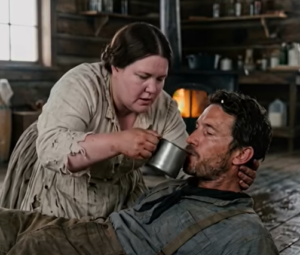
Silas made a wet sound that might have been a plea. Ada did not look at him. “The salt was a stage. The town needed a reason not to listen to you. They have been practicing not listening since the day they let the magistrate read the accident report.”
Dawson spoke without taking his eyes off the sheriff. “Ada. If you ever meant the bargain you made with Thomas Hayes, this is the last minute it can still be a bargain. Walk out with us. Name Crowe. Name the sheriff. The pouch on that counter is not the only one.”
“Crowe is a tool,” she said. “You still think the syndicate ends at a county star and a store ledger. The money that bought these deeds bought a railroad spur, a senator’s quiet, and a grave with my name on it so I could move the ore rights without a living wife attached to them. Thomas found the second set of plates. He was going to Cheyenne with them. I told him to wait. He did not wait.”
The sentence landed harder than the explosion. I heard my own breath go out. “You knew they would take him.”
“I knew he would force them to. There is a difference, if you have spent twenty years paying for it.” She lifted the rifle a fraction. “Come with me, Molly. There is a carriage on the north road and a life that does not include a noose. Refuse, and you are only evidence.”
A beam cracked overhead. Embers drifted onto the counter. The sheriff lunged, not for Dawson’s gun, but for the leather pouch. Dawson fired once into the floor at the man’s boots and the sheriff froze, pride and terror arguing in his face. I grabbed the pouch, felt the weight of paper and not coin, and understood Dawson had never put the real ledger in reach of Silas’s hands. The real one was already in a flour sack on a freight wagon. This was a copy, and a dare.
“I am not going with you,” I said.
Ada’s eyes flickered, not soft, only surprised that the sum had changed. “Then get down.”
The second charge was not the front wall. It was the porch roof, a mean smaller blast meant to scatter deputies and make a hole toward the alley. The doors blew inward. Daylight and dust came with them. Dawson hauled me over the counter. We hit the aisle as bottles burst and the smell of vinegar cut through the powder. I saw Esther Quinn from the creek homesteads drag a child under a table. I saw the immaculate woman with the lace gloves staring at her own hands as if gloves could not survive a fact. I saw Silas crawl for the back and Ada step over him without pausing.
We went out through the torn wall into the lot behind the mercantile, where the delivery wagon still stood with one horse down and the other screaming in the traces. Dawson cut the dead animal free. I climbed the box with the pouch inside my shawl. A deputy rounded the corner and Dawson put a shot into the dirt that changed the man’s mind. Ada appeared in the gap, rifle rising, and for a half second I was ten years old and she was calling me in from the yard. The rifle spoke. The shot took the wagon’s sideboard, not my back. Whether she missed on purpose I would not know until later, and later did not forgive her for making me wonder.
Dawson lashed the horse. We hit the creek road as the mercantile roof took the fire in earnest. Behind us the town bell started, late and useless. The mountains cut the sun into a red blade. I held the pouch and the sideboard and tried to put my mother back into the category of ghost, where she had been safe.
“She is not the trigger,” Dawson said over the wheel noise. “She is the hand that opened the door. The man who shot Thomas was the sheriff’s brother. He died of a fever in Laramie two winters back. That is the part I had not told you. The part she just told both of us is worse.”
“There is a senator.”
“There is a company. Crowe sits on a territorial bench and signs what the land office sends. Your father hid the original signature book under the smithy floor, then moved it when he knew they were watching the shop. The journal you followed was the map. The advertisement was mine. I have been waiting for the daughter who could read his hand.”
“You let them call me a thief.”
“I let them gather in one room. I am sorry for the shape of it. I am not sorry they are gathered.”
We made the bend above the creek where the cottonwoods thickened. A rider was already there, hat low, horse fresh. Not a deputy. The boy from the livery, the one my father used to pay in nails. He lifted a hand.
“Wagon’s past the narrows,” he said. “Esther’s nephew has the sack. Marshal’s men are at the junction if the wire held. Sheriff’s posse took the south trail. They think you went to the old claim.”
“And the woman?” I asked.
The boy looked at the fire glow on the sky. “She took the north road with two men. Not toward the posse. Toward the spur.”
Dawson nodded. “Then we do not chase her. We get ahead of the paper.”
The narrows were a slot of rock and willow, dark already at the bottom. The freight wagon waited with its lantern hooded. Esther’s nephew, a long boy with ash on his cheek, handed me the flour sack without a speech. Inside, the ledger smelled of iron and hide, my father’s figures in the margin, the magistrate’s flourish, Silas’s tighter hand, the sheriff’s mark beside amounts that had bought fences, wells, and one blacksmith’s silence. A newer page, slipped in since the accident, carried a railroad initial and a line that named a senator’s factor in Cheyenne. Ada’s hand was not on that page. Her hand was on the quitclaim that had moved the smithy lot the week after the funeral, witnessed by a clerk who had since left the territory.
I understood the design then, not as a speech, but as a machine. Kill the man. Bury the wife in rumor. Brand the daughter if she returned. Sell the ground twice, once to frightened homesteaders and once to a company that wanted what was under it. The salt, the shawl, the public shame, all of it was only the latest gear.
“We split,” Dawson said. “Boy takes the ridge with a dummy sack. We take the ledger to the junction. If they stop one, they must guess.”
“I am not a dummy,” the nephew said, almost offended.
“You are a target who can ride,” Dawson said. “There is a difference, and it is an honor I do not want for you. Go.”
The boy went. We turned the wagon onto the junction track, lantern still low. Night came down with a wind that tasted of snow somewhere high. My shawl was not enough. Dawson put his coat over my shoulders without asking, and I let him, because pride was a luxury the ledger could not afford.
They hit us a mile short of the junction. Not the posse. Two riders and a buckboard, Ada on the seat, the fuse man beside her. She raised a hand and the riders peeled to block the road.
“Last offer,” she called. “The book for your life. Dawson can take the horse. I only need you unsworn.”
I stood on the box. The coat was heavy. The ledger was heavier. “You do not need me unsworn. You need me ashamed. That was Silas’s job, and it failed in front of the town. If I give you this, you will still need me dead by morning, because a living daughter is a witness even without paper.”
Ada studied me. The pendant moved when she breathed. “You sound like him.”
“I sound like the part of you that buried river stones and hated it.”
The fuse man lifted his rifle. Dawson’s Colt came up. For a moment the road held only wind and horse-breath. Then a new sound arrived from the junction side, harness and more than one animal, a voice calling the halt of people who expected to be obeyed. Lanterns. A gray-haired woman on a tall horse with a marshal’s badge catching the light, and behind her two riders and the livery boy, hat gone, dummy sack still in his fist, grinning like a fool who had lived.
“Federal marshal,” the woman said. “Ada Hayes, if that is the name you are using, step down. Sheriff Crowe’s warrant is quashed. The Cheyenne wire held. Anybody who fires now fires at this office.”
Ada did not step down at once. I saw the calculation, twenty years of it, run across her face and fail. The fuse man looked at the badge and decided he was paid for arson, not for a hanging. He dropped the rifle. The riders broke for the willows. One of the marshal’s men went after them without hurry. Ada set the reins down as if they had become too hot.
“I can give you the factor,” she said. “The senator will not save a storekeeper. He may save himself by feeding you Crowe.”
“You can give it in a room with a stenographer,” the marshal said. “Tonight you give me the rifle.”
Ada looked at me one last time. There was no blessing in it, and no curse complete enough to use. “I did not pull the trigger,” she said.
“You opened the door,” I said. “That was enough.”
They took her off the buckboard. The pendant caught the lantern and went dull when her coat closed over it. I did not ask for it back. Some objects belong to the lie that wore them.
The junction station was a single room, a stove, a key on a wire. The marshal read by bad light while the stove cracked. Dawson sat with his leg out; a splinter from the mercantile had found him and he had not mentioned it. I kept my hand on the ledger until the marshal moved it herself, carefully, the way people move things that have already cost a life.
“Your father was not executed by a court,” she said. “He was killed and the report was signed. That distinction will matter in Cheyenne, and it will not bring him to this stove. What it will do is void the deeds that used his death as a clearance. The homesteaders get a hearing. Silas gets a cell if he survived his store. The sheriff gets a stronger cell. Your mother gets whatever a judge believes a bargain is worth.”
“And the senator?”
“The senator gets named. Naming is not conviction. Do not confuse them. People in this territory have built ranches on that confusion.”
I nodded. Outside, the fire glow over Cottonwood Creek had sunk to a smear. Esther would be counting who had walked out of the mercantile. The lace-glove woman would be deciding what she had seen, and whether seeing it was safe. I thought of the two weeks under an assumed name, the salt, the burning in my eyes, the way a town will hold a woman up to a ledger and call the ledger holy until the ledger turns in her hand.
By morning the statements were taken. Silas lived, burned along one arm, already offering percentages. The sheriff did not offer anything until they found his brother’s old pistol wrapped in an oilcloth under the jail floor, matched to the ball the marshal’s surgeon had kept from my father’s body for twenty years because a clerk in Cheyenne had owed Thomas Hayes a favor and a locked drawer. Ada talked. She named the factor. She named the dates. She did not ask to see me. I did not ask to be spared her voice through the station wall.
Dawson found me on the platform when the eastbound slowed.
“You can ride it,” he said. “Testify and not come back. No one would call that running.”
“They would,” I said. “I would.”
“Then we go back after Cheyenne. The smithy lot is still a lot. The creek families will need someone who can read a deed without flinching.”
“You are staying for the work, or for a debt?”
“The debt was your father’s. The work is yours if you want it. I am good with a hinge and bad at leaving a thing half finished.”
The train hissed. I did not board it that day. The marshal took the ledger in a sealed case, and I took a sworn copy, and we rode toward Cottonwood Creek in clear cold, past the narrows, past the place where my mother had made her last offer. The mercantile was a black ribcage. People stood in the street with the particular quiet of those who have learned their gossip had a body count. Esther nodded once. The boy from the livery held the dummy sack as if it had become a relic. I lifted the copy so they could see it was paper, not a miracle.
“The salt was paid for,” I said. “The land was not. If you want the difference, it will be in the hearing, and it will be dull, and you will have to stand up more than once. That is the whole trick they used. They only needed you to stay seated.”
No one applauded. An old man took his hat off, which was better.
In Cheyenne the room was oak and ink and men who did not like a woman’s certainty. I spoke the dates until they were no longer mine. Ada, thinner in a gray dress, confirmed the door and not the trigger, and the court wrote both down. Crowe was indicted. The factor fled and was taken off a stage with a carpetbag of deeds. The senator issued a denial so careful it confirmed the shape of the hole. Some money was gone. Some fences came down. Justice arrived looking like a docket, which is to say incomplete, and still more honest than a carriage accident.
I rebuilt nothing grand. The smithy roof. A gate. A habit of copying every page that entered the house and sending one copy to Esther and one to the marshal’s clerk. Dawson stayed through the first winter and the second, not as a monument, but as a man who fixed what the thaw dropped. Ada lived inside a sentence that did not include our table. I wrote to her once, not for forgiveness, and not for the pendant. I wrote that a family name is not a lock, and that she had spent twenty years proving a lock can be forged. She did not answer. The silence was a kind of answer, and I let it stand.
On the anniversary of the mercantile fire I walked to the creek alone. The water moved under a skin of ice. I thought of river stones in a coffin, of a public accusation over salt, of a pendant in the smoke, of my father’s margin figures that outlived the men who wanted them ash. The lesson was not that blood tells the truth. Blood had stood in a torn wall and offered me a carriage. The lesson was that a lie needs a crowd that will not look down at the page, and a truth needs someone willing to be shamed in public before she is believed. I had been that someone. The valley did not become pure. It became harder to rob in daylight. That was not a small thing. I turned back toward the smithy, where the hinge waited and the copy waited and the work, unfinished on purpose, kept the door open from the inside.