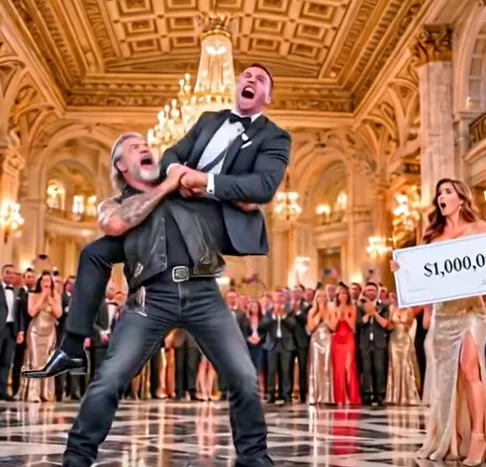
In the center of the grand ballroom under crystal chandeliers while a rugged biker slammed my wealthy CEO brother onto the marble floor and snatched our family’s $1,000,000 charity check
The rain had thinned to a fine silver mist by the time I reached the warehouse doors, and the dawn behind the cranes looked like a bruise slowly healing.
Behind me, agents were leading Victoria’s two hired guards toward a line of black vans, their balaclavas gone and their faces pale and young and suddenly ordinary.
Victoria herself sat on the rear bumper of an SUV with her wrists cuffed in front of her, her gold dress traded for a leather jacket and her mascara drawn down her cheeks in thin dark rivers.
She did not look at me.
I was grateful for that, because I did not yet know what my face would do.
“Mr. Vance?” said a low, steady voice at my shoulder.
The woman who had spoken was tall and lean, in a navy windbreaker with FBI stitched across the back, with close-cropped gray hair and a pair of reading glasses hooked over her collar.
“Special Agent Helen Okonkwo,” she said, and offered a hand. “Financial Crimes. I’ve been waiting four years to meet whoever finally sent me that file.”
“I didn’t send it alone,” I said.
“No.” Her eyes moved past me to the shadow of the warehouse door. “I don’t imagine you did.”
My father stood just inside the frame, a dark shape against the dim fluorescent hum, his leather vest damp and his hands hanging loose at his sides.
He had not come out.
I understood why, and it made my chest ache.
He had been a dead man for fifteen years, and a dead man does not walk into daylight without wondering whether it will burn him.
“Dad,” I said.
“Son.”
“Come out here.”
“There are cameras.”
“Let them look.”
He hesitated, and I watched the old fear cross his face like a cloud crossing a field, and then Agent Okonkwo stepped quietly beside me.
“Mr. Vance,” she said to him. “Marcus. I have a signed order from a federal magistrate that vacates the warrant issued fifteen years ago for your arrest. It was a fabrication, and we’ve known it for six hours. You are not a fugitive. You never were.”
My father stared at her.
“Say that again,” he said, very softly.
“You are free to walk out that door.”
He did not move for a long moment.
Then he took one step, and another, and the pale morning light fell across his silver beard and his scarred knuckles and his blue eyes, which were so exactly like mine that I felt something in my throat give way.
He stood in the open air of the east docks, with the gulls wheeling over the black water and the smell of diesel and rain around him, and he lifted his face and closed his eyes.
“Fifteen years,” he whispered. “I’d forgotten what a morning smelled like.”
I crossed the wet concrete in three strides and threw my arms around him, and he caught me with a force that nearly lifted me from my feet, and for a while neither of us said a word.
He smelled of motor oil and rain and cedar, and beneath it, faintly, of something I had not smelled since I was nine years old, the soap he had used to shave with every morning in the big white bathroom of our house on Alder Street.
“I thought you were dead,” I said into his shoulder. “I mourned you. I stood at a memorial in a black suit and read a speech.”
“I know. I was in the back, in a baseball cap.”
“You were there?”
“I wouldn’t have missed it.” His voice cracked. “You said I taught you to tie your shoes on the back steps and that I always let you win at checkers. You said it like you meant it.”
“I did mean it.”
“You were a terrible checkers player.”
“You let me win.”
“I did,” my father said, and a wet laugh broke out of him. “God, I did.”
Okonkwo cleared her throat, with great delicacy, and turned to examine a seagull with intense interest.
It was nearly noon before they let us leave.
The agents had worked through the morning with the efficiency of a surgical team, hauling out the laptop and the hard drive, photographing every file, taking my statement in a cramped trailer parked beside the storage building while a young agent brought me coffee in a paper cup I could not drink.
The global freeze had worked.
By the time the banks opened, every account Richard had hidden in the Cayman Islands was locked behind a federal order, and ninety million dollars in stolen charity money sat suspended in digital amber, waiting to be returned.
The merger collapsed at nine-fifteen, in a conference room on the fortieth floor, when the other company’s lawyers received a single email and quietly closed their folders.
Richard was arrested in the middle of it.
I did not see it, but I was told about it later, in detail, by a very amused paralegal.
He had been standing at the head of a long glossy table in a charcoal suit, explaining the synergies of the deal with a laser pointer, when the doors opened and six agents walked in.
He had said, “This is a private meeting.”
One of the agents had said, “Not anymore.”
And then, according to the paralegal, my brother had dropped the laser pointer and said, in a very small voice, “I want to speak to my brother.”
I had not decided yet whether to grant it.
My father drove me home on the crimson Harley, slowly, through streets slick with washed light, and I clung to the back of his vest the way I had once clung to the back of his bicycle seat.
The city slid past, glittering and unconcerned, and I thought about how strange it was that a world could look exactly the same after it had ended.
My apartment on the thirty-first floor smelled of nothing at all.
I had never noticed before how empty it was, how cold, how perfectly arranged, with its white leather sofa and its glass coffee table and its abstract painting that Victoria had chosen because it was, she said, “a good investment.”
I stood in the doorway and looked at it as though it belonged to a stranger.
“It’s very clean,” my father said.
“It’s a showroom.”
“Nobody lives here.”
“No,” I said quietly. “I don’t think anyone ever did.”
He walked in and ran one scarred finger along the edge of a glass shelf, and looked at the framed photographs arranged on it, Richard shaking hands with a senator, Victoria at a gala in gold, me in a tuxedo at some ribbon-cutting with a smile that did not reach my eyes.
There was not a single picture of the family I had grown up in.
“I’ll make coffee,” I said, because I could not stand the silence.
I made it badly, because I had never learned how, and he drank it without complaint, and we sat on the white sofa looking at the city through the long windows while the sun climbed toward noon.
“Tell me everything,” I said. “From the beginning.”
He told me.
Fifteen years ago, my father had been the chairman of Vance Global, a quiet, careful man who had built a modest shipping company into a regional powerhouse and given a third of its profits to children’s hospitals. He had discovered that the company’s pension fund was being drained by a handful of insiders, and when he went to confront them, he found my brother Richard at the center of it.
“He was twenty-three,” my father said. “A boy. I thought he’d been manipulated. I thought if I went to him gently, as a father, he would confess and we could fix it together.”
“He didn’t.”
“He called a man I’d never met. A man who worked for the people above him. And that night my yacht blew up in the harbor, with a hired crew aboard, and a body in the cabin that had been dressed in my clothes.”
“The offshore explosion.”
“It was meant to be me.” His jaw tightened. “I was ashore. I’d gone back to the dock for my reading glasses. I watched it burn from a pay phone, and when I called your mother, a man answered who was not your mother.”
The room was very quiet.
“What happened to Mom?” I asked.
My father looked at his hands.
“I don’t know,” he said. “That’s the part I’ve never been able to bear.”
My heart stopped.
“Mom died,” I said slowly. “Mom died of pneumonia the winter after the explosion. I was thirteen. I was in the room.”
“You were told that.”
“I watched her.”
“You watched a woman in a bed,” my father said gently. “A sedated woman under a false name, in a private clinic that Richard’s friends owned. I have spent fifteen years trying to find out whether the woman who died in that clinic was your mother, and I have not been able to prove it.”
The floor tilted beneath me.
“You’re saying she might be alive.”
“I’m saying I don’t know,” my father whispered. “But I’ve found a name, Jax. A nurse who worked at the clinic. She kept records, and last month she sent me a single line.”
He reached into his vest and drew out a folded scrap of paper.
It read, in a shaky hand, She never died. Come to Willowbrook before the end of the month.
“Willowbrook?” I said.
“A private care home, upstate. Eleven hours north by road.” He looked at me with enormous, aching hope. “I wasn’t going to go without you.”
I was already on my feet.
“Now,” I said. “We go now.”
“Jax, you’ve had no sleep, and the case—”
“The case has Agent Okonkwo and four hundred pages of evidence. My mother has been waiting fifteen years.” My voice cracked. “I’m not making her wait a day longer.”
He looked at me for a long moment, and the corner of his mouth lifted.
“She always said you were stubborn,” he said. “She said you got it from me.”
“She was right.”
“She usually was.”
We rode north that afternoon, in the long gold light, with the highway unrolling gray and endless between rows of tall dark pines.
I had never ridden so far on a motorcycle.
My arms ached, my legs went numb, and by the third hour I was certain I would never feel my spine again, but somewhere past the state line, with the wind in my face and the mountains rising blue along the horizon, I began to understand why my father had loved this.
It was not the speed.
It was the plain, unadorned fact of being in the world, with nothing between you and the sky.
We stopped at a roadside diner at dusk, and a waitress with a gold tooth called us both “hon” and brought us pancakes, and my father ate with the focus of a man who had not tasted real syrup in years.
“I’ve missed this,” he said.
“Pancakes?”
“Sitting across a table from you.” He smiled, and set down his fork. “I used to do it in my head. Every morning for fifteen years. I’d pour a cup of coffee and imagine you across from me, arguing with me about the news.”
“What did I argue about?”
“Everything.” His eyes shone. “You were a very opinionated child.”
“I’m a very opinionated adult.”
“I’ve noticed.”
We laughed, and the gold-toothed waitress refilled our cups without being asked, and outside the window the last light bled out of the sky in long ribbons of rose and violet.
Willowbrook Manor stood at the end of a winding gravel drive, a pale stone house in a field of tall grass, with a wide porch and a row of white rocking chairs and a single lamp burning in the front window.
It was past ten when we arrived.
The night was clear and cold, thick with stars, and the engine ticked as it cooled in the silence.
“Do you want me to go first?” my father asked.
“No.” My voice shook. “Come with me.”
We climbed the porch steps together.
A nurse answered the door, a stout gray-haired woman in a cardigan, and she looked at us both for a long time.
“You’re early,” she said. “She said you’d come at the end of the month.”
“She said?” I whispered.
“Mrs. Eleanor,” said the nurse. “Room fourteen. She hasn’t been well, but she has good days. She talks about a little boy with a cowlick and a husband who always lost his glasses.”
My father made a sound I will never forget, a low broken sound like a man being struck.
We followed the nurse down a long, hushed corridor smelling of lavender and floor polish, and she stopped before a pale green door, and knocked gently, and opened it.
The room was small and warm, lit by a single bedside lamp.
A woman sat in a wingback chair by the window with a knitted blanket across her knees, looking out at the stars.
She was thinner than I remembered, and her hair, once dark and glossy, had gone the soft white of dandelion seed, but her profile was exactly as it had been, the straight nose, the stubborn chin, the small crooked tilt of the head.
“Eleanor,” my father said, and his voice failed him entirely.
She turned.
For a moment she only looked at us, and her face was empty and polite, the face of a woman greeting strangers.
Then her gaze fell on my father’s eyes, and something moved in her face, like light moving through deep water.
“Marcus?” she whispered.
“Yes, my love.”
“You’re dead.”
“I got better,” my father said, and she began to cry.
I stood in the doorway, unable to move, while my father crossed the room and knelt at her feet and took her thin hands in his, and she touched his face with trembling fingers as if he were made of mist.
“I dreamed you,” she said. “Every night. I dreamed you came, and then I woke up and the room was empty.”
“I’m here.”
“You’re older.”
“So are you.”
“I’m an old woman.” She laughed, wetly, and tears ran down the soft lines of her face. “I look like my mother.”
“You look like the best thing I ever saw.”
She laughed again, and then her eyes lifted over his shoulder and found me standing in the doorway.
I watched her stop breathing.
“Jax?” she said, in a voice like a held note. “Jaxon?”
“Hi, Mom,” I said.
It was the smallest thing I had ever said, and it broke me open.
I crossed the room in a stumble and fell to my knees beside my father, and she gathered both of us into her arms, thin and fragile and impossibly strong, and the three of us wept together in a small green room at the end of a long gravel drive, with the stars burning in the window and the old clock ticking on the mantel.
“I tried to find you,” she kept saying. “I tried, I tried. They told me you were gone. They told me you’d both died.”
“We were told the same,” I said.
“They kept me asleep for so long. I woke up and the world had changed, and I couldn’t remember how to say your name.” She pressed her lips to my forehead. “But I never forgot your face. Never.”
“I’m here, Mom.”
“You’re so tall.”
“I’ve been told.”
“You have your father’s chin.”
“I’ve been told that, too,” I said, and she laughed, and I buried my face in her shoulder and wept like a boy of thirteen who had finally been allowed to stop being brave.
We stayed with her that night.
The nurse brought a rollaway bed and two blankets and a plate of shortbread, and we sat up until dawn talking in low voices, three people who had lost fifteen years and were trying to find the thread of them in the dark.
She told us about the clinic, and the long slow fog of sedatives, and the nurse named Agnes who had slipped her out of the building in a laundry cart six years ago and hidden her at Willowbrook under a false name.
My father told her about the motorcycles, and the road, and the little towns he had hidden in, and the dog he had once adopted who had saved his life.
I told her about Richard, and Victoria, and the long careful lie that had been my adult life.
When I finished, she was quiet for a long time.
“Oh, my darling,” she said at last. “My poor boy. I’m so sorry.”
“It’s not your fault.”
“It’s not yours, either.” She took my face in her hands. “You trusted the people who were supposed to love you. That isn’t a sin, Jaxon. It’s the best thing about you.”
I could not speak.
“And Richard?” she said, after a moment, very softly. “My other boy.”
My father’s hand tightened on hers.
“Richard did terrible things,” he said.
“I know.” She closed her eyes. “I know he did. But he’s still my son.”
It was the hardest thing I had ever heard anyone say, and the truest.
Richard’s trial began in the autumn.
It lasted seven weeks, and it filled the newspapers and the evening news, and I attended every day with my mother’s hand in mine, wearing the dark suit I had once worn to my father’s memorial.
My brother sat at the defense table with his lawyers, in a gray suit that no longer fit, and he did not look at us once.
The evidence was overwhelming.
There were the shell companies in the Caymans, and the forged signatures, and the recorded conversation in the storage locker, and the testimony of a dozen frightened men who had once been his associates and now fought one another for the privilege of cooperating.
Victoria’s father, the powerful financier, turned state’s evidence on the third week, and the whole vast tangle of fraud unraveled in a single dazzling afternoon, a federal judge, a senator, a half dozen bankers, all of them sinking beneath a weight of paper they had spent thirty years trying to shred.
Victoria pleaded guilty in the fourth week.
I was in the courtroom when she did it.
She stood in a plain gray dress with her hair pulled back and no makeup, and she looked smaller than I remembered, and younger, and very tired.
“Your Honor,” she said, in a voice that barely carried, “I would like to say something to Mr. Vance.”
The judge nodded.
She turned, and for the first time since the warehouse, she looked directly at me.
“I don’t expect you to forgive me,” she said. “I was twenty-four when my father told me what to do, and I did it, and I told myself it was a job. And then I started to love you, and I told myself it was still a job, because the alternative was that I’d have to stop.”
The courtroom was silent.
“I am sorry,” Victoria said. “Not because I was caught. Because you were kind to me, every single day, and I let you be.”
I held her gaze for a long moment, and I felt, to my surprise, no anger at all.
Only a deep and quiet sorrow, like a house with the lights left on and nobody home.
“Thank you for saying it,” I said.
She nodded, and her eyes filled, and the bailiffs led her away.
She received eight years.
Richard’s sentencing came in November, on a bright cold morning with frost glittering on the courthouse steps.
He stood before the judge in an orange jumpsuit, with his hands cuffed in front of him and his hair gone gray at the temples, and when she asked whether he wished to speak, he was silent for so long that I thought he would refuse.
“I wanted to be Dad,” he said at last.
The words came out hoarse and thin.
“That’s all it ever was. When I was a boy, I used to stand in his office and look at the portrait on the wall, the great Marcus Vance, and I thought, I’ll never be enough. And then I found the way to be more than enough, and I took it, and I told myself it didn’t count because nobody was getting hurt.”
He turned in his chair and looked at the gallery, at my father, sitting with his hands folded and his eyes wet.
“Dad,” he said. “I’m so sorry. I killed a man and I tried to kill you, and I put my little brother in a trap. I don’t have a word for what I am.”
My father rose slowly to his feet.
The whole courtroom held its breath.
“You’re my son,” he said, in a voice that carried to every corner of the room. “You did a monstrous thing, and you will pay for it. But you’re my son, and I’m not going to stop saying so.”
Richard put his face in his cuffed hands, and his shoulders shook.
He was sentenced to thirty-five years, with a recommendation of review at twenty, and as the deputies led him toward the side door, he stopped, and turned, and looked at me.
“Jax,” he said. “I don’t deserve it. But if you ever have a minute.”
“I’ll come,” I said. “Once a month. I’ll bring the newspaper.”
“You hate the newspaper.”
“I know.”
He laughed, a cracked and broken sound, and the deputies led him through the door.
The foundation was the first thing I fixed.
With the Cayman accounts unfrozen and the ninety million returned by order of the court, the Vance Foundation received more money in a single week than it had raised in the previous five years, and I sat down in the empty executive office with a legal pad and a pot of terrible coffee and wrote a plan.
It took me three months.
When I was finished, the foundation had a new name, the Eleanor and Marcus Vance Fund for Children, and a new board of directors drawn from the families it served, and a new rule printed on the first page of its charter in bold black type.
Every dollar is spent in the open.
We funded a pediatric research wing at the city hospital, and a free clinic in the east side, and a scholarship program for kids from foster care, and a little yellow house on Alder Street that had once belonged to a family named Vance and was now a home for children who had nowhere else to go.
I found it by accident, a week after the sentencing, on a drive through the old neighborhood.
It was the same house, the white porch gone gray, the swing sagging, the garden choked with weeds.
It had been empty for a decade.
I bought it that afternoon with my own money.
We spent the winter restoring it, my father and I, with hammers and paint and a great deal of bad language, and my mother sat on the porch in a blanket, directing us like an admiral and laughing at every mistake.
We painted the front door a deep, rich red.
We planted a row of tulip bulbs along the walk.
We hung the old swing on new chains, and my father tested it with his full weight and pronounced it sound.
On the first warm Saturday of April, we opened the doors.
Eleven children moved in that day, aged six to sixteen, with duffel bags and backpacks and wary, watchful eyes.
They stood in the front hall looking up at the high ceiling, and the smallest, a thin boy of seven with a cowlick and a fierce scowl, gripped the strap of his bag with both hands and said, “Is this the real one?”
“The real what?” I asked.
“The real house. The one where they let you stay.”
My throat closed.
“Yes,” I said. “This is the real one. You can stay as long as you like.”
He studied me with narrowed eyes.
“What if I’m bad?”
“Then you’ll be bad, and you’ll still be here.”
“What if I break something?”
“Then we’ll fix it,” said my father, appearing beside me with a screwdriver in his belt, “and I’ll teach you how.”
The boy looked up at him, at the silver beard and the scarred hands and the kind tired blue eyes, and something in his small fierce face began, slowly, to loosen.
“Can you teach me to ride a motorcycle?” he asked.
“When you’re older.”
“How much older?”
“A lot.”
“How much is a lot?”
“Enough to know that the secret,” my father said, kneeling in front of him, “is to look where you want to go, and not where you’re afraid to land.”
The boy thought about this very seriously.
“Okay,” he said, and took my father’s hand.
That evening, after the children had gone to bed and the dishes were done and the old house had settled into its creaking, comfortable quiet, the three of us sat on the porch with mugs of cocoa and a plate of burnt cookies.
The stars were out, thick and bright above the rooftops, and the warm air smelled of damp earth and new tulips.
My mother sat in the swing, wrapped in her blanket, with her head on my father’s shoulder.
I sat on the steps, with my back against the post, looking out at the quiet street.
“Jax,” she said softly.
“Yes, Mom?”
“Do you remember what you asked me, when you were small? On this porch, on the night of your sixth birthday?”
I thought.
“I asked if the stars were lonely,” I said slowly.
“And what did I say?”
“You said they weren’t. You said they were just very far away from each other, and the light was how they said hello.”
“That’s right.” She smiled, and her eyes were wet. “I think that’s what happened to us. We were very far apart for a very long time. But the light was still traveling.”
My father kissed the top of her head.
I looked up, and the night sky spread over the old yellow house like a great dark blessing, and somewhere in the bright scatter of stars I could have sworn that something winked.
Inside, a small voice called out sleepily from an upstairs window, “Is somebody still down there?”
“We’re here,” I called back. “We’re all here.”
“Okay,” said the voice, and the window went quiet.
I sat for a while longer in the warm dark, listening to the swing creak, and the crickets sing, and my parents murmur softly to one another like two people learning a language they had once known by heart.
I thought of a grand ballroom full of crystal and cold, and a biker with blue eyes slamming my brother onto marble.
I had believed, in that moment, that I was watching the end of everything.
I had not known I was watching the first light of a long road home.
And as the porch lamp burned gold on the old red door, and the stars wheeled slowly above us, I understood at last that a family is not the people who stand beside you at the gala.
It is the ones who come in through the doors you thought were locked, and stay.