In the center of our modest wooden kitchen in Montana while my husband cruelly announced he was leaving me for a younger woman
The yellow letter landed in the flour dust like it had been waiting for the cuffs.
My handler’s name sat on the authorization line. Not a clerk. Not a rumor. Pike. The man who had shown me the loose board under the bin and called it duty. Twenty years. Thomas’s first grab. A signature I had trusted with my real name and with the three years I had spent begging on cue.
Thomas laughed into the counter, cheek mashed to wood.
“Now you see the kitchen you married.”
Harlan bagged the letter before my hands could make a relic of it.
“Don’t touch it again.”
“I already lived in it.”
The young woman in the doorway had not run. Blank face. Younger, as Thomas had advertised to the room, and not surprised enough for innocence.
“Sit,” I told her.
“Hands where I can see them. You are a witness until the record says otherwise.”
She sat. Her voice, when it came, was smaller than the doorway.
“He said you would cry and we would be gone before noon.”
“He was half right.”
Thomas twisted against the steel.
“Lila doesn’t know the books.”
“She knew which door to stand in,” I said.
“That was the part you needed an audience for.”
Harlan jerked his chin at the yard, where marshals were already turning the barn into an inventory.
“Pike does not get a courtesy call. We copy the ledger. We move it to the office that does not route through him. You do not go back to playing wife.”
“The wife left with the dough scraper. I am done with that part.”
They took Thomas past the kettle, which had boiled itself into a black smell. He still tried the old voice on the step.
“You begged.”
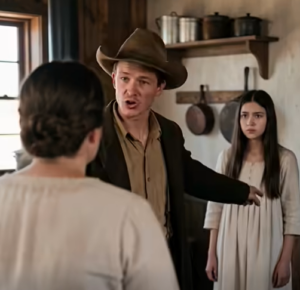
“I performed. You liked the sound. The books did not applaud.”
Lila gave a first statement at the table, flour on her sleeves, eyes on the ledger as if it might bite.
“He told me the marriage was already dead. He told me the ranch was his by right. I did not ask about the families. I should have asked when he laughed about a widow marking an X.”
“You will ask on the record,” Harlan said.
“That is the useful part of standing in the door.”
I rode with the ledger in a locked satchel and Pike’s letter in a separate sleeve. Paper can infect paper if you let it share a pocket. The territorial room that did not belong to Pike was brick, bad coffee, and a woman named Ruiz who read the signature once and went still.
“He has been your tasking officer for three years.”
“He sent me into the kitchen.”
“He sent you to finish a story he started before you wore a badge. We freeze his desk. We do not warn him. If he runs, he runs toward the parcels he still thinks he can burn.”
“South is the rail camp.”
“Then south is where Harlan goes. You stay with the books until I say the camp is boring.”
I slept in a chair and dreamed of dough that would not rise. Morning brought Pike’s empty peg and a clerk who had seen him take the south road before dawn with a satchel and no goodbye. Not a ghost. A direction.
Harlan spread a map on the same table where I had signed my false grief into the file.
“You know his tells. You ride behind the line. If he sees you first, he will talk. Talking is evidence. Charging is how widows get made.”
“I will not charge.”
“Good.”
The camp at dusk was canvas, stakes, and a lantern fighting the wind. Pike was not grieving. He was feeding copies to a washbasin and cursing the wet. He saw me at the edge of the light and almost smiled, the old tasking smile.
“You were supposed to stay broken until the train.”
“You were supposed to be the oath.”
“I was the oath that understood the valley. Thomas was the knife. You were the handle. Handles do not judge the cut.”
Harlan stepped out of the dark with two marshals and no patience for metaphor.
“Hands. The basin stays. The names in the ash still count.”
Pike reached for a pocket and found the mud instead. A trip, a knee, cuffs that did not care about his years of clean memos. Half-burned pages still showed homestead names. I knew two. I had eaten at their tables before Thomas’s men called the tax late and the law looked away.
They walked him past me. He spent his last free sentence cheaply.
“Your husband was leaving you anyway.”
“My husband was a case. You were the signature on the first theft. I know which betrayal I will put on the stand first.”
The ride back was colder and cleaner. Lila remained in town under a watch that was not a punishment and not a friendship. Thomas remained loud. Pike went quiet, which frightened his lawyer more than noise ever had.
I signed the seizure pages with a hand that finally belonged to me. Pike’s letter went into the same file as Thomas’s first deed. Twenty years stopped being a story I told myself in the dark and became a column a clerk could read without flinching.
Court took weeks. Weeks are kinder than myths. Thomas named Pike to shave years and lost the ranch anyway. Pike named a banker, a survey clerk, and the habit of calling evictions “development.” Lila told the truth about the doorway and was allowed a train she bought herself, with a warning not to confuse a man’s promise with a title. Homesteaders who had been written down as squatters got lines back on the map. Not every acre. Enough that the valley sounded different when the wind hit wire that belonged to the right name.
I did not return to the cabin as a wife. I returned once as the officer who had hidden a ledger under flour, and once as a woman who no longer owed Thomas a tear for the neighbors. The kettle went outside. Some objects do not get a second life. The scraper I had dropped stayed in a drawer at the office, not as a shrine, as a reminder that performance is a tool.
Harlan found me on the step the day the last parcel notice was posted.
“Desk is yours if you want it. No more kitchens. No more Pike.”
“I will take the desk. I will keep the scraper. If I start believing a handler because he sounds kind, I want the flour on my hands again.”
“He will write you from the cell.”
“He can write the file. I am finished being his audience.”
Peck, the widow whose X had been turned into a deed, did not give me a speech. She gave me coffee and a post that needed setting. We set two before the wind rose. She said my name without the word wife attached. That was the medal I kept.
Thomas did not get a goodbye. Lila did not become a moral lesson in a younger dress. The ledger stayed in a room whose lock did not answer to a husband or a handler.
On the first morning that felt like mine, I rode the fence of Peck’s returned ground and did not rehearse grief. The sky was the same Montana sky. The work was different. I had begged in a kitchen so a man would keep talking. I had opened a book so the talking would have a cost. When the letter fell out of the binding, I did not let it become the end of my name.
The lesson sat in the saddle, plain as a brand.
A leaving can be a tactic.
A stranger in the doorway can be a prop.
A handler’s signature can be the oldest theft in the drawer.
You swallow the heartbreak if the room requires the scene.
You do not swallow the ledger.
And when the yellow page hits the flour, you call the office that is not his, you stay for the map, and you ride home under your own authority.
I turned the horse toward town. The cabin smoke belonged to no one I had to save by crying. My hands were clean. The evidence was filed. For the first time in three years I did not have to ask a man to stay in order to finish the work.
That was the ending I kept.