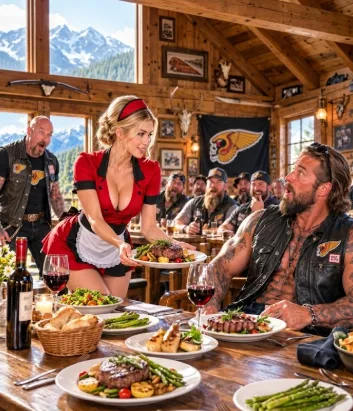
In the center of a crowded mountain tavern while a ruthless gang leader mockingly demanded to know what a refined city girl could possibly offer his crew,
The revolver caught the flashlight beam and threw it back in a thin white line. I did not drop the drive. I closed my hand around it inside the jacket the commander had thrown over my shoulders and felt the false-bottom cold of the flour bin still living in my fingers. Mr. Cross stood on the top step as if the mountain had been built to frame him, city coat wrong against the frost, smile practiced in boardrooms where men like my father were reduced to a line item.
“Commander,” he said, tasting the word. “Grant. You kept the costume longer than the contract required.”
The leader did not raise his hands. He set them where Cross could see them, empty of the gloves, and angled his body half a step in front of me. “The contract was a dirt nap that never happened. You paid for a photograph. I delivered a photograph. The man walked out of the drainage cut while you were busy signing his timber into your name.”
“And walked into a fairy tale,” Cross said. “Madison, the drive. Your father is below us. I would prefer not to spend the bullet on ceremony, but ceremony has never been a requirement.”
A cough rose from the staircase, old smoke in it. I knew the sound without having heard it in twenty years. My knees tried to refuse the step. The commander said, quietly, “He is not bluffing about the room. He is bluffing about the trade. The drive is the only copy that still has his wire authorizations. If you hand it over, the deeds in the box become a story he can burn twice.”
Cross’s finger settled. “Now.”
I looked past him at the dark between the pines, where our dust had swallowed the cruisers, and understood the tavern lock-down for what it had been: his perimeter, not the club’s. The lookout with the rifle had been early because someone in the dining room had texted the canyon. Three months of steaks and smiles, and the leak had worn a patch or a badge. Maybe both. I took the drive from my pocket and held it up so the silver gun could see it. Then I threw it, not to Cross, but down the staircase, into the cough and the dark.
He fired. The shot took a chip out of the iron box and screamed off into the precipice. The commander hit him at the knees while the revolver climbed for a second aim. They went down on the frost-covered stone, city coat and leather, the flashlight spinning until it painted the cliff and nothing else. I went down the stairs because the drive was not a sacrifice. It was a direction.
The room at the bottom was dry, as he had promised, and lit by a single battery lamp. My father sat on a crate with his wrists zip-tied in front of him and the drive already under his boot. Thinner, gray, the same jaw. He looked at me as if the looking might break the lamp. I cut the ties with a rusted hinge leaf from the floor panel hardware and put the drive in his hand because I needed him to feel the weight before either of us spoke.
“You let them frame you,” I said.
“I let them film a grave,” he said. “Grant dug the drainage. Cross signed the leases. I stayed down here whenever the mountain was searched and came up when it wasn’t. I thought if I surfaced, they would move the frame onto you. Grant told me three months ago that you had already walked into the frame wearing a waitress uniform. I told him to get you out. He told me you would not leave without the transfers. He was right. I hate that he was right.”
Above us something heavy hit the panel. A shout. Not Cross’s voice. The commander’s. I pulled my father up the stairs into a wind that had teeth. Cross was on his side, revolver gone, lip split, the aristocratic line ruined by gravel. Two of the tavern crew had come up the trail on a second bike, the scarred enforcer and the lookout, rifles pointed at the frost and not at us. The lookout’s eyes were wrong. Too ready. The commander had his knee in Cross’s back and his gaze on the lookout.
“Who texted the canyon,” he said.
The lookout twitched. The enforcer understood a half-second later and turned the rifle. Too late for loyalty, on time for the shot that did not come, because I had the revolver by then, lifted from the stone, and I did not want a body on the incorporation deeds. “Down,” I said. He went down. The enforcer zip-tied him with a cord from his own belt and looked sick. Three months of plates, and the sniff at the logging camp had been invited.
We did not wait for the cruisers to find the switchback. The deeds were in the electrical box, oilskin, my father’s original incorporation and the assignment pages Cross had forged after the photographed grave. The drive held the wires: tavern cash to a shell, shell to a deputy overtime account, overtime to the men who had kicked the pine doors. Cross, walking with his hands bound and his smile finally tired, said the mountain would not care about paper. The mountain did not have to. A county clerk two ridges over kept ranch hours and owed the timber company nothing.
We reached her at daylight. I put the uniform in a trash bin behind the chambers and stood in the leather jacket while my father said his own name into a recorder and did not flinch at the date. The judge listened to the wires. She looked at the deeds. She looked at Cross as if a hostile takeover were a kind of weather she had seen before and did not intend to bless. By noon she had frozen the shell accounts and signed a pickup order that did not route through the canyon deputies. The lookout traded a text log for a narrower charge. The log named a board assistant in the city and a sergeant at the valley barracks. Both were in holding by dark.
Cross’s counsel arrived with a line about a grieving daughter and a biker costume. The drive did not care about the line. Grant testified that the execution photograph had been staged in the drainage cut and that he had taken the money and then spent twenty years trying to unspend it. He did not ask to be forgiven in the transcript. My father testified that he had chosen the ghost and that the choice had cleared other families off the timber leases while he hid. The judge wrote the admission into the order. I testified to the flour bin, the uniform, the throw down the stairs. Leaving out the throw would have made the rest look clean, and clean was how Cross had burned the office.
The company did not come back to my father as a throne. It came back as a reversion. Families who had lost cutting rights under the forged assignment stood in the rear of the courtroom and heard their names returned. He refused the chair. He signed the restorations and asked that the record note the years he had been absent while the trees were sold. Grant refused a reward and took a repaired bike and a suspended sentence that required him to walk the new boundary lines with the surveyor. I kept the jacket because the uniform had been a lie and the jacket had been a tool, and I knew the difference now.
On the day the tavern reopened under a manager who did not take shell cash, I went back for the flour bin. The false bottom was empty. I had the drive in evidence. I stood in the kitchen anyway and let the pine doors swing and not mean a raid. My father waited outside. He did not pretend the months of grease had been his plan. He said he was sorry for the grave, and for the silence, and for the fact that sorry did not replant a ridge. I said sorry could start by not signing anything Grant had not read aloud. He agreed. It was a small oath and it held.
Cross took a plea on the forgery, the wire fraud, and the procurement of the false execution. The sergeant took the overtime. The board assistant took the texts. None of them took the mountain. In the spring the observation deck was just a deck again, panel sealed, deeds copied into a public file anyone could request without a flashlight or a revolver. I rode the trail once with Grant, not as a waitress and not as cargo, and we did not stop for ghosts. My father met us at the ridge with the survey stakes. He looked older in the daylight and more true.
What the tavern test had been built to hide was a signature moved in the dark. What the mountaintop broke open was the photograph, the pipe, the drive, the choice to throw the evidence toward the man it belonged to instead of toward the gun. A happy ending, if the word still fits, is not a spotless reunion. It is a father living, a name cleared in the clerk’s book, leases back on the families who cut the timber, a commander who confessed the costume and then walked the lines, and a woman who no longer has to smile at steaks to steal her own life back. The lesson sits in the flour bin I left empty on purpose. Masks are how conspiracies rent a room. They fall when you stop performing the role that keeps the ledger hidden, when you put the paper in a judge’s hands before the cliff can be sold as fate. I cook for myself now, when I cook. The mountain is not a hideout. It is a boundary we can read. And the people who were meant to vanish are at the table, alive, accounted for, and done paying for a grave that never held them.