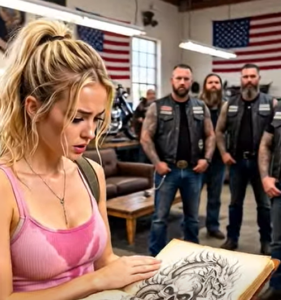
In the a noisy motorcycle repair garage while a massive
For several seconds, I could not move.
The signature on the final page stared back at me beneath the harsh glow of the emergency lights. I had seen that name thousands of times in newspapers, on official documents, during televised congressional hearings, and printed beneath photographs of decorated agents standing beneath the American flag.
Director Malcolm Voss.
The man who had personally approved my father’s arrest three years ago.
The man who had publicly called Ryan Carter a corrupt federal informant who had betrayed his country.
The man who had stood beside my father’s coffin and told me that sometimes good men made terrible choices.
My fingers tightened around the journal until the leather creaked.
“No,” I whispered.
Agent Mason turned toward me. “What is it?”
I shoved the journal into his hands.
His expression changed the moment he saw the signature.
For the first time since I had met him, the veteran agent looked genuinely afraid.
“Where did you get this?”
“It belonged to my father.”
Mason stared at the page, then at me.
“Who else has seen this?”
“Nobody.”
He looked toward the other agents filling the garage.
“Good.”
The word was barely audible.
Then he grabbed my arm.
“We need to leave. Now.”
“Why?”
“Because if Voss signed this, then every person wearing a federal badge in this building could be compromised.”
A gunshot exploded somewhere outside.
Everyone froze.
Another shot followed.
Then another.
Mason immediately pulled his weapon.
“Lights out!”
The garage plunged into darkness.
Someone screamed.
I heard boots pounding across the concrete, followed by the sharp crack of gunfire.
“Get down!”
Mason shoved me behind a steel tool cabinet just as bullets tore through the office window above us.
Glass rained onto the floor.
The bikers who had been arrested moments earlier were screaming and crawling for cover.
For several terrifying seconds, nobody knew who was shooting whom.
Then the radio on Mason’s shoulder came alive.
“Unit Seven, respond! Unknown federal personnel have breached the eastern perimeter!”
Mason’s face went pale.
“They’re here already.”
“Who?”
“The cleanup team.”
My stomach dropped.
“The what?”
Mason looked at me.
“The people who erase evidence when an operation goes wrong.”
Another burst of gunfire thundered through the compound.
I suddenly understood.
The raid had never been the endgame.
It had been bait.
The federal government hadn’t sent agents to arrest the motorcycle syndicate.
Someone had sent us here to retrieve the ledger, expose the gang, and then eliminate everyone who knew enough to connect the gang to the real organization.
Including me.
Including Mason.
Including every surviving witness.
“Your father figured this out,” Mason said.
“What?”
“He wasn’t trying to disappear three years ago.”
He crouched beside me, speaking rapidly while bullets continued tearing through the walls.
“He was building a case against Voss and the people above him. When they discovered what he was doing, they framed him as a traitor. He tried to get the evidence out.”
“My father died because of it.”
Mason hesitated.
“Not exactly.”
I stared at him.
“What does that mean?”
Mason looked toward the shattered garage doors.
“Your father isn’t dead.”
The world seemed to stop.
I could hear nothing.
Not the gunfire.
Not the rain.
Not the shouting.
Nothing.
“What did you just say?”
“Your father survived the crash.”
My heart slammed against my ribs.
“You knew?”
“I found out six months ago.”
“Then why didn’t you tell me?”
“Because I didn’t know where he was.”
“You expect me to believe that?”
“I don’t expect you to believe anything.”
Mason pulled a folded photograph from inside his tactical vest.
He handed it to me.
The picture showed an old warehouse beside a railroad track.
On the back, someone had written three words.
BLACK RIVER.
My hands began to shake.
I knew that place.
It was an abandoned freight depot nearly two hundred miles from the city.
My father had taken me there once when I was a child.
He had called it our secret place.
Before I could say anything, the garage doors exploded inward.
Three men in black tactical uniforms stormed through the smoke.
They weren’t wearing agency patches.
They didn’t identify themselves.
They simply raised their rifles.
Mason fired first.
The garage erupted again.
We ran.
I followed him through a side corridor while alarms screamed overhead.
Behind us, men shouted commands.
“Find the girl!”
“Recover the journal!”
“Nobody leaves the compound!”
We reached a back exit and stepped into the freezing rain.
Mason grabbed a motorcycle from one of the arrested bikers and tossed me a helmet.
“Get on.”
“You know how to ride?”
“I know enough.”
We disappeared into the darkness.
For nearly an hour, neither of us spoke.
The highway stretched endlessly beneath us, slick with rain and illuminated by distant headlights.
My father’s journal was secured beneath my jacket.
The final page seemed to burn against my chest.
Eventually, Mason pulled onto a deserted road.
“We can’t contact headquarters.”
“I know.”
“We can’t contact local police.”
“I know.”
“So what are we doing?”
I looked at the photograph again.
“We’re going to Black River.”
Mason nodded.
But there was something in his silence that bothered me.
“You’ve been there before.”
He didn’t answer.
“Mason.”
He finally sighed.
“Yes.”
“When?”
“Three years ago.”
I felt cold despite the warm engine beneath us.
“Was my father there?”
Mason stared into the darkness.
“Yes.”
My breath caught.
“How do you know?”
“Because I was the one who helped him disappear.”
The confession hit harder than any gunshot.
“You worked with him?”
“At the time, I was investigating Voss independently. Your father discovered that someone inside the agency was selling intelligence to organized crime. He trusted almost nobody.”
“But he trusted you.”
“Eventually.”
“Why didn’t he contact me?”
Mason looked down.
“Because he believed anyone close to him would become a target.”
I closed my eyes.
Three years.
Three years of believing my father had died disgraced.
Three years of watching strangers whisper that he had betrayed his country.
Three years of hating him for leaving me with nothing except an old journal.
And all this time, he had been alive.
Waiting.
Hiding.
Watching from somewhere in the shadows.
We reached Black River just before dawn.
The warehouse stood exactly as it appeared in the photograph.
Rust covered the doors.
Weeds grew through cracks in the concrete.
The railroad tracks beside the building disappeared into a gray horizon.
Mason raised his weapon.
“Stay behind me.”
We entered.
The warehouse was empty.
Almost.
A single desk stood beneath a hanging light.
On top of it was a cup of coffee.
Still warm.
My heart stopped.
Someone had been waiting for us.
Then a voice emerged from the darkness.
“You took your time.”
I knew that voice.
Every memory I had spent three years trying to bury came rushing back.
My father’s voice.
I turned slowly.
He stepped into the light.
Older.
Thinner.
His hair streaked with gray.
A scar ran from his left temple down toward his jaw.
But his eyes were the same.
The same eyes that had watched over me when I was a child.
The same eyes I had seen every night in my dreams.
“Dad?”
He didn’t move.
Neither did I.
For one impossible moment, we simply stared at each other.
Then I ran.
He caught me in his arms.
I buried my face against his shoulder and finally allowed three years of grief to escape.
He held me tightly.
“I’m sorry,” he whispered.
I hit his chest with both fists.
“You let me believe you were dead.”
“I know.”
“You let everyone think you betrayed them.”
“I know.”
“I hated you.”
“I know.”
“Why?”
He pulled away and looked directly into my eyes.
“Because if Voss believed you knew I was alive, he would have killed you.”
I cried harder.
He wiped my face with trembling fingers.
“I watched you from a distance.”
“Then why didn’t you come home?”
“Because I wasn’t finished.”
Mason stepped forward.
“We don’t have much time.”
My father nodded.
“He’s right.”
He walked toward the desk and opened a hidden compartment.
Inside were dozens of photographs, encrypted drives, bank records, shipping manifests, and surveillance files.
Everything connected.
The motorcycle syndicate.
Drug trafficking.
Weapons shipments.
Money laundering.
Corrupt officials.
Federal contractors.
Judges.
Politicians.
But there was one thing that frightened me more than all the rest.
A photograph of Director Voss shaking hands with the leader of the motorcycle gang.
Taken five years earlier.
My father placed another file on the desk.
“This is the real ledger.”
I opened it.
Thousands of transactions were listed inside.
Every payment had a name.
Every name led somewhere higher.
And at the very top was Voss.
“Why did you need me to bring the journal?”
“Because the journal contains the encryption key.”
I stared at him.
“Then you knew I’d find it.”
“I hoped you would.”
“That’s why you left the clues.”
He nodded.
“I knew you would never stop looking.”
A sudden noise came from outside.
Mason raised his weapon.
“Someone followed us.”
My father closed the case.
“We’re out of time.”
We rushed toward the rear exit.
Headlights appeared through the warehouse windows.
Dozens of vehicles.
The cleanup team had found us.
“They’re surrounding the building,” Mason said.
My father looked at me.
“There’s one way out.”
He pulled open a steel hatch beneath the floor.
A narrow tunnel disappeared into darkness.
“You built this?”
“Three years ago.”
We climbed down.
The hatch slammed shut above us.
Seconds later, gunfire erupted inside the warehouse.
We moved through the tunnel as quickly as possible.
My father led us toward an underground railway line.
At the end stood an old maintenance train.
“Get on.”
We climbed aboard.
Mason started the engine.
The train lurched forward just as explosions shook the tunnel behind us.
We escaped into the morning darkness.
For the next two hours, my father explained everything.
The motorcycle syndicate had never been the real organization.
They were only one branch.
The true network was a private intelligence and trafficking operation hidden behind legitimate federal contracts.
Voss had built it slowly.
Anyone who discovered the truth was discredited, arrested, or killed.
My father had gotten too close.
So they framed him.
Then they staged his death.
But my father had managed to steal one thing before disappearing.
Proof.
“Why not release it yourself?” I asked.
“Because evidence can disappear.”
He looked at me.
“But a witness can speak.”
I understood.
He hadn’t brought me into this because he wanted me to become a soldier.
He wanted me to become the person who could tell the truth after he was gone.
We reached an underground station shortly before sunrise.
Mason connected the encrypted drive to an old communications terminal.
The files began uploading.
“Where are they going?”
“Everywhere,” Mason said.
News organizations.
Federal courts.
International investigators.
Independent journalists.
Once the upload finished, nobody could erase everything.
Then the screen flashed red.
UPLOAD COMPLETE.
For the first time in three years, my father smiled.
“They can’t bury it now.”
We emerged from the station as the sun rose over the city.
By noon, the country was exploding with news reports.
Federal raids began across multiple states.
Officials resigned.
Arrests were made.
Investigations were announced.
Director Malcolm Voss disappeared before authorities could reach him.
But six days later, he was captured at an international border.
The same man who had once controlled entire departments was photographed in handcuffs.
My father’s name was officially cleared.
The charges against him were dismissed.
His government records were restored.
But none of that erased the years we had lost.
A month later, we stood together at my mother’s grave.
My father placed a single white flower against the stone.
“I should have been here,” he whispered.
I took his hand.
“You’re here now.”
He looked at me.
“Are you sure you can forgive me?”
I thought about the years of anger.
The empty chair at family dinners.
The birthday calls that never came.
The nights I had wondered whether he had ever loved me enough to come home.
Then I realized something.
Forgiveness didn’t mean pretending those years hadn’t happened.
It meant refusing to let them control the years that remained.
“I can’t give you back the past,” I said.
“But maybe we can stop wasting the future.”
He nodded.
And for the first time since I was a child, we walked away from the grave together.
Months later, I published my father’s story.
Not as a tale about a heroic agent.
Not as a story about motorcycle gangs, corrupt officials, or secret federal operations.
I wrote it as a warning.
Because the most dangerous conspiracies are not always built in dark alleys.
Sometimes they hide behind polished offices, official titles, expensive suits, and trusted institutions.
Power becomes dangerous when nobody is willing to question it.
Fear becomes stronger when people remain silent.
And lies survive only as long as everyone believes the truth is too frightening to uncover.
My father’s leather journal sits on my desk now.
The pages are worn.
The corners are stained.
The final page still carries the signature that once made my hands tremble.
But underneath it, I wrote something of my own.
“Truth does not always arrive like a hero.”
“Sometimes it arrives as a frightened daughter who refuses to stop asking questions.”
I closed the journal.
Outside my window, the city continued moving.
People went to work.
Children walked to school.
Cars filled the streets.
Life went on.
And somewhere beneath all that ordinary noise, the truth had finally found its way into the light.
My father once told me that courage wasn’t the absence of fear.
It was deciding that something mattered more than fear.
For three years, I thought I was searching for the truth about my father.
I was wrong.
I was searching for the courage to face it.
And when I finally found it, I discovered the greatest lesson of all.
You cannot change the lies someone told about your past.
You cannot recover every year that was stolen from you.
You cannot undo betrayal, loss, or injustice.
But you can decide what happens next.
You can keep asking questions.
You can refuse to look away.
And sometimes, one person holding onto the truth long enough is all it takes to bring an entire hidden world crashing into the light.
That night, I opened my father’s journal one final time.
The last sentence he had written before disappearing was still there.
“If you ever find this, don’t come looking for me.”
I smiled through my tears.
“Sorry, Dad.”
“You’re terrible at giving instructions.”
Then I closed the journal.
And for the first time in my life, I knew exactly where I was going.
Home.