In Texas, while a ruthless biker gang leader traded away my freedom over a crumpled paper contract
The photograph hit the floorboards face up, as if it had been waiting for the cuffs to land first.
My mother’s smile was younger than any memory I owned. The man beside her wore no club colors. He wore a watch that cost a house and a stillness that did not belong in Texas heat. The date on the back was written in a hand I knew from birthday cards that always arrived from the wrong city.
Twenty years.
The lead marshal—Harlan—followed my eyes.
“Don’t touch it.”
“I already lived in it.”
He bagged the photo with the torn contract halves. My stepfather, cheek mashed to wood, still found a laugh.
“You wanted a family tree, sweetheart. There it is. Roots and rot.”
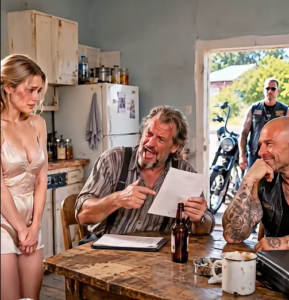
The lieutenant who had ripped the paper did not laugh. His name, on the wire logs, was Rhodes. He looked at the bag, then at my dress, then at the marshals as if adding a column he had not agreed to.
“She is not livestock,” he said again, quieter, to no one who could still use the word arrangement.
They moved us in pieces. Club members to the gravel. Stepfather to a van that did not care about eighteen thousand dollars. Me to a command truck that smelled of electronics and dust, a jacket over the silk because silk in a raid photographs like a costume.
A tech cut the lining with gloves. Micro-film wafers. Routing numbers. Manifests. Audio of my stepfather pricing product in a voice he used for grace at Thanksgiving. Two years of bowed head and cheap beer and counting exits.
Harlan watched the wafers go into a shielded case.
“Vance was your work name.”
“Reed is the birth name. Vance is the one that kept me breathing. Reed is the one on that photograph’s other side, I think.”
“You think.”
“I was told she died in a clinic fire when I was four. I was told my stepfather saved what was left. I was told a lot of things that fit in a purse.”
Rhodes sat cuffed on a bench opposite, not because he was the ringleader, because he had put a fist through a sale of a person and the room had not known where to file him.
Harlan jerked his chin.
“He ripped the contract. That buys him a conversation, not a medal.”
I looked at Rhodes.
“Why.”
He stared at the floorboards still in his head.
“My sister was signed over in a kitchen in El Paso for a truck note. I was sixteen. I don’t watch it twice.”
“You still wore the patch.”
“I wore the patch to stay close to the books your stepfather kept in this dump. You are not the only one who can count.”
Harlan’s mouth flattened.
“We will sort saints later.”
Night in Texas does not cool so much as change weapons. They processed the roadhouse like a carcass. I sat with an ice pack I did not remember requesting and watched the photograph on a tablet, zoomed until the watch face became a brand I had seen on a cartel indictment two years before I ever put on this dress.
The boss’s name in the files was Orellana. Alive. Not a ghost. A man who used Texas clubs as plumbing.
My stepfather talked in the van like talking could renegotiate physics.
“Her mother chose that table. I chose the kid. You want a villain, pick the watch, not the man who kept the girl fed.”
Harlan let me hear the clip. I did not answer it. Answers were for rooms with transcripts.
They flew a specialist from Houston because micro-film and mothers require different gloves. By midnight the wafers had given up every routing number I had promised. By two, a still from an old embassy party matched the photo’s background. My mother had not died in a clinic fire. A clinic fire had died in a report.
I walked outside to throw up behind a generator and found Rhodes being moved to a second vehicle.
“If you knew about Orellana,” I said,
“you knew about her.”
“I knew a rumor that the accountant’s wife wasn’t dead, she was promoted. I did not know the accountant’s kid was wearing the archive in a dress. If I had, I would have ripped that paper sooner.”
“Would you.”
He did not dress it up.
“I don’t know. I like to think the kitchen in El Paso still works on me. Thinking is not the same as having done it.”
They did not let me sleep in the county. Safehouses had been a joke since the sedan in every other story I had lived through in my head. I slept in a field office with a female agent outside the door who did not pretend this was normal.
Morning brought a video call I had not approved. A woman in a pale room, older than the photograph, younger than the lie. The connection was delayed on purpose. Witness protection, the caption said. The face said something harder.
“Mara.”
My work name and my child name collided and left Reed standing.
“You are supposed to be ash.”
“Ash is a useful story. It keeps daughters from walking into rooms with watches.”
“You left me with him.”
“I left you with a man who could still enter the United States. I could not. That is not a hymn. It is a routing decision.”
Harlan stood off camera, jaw tight.
I kept my voice level because level was the last clean tool I had.
“The dress has your husband’s ledgers. It also has your smile next to Orellana. Which column do I file you in.”
She closed her eyes once.
“I was a courier who became a wife who became a problem. Orellana kept me as proof the pipeline had a human face for American partners. Your stepfather sold product and, when the debt got stupid, tried to sell you because he thought the club still bought people. I sent the marshals the compound layout six hours before they kicked the door. I could not send them sooner without sending them your body.”
“Two years.”
“Two years I watched a feed and did not pull you because pulling you early burned the only files that could retire Orellana’s Texas plumbing. I am not asking you to thank me. I am telling you why the photo was in the contract lining. He kept it to threaten me if I ever grew a spine in public. He dropped it because men like him think daughters fold when they see a ghost.”
I folded nothing.
“I want Orellana’s name on the same indictment as the man who slid me across a table. I want the clinic fire amended. I want the silk logged as evidence, not as a costume in somebody’s war story.”
“You will get the first two if the wafers hold. The third is already true.”
The screen died before I could ask whether she had ever learned my favorite color, which was a stupid question and therefore the only one that still hurt.
Harlan sat down across from me with two coffees, both bad.
“We can take you off the board tonight. New paper. New state. The dress did its job.”
“The dress did its job. I am not paper. I will testify as Reed. If they hunt, they hunt a woman who already survived a sale.”
“That is pride.”
“That is a routing decision.”
He almost smiled, then remembered the photograph.
The next weeks were not a raid. They were rooms. Grand jury. Deconfliction. A cartel lawyer who called the photo deepfake until the embassy stills arrived with timestamps. My stepfather took a plea that saved him from a map of graves and not from my voice on a recording saying the price of a human being in a roadhouse.
Rhodes flipped on the club’s side of the plumbing and asked for nothing that looked like redemption. I did not offer any. I put in the record that he ripped the contract. That sentence could live without a halo.
Orellana did not walk into a Texas courtroom. Men with watches rarely do. He lost the pipeline, the partners, the polite fiction that motorcycle clubs were only scenery. It would have to be enough for the part of me that still counted.
They gave me the photograph copy after it was logged. I did not put it in a locket. I put it in the file next to the torn debt paper so the story could not pretend one existed without the other.
On a dry evening I went back to the roadhouse under escort because some rooms need a last walk or they keep renting space in your sleep. The table was still scarred. The heat was still a weight. The beer signs were dead.
I stood where I had choked on terrified tears and said, not to the walls, to the record in my head,
“You do not pay debts with people.”
Rhodes’s line. I could use a line without adopting the man.
Harlan waited in the doorway, back to the sun.
“Your mother asked if you wanted a meeting in person. Protection would allow it once. Not twice.”
I thought of silk and micro-film and a smile that had survived twenty years in a monster’s pocket.
“Tell her I will meet after the verdicts, in a room with a window, and I will not call her Mom until the clinic fire is a corrected document. If that is too much paperwork for a ghost, she already knows how to disappear.”
“I’ll tell her.”
I left the roadhouse without looking for the purse I had dropped. Purses come back as exhibits.
Texas unrolled in the windshield, ordinary and armed with sky. I was not livestock. I had not been saved by a lieutenant’s morality play or damned only by a stepfather’s laugh. I had been a federal witness in a dress designed to look like an offering, and I had walked out with the archive intact because the sale failed in public and the marshals arrived before the next signature.
The lesson did not need a patch or a hymn. People are not currency, even when a table is scarred enough to believe otherwise. Blood can sit beside a cartel watch and still not own your testimony. Undercover work can put the truth against your skin and still not make every rescuer family. A torn contract can be the first honest sound in a room. And the photograph that freezes your blood is not the end of you. It is the exhibit that finally forces every name—mother, stepfather, boss, daughter—onto the same page, where none of them get to hide behind a fire that never happened.
I rode toward the city with the jacket zipped over nothing but a plain shirt, the silk already in a bag that would outlive every man who had tried to price it. The files would travel farther than I would. That was the point of sewing them in. That, and living long enough to watch the laugh die on the wood when the cuffs took the hands that had pushed me across a debt.