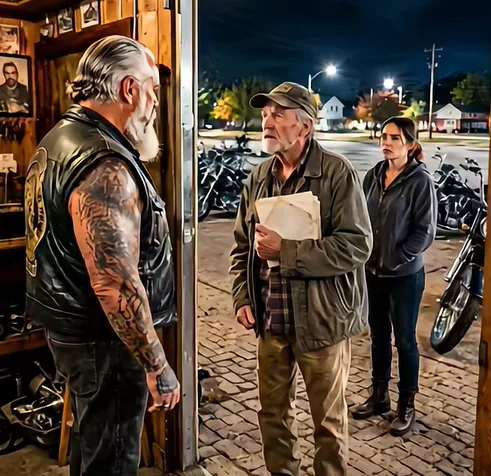
In Texas motorcycle club garage, my ruthless former boss scoffed at my desperate pleas and shoved me toward the street
I stared at the photograph until the edges of it began to swim, and the red and blue light from the street turned the wet shine of my daughter’s face into something I could not look at and could not look away from.
“That’s not possible,” I said, and my voice sounded like it belonged to a much older man. “Sarah was fifteen the night her mother died. She was home asleep.”
“The photo is stamped and dated,” the federal supervisor said quietly. “But I’d like you to look at the corner before you decide what it means.”
He was a lean, gray-templed man in a navy windbreaker, with a badge that read SPECIAL AGENT ELIAS OKAFOR and the patient, bruised eyes of someone who had learned to deliver terrible news in small doses.
I turned the photograph toward the garage light and looked at the lower right corner, where a strip of white border had been trimmed away with scissors.
Someone had cut off the caption.
Someone had cut off the evidence tag, too, and glued the photograph onto a fresh card, and typed a new date across the top.
“This isn’t a police photo,” I whispered.
“No,” Okafor said. “It’s a composite. A good one. Someone took the real crash photograph and pasted your daughter’s face over the driver’s. We pulled the original from the county archive an hour ago. In the original, the driver’s seat is empty, because the driver fled on foot.”
Sarah made a small broken sound beside me.
She had not let go of my arm since the handcuffs clicked around Vance’s wrists, and her fingers were shaking so hard that I felt it through my sleeve.
“Who would do that?” she asked. “Who would do something like that to me?”
“Someone who wanted your father to stop,” Okafor said gently. “Someone who slipped it behind the ballistics report in the evidence room tonight, hoping the shock would break him before he could testify.”
My eyes went across the garage to the place where Vance sat on a steel stool with his hands cuffed behind him and two agents flanking him.
He was grinning.
It was a thin, tired, horrible grin, the grin of a man who had lost everything and had still managed to leave one knife lodged in the wall.
“You did that,” I said.
“I did nothing,” Vance said. “I’ve been sitting in a garage with a gun in my face. But I’ll tell you something for free, Thomas. Somebody in that evidence room has a lot of reasons to want you quiet. And it ain’t me.”
“Quiet,” Okafor said, without turning his head. “Mr. Vance, you have the right to remain silent. I’d strongly suggest you use it.”
Vance shrugged, and his eyes slid back to me, and I saw the real message beneath the sneer.
The man who had killed my wife was not the one who had just tried to destroy my daughter.
My name is Thomas Reyes, I am fifty-three years old, and for three years I had believed there was only one monster in my story.
I had been wrong.
Okafor drove us to the federal field office in the back of a gray sedan, with Sarah curled against my side and the Texas night sliding past the windows in long ribbons of orange and black.
She did not speak for the first twenty minutes.
Then she said, very quietly, “Dad. Was it true? What Vance said?”
“Which part?”
“That he set me up. That it was him the whole time.”
“Yes,” I said. “He staged the robbery. He planted the money in your apartment. He sent his men to scare you into running, because you started asking questions about your mother’s accident, and he was afraid of what you’d find.”
“And you knew.”
“I found out three weeks ago.”
“And you didn’t tell me.”
“I didn’t know how,” I said, and my throat closed. “I thought if I could get the proof first, if I could put him in handcuffs before I told you, you’d never have to carry it.”
She turned her face to the window.
I watched her shoulders rise and fall, small and thin under the gray hoodie, and I felt the old helpless ache of every father who has ever tried to stand between a child and the world and discovered how narrow a doorway is.
“I’m angry at you,” she said.
“You should be.”
“I’m angry that you went in there alone. That you begged him. That you stood in front of a gun.” Her voice cracked. “You could have died, Dad. I would have been alone.”
“Sarah.”
“I’m not finished.” She turned back, and her dark eyes were swimming. “You don’t get to be a hero without asking me first. You don’t get to decide that I can’t handle the truth. I’m twenty-two years old. I buried Mom too.”
The words went through me like a clean blade.
“You’re right,” I said.
“I know I am.”
“I should have trusted you.”
“Yes.”
“I’m sorry.”
She looked at me a long moment, and then the stern line of her mouth wobbled, and she put her head on my shoulder like she had when she was small and had fallen asleep on long drives home from her grandmother’s.
“Don’t do it again,” she mumbled.
“I won’t.”
“Promise.”
“I promise,” I said, and I meant it more than I had meant anything in my life.
The field office was a low concrete building off Interstate 35, cold and humming and smelling of burnt coffee, and Okafor put us in a small conference room with a plate of stale donuts and two blankets that smelled faintly of mothballs.
He came back after an hour with a woman in a gray pantsuit, tall and sharp-featured, with silver hair cropped close to her skull and a manila folder pressed against her chest.
“Mr. Reyes, Ms. Reyes,” Okafor said. “This is Deputy Director Margaret Hollis. She’s overseeing the internal inquiry.”
“Internal,” I repeated.
“The photograph was tampered with inside our building,” Hollis said. She did not soften it, and I was grateful. “Four people had access to that evidence box tonight. Three of them are in this hallway, awake and furious. The fourth has not been seen since six o’clock.”
“Who?”
“A records clerk named Dennis Pruitt. Twenty-two years with the Bureau. Clean file, no complaints, a widower with a bad knee.” Hollis’s eyes were cool and steady. “He has also, we have just discovered, been wiring small sums to an offshore account since 2019. All of them traced back to a shell company registered in Vance’s brother’s name.”
My stomach turned over.
“The brother who killed my wife.”
“Wade Vance,” Hollis said. “He’s been dead since last spring. Overdose in a motel in Laredo. But the account is still open, and someone has been drawing from it every month.”
“Someone who’s afraid of what’s in that envelope.”
“Someone,” Okafor said, “who has a great deal more to lose than Vance does.”
The room went quiet.
I looked down at my hands, at the old scars on the knuckles from thirty years of turning wrenches, and I thought of a long dark highway, and a woman I had loved for twenty-six years walking home from a late shift at the hospital with a bag of groceries in her arms.
“Tell me what you need,” I said.
Hollis sat down across the table.
“Your daughter was never the target, Mr. Reyes. She was the leverage. Somebody inside this building needed to push you into a corner, so you’d either stop investigating or do something reckless. The photograph was meant to make you doubt her.” She leaned forward. “We think they’ll try again. Not with paper. With something more direct.”
“You want to use us as bait.”
“I want to use you as bait,” Hollis said, “if you consent, and if your daughter consents, and if I can keep you both alive. But I’ll be honest. I’m not certain I can.”
Sarah’s hand slid into mine under the table.
“Dad,” she said softly.
“Yes?”
“I’m in.”
“Sarah, you don’t have to—”
“I said I’m in.” She raised her chin, and in the harsh fluorescent light I saw her mother’s face, stubborn and clear-eyed and absolutely unafraid. “Mom would want us to finish it.”
I looked at her for a long time.
“Okay,” I said. “We finish it.”
They moved us to a motel the next night, a rundown place on the outskirts of San Antonio with a flickering vacancy sign and a pool full of green water.
Hollis had chosen it deliberately. Two agents in the next room, three in the lobby, one on the roof disguised as a man repairing the air conditioning. A wire taped beneath my shirt. A second wire sewn into the collar of Sarah’s hoodie.
“Pruitt knows you’re here,” Okafor said, adjusting the tape on my chest with careful, clinical fingers. “We leaked the address to a source he trusts. If he’s the one who wants you dead, he’ll come tonight.”
“And if he isn’t?”
“Then someone worse will.”
I lay on the stiff motel bed in the dark, with the rattle of the air conditioner in my ears and the red glow of the vacancy sign pulsing through the thin curtains, and I listened to my daughter breathing in the other bed.
She was not asleep either.
“Dad?” she whispered, after a long time.
“Yeah.”
“Do you remember the last thing Mom said to us? Before she left for her shift?”
I closed my eyes.
“She said she’d bring home lemon cake,” I said, and my voice caught. “From the bakery on Fourth Street. You asked for the one with the raspberry on top.”
“She came home with the cake in the bag.” Sarah’s voice trembled. “The police gave it back to us. Do you remember that? In a clear plastic evidence bag, with the frosting smashed.”
“I remember.”
“I couldn’t eat anything for a week.”
“Neither could I.”
“I just thought of it tonight.” She let out a shaky breath. “I don’t know why.”
“Because grief doesn’t ask permission,” I said. “It just walks in.”
She laughed, a small, wet sound, and then she was crying quietly into her pillow, and I got up and sat on the edge of her bed and put my hand on her back and said nothing at all.
It was the only thing I knew how to do.
At two in the morning, the knock came.
It was soft, three raps, spaced evenly, the knock of a polite man delivering a pizza.
I sat up in bed with my heart slamming and saw Sarah’s eyes snap open across the dark room, and we both stared at the door.
“Mr. Reyes?” said a mild, gentle voice. “Thomas Reyes? I’m sorry to wake you. It’s Dennis Pruitt, from the Bureau. I have something that belongs to your wife.”
My blood went cold.
Okafor’s voice crackled faintly in my earpiece. “Hold. Stay calm. Let him talk. We have him on camera.”
I stood up, and crossed the room on shaking legs, and put my hand on the chain.
“What do you have?” I said.
“Open the door and I’ll show you.”
“I’ll listen from here.”
There was a pause, and then a small, tired sigh.
“All right,” Pruitt said. “I suppose that’s fair. I’ll tell you through the door, then. I have a letter. A letter she wrote to you, three hours before she died.”
My knees nearly buckled.
“She wrote to me?”
“She came into my office that afternoon,” Pruitt said. “Eleanor. Your wife. I was working in the records annex then, and she walked in with a folder and a very tired smile and asked whether I could help her file a complaint.”
“A complaint.”
“Against Wade Vance. She’d seen him, Thomas. At the hospital, the week before. She’d seen him in the parking garage, handing a bag to a doctor, and she’d recognized the doctor from an old case file, and she put two and two together.” His voice thickened. “She was going to report them. A drug ring, run out of Mercy General, with the Vances moving the product. She came to me because she trusted the Bureau.”
“And you told Vance.”
“I told Vance,” Pruitt said hoarsely. “God forgive me. I was in debt. I had a mortgage and a sick wife and I’d been taking his money for two years, and when she walked out of my office I picked up the phone before I’d even decided to.”
Sarah had come up behind me, her hands over her mouth.
“They killed her because of you,” she whispered.
“Yes.”
“You killed her.”
“Yes,” Pruitt said, and his voice broke apart on the word. “I have known it every day for three years. I’ve sat in that annex and read about your investigation in the reports, and I’ve watched you chase it, and I’ve done everything I could to bury it. I forged the photograph. I wired the money. I tried to scare you off. And I have not slept a full night since.”
Okafor’s voice in my ear was a low, urgent whisper. “Reyes, he’s not armed. We’ve scanned the hallway. He’s alone.”
“Open the door,” Pruitt said wearily. “Please. I’d rather you hear this to my face. I’d rather you see what you’re dealing with.”
I looked at Sarah.
She was staring at the door with huge dark eyes, her face white, her lips moving silently around her mother’s name.
“Dad,” she said. “Open it.”
I slid off the chain, and turned the lock, and pulled the door back.
The man standing in the pale yellow light of the motel walkway was small and stooped, in a rumpled tan raincoat with a bad knee and thinning gray hair that stood up in tufts. He looked like somebody’s uncle. He looked like a man who coached Little League.
In his left hand he held a plain white envelope, soft with age.
In his right, a slim black pistol, pointed at the floor.
“I’m not going to use it,” he said at once, raising the gun slowly and laying it on the concrete between us. “I wanted you to know that. I came here to give you this, and to turn myself in, and if you want, to let you hit me.”
“Federal agents!” Okafor’s voice roared from the stairwell, and the walkway flooded with white light and a dozen armed figures in tactical gear came pouring from every direction. “Hands where we can see them! Step away from the weapon!”
Pruitt raised his empty hands and knelt on the concrete without a word.
He did not look at the agents.
He looked at me, with wet, tired, desperate eyes, and he held out the envelope with both hands like an offering.
“Take it,” he whispered. “Please. It’s hers. It’s the only thing I’ve ever kept that I didn’t steal.”
I took it.
The paper was warm from his hands.
The agents cuffed him gently, almost respectfully, and led him down the stairs, and he went without a sound, a small old man in a tan raincoat walking toward the end of his life.
I stood in the open door of the motel room with the envelope in my fingers, and my daughter’s arm around my waist, and the red glow of the vacancy sign washing over us in slow pulses.
“Are you going to read it?” Sarah asked.
“I don’t know.”
“I think we should.”
“Together?”
“Together,” she said, and we sat down on the edge of the bed, side by side, and I tore open the envelope.
Inside was a single sheet of hospital stationery, creased in thirds, covered in my wife’s quick, slanting, beautiful handwriting.
My loves, it began.
If you are reading this, then I did not get to tell you in person, and I am sorry for that more than I can say.
I am about to do something frightening, and I want you both to know I am not afraid, because I have you.
I found something at the hospital, and I am going to report it tomorrow morning. If it goes the way I hope, you will never read this letter, and we will have a very boring Saturday, and you will make fun of me for being dramatic.
But if it goes the other way, I want to say some things.
Thomas, you were the best decision I ever made. You made me laugh on the worst day of my life, and you have made me laugh on every day since. You taught Sarah to ride a bicycle in the church parking lot, and you stood beside me in the delivery room with a face the color of wet cement, and I have loved you through every single one of it.
Sarah, my darling girl. You are brave, and clever, and stubborn as a mule. Do not let anyone ever tell you to make yourself smaller. And please, please eat a vegetable once in a while.
If I am gone, I want you to be kind to each other. I want you to be loud, and silly, and eat dessert before dinner. I want you to forgive anyone who needs forgiving, because grief is heavy enough without carrying hatred too.
And if there is a lemon cake in the bag, share it.
I love you more than all the stars.
Eleanor.
Neither of us could speak.
I read the last line twice, and the page blurred, and I felt Sarah’s shoulders begin to shake beside me, and I put my arm around her and held her against my chest while the sign outside flickered red, and red, and red.
“She knew,” Sarah whispered, finally. “She knew, Dad. And she wasn’t afraid.”
“She was afraid,” I said, through tears. “She was the bravest person I ever knew, and she was afraid. That’s what brave is.”
“The cake,” Sarah said, and a wild half laugh broke out of her. “She told us to share the cake.”
“We didn’t.”
“We could have.”
“We will,” I said. “I promise you. We will.”
The trial began in March, in a federal courthouse in Austin.
It lasted eleven weeks, and it was the largest drug-trafficking prosecution in the history of Texas, with forty-three defendants and a dozen doctors and two county commissioners and a hospital administrator who wept openly on the witness stand.
Vance took a plea in the second week.
He pleaded guilty to racketeering, conspiracy, and the murder of Eleanor Reyes, and he gave up every name he knew, and when the judge sentenced him to life without parole, he stood very still in his orange jumpsuit and said nothing at all.
Dennis Pruitt testified for four days.
He sat in the witness box with his hands folded and his face gray, and he told the whole story without once trying to make himself smaller. He told the jury about the debt, the phone call, the three years of lies. When the prosecutor asked him why he had come to the motel, he turned and looked across the courtroom at me.
“Because she wrote a letter,” he said. “And I kept it. And I could not stand to keep it any longer.”
He received twenty-five years.
When the bailiffs led him out, he stopped in front of the first row, and looked at Sarah, and said in a cracked voice, “I’m so sorry, Miss Reyes.”
She was quiet a long time.
“I know,” she said finally. “I don’t forgive you. But I heard you.”
He nodded, and his eyes closed, and he went.
Deputy Director Hollis testified, too, and so did Okafor, and the thin young woman from the evidence room who had been the first to notice the cut corner of the photograph. When the last witness had left the stand and the last gavel had fallen, I walked out of that courthouse into a cold bright afternoon with my daughter on my arm.
The steps were crowded with reporters, and microphones, and flashing cameras.
“Mr. Reyes! Mr. Reyes! How do you feel?”
I stopped on the top step, and looked out over the sea of faces, and thought of a woman in a hospital stairwell with a folder pressed to her chest.
“Grateful,” I said. “And very tired. And proud of my wife.”
That was all I said.
We went home to our small house in Round Rock that night, and I opened the door, and for the first time in three years the rooms did not feel haunted.
They felt like rooms.
Sarah went straight to the kitchen and began digging through cabinets, humming under her breath, and I stood in the doorway watching her with a feeling I could not name.
“What are you doing?” I asked.
“Cake,” she said.
“It’s nine o’clock at night.”
“Mom said to eat dessert before dinner.”
“There’s no cake.”
“Then I’m making one.” She pulled a bag of flour from the pantry and set it on the counter with a thump. “Lemon. With a raspberry on top. I found her recipe card in the drawer. The handwriting’s all smudged, so I’m guessing about the sugar.”
I stared at her.
I could not seem to find any words.
“Dad,” she said, and her eyes were bright and wet and fierce. “Come help. You’re terrible at it. But Mom would want you in the room.”
I crossed the kitchen and took off my jacket and rolled up my sleeves.
We made the worst cake in the history of baking.
It came out of the oven lopsided and slightly burned, with a crater in the middle and a raspberry that had slid sideways off the frosting like a drunk off a barstool. Sarah looked at it with her hands on her hips and began to laugh, and I began to laugh, and soon we were both leaning against the counter, wheezing, tears running down our faces.
“It’s perfect,” I gasped.
“It looks like a disaster.”
“That’s what makes it perfect.”
We carried it out to the back porch, and sat on the old wooden steps with two forks and the whole ruined cake between us, under a great dark Texas sky strewn with stars.
I took the first bite.
It was too sweet and slightly burnt, and it was the best thing I had ever tasted.
“Mom,” Sarah said softly, lifting her fork toward the night. “We shared it.”
A warm wind moved through the live oak at the edge of the yard, rustling the leaves, and somewhere far away a train sang its long slow note across the prairie.
I put my arm around my daughter’s shoulders, and she leaned her head against me, and we sat together in the dark with a lopsided cake and a letter in my shirt pocket and the whole long road behind us.
“Dad?”
“Yes, sweetheart?”
“I think she’s happy.”
I looked up at the stars, thick and bright and endless.
“So do I,” I said. “So do I.”
And as we finished the cake in the quiet of the porch, with the smell of lemon and cut grass drifting through the warm night, I understood that the thing Eleanor had asked of us was not justice, or vengeance, or even peace.
She had asked us to be kind, and loud, and silly, and to share the cake.
And at last, after three years of darkness, we knew how.