In our kitchen was humiliating, but my husband’s cold, mocking laughter didn’t make sense until I found the hidden ledger revealing he had engineered
“If Arthur is ever arrested, tell Hannah to look beneath the third floorboard under the flour barrel, because I hid the true deed there, and the truth is the only inheritance I ever wanted her to have.”
I read the line twice, and the paper shook so hard in my fingers that the ink seemed to dance.
The kitchen had fallen into a strange, ringing quiet, broken only by the distant shouting of the marshals dragging Arthur across the yard and the soft crackle of the stove.
“Hannah,” Caleb said gently, and his warm hand settled on my shoulder.
“What does it say?”
I held out the slip of paper without a word, and he read it, and his blue eyes widened.
“Under the flour barrel,” he murmured.
“It was right under your feet the whole time.”
I looked down at the old wooden barrel that had stood in that corner since before I was born, and my heart began to pound.
My father had taught me to bake in this kitchen, standing on an overturned crate with flour up to my elbows, and he used to say that the best secrets were kept in the plainest places.
“Help me move it,” I said.
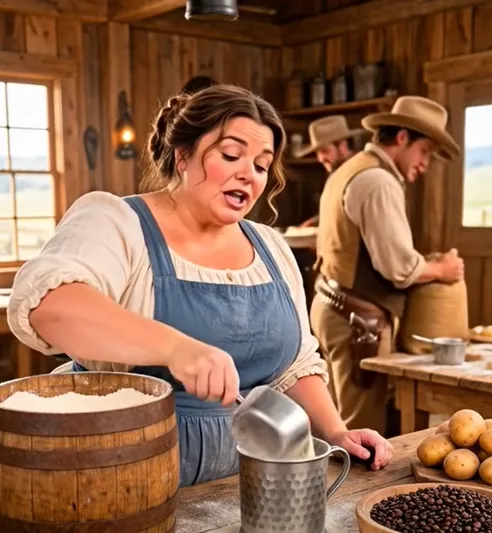
Caleb braced his shoulder against the barrel, and together we dragged it across the planks with a long, groaning scrape, leaving a pale trail of spilled flour behind us.
Beneath it, the floorboards looked ordinary, gray and scarred and worn smooth by decades of boots.
I knelt and counted, one, two, three, and pressed my palm against the third board, and it shifted under my hand with a soft wooden click.
I lifted it away, and in the dark space beneath lay a flat tin box, rusted at the corners and wrapped in oilcloth.
My breath caught in my throat, and I drew it out and set it on the floor, and my fingers fumbled with the latch.
Inside, folded in thirds and sealed with a blob of red wax, was a single sheet of heavy parchment bearing the territorial seal.
It was the original deed to the Lazy T, every acre of it, signed by the governor and bearing my father’s bold signature, and beneath it lay a smaller envelope with my name written across the front.
“Hannah,” it read, in the looping, slanting hand that I had known all my life.
My eyes filled, and the letters blurred, and I pressed the envelope against my chest for a long moment before I could bring myself to open it.
“Take your time,” Caleb said quietly, and he sat down on an overturned crate beside me, patient as the hills.
I broke the seal and unfolded the page.
“My dearest girl,” my father had written.
“If you are reading this, then the man I feared has finally shown his true face, and I am sorry that I did not live to protect you from him.”
“I knew in the weeks before my death that Arthur was a liar, though I could not prove it, and I knew that he wanted the northern water rights more than he wanted my daughter’s happiness.”
“I have hidden the true deed where only you would think to look, and I have sent a letter to the territorial marshal, who is an honest man and an old friend.”
“Do not blame yourself for loving the wrong person, because Arthur is a master of masks, and he fooled better men than you.”
“Be brave, be kind, and bake bread for the hungry, because that is what your mother and I always did, and it is the finest work there is.”
“I will be watching from wherever good ranchers go, and I will be proud of you, whatever you choose.”
“All my love, Papa.”
I folded the page against my knees and bent over it, and the sobs came up from somewhere so deep that I thought they might tear me apart.
Caleb did not say a word, and he did not try to stop me, but he moved close and wrapped both arms around my shaking shoulders, and I leaned into his chest and cried for ten years of grief at once.
When the storm in me finally began to ease, I lifted my head and wiped my face on my flour-stained apron.
“You knew,” I said, and my voice was hoarse.
“You were working for the marshal, and you knew all of it.”
“Not all of it,” Caleb said softly.
“I knew that your father’s death had been investigated twice and ruled an accident, and I knew that the marshal never believed it.”
“He sent me to the Lazy T three years ago as a hired hand, and I was supposed to watch Arthur and gather evidence, nothing more.”
“I did not expect to fall in love with the sound of someone humming in the kitchen at dawn.”
My cheeks flamed, and I stared at him.
“Caleb,” I began.
“You do not have to say anything,” he said quickly, and a rueful smile touched his face.
“I am not telling you so that you will feel obligated, and I would never presume while you are still married, and in shock, and covered in flour.”
“I only want you to know that I did not stay on this ranch for the marshal.”
“I stayed for you.”
A small, startled laugh escaped me, and then another, and I pressed my hand over my mouth because I did not want to cry again.
“Thank you for telling me,” I managed.
“I think I needed to hear that something in this house had been real.”
“This was real,” he said, and he glanced around at the warm yellow kitchen with its crowded shelves and dented pots.
“The cornbread was real, and the laughter at supper was real, and so was every kindness you showed those men, and none of it was ever Arthur’s to take.”
Outside, the clatter of wagon wheels rose in the cold air, and a tall, gray-haired man in a long black coat appeared in the kitchen doorway, with a silver star pinned to his chest and a weary, gentle face.
“Mrs. Turner,” he said, removing his hat.
“I am Marshal Josiah Quinn, and I knew your father for thirty years.”
“I wish we had met under kinder circumstances.”
I rose on shaky legs and held out the tin box, and the deed, and my father’s letter.
“He wrote to you,” I said.
“He said you were an honest man.”
Quinn took the pages with trembling fingers, and his eyes ran down the lines, and he had to stop and clear his throat twice.
“I received his letter the morning after he died,” he said at last.
“By the time I read it, Arthur had already filed the forged deed with the county clerk, and the clerk was a cousin of his.”
“I spent ten years building a case, and I could never find the original, and I could never find a witness who would stand against him.”
“You have given me both tonight, because the deed proves the forgery, and you can testify to the confession.”
“He confessed to me in this kitchen,” I said, “and Caleb heard every word.”
“I did,” said Caleb.
“And so did Deputy Harlow, who was crouched under the window with his ear against the glass.”
I let out a breath that was half laugh, half sob.
“Everyone in this ranch has been spying on everyone else,” I said.
“It seems that way,” said the marshal, and for the first time a smile warmed his tired face.
“But you were the only one who never lied, Mrs. Turner, and that is why you will win.”
They kept Arthur in the county jail that night, and I did not sleep.
I sat at the long kitchen table with a pot of tea going cold in front of me, and the ranch hands filed in one by one, quiet and sheepish, with their hats in their hands.
They stood in a semicircle around me, a dozen sun-browned men who had eaten at my table for years, and none of them seemed to know where to begin.
“Ma’am,” said a red-bearded giant named Big Tom, twisting his hat so hard that the brim creased, “we did not know.”
“If we had known what that man was, we would have done something, I swear on my mother’s grave.”
“I know,” I said, and I meant it.
“None of you could have known, because he hid it from everyone.”
“Still,” said a young cowboy named Billy, who could not have been more than nineteen, “we ate your food and took your wages, and we let him treat you like dirt.”
“I am so sorry, Miss Hannah.”
“Billy,” I said gently, “you were fifteen years old when you came to this ranch, and you cried because you missed your mother.”
“I gave you a biscuit and told you that nobody here would ever let you go hungry.”
“That is the truest thing anyone has ever said to me,” he whispered, and his eyes filled.
I stood and went around the table and hugged him, and he sobbed into my shoulder like the boy he still was, and one by one the other men came forward and added their arms until I was wrapped in a rough, warm, awkward circle of cowboys.
“Now,” I said at last, wiping my face, “who is hungry?”
A ripple of astonished laughter went through the room.
“Ma’am,” Big Tom said, “it is two in the morning.”
“I do not care what time it is,” I said.
“My father said that bread is the finest work there is, and I would like to honor him.”
I rolled up my sleeves, and the men scrambled to build up the fire, and within the hour the kitchen was full of the scent of baking.
We ate at dawn, thirteen of us crowded around the long table, passing around steaming loaves and butter and honey and strong black coffee, and nobody spoke much, but nobody left.
The trial was held in the spring, in the white clapboard courthouse of Redwater, and the whole county crowded in to watch.
Arthur sat at the defense table in a rumpled gray suit, with a hired lawyer from Denver at his elbow, and he looked at me only once, a cold, contemptuous glance that slid off me like rain.
Marshal Quinn laid out the case with a plain, steady dignity.
He presented the forged deed and the true one, the hidden ledger, and the testimony of the county clerk, who had panicked at the first threat of prison and confessed that Arthur had paid him a thousand dollars to look the other way.
Then he called me.
I walked to the witness stand in my mother’s gray dress, with her cameo brooch pinned at my throat, and I swore the oath with my hand on the Bible.
Caleb sat in the front row, with his hat on his knee and his eyes fixed on mine, and I took a deep breath and began to speak.
I told them about the afternoon in the kitchen, and the flour barrel, and Arthur’s voice saying that he had helped my father lose his footing in the dark.
My voice shook at first, and then it steadied, and I felt something rising in me that I had not known was there, a calm, clear, bell-like strength.
When the defense attorney rose to cross-examine me, he was a florid man with a gold watch chain and a smile like a smear of grease.
“Mrs. Turner,” he said, “is it not true that you have been in a fragile emotional state since your father’s death?”
“I have grieved for ten years, sir,” I said.
“But grief is not the same as madness, and I would remind you that I am the only person in this room who can tell you the exact weight of a sack of flour, the date of every payment in my father’s ledger, and the sound my husband’s voice made when he confessed.”
“Would you like me to repeat it for the jury?”
The lawyer’s smile died, and a ripple of laughter swept the gallery.
“No further questions,” he muttered.
Arthur himself took the stand on the last day, and he lied beautifully for an hour, with wounded eyes and a trembling voice, and he almost convinced me.
Then Marshal Quinn rose with a single sheet of paper in his hand.
“Mr. Turner,” he said, “is this your signature?”
It was the forged deed, and beside it, the true deed with my father’s real signature, and Quinn laid them side by side on the rail where every juror could see.
The difference was as plain as a mountain beside a molehill, and Arthur stared at them, and his face went gray.
“I do not recall,” he said weakly.
“You do not recall,” said Quinn gently.
“Then perhaps you will recall this.”
He read aloud from the last page of my father’s journal, the page that had fallen from the back and landed at my feet, and the words rang out across the silent courtroom like a verdict.
“If Arthur Turner ever lays a hand on my daughter, let the world know that I saw the darkness in him and could not stop it, and let the world judge him by what he does with her kindness.”
He lowered the page, and he looked at Arthur, and he said, very quietly, “You answered that question yourself, sir, in the kitchen.”
Arthur said nothing at all.
The jury was out for ninety minutes.
When they filed back in, a hush fell over the courtroom so deep that I could hear a fly buzzing against the window glass.
The foreman, a stooped old rancher with a white mustache, stood and read the verdict in a quavering voice.
“On the charge of murder in the first degree, guilty.”
“On the charge of forgery, guilty.”
“On the charge of fraud and theft of property, guilty.”
Arthur’s lawyer slumped, and the judge, a stern woman in black robes, pronounced the sentence of life in the territorial penitentiary, and a great sigh rolled through the crowd like wind through wheat.
I sat in my seat with my hands folded in my lap, and I felt nothing but a vast, cool stillness, the quiet of a house after a long, loud storm.
Caleb was beside me before I knew it, and his hand closed around mine, and I looked up and saw that his eyes were wet.
“It is over,” he said.
“It is over,” I said, and I almost could not believe it.
Outside, on the courthouse steps, the spring sun poured down in a warm gold flood, and a crowd of neighbors was waiting.
Old Mrs. Delaney from the next ranch pressed a jar of peach preserves into my hands and told me that my mother used to make the same kind, and that she had always known that the Turner boy was bad blood.
The blacksmith took off his cap and said that he was sorry he had never asked why I wore long sleeves in July.
I had forgotten that, the bruises Arthur had left on my arms over the years, and the way I had hidden them so carefully, and the way the whole town must have wondered and said nothing.
“It is all right,” I told him, and I clasped his big callused hand.
“You are speaking up now, and that is what matters.”
We rode back to the Lazy T that afternoon in Caleb’s wagon, with the reins loose in his hands and the horses plodding gently along the dusty road.
The prairie rolled out on either side, green and gold and endless, dotted with grazing cattle and nodding wildflowers, and meadowlarks sang from the fence posts.
For ten years I had seen that land through a veil of fear, and now it looked like a gift I had never opened.
“What will you do with it all?” Caleb asked, nodding toward the horizon.
“The ranch, I mean, and the cattle, and the water.”
I thought for a moment, and then I smiled.
“I think I will do what my father would have wanted,” I said.
“I will feed people.”
He glanced at me, startled, and I laughed.
“I am serious,” I said.
“The Lazy T has more beef than we can sell, and half the county is struggling after the long winter.”
“I want to open the kitchen to anyone who is hungry, and I want to hire widows and orphans and men back from the war, and I want the doors to stay open until the last plate is clean.”
Caleb stopped the wagon, and he turned to face me, and his face was soft with something that looked like wonder.
“Hannah Turner,” he said, “you are the finest person I have ever met.”
“Hannah Whitmore,” I said.
“I am taking back my name.”
“Hannah Whitmore,” he repeated, as though tasting it, and a slow, glowing smile spread across his face.
“It suits you.”
We opened the Whitmore Table that summer, in the great sunny dining room of the ranch house, with long pine benches and red-checked cloths and a hand-painted sign above the door that read, All Are Welcome, All Will Be Fed.
The first day, nine people came, and by the end of the month there were ninety, and by autumn the line stretched out the door and down the drive.
Farmers and drifters, schoolteachers and cowhands, widows with babies on their hips and old soldiers with empty sleeves, all of them filed in and sat shoulder to shoulder over steaming bowls of stew and warm cornbread.
I hired Big Tom to run the grill, and Billy to wait tables, and Mrs. Delaney to bake her famous peach pies, and I made a place at the counter for every person who had ever been told they were too much trouble.
One chilly evening in October, as I was wiping down the long counter after the last guests had gone, a small, thin girl of about twelve slipped through the door and stood hesitating on the mat.
Her coat was too thin, her shoes were worn through, and her dark eyes darted around the room as though she expected a trap.
“Ma’am,” she whispered, “is it true that you give food to anyone?”
I set down my rag and came around the counter, and I knelt so that our eyes were level.
“It is true,” I said.
“What is your name, sweetheart?”
“Rosie,” she said, and she swallowed.
“I have not eaten since Tuesday.”
My heart cracked, and I took her cold hand in mine.
“Then you have come to the right place,” I said.
“Sit down by the stove, and I will bring you the biggest bowl we have.”
She stared at me as if I had offered her a pot of gold, and then, very slowly, she smiled, and it lit her thin face like a lantern.
I fed her chicken stew and a thick slice of cornbread with honey, and she ate in silence with her head bowed, and when she finished, she looked up and said, in a tiny voice, “Thank you, ma’am, nobody has ever just given me anything.”
I turned my face away so that she would not see me cry, and across the room I saw Caleb leaning in the kitchen doorway with his arms folded and his eyes shining.
Rosie stayed that night, and the next, and by the end of the week she had a cot in the pantry and a patched wool blanket and a place at the table.
We searched the county for her family and found none, and one snowy morning in December, I knelt beside her cot and asked her if she would like to stay for good.
She burst into tears and threw her arms around my neck, and I held her for a long, long time.
“I will be good,” she sobbed.
“I will work hard, I promise, I will not be any trouble.”
“Rosie,” I said, “you are not trouble, you are family.”
Caleb and I were married that same winter, in the front parlor of the ranch house, with snow falling softly outside the windows and a fire crackling in the grate.
The whole county crowded in, and the marshal stood as Caleb’s best man, and Rosie, in a new green dress, scattered dried rose petals down the aisle with fierce, solemn concentration.
I wore my mother’s wedding gown, soft and cream and faintly scented with lavender, and I carried a bouquet of winter greens tied with a ribbon from my father’s old saddle.
When I reached the end of the aisle, Caleb took my hands, and his voice trembled as he spoke his vows.
“I promise to love you in good seasons and bad,” he said.
“I promise to eat every biscuit you bake, even the burnt ones, and I promise to never once let you stand alone in a doorway again.”
I laughed through my tears, and I answered him in kind, and when the preacher pronounced us husband and wife, the room erupted in cheers.
Rosie flung her arms around both of us, and we scooped her up between us, and a flash of light went off as the town photographer captured the moment.
I still have that photograph, framed above the kitchen mantel, and every morning when I light the fire I look at it and smile.
The years passed softly, like warm bread cooling on a windowsill.
The Whitmore Table grew into the heart of the county, and the ranch thrived, and Rosie grew into a tall, laughing young woman with her own quick mind and her own stubborn chin.
We had two sons of our own, a sturdy boy named John, after my father, and a bright, curious boy named Samuel, and they grew up wild and happy among the cattle and the flour barrels.
On the tenth anniversary of the arrest, I stood alone in the kitchen at dawn, with the first gray light creeping through the windows and a batch of bread rising under a cloth on the counter.
I dragged the old flour barrel back to its corner, the same barrel, scarred and weathered, and I laid my palm flat against the third floorboard and felt the faint, familiar give.
Beneath it, in the dark, rested a new tin box, and inside it, a smaller envelope that I had written myself the week after the trial.
Dear child, it began, and I had never decided exactly who I was writing to, a daughter, a granddaughter, any girl who might one day be frightened and alone in this kitchen.
I had written that the truth is the only inheritance that matters, and that love is a kind of bread, meant to be broken and shared, and that no cruelty on earth is strong enough to put out a lit stove.
I tucked the envelope back into its place and replaced the board, and I stood for a moment in the quiet, and I felt my father’s presence in the warm air as clearly as if he were standing at my shoulder.
“I did it, Papa,” I whispered.
“I baked the bread.”
The kitchen door creaked open, and Caleb came in with a pail of fresh milk and a smear of dirt across his forehead, and he paused when he saw my face.
“Everything all right?” he asked softly.
“Everything is perfect,” I said.
He set down the pail and crossed the room and wrapped his arms around me from behind, and I leaned back against his chest and watched the sunrise spill gold across the floor.
Upstairs, a small voice called out for breakfast, and another answered with a giggle, and the boards creaked under a pair of running feet.
I pressed Caleb’s hand against my heart and closed my eyes, and the smell of cinnamon and warm butter rose around us like a blessing.
For ten years I had believed that the kitchen of the Lazy T held only humiliation and grief, and now I knew that it held everything my father had ever wanted for me.
Love, and bread, and a table where nobody was ever turned away.
The sun climbed higher, and the voices of my children rang down the stairs, and the whole house seemed to hum with life.
I opened my eyes, and I smiled at the golden morning, and I whispered the words that I had waited my whole life to say.
“We are home.”