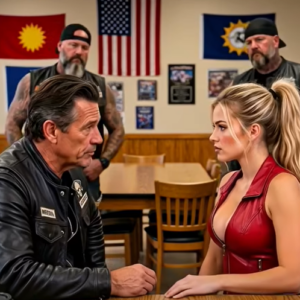
In gravel yard of the clubhouse while a dozen scarred bikers glared down at me with hostile eyes and the club president laughed off my warning
The agents did not let the peace last. The lead commander, a woman whose vest read Solano, stayed after the others had walked the president to the van. She looked at the briefcase, then at me, and did not lower her voice for the remaining bikers still kneeling in the yard.
“The warrant was for the books and the weapons cache,” she said. “It was not for a speech. If you have more than the handkerchief and the transfers, I need it before his lawyer claims you planted the box on your own porch.”
I opened the briefcase again. The lockbox the treasurer had left was already inside, the blood-stained cloth in a separate sleeve, the bank slips clipped in order. Solano photographed them on the scarred table while two of her people kept the yard quiet. One of the bikers, a man with a gray beard and no patch on his chest, watched the camera and did not look away when I met his eyes.
“Ruiz,” he said when Solano glanced at him. “I rode with her father. I told the treasurer where to leave the box. If you’re taking statements, take mine before the rest of them decide remembering is dangerous.”
Solano nodded. They took Ruiz in a separate car. They took me in another. At the field office I repeated the porch, the monogram, the polaroid note, and the night my father had not come home from a run Raymond had scheduled. Solano listened without writing until I finished. Then she set a single photograph on the table: the quarry gate, tire tracks, a dark stain the crime-scene report had called motor oil.
“Your father is not in that quarry,” she said. “The blood on the handkerchief is his. The body was moved. We have a witness who will say Raymond ordered the move. We do not yet have the second location. If you know it, now is the time.”
“I don’t,” I said. “The box had the transfers and the cloth. It didn’t have a map.”
“Then we keep looking. You stay available. You do not go back to the clubhouse. You do not take calls from anyone who still wears the patch.”
I stayed available. Ruiz’s statement matched the transfers and added a date: the night Raymond had told the chapter my father had stolen from the cartel and run. Two members had believed it. The rest had stayed quiet because Raymond already held the charter and the keys to the safe. The witness Solano mentioned was one of those two. He had left the state, then called a tip line when he saw the president’s arrest on a phone in a diner. He agreed to identify the second location if the agents met him halfway and did not ask him to return.
They met him. The location was a drainage culvert under the old highway spur, twenty miles from the quarry. The remains were there. Dental records confirmed them before the end of the week. I identified the watch they found in the silt because I had given it to him the year he made lieutenant. Solano did not ask me to look at anything else.
Raymond’s lawyer called the box a fabrication and the culvert a convenient discovery. The bank slips carried his signature in two places and a notary stamp from a clerk who still worked in the county building. The clerk remembered the day because Raymond had paid in cash and asked her to backdate the seal. She had refused the backdate and kept the receipt. The receipt was enough.
The plea came faster than I expected. Raymond named the cartel contact and the two members who had helped move the body. He did not name Ruiz. In exchange the gun charge was dropped and the trafficking counts were reduced to a single conspiracy that still carried years. He looked at me once on the way out of the courtroom, the same venom, smaller now that his hands were cuffed in front. I did not look back.
Ruiz found me in the parking lot afterward. He had shaved. The gray beard was gone. “The shop your father kept in town is still in his name,” he said. “The lawyer says it clears probate if you want it. Or you can sell it. Either way, the chapter that is left has been told the charter is dissolved. Most of them will ride somewhere else. A few will stay and pretend they never heard the transfers.”
“I’m not opening a clubhouse.”
“Didn’t think you were. The tools are still there. He kept them clean.” Ruiz paused. “He used to say you noticed the people other people stepped over. That’s why the note was in the album. He figured if anything happened, you would be the one who opened the box.”
I drove to the shop that evening. The bay door stuck and then gave. Inside, the lifts were dusty and the parts bins were labeled in his handwriting. I stood in the quiet and did not turn the lights on right away. When I did, the fluorescent hum was the same as every garage I had ever stood in. I found the monogrammed bag where I had left it in the car and set it on the workbench. The polaroid was still inside. I did not take it out.
In the weeks that followed I cleaned the benches, changed the locks, and put a sign in the window that said mechanical work only. A few of the old members came by, saw the sign, and left. One left an envelope with no note. I opened it in front of the camera I had installed and found cash and a key to a storage unit. The unit held three crates of parts that matched invoices from the lockbox, nothing else. I called Solano. She sent someone to collect them. The cash went into the lawyer’s trust account until the probate cleared.
On the day the death certificate was amended I met Ruiz at the culvert because he asked and because I needed to see the place with no tape left on the railing. We did not stay long. The water moved under the concrete and did not care what had been hidden there. Ruiz said he was leaving the state. I said I was keeping the shop open three days a week. He nodded, got on his bike, and rode south. I drove back to town with the windows down and the radio off.
The lesson was not that a torn photograph could undo two years of silence. Raymond had held the charter and the story long enough to move a body and collect the payments. The lesson was that a locked box on a porch only matters if someone is willing to carry it into the yard and open it while the men with patches are still watching. I had done that. The agents had done the rest. What remained was a shop with clean tools, a sign that limited the work, and the knowledge that my father had left the album where I would find the note. I turned the lights on, rolled the first customer’s bike into the bay, and started the job. The truth had stood. The work could stand with it. That was the part no one could drag back into the sunlight and call a lie.
The first customer was a woman with a softail whose charging system had quit on the highway. She watched me test the stator and did not mention the sign or the camera or the fact that the bay had been dark for two years. When I gave her the estimate she paid the deposit in cash and asked whether I could have it done by Friday. I said yes. She left her number on the back of a parts receipt and rode off on a borrowed bike her brother had trailered over.
By Friday the stator was in, the battery was new, and the bike started on the first touch of the button. She came back alone, paid the balance, and stood in the doorway a moment longer than necessary. “People are saying the clubhouse is empty,” she said. “They’re also saying you walked in with a briefcase and walked out with agents. I don’t need the story. I need to know if the tools stay available.”
“They stay available,” I said. “Three days a week. No patches on the property. No conversations about old routes.”
She nodded, took the key, and was gone. The receipt stayed on the bench until I filed it. That night I locked the bay, checked the camera, and drove home the long way so I would not pass the clubhouse sign. The sign was still there. Someone had spray-painted a single line through the charter name. I did not stop.
Ruiz called once from a number I did not recognize. He was in a different time zone and did not say which one. “The storage unit was clean,” he said. “Solano’s people logged the crates and closed the file on the parts. If anyone else shows up with a key, it’s a copy. Don’t open the door for copies.”
“I won’t.”
“Your father’s watch is still in evidence. They’ll release it when the appeals window closes. I’ll text the lawyer the date.” He paused. “You did the part he couldn’t. The rest is just keeping the lights on.”
The appeals window closed without an appeal. The lawyer mailed the watch in a padded envelope with a short letter that listed the remaining probate steps and nothing else. I put the watch in the office safe beside the polaroid and did not wind it. Customers kept coming. A man with a touring bike wanted new tires and asked, carefully, whether I had known Raymond. I told him I had known the man who held the charter before Raymond and that the shop did mechanical work only. He accepted the limit and left a tip that was too large. I logged it and moved on.
Three weeks after the amended certificate a prospect I half-recognized from the yard photos sat on his bike at the edge of the lot for twenty minutes without killing the engine. The camera caught his face. I called Solano’s duty number, described the bike, and stayed inside with the bay door half-down. A patrol car rolled past twelve minutes later. The prospect left before the car reached the driveway. Solano texted that the plate matched a rider who had been told, in writing, that the charter was dissolved and the property was no longer a meeting place. She also texted that he had no new warrants. I saved both messages and raised the door again only after the lot had been empty for an hour.
The woman with the softail came back for a thirty-day check and brought coffee. She did not ask about the prospect or the patrol car. She asked whether the stator was holding and whether I had time next month for a fork seal. I wrote her into the book. When she left I stood in the bay with the coffee and the ordinary noise of the highway and understood that the remaining work was not dramatic. It was the decision, repeated, to open the door for the jobs that fit on a ticket and to close it for everything else. Raymond’s last threat had been about the valley. The valley was still here. So was the shop. So was the camera, the sign, the watch in the safe, and the choice to treat each of them as tools instead of relics. I finished the coffee, rolled the next bike in, and started the teardown. The truth had done what it could. The rest was maintenance, and maintenance was enough to keep the lights on.