I was just a lowly maid and shoved me away while his brothers laughed
The drive sat in an evidence bag like a tooth knocked out of the raid.
Axel spit gravel and blood and still found my name.
“Vance. I should have smelled badge on the bleach.”
I did not give him the balcony as a stage. I came down the exterior stairs with my service pistol holstered and the apron already gone. Six months of bowed head left a crease in the neck that the desert sun would not iron out in an afternoon.
A task force lead named Ruiz met me at the courtyard tape.
“Wire’s clean. Shipment teams are hitting the motel and two sheds off the wash. Axel’s screaming for a lawyer who does not exist on this side of the state line.”
I held up the bag.
“This was in his pocket. Encrypted. File header is my father’s name and a year I was told was a traffic wreck.”
Ruiz’s face did the small change agents make when a case grows a second spine.
“We don’t open that in a courtyard.”
“We open it before someone else deletes it from a server we have not found.”
They took Axel to a van. He twisted for a last cut.
“Your old man wasn’t clean, maid. You just inherited the rag.”
Marshals shut the door on him. The compound became a grid of numbered cones and men in riot plates photographing choppers as if engines could confess.
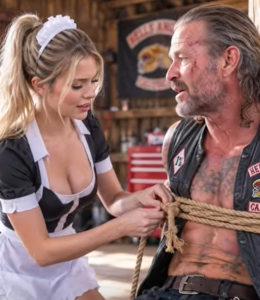
I stood in the workshop where he had yanked his arms from hemp and called me furniture. The pillar still had rope fibers. The linen basket had spilled. A lieutenant in cuffs watched me with the hatred of a man who had believed in maids.
“You mopped our floors.”
“I mapped your floors. Different verb.”
Ruiz pulled me to a mobile command truck that smelled of electronics and dust. A tech named Patel cloned the drive on a machine that did not touch the open net. Encryption fell in layers that had been fashionable twenty years ago. Not amateur. Not current. A man hiding something in the style of the year he died.
The folder opened on a photograph first. My father in a windbreaker that was not federal issue. A desert lot. Crates with the same stencil I had logged in Axel’s midnight shipment notes. A second photo: Axel younger, no gray, shaking hands with a man whose face had been cropped in every public file I had ever pulled during briefing.
Patel exhaled.
“That’s not a traffic wreck.”
The documents were worse than photos. A tasking memo with a redacted header. Informal asset. Weapons interdiction. Then a payment schedule that did not match any Bureau string I knew. Then a termination note written like an apology and filed like a burial.
Subject compromised. Arrange accident. Family to be told mechanical failure.
The signature block was a tangle of offices that no longer existed under those names. One initial set matched a deputy director who now sat on a task force oversight board that had signed my own deployment.
The truck felt smaller.
Ruiz closed the laptop partway as if light could leak.
“Emily. This can be a planted file. Axel had six months to smell you and build a bomb for your badge.”
“He called me maid until the rag blinked. He did not have six months of this quality. This is old paper wearing new plastic.”
“Then we treat it as both. Evidence against him. A knife aimed at you.”
My watch had stopped buzzing. The perimeter was ours. Justice, Axel had screamed, was a rat in an apron. Justice was also a filename I had not been cleared to see when they sent me in with towels.
I went back to room twelve because muscle memory is a kind of grief. Fresh linen still sat folded where a maid would leave it. I sat on the bed I had made for men who sold rifles through motel ice machines and looked at my hands. Dishwater. Gun oil. Both true.
A junior agent knocked.
“Vance. Axel wants to deal. He says the drive is a preview. He says the rest is in a box under the pillar you stood beside.”
Of course it was. Criminals love symmetry. So do wounded operations.
We pulled the pillar. The concrete had been patched by someone who thought patches were invisible. Inside: another drive. Paper. A cloth patch from a club that did not use that rocker anymore. A letter in my father’s handwriting that began with my childhood nickname and ended with do not wear a wire into a room that already bought your blood.
I read it twice. The handwriting was his. The warning was late by twenty years and six months.
Ruiz swore softly.
“We freeze the oversight board contact. We do not call him. We go sideways.”
“If I go sideways they call me compromised like they called him.”
“If you go straight they get a meeting and a shredder.”
Night in Nevada is a clean blade. The compound lights turned the choppers into museum pieces. I walked the fence line with a rifle I no longer had to hide in a laundry cart. The desert did not care which name I used. Emily Carter had fetched towels. Emily Vance had called a raid. The woman holding both was the one who had kept her face blank while brothers laughed.
At 0100 Patel found a routing slip on the second drive. A storage unit in a town that was only a gas station and a lie. We rolled a small team before dawn because large teams make obituaries.
The unit opened on crates stenciled with the same mark as the photos. Not a full arms cache. A museum of a crime: sample weapons, ledgers, a video tape that had no business surviving into a world of flashes. We watched enough to see my father argue with a man off camera. Enough to hear Axel’s laugh from a younger throat. Enough to hear someone promise that the maid’s future daughter would never need to know.
I turned it off.
“Chain it. Copy it. If that board member’s initial appears again I want it on a warrant, not a rumor.”
Ruiz watched me.
“You can recuse.”
“I can finish. Recusal is how this stayed a wreck for two decades.”
Axel’s deal died in a room with no windows when he understood the second box made him a narrator, not a priest. He still tried.
“Your father played both sides. So did I. Difference is I didn’t die in a ditch they called a guardrail.”
“Difference is I am not here to wash your pillar.”
He leaned until the chain stopped him.
“They will burn you for opening that file.”
“Then they can explain the burn in discovery.”
The next days were not a movie. They were memos, holds, a quiet storm in offices that preferred storms to stay in Nevada. The deputy director with the matching initials took leave that fooled no one. A closed hearing that would not stay closed began to grow a date. The Hell’s Angels case, or the franchise that used the name like a rented jacket, lost its midnight motel and its offshore funnels in a stack of indictments that did not mention aprons.
I wrote my after-action without poetry. Undercover duration. Wire integrity. Raid timeline. Separate addendum: recovered material concerning deceased Special Agent—no, the file never gave him that title cleanly—concerning my father. I used his legal name. I used the wreck report number. I used the word homicide where the old memo used arrange.
They offered me time off. I took forty-eight hours and a shower that could not get the motor oil out of memory.
On the second morning I went back to the workshop alone with authorization and a camera for the file. The hemp fibers were gone. The pillar was a hole. I stood where I had bowed my head and said the sentence I had not been allowed on the balcony.
“I was not in your way. I was in your books.”
It did not echo. Concrete swallows speeches. That was fine. Speeches were for men who needed brothers to laugh on cue.
Ruiz found me there.
“Board’s going to ask if your judgment was contaminated.”
“My judgment was a wire in an apron. It worked. The contamination was older than my deployment. They sent a daughter into a network that had already purchased her origin story. Ask them about that contamination.”
He almost smiled.
“I’ll put it in a footnote so they have to see it.”
The darkest secret did not resolve into a neat arrest the same afternoon. Real rot has lawyers and calendars. What resolved was the lie I had lived beside: that I was only a maid who had gotten lucky with a buzzing watch. I had been assigned a ghost’s unfinished route. Someone in a clean office had likely known the rhyme. Someone had let me mop toward it anyway.
I would not give them the gift of my collapse. I would give them testimony, timestamps, and a face that had practiced blankness long enough to use it in a hearing room.
Before I left Nevada I stopped at the motel desk and put a federal card where the room twelve key had been. Not a trophy. A marker. The next girl they hired to be invisible might find a better ending than a blinking rag and a gun at her spine.
On the flight out, the desert shrank to a tan abstraction. I looked at my hands again. They were just hands. They had carried linen and a pistol and a drive with a dead man’s name. They would carry a file into a building where people still thought traffic wrecks were weather.
Axel would sit in orange and call me rat until the word bored even him. The brothers who laughed would learn new jokes in smaller rooms. The oversight initial would learn that daughters read termination notes.
The lesson was not that undercover work ennobles humiliation. It does not. Being shoved and named maid is still a shove. The lesson was that a blank face can be a weapon and also a wound, and the job is to spend the weapon on the right door. Empires that joke about the help are already describing their own security hole. Files that outlive the men who buried them do not care about rank. And justice that arrives with sirens is only half a verdict if the name on the encrypted folder is left as a shiver in a courtyard.
I closed my eyes against the cabin hum and did not sleep. I reviewed the transmission, the flashbangs, the balcony, the pillar, the letter that had known I would come wearing someone else’s smallness. When I landed I would walk into the building as Vance, not Carter, and I would put the flash drive on a table that could not call me maid.
The raid was over. The network was in cuffs. The secret was no longer only mine. That was as close as the desert allowed to peace: not silence, but a record that finally used the right names in the same sentence.