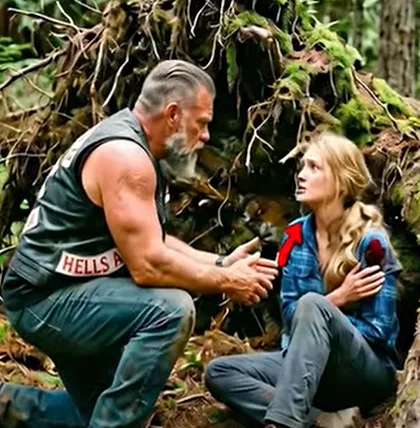
Hiding inside a cold, damp forest lean-to while my ruthless outlaw pursuer gently begged me not to give him away to the syndicate
The helicopter shuddered through the storm, and I pressed my forehead against the cold window until the forest below shrank into a black, shapeless sea.
Somewhere down there, my father was fighting for his life, and I had left him behind.
“Ma’am, you need to put this on,” shouted a young medic over the roar of the rotors, and he held out a pair of heavy headphones.
I snatched them and pulled them over my ears, and the noise dropped into a muffled hum.
“We have to go back,” I said, and my voice came out thin and cracked.
“There’s a man in those woods, and he’s my father, and he’s bleeding.”
The pilot glanced over his shoulder, and beside him a woman in a dark tactical jacket turned around in her seat.
She was in her forties, with short auburn hair, tired hazel eyes, and a federal badge clipped to her belt that read Special Agent Nora Quinn.
“Mila Hartwell,” she said, steady and calm, “I need you to listen to me carefully.”
“We have a second team on the ground at the ranger station, and they are moving toward your father’s position right now.”
“We cannot land in those trees in this weather, and if we try, we will lose the aircraft, and you, and the drive.”
“Then what good is the drive?” I cried, clutching the jacket that held it against my chest.
“If I lose him, what good is any of it?”
Quinn’s expression softened, and she unbuckled her harness and crouched in the narrow aisle in front of me.
“Your father told me you would say exactly that,” she said quietly.
“Six years ago, he sat across from me in a parking garage in Portland and told me that if this ever went wrong, you would try to turn around.”
“He made me promise that I would not let you.”
My breath caught, and I stared at her through a film of tears.
“You knew him,” I whispered.
“You’ve known all along that he was alive.”
“I have known him as a confidential informant for six years,” she said gently.
“And I have never met a man who loved someone more than he loves you.”
I pressed my hands over my mouth, and a sob shook through me so hard that the medic reached over and steadied my shoulders.
“Check the drive,” Quinn said after a moment, softly, giving me something to hold onto.
I unzipped the lining of my jacket with trembling fingers and drew out the heavy waterproof drive, and a green light blinked steadily on its side.
“Upload complete,” I read aloud, and the words sounded impossible.
“Every record, every transfer, every signature,” Quinn said, and for the first time a real smile crossed her tired face.
“The inspection reports on the Cascade Ridge reservoir, the falsified safety certifications, the payments to the mayor and the county judge.”
“By the time we land, my director will have eleven warrants ready to sign.”
I looked down at the drive in my palm, and I thought of the thousands of families asleep in the valley below the dam, who had no idea that the wall holding back a lake of poisoned water was cracking from the inside.
“They’ll be safe?” I asked.
“They will be evacuated by morning, and the dam will be drained under federal order,” Quinn promised.
“You did that, Mila, and I want you to hear me say it.”
“You did that with your own two hands.”
I nodded, but I could not feel proud, because every part of me was still standing in that cold forest beside a man in a leather vest.
The helicopter set down on a lit rooftop in the early hours of the morning, and the wind from the blades whipped my hair across my face.
Agents in dark jackets rushed me through a steel door and into a bright, humming building that smelled of burnt coffee and floor wax.
They gave me a gray blanket and a paper cup of tea, and they put me in a small glass room with a table and four plastic chairs.
I sat there for hours, staring at the clock on the wall, watching the second hand sweep around its pale face.
Every time the door opened, my heart leaped into my throat, and every time it was only someone bringing paperwork.
Around five in the morning, the door opened again, and Quinn walked in with her jacket splattered with rain and her eyes dark with exhaustion.
I stood so fast that my chair clattered backward onto the floor.
“Tell me,” I said.
“Please, just tell me.”
She held up one hand, and I saw that she was smiling, a small, careful, wondering smile.
“They found him,” she said.
The room tilted, and I grabbed the edge of the table.
“Alive?” I breathed.
“Alive,” Quinn said, “and furious that anyone is fussing over him.”
A wild, helpless laugh burst out of me, and then I was crying again, bent over the table with my face in my hands.
Quinn rested her palm on my back and let me cry until I could breathe.
“He took a bullet through the meat of his left shoulder and another across his thigh,” she explained.
“He lost a lot of blood, and he was hypothermic when the team reached him, but he was conscious, and he was still sitting up against a tree with his sidearm in his lap.”
“He told the team leader that he was fine and that someone should check on his daughter.”
I laughed again, a wet, shaky sound, because it was the most perfectly him thing I had ever heard.
“The enforcer who came after you is in custody, and so are eight other mercenaries,” Quinn continued.
“The corporation’s head of security tried to flee north in a private plane, and he was arrested on the tarmac at four this morning.”
“They’re all falling, Mila, one after another, like dominoes.”
“Where is my father?” I asked.
“Cascade General, two floors up from the emergency room,” she said.
“I’ll drive you myself.”
The hospital was a pale concrete building at the foot of the mountains, and the early sun had begun to touch its windows with a thin gold light.
The rain had stopped, and the world smelled of wet pine and clean asphalt, as though the whole valley had been washed.
I walked down the third-floor corridor with my muddy boots squeaking on the linoleum, and a nurse at the desk looked up and pointed without a word.
Room 314 had a door that stood half open, and a strip of morning sunlight lay across the floor like a path.
I stopped in the doorway, because my legs suddenly refused to move.
Jaxson lay propped up against a pile of white pillows, wearing a thin blue hospital gown, with a thick bandage across his shoulder and a clear line running into his arm.
His gray-streaked beard had been trimmed away by the medics, and without the leather vest and the scowl, he looked older, thinner, and heartbreakingly human.
His eyes were closed, and the monitor beside him beeped in a slow, steady rhythm that I had never been so grateful to hear.
I took one step into the room, and his eyes snapped open.
They were that same piercing blue that had terrified me for three years, and now they filled with such naked, trembling joy that my chest ached.
“Mila,” he said hoarsely.
“Dad,” I answered, and the word came out so naturally that we both laughed and cried at once.
I crossed the room in three strides and sat on the edge of his bed and carefully, carefully put my arms around him.
His good arm wrapped around my back with surprising strength, and he pressed his face into my hair, and his whole body shook.
“I told you to get on the chopper,” he rasped.
“I did get on the chopper,” I said into his neck.
“I just didn’t like it.”
He let out a wet, helpless chuckle, and it turned into a cough that made him wince.
“Easy,” I said, drawing back and wiping my face with my sleeve.
“You’re not allowed to laugh yet, you’ve been shot twice.”
“Three times, if you count the one that ruined my vest,” he said, with the ghost of his old gruff humor.
“I’m never getting that jacket back, you know.”
“I will buy you a hundred jackets,” I said fiercely.
“I will buy you a whole leather factory.”
He smiled, and he lifted his hand and brushed a strand of hair from my cheek with his rough, scarred fingers, and the tenderness of it undid me completely.
“I wanted to tell you for so long,” he said quietly.
“Every night for twenty years I rehearsed it, how I would sit you down and explain, and every version ended with you walking away.”
“I thought if you hated me, at least you’d be alive.”
“I did hate you,” I admitted, and I made myself meet his eyes.
“I hated you so much that I took a job in your office and spent three years planning how to destroy you.”
“But I think part of me always knew,” I said slowly.
“The way you looked at me across the table every Friday when I brought you the quarterly reports.”
“You looked at me like I was something precious that you were afraid to touch.”
His lips trembled, and he turned his face toward the window.
“I looked at you like you were everything I had lost,” he whispered.
For a long while we simply sat together while the sunlight crept across the blanket and the monitor kept its patient time.
At last I took a deep breath and asked the question that had been burning in me since the forest.
“Dad, what really happened to Mom?”
His hand tightened around mine, and his gaze came slowly back to my face.
“I need to tell you something, and I need you to stay calm,” he said.
“I don’t think I can promise that,” I said, and my heart began to pound.
“Then at least stay in the room.”
He glanced toward the door, and I turned and saw that a woman was standing in the corridor, half hidden behind the frame.
She was slender, with long silver-brown hair tied back in a loose braid, and she wore a plain gray cardigan buttoned wrong, as though she had dressed in a hurry.
She held both hands tightly against her mouth, and her eyes, wide and green and swimming with tears, were fixed on me.
I knew those eyes.
I had seen them every morning in the mirror, and I had seen them in the single faded photograph of my mother that I kept inside my wallet.
“Mila,” the woman breathed, and the sound was a cracked, trembling whisper.
The room fell away, and the beeping monitor faded, and for a moment I forgot how to stand.
“No,” I said, shaking my head slowly.
“No, she’s dead, they told me she’s dead, they showed me the report.”
“They lied,” Jaxson said, very gently.
“Mila, they lied to both of us, in different ways.”
The woman stepped into the room one hesitant footstep at a time, as though afraid that the floor might vanish beneath her.
She stopped three feet from me, and her whole body shook with the effort of holding still.
“My darling girl,” she whispered.
“My beautiful, brave girl.”
I rose from the bed without knowing I had moved, and I stared at her face, at the fine lines around her mouth and the gray threading her hair, at everything that twenty years had done to her.
“Mom?” I said, and the word broke in half.
She made a sound that I will remember until the day I die, a sound of pure, aching, impossible joy, and then we were in each other’s arms.
She was smaller than I had imagined, and she smelled of lavender soap and clean cotton, and she held me so tightly that I could feel her heart racing against mine.
“I’m here,” she sobbed over and over, “I’m here, I’m here, I’m here.”
I buried my face in her shoulder and cried like I had when I was a little girl, with great gulping breaths, and she rocked me back and forth and stroked my hair.
Over her shoulder, I saw Jaxson watching us with tears running freely down his weathered face, and I reached out one arm and he took my hand.
It took a long time before any of us could speak.
Quinn arrived eventually, carrying a cardboard tray of coffee and a paper bag of pastries, and she stopped in the doorway with an apologetic cough.
“I can come back,” she said softly.
“No,” my mother said, wiping her eyes and laughing shakily.
“No, please, come in, you’ve earned a seat at this table more than anyone.”
We sat together in that small hospital room, my mother in the visitor’s chair, me perched on the edge of the bed, Jaxson propped against his pillows, and Quinn leaning against the windowsill.
And slowly, piece by piece, my mother told me the story that had been stolen from me.
Her name was Elise Hartwell, and twenty-two years earlier she had been a young hydrologist hired by a timber and chemical company called Verran Industries to inspect the dams above our valley.
She had discovered that the company was dumping industrial waste into the old reservoir, and that the walls had been weakened by years of corrosion.
She had written a report, and she had taken it to the county, and the mayor and the county judge had assured her that they would handle it.
Instead, they had buried her report and begun to watch her.
“Your father was a young motorcycle mechanic then, who fixed my beat-up car for free because he said a woman who studied rivers deserved a car that ran,” she said, smiling at Jaxson through her tears.
“We fell in love within a month, and we married within a year, and when I found out I was pregnant with you, I thought nothing in the world could ever be wrong again.”
Jaxson’s fingers tightened around mine.
“Then the warehouse fire happened,” he said.
“Verran’s security men set it to destroy your mother’s original data, and they thought she was inside.”
“I pulled her out through a loading door,” he continued, his voice low, “and she had smoke in her lungs and burns on her arms, and we both knew they would try again.”
“A federal investigator offered us a way out,” my mother said.
“He told us that if the two of us disappeared, the company would stop hunting, and he would build a case quietly in the background.”
“But it had to look real, and it had to be convincing, and it had to be separate.”
“They told us that if they saw us together, they would know we were alive,” Jaxson said.
“So your mother went into federal protection, and I stayed behind as a ghost, and we had to leave you.”
“Leave me,” I repeated, and my voice cracked.
“With my aunt Rosalind, the one who raised me, the one who died when I was fourteen.”
“Rosalind knew,” my mother said, wincing with remembered grief.
“She was the only one who knew, and she loved you as her own, and she kept the secret until the day she died.”
“I wanted to come for you so many times,” she whispered, and a tear slid down her cheek.
“There were nights when I stood at the window of the safe house with a packed bag, and my handler had to talk me out of the door.”
“They told me that one slip, one visit, one letter, and you would be the first thing Verran came for.”
I looked at the two of them, my mother with her trembling hands and my father with his bandaged shoulder, and for the first time in my life I saw the whole picture.
“You didn’t abandon me,” I said slowly.
“You gave up everything so I could live.”
“We gave up what we could not keep,” Jaxson said, “and we spent twenty years making sure it would be worth it.”
“The motorcycle club?” I asked, remembering the leather vests and the rumbling engines.
“A cover,” he said, with a small, rueful smile.
“We were mostly ex-soldiers and ex-sheriffs, and we ran a slow, patient investigation disguised as a gang of outlaws.”
“Verran’s men were never afraid of men who wore badges, but they were very comfortable around men who wore vests.”
“We got closer to them than any agent ever could.”
“And then you walked into my office with a degree in forensic accounting and a hatred of me that could have burned down a building,” he added, shaking his head in wonder.
“Do you know how terrified I was, the first time you walked in?”
“I did not look like I was terrified,” I said.
“I was terrified every single day,” Jaxson said, “that they would find out who you were, and that I would have to watch them take you.”
I laughed through my tears and shook my head at him.
“You are the worst secret keeper in the history of the world,” I said.
“You stared at me constantly, and you gave me a corner office with a window, and you left a cup of hot chocolate on my desk every time it rained.”
“I thought you were trying to poison me,” I confessed.
“A fair assumption,” he admitted gravely, and the whole room dissolved into laughter.
It was the first time in two decades that the three of us had laughed together, and the sound of it filled the small hospital room like sunlight.
The following weeks passed in a strange, dazed whirl of hearings, interviews, and unexpected quiet.
The evidence on my drive, combined with the records the club had gathered over twenty years, was more than the federal prosecutors had ever dared to dream of.
Within days, the mayor was arrested at his lakeside home, and the county judge was pulled from the bench in the middle of a hearing, with his black robe still on his shoulders.
The chief executive of Verran Industries surrendered at his headquarters in Seattle, flanked by seven lawyers and not one friend.
The dam above our valley was drained slowly and carefully under the supervision of federal engineers, and my mother was asked to lead the technical team.
She stood on the concrete wall every morning in a yellow hard hat, with her silver braid tucked into her collar, and I stood beside her with a clipboard.
“Twenty-two years ago I told them this wall would fail,” she said, watching the dark water slide through the new spillway.
“And twenty-two years later, you’re the one who saved it.”
“We saved it,” I said.
“All three of us, and Aunt Rosalind, too.”
She slid her arm around my waist and rested her head against my shoulder, and the wind carried the smell of clean water and pine across the wide gray valley.
“I am so proud of you,” she murmured.
“I want you to know that I have been proud of you every day, even from far away.”
“I used to read the school newsletters that Rosalind mailed to a post office box,” she added, smiling.
“I knew about your spelling bee and your science fair project on tidal erosion, and I cried when you won the regional debate.”
“You were at my debate?” I asked, astonished.
“Back row, wearing a hat and a very bad wig,” she admitted.
“Your father sat three seats away, wearing a different hat and a different bad wig, and neither of us knew the other had come.”
I laughed so hard that I had to lean against the railing, and she laughed with me, her whole face lighting up with a joy that made her look ten years younger.
Jaxson recovered faster than the doctors had expected, which he claimed was because of the hospital food being so terrible that he refused to stay.
By the end of the month, he was walking the corridors with a cane and a scowl, and on the day of his release, the nurses lined up in the hallway and applauded.
He grumbled about it all the way to the parking lot, but I saw him wipe his eyes when he thought nobody was looking.
My mother wheeled a worn black motorcycle up to the curb, the one that had been seized as evidence and returned by the federal government with an apology and a full tank of gas.
“I thought you might want a ride home,” she said, and she handed him a leather jacket.
It was new, black and supple, and sewn into the lining over the heart was a small silver patch in the shape of a heron.
“That’s the symbol of the Hartwell River Conservancy,” my mother said softly.
“I thought a man who spent twenty years guarding a valley deserved to wear its colors.”
Jaxson stared at the jacket for a long, silent moment, and then he pulled it on over his bandages and straightened his shoulders.
“How do I look?” he asked gruffly.
“Like a man who’s finally allowed to go home,” I said.
He swung his good leg over the motorcycle, and my mother climbed on behind him and wrapped her arms around his waist, and they looked at each other with a tenderness that made my heart ache.
“You coming?” he called to me over the rumble of the engine.
I looked at the old truck that Quinn had lent me and the long road winding through the green hills, and I shook my head.
“I’ll follow you,” I said.
“I want to watch the two of you ride off together.”
They pulled out of the parking lot with the sun in their faces, and I climbed into the truck and followed them down the valley road at a slow and happy distance.
Their house stood on a hill above the river, a low timber cabin with a wide porch and a roof the color of moss, built by my father with his own hands in the years when he was supposed to be dead.
I had never known it was there, and when I stepped through the front door, I stopped in astonishment.
Every wall was covered with photographs of me.
There was a school picture from the first grade, with a gap where my front teeth had been, and a snapshot of me at twelve clutching a trophy, and another of me at my college graduation in a cap that had slipped sideways.
There were hundreds of them, framed and unframed, pinned to corkboards and tucked into bookshelves, a whole lifetime of a daughter watched from the shadows.
“I took them from a distance,” Jaxson said awkwardly, standing beside me with his cane.
“I couldn’t help it, I’m sorry, I know it’s strange.”
“It’s not strange,” I said, and my voice shook.
“It’s the most beautiful thing anyone has ever done for me.”
I walked slowly along the wall of memories, touching one frame after another, and the weight of all those years of silent love pressed warmly against my heart.
In the middle of the room, hung above the stone fireplace, was a large painting of a river at sunrise, and in the lower corner, painted in my mother’s careful hand, was a small girl with a red kite.
“I painted it the year you turned five,” she said quietly.
“I never knew whether you remembered that kite.”
I did.
I remembered a bright red kite dancing above a hillside, and a pair of strong hands guiding the string, and a woman’s laughter somewhere behind me.
It was my earliest memory, the one I had always believed was a dream.
“It was real,” I whispered, and my tears spilled over again.
“All of it was real.”
“All of it,” my mother said, and she took my hand.
That evening, we ate dinner together at the long pine table on the porch, with candles flickering in jars and the river murmuring below.
My mother had cooked a huge pot of vegetable stew and a loaf of crusty bread, and Jaxson had burned a pan of cornbread, which we all agreed was the best cornbread we had ever eaten.
Quinn joined us, and so did the old men from the motorcycle club, a dozen grizzled, soft-hearted giants who ate like starving wolves and told embarrassing stories about my father.
“He once cried at a puppy commercial,” said a barrel-chested man called Tiny, who was well over six feet tall.
“I did not,” Jaxson protested.
“He cried so hard he had to pull off the highway,” Tiny insisted, and the entire table roared with laughter.
When the dishes had been cleared and the stars were spilling over the dark river, my mother tapped her glass with a spoon.
“I would like to say something,” she said, and everyone fell quiet.
“For twenty-two years, I believed that the best thing I could do for my daughter was to disappear.”
“I was wrong about that, in many ways, and I will spend the rest of my life trying to make up for it.”
“But I was right about one thing,” she said, looking at me with shining eyes.
“I was right that she would grow up strong and clever and kind, and that she would one day save the valley that I couldn’t.”
“To Mila,” she said, raising her glass, “and to second chances.”
“To Mila,” the table echoed, and a dozen rough voices rang out under the stars.
I rose, with my heart so full I could hardly speak, and I looked around the table at the faces of everyone who had fought for me in the dark.
“I used to think that being brave meant being alone,” I said.
“I thought I had to carry everything myself, and I thought that was the only way to keep people safe.”
“But I’ve learned that the bravest thing anyone can do is let somebody carry it with you.”
“So thank you,” I said softly, “for carrying me.”
I sat down, and my father reached across the table and squeezed my hand, and I felt his warm, scarred fingers tremble against mine.
In the spring, the dam was officially decommissioned, and the old reservoir was replaced by a wide, shallow wetland that my mother designed with a team of engineers and ecologists.
Herons settled along its banks within the first month, and by summer there were otters in the reeds and wildflowers along every path.
The valley council voted unanimously to name it the Hartwell Wetlands, and on the day of the dedication, nearly the whole town came to walk the new boardwalk.
I stood at the entrance in a simple green dress, with my mother on one side and my father on the other, and a ribbon stretched across the path in front of us.
“Would you like to cut it?” the new mayor asked, a kind, silver-haired schoolteacher named Mrs. Alvarez, who held out a pair of enormous golden scissors.
I looked at my parents, and they looked at me, and my mother placed her hand over mine.
We cut the ribbon together, three hands on one pair of scissors, and the crowd burst into applause.
Children ran past us, laughing, and a little boy in muddy boots shouted that he had spotted a frog.
Jaxson, who had traded his cane for a walking stick and then for nothing at all, bent down and showed the boy how to cup his hands so the frog would not be afraid.
I watched them, my huge, gruff father crouching in the grass beside a tiny, wide-eyed child, and I thought that I had never seen anything so tender.
My mother slipped her arm through mine, and we stood together at the edge of the wetlands, looking out at the shining water.
“Do you know what I thought about, all those years in hiding?” she asked.
“I thought about this exact moment, the three of us, standing together in the sun, with nothing to run from.”
“I used to think it was only a dream,” she said.
“And now?” I asked.
“Now I think dreams are just memories that haven’t happened yet,” she said, smiling.
That autumn, I took a new job as the chief financial officer of the Hartwell River Conservancy, the nonprofit my parents had founded to protect the valley’s water.
I had a small office with a view of the river, and every morning I found a cup of hot chocolate waiting on my desk, even though the weather was clear.
I never asked who left it there, because I already knew.
On the first rainy day of November, I sat at my desk with the window open and the smell of wet leaves drifting in, and I felt a quiet, steady peace settle into my bones.
The phone on my desk rang, and I answered it with a smile.
“Hartwell Conservancy, this is Mila,” I said.
“Mila, it’s Nora Quinn,” said the familiar voice, bright with something that sounded like happiness.
“I have news that I think you’ll want to hear in person.”
“Is something wrong?” I asked, sitting up.
“Nothing at all,” she said.
“The final sentences came in this morning, and every last member of the Verran network has been convicted.”
“The mayor, the judge, the executives, and the whole rotten chain, all of them.”
“It’s over, Mila, really over, this time.”
I put my hand over my heart, and I breathed out slowly, and the last small knot of fear that I had carried for so long came gently undone.
“Thank you, Nora,” I said.
“Thank you for keeping my father alive.”
“Thank you for keeping the valley alive,” she replied, and I could hear her smiling.
I hung up the phone and sat in the quiet for a moment, listening to the rain on the roof.
Then I stood, grabbed my coat, and walked out into the soft gray afternoon.
I drove up the winding road to the little cabin on the hill, where smoke curled from the stone chimney and a light glowed in the kitchen window.
I found my parents on the porch, wrapped in a patchwork blanket on the old wooden swing, with a pot of tea steaming on the table beside them.
My father had a book open on his knee, and my mother was reading over his shoulder, and they both looked up when I climbed the steps.
“What’s wrong?” my father asked immediately, with that sharp old protective look in his eyes.
“Nothing’s wrong,” I said, laughing, and I told them the news.
For a moment they sat very still, and then my mother pressed her hands to her mouth, and my father let out a long, shuddering breath.
“It’s finished,” he said, as though the words were too large to understand.
“It’s finished,” I agreed.
He closed the book gently and set it aside, and then he opened his arm, and I climbed onto the swing and squeezed in between them.
The blanket smelled of wood smoke and lavender, and the swing creaked softly beneath our weight, and the rain tapped a gentle rhythm on the porch roof.
My mother laid her head on my shoulder, and my father rested his cheek against my hair, and for a long time none of us said anything at all.
Below the hill, the river ran silver and clear toward the sea, and the herons stood motionless in the shallows, and the evening settled over the valley like a blessing.
“I used to think I was born in the middle of a storm,” I murmured.
“I think I was,” my mother said gently, “but I think you were born to bring the sun.”
I closed my eyes and smiled, and I let myself be held by the two people who had loved me through twenty years of darkness.
The nightmare was over, and the long, winding road had finally brought us home.
And as the last light faded from the sky, I whispered, so softly that only they could hear, the words that I had waited my whole life to say.
“I love you, Mom. I love you, Dad. We made it.”