Did you put your hands on my wife? The voice was quiet, no threat, no anger, just a question that turned the air in that diner completely cold.
Nobody in that diner breathed.
The only sound was the dry rattle of the old air conditioner and the slow tick of the clock above the pie case. Forty men in leather stood in the doorway and along the windows, and not one of them said a word.
Kendall had backed into the vinyl booth so hard that a napkin dispenser toppled and spilled across the table. His mouth opened and closed like a fish on a dock.
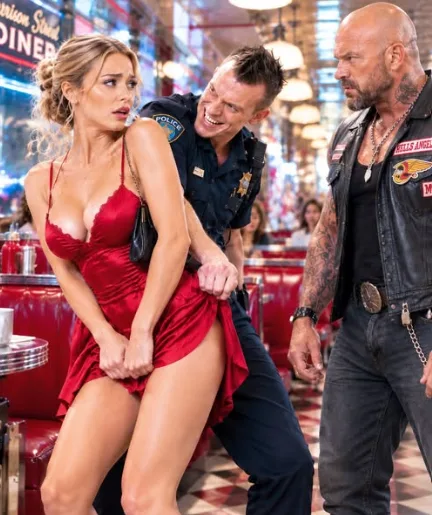
“Sir,” Travis Cole said, and his hand settled on his holster with a forced, easy smile that fooled no one. “I’m going to ask you and your friends to step back outside. This is a law enforcement matter.”
The big man in the black vest did not look at him.
His name was Declan Maddox, though most of the road called him Bear. He was six foot five, bald as a river stone, with a gray beard braided at the tip and a scar that ran from his left ear down into his collar. His arms were covered in faded ink, and on his forearm, in plain block letters, was a single name.
CLAIRE.
He crossed the floor in six slow strides and stopped in front of the red dress.
“Are you hurt?” he asked, and his voice was a different voice entirely, low and gentle, the voice of a man speaking to something fragile.
“I’m all right,” Claire said.
“Did he hurt you?”
“He grabbed me. He lifted my dress. Then he laughed.” Her chin was steady, but her fingers were white around the fabric. “The others laughed too.”
Bear closed his eyes.
For a heartbeat I thought the whole building might shake. I saw the muscle in his jaw leap, and the knuckles of his right hand creak as they curled, and every man behind him took a half step forward.
Then Claire reached up and laid her palm flat against his chest.
“Declan,” she said quietly. “Remember what we agreed.”
He opened his eyes.
“I remember,” he said.
“Say it.”
“We do not give them what they want.”
“Say the rest.”
“We let it be clean.” His voice cracked on the word. “So it stays.”
Travis Cole took one look at that hand resting on that chest and made the first honest mistake of his life. He decided the man was backing down.
“That’s right,” Travis said, and the grin came back. “Smart. You know, folks, a lot of people get excited about a little misunderstanding. Kendall here was just horsing around. Ain’t that right, Ken?”
Kendall nodded too fast.
“No harm done,” Travis said. “Now, I’ll need everybody’s name, and I’ll need all of you out of this lot in five minutes, or I’m calling in every unit in Mohave County.”
“Call them,” said Claire.
Travis blinked.
“Please,” she said. “Call every unit you have.”
I should explain who I am, because I was sitting two stools down from Travis the whole time, nursing a cup of coffee I hadn’t touched. My name is Joe Beckett, I am fifty-eight years old, and I drive a flatbed for a freight company out of Flagstaff. I had been a CB radio man for thirty years, and when I saw what happened to that woman, my hands had already moved before my mind caught up.
I’d keyed the mic on my belt, said three sentences, and set it back down.
I am not ashamed of that. I would do it again.
“Mr. Beckett,” Maggie whispered from behind the counter. She was a small, sharp woman with a gray bun and a face carved by nineteen years of listening to men like Travis. Her eyes were shining. “I think I’m going to be sick.”
“You won’t be,” I said. “Sit down.”
“I’ve never in my life seen so many bikers.”
“They’re not what you think.”
“What are they?”
I looked at the vests. On the back of each was a patch, a pair of crossed wrenches over a mountain range, and beneath it, in plain white thread, three words.
BROTHERHOOD OF THE HIGHWAY.
“They’re truckers’ friends,” I said. “They fix our rigs when we break down at three in the morning. They carry food to stranded families. They ride escort for funerals.”
“Funerals?”
“Every veteran in northern Arizona. If the family asks, they come.”
Maggie stared at me.
“And that one?” She tilted her head toward the big bald man. “He’s the president?”
“He founded it,” I said. “Twenty years ago. After his brother died on this very highway, run off the road by a deputy who got a promotion instead of a hearing.”
I watched the realization move across her face.
“Travis,” she breathed.
“Not Travis. The man who taught him.”
Outside, the engines were still ticking as they cooled, and the lot was a sea of chrome in the white afternoon glare.
Travis had noticed something too, finally.
He had noticed that the bikers were not shouting, not threatening, not reaching for anything. They stood in rows with their hands open at their sides, and each man held a phone raised in front of him, red lights blinking.
Forty phones, all recording.
“What is this?” Travis said, and for the first time the arrogance slipped. “You can’t film a police officer on duty.”
“Actually,” said a new voice from the doorway, “you can.”
A woman had stepped in behind the bikers, slim and silver-haired, in a charcoal pantsuit with a leather folio under one arm. She had a state badge clipped to her belt, and her eyes were the calm, patient gray of someone who had waited a long time to arrive.
“Special Agent Priya Raman, Arizona Attorney General’s Office, Civil Rights Division,” she said. “Deputy Cole. Deputy Moore. Deputy Hatch. I would like to speak with each of you separately.”
Travis went white.
“Who called you?” he said.
“Nobody called me,” said Raman. “I’ve been in the second booth since noon.”
She nodded toward the corner behind me.
I turned, and saw a woman in a faded blue baseball cap, quietly sipping tea, who had been there the entire time, so ordinary that I had not looked at her twice. She lifted her cap in a small salute.
“You’ve been following me,” Travis said hoarsely.
“For fourteen months,” said Raman. “Since a trucker’s widow in Bullhead City filed a complaint that nobody would take.”
The room seemed to tilt.
“That was Mrs. Delgado,” I said, without meaning to. “Rosa Delgado. Her husband, Hector.”
“Hector Delgado was a veteran,” said Raman. “He drove for the same company as Mr. Beckett. Eighteen months ago he was pulled over on this highway for a taillight, and he was found dead in his cab three days later. The county called it a heart attack.”
“It was a heart attack,” Travis snapped. “The medical examiner—”
“Signed by a man who has not worked in this county since March, who is now on a beach in Costa Rica under a different name.” Raman opened her folio. “We found him last week. He had a great deal to say.”
I felt Maggie grip the counter beside me.
“I don’t understand,” she whispered. “Why is she telling us this?”
“Because she wants him to hear it,” I said, “in front of witnesses.”
Raman faced the three deputies.
“Mr. Maddox contacted my office four days ago,” she said. “He told me that his wife would be passing through Kingman on Tuesday, and that she had volunteered to be bait.”
A sound escaped Claire, half laugh and half breath.
“Volunteered,” she said. “That’s a word.”
“Claire,” said Bear softly.
“I did volunteer, Declan.” She turned to the room, the red dress bright as a signal flare. “My name is Claire Maddox. I spent eleven years as a prosecutor in Phoenix. I put away men like Travis Cole for a living, and one by one I watched them walk because a deputy would not testify against another deputy.”
“She’s lying,” Kendall squeaked.
“I left that job two years ago,” Claire went on, “because I got tired of watching victims stand alone. And when Rosa Delgado’s case came across my desk, I thought, somebody has to go in without a badge.”
“You set us up,” Travis said.
“I sat in a diner.”
“You wore that dress on purpose.”
“I wore it because it’s my favorite,” said Claire. “You chose what you did all by yourself.”
He lunged.
I don’t know what he planned. Perhaps he meant to snatch her wrist, or drag her toward the door, or simply lash out because the walls were closing in. But before he had moved two feet, the biker nearest the entrance, a lean gray-bearded man named Tuck, stepped in front of the aisle and held out both hands, palms up, perfectly calm.
“I wouldn’t, son,” Tuck said mildly.
Travis stopped.
The other deputies had backed against the wall, and Danny, the youngest, a freckled boy of twenty-three with a nervous swallow, was shaking.
“Travis,” Danny said in a small voice. “Travis, I didn’t want to do the thing. I told you. I said it wasn’t right.”
“Shut your mouth.”
“I said it wasn’t right.”
“Danny,” said Raman gently. “Come stand beside me.”
The boy stared at her.
“I’m not offering you a deal,” she said. “I’m offering you a chance to stop. You can walk across this room right now, and you can tell the truth, and you will still face consequences. But you will face them as a man who chose to do right when it mattered.”
Danny looked at Travis, and at Kendall, and at forty silent bikers.
Then he looked at Claire.
“I’m sorry,” he whispered.
“I know,” she said. “Cross the room.”
He did.
It took him eleven steps. I counted. When he reached Raman’s side, he put his face in his hands and began to sob, and she laid a hand on his shoulder and turned him quietly toward the door where two uniformed state troopers had appeared, as if conjured out of the heat.
“I want a lawyer,” Kendall blurted.
“You’ll have one,” said Raman. “You’ll need a good one.”
“I didn’t do anything.”
“You assaulted a woman in front of eleven witnesses and a recording device that is currently running in her purse.”
Everyone turned.
Claire reached into the small red handbag on the seat beside her, drew out a slim black phone, and set it on the table where the light caught the screen. A tiny green dot was blinking, with a timer beside it.
“It’s been recording since the moment I walked in,” she said. “Audio, video, and GPS. My husband’s friends hold the backup. So do Agent Raman’s people. So does Maggie.”
“Me?” said Maggie, faintly.
“The camera over your register,” said Claire. “The one you installed after the third burglary. It’s a very good camera.”
Maggie blinked. She turned, slowly, and looked up at the little black dome above the pie case, and began, without any sound at all, to cry.
“Nineteen years,” she said, to nobody. “Nineteen years I paid that man. I put it in an envelope every month.”
“Maggie,” I said.
“I thought if I kept it quiet, he’d leave me my diner.”
“I know.”
“I was so afraid.”
“I know,” I said, and I came around the counter and put my arm around her, the way I would have done for my own mother.
Travis Cole stood in the middle of the floor with his hands hanging at his sides.
He looked like a man who had walked out of a house and found the street gone. His grin had curdled, and his eyes darted from the camera to the phones to the quiet bikers, and then to the badge on his chest as if he expected it to speak.
“You can’t,” he said. “You don’t understand. I’ve got friends. The sheriff. The county commissioner. People who owe me.”
“They’ve been informed,” said Raman.
“My uncle’s a judge.”
“He recused himself this morning.” She almost smiled. “He’s been very cooperative.”
“This is my town.”
“It was never your town,” said Claire.
Her voice was low, level, almost kind. She stepped out from behind the table with her red dress swaying, and she looked at Travis the way a doctor looks at a patient she has finally managed to diagnose.
“This diner belongs to Maggie. That road belongs to everyone who drives it. And that badge you’ve been wearing for twelve years belongs to the people you swore to protect.”
“I know what it belongs to.”
“Then why do you keep using it for this?”
He opened his mouth.
Nothing came out.
I will tell you the strangest thing I saw that day, in thirty years of watching strangers on the road.
I saw Travis Cole’s face, for just one moment, stripped of every trace of cruelty. It was a plain, round, ordinary face, a little weak around the chin, a little frightened around the eyes. It was the face of a boy who had once been shoved down in a schoolyard and had sworn, in some quiet bitter place inside, that he would never be the one on the ground again.
Then the moment passed, and he let out a long, trembling breath.
“I never meant,” he said, and stopped.
“I know,” said Claire.
“I just wanted,” he said, and stopped again.
“I know that too.”
“Nobody ever listened to me.”
“Then now’s a good time to start talking,” Raman said gently, and took his arm.
They led all three of them out into the white blaze of the parking lot, past the long row of motorcycles, and nobody touched them, and nobody shouted. The bikers stood with their helmets over their hearts and their eyes lowered, silent as a congregation.
Maggie let out a breath that I think she had been holding since 2005.
I walked her to a booth, sat her down, and poured her a glass of water with a shaking hand. A big biker named Moses, black-bearded and gentle-eyed, brought her a plate of toast from the grill without being asked, and a young woman in leathers wrapped a blanket around her shoulders even though the air was ninety-eight degrees.
“I’m all right,” Maggie kept saying. “I’m all right.”
“Of course you are,” said Moses.
“I just have to sit a minute.”
“Sit as long as you like, ma’am.”
“I’ve never been looked after in my own diner.”
“First time for everything,” said Moses, and smiled, and sat down across from her to make sure she ate.
Bear had not moved.
He stood at the window with his back to the room, his enormous shoulders rising and falling in slow, careful breaths. He had not raised his voice or his hand, and I understood, watching him, that this was the hardest thing he had ever done.
Claire came and stood beside him.
“Declan,” she said.
“I wanted to put him through the wall.”
“I know.”
“I wanted to take that boy apart.”
“I know you did.” She slipped her hand into his enormous scarred one. “And you didn’t.”
“Because you asked.”
“Because you chose.”
He turned his head slowly, and looked at her, and the tears that had been standing in his eyes slipped down into his beard.
“I’m so sorry,” he said. “I wasn’t there. I was ten feet away on the phone, and I wasn’t there.”
“You were exactly where we planned.”
“That’s not the same.”
“No,” she said softly. “It isn’t. But you came.”
“I’ll always come.”
“I know,” said Claire, and rested her forehead against his chest.
He wrapped both arms around her, and for a long time the two of them stood by the window while forty bikers pretended to study the ceiling. Somewhere behind me, a grizzled old rider named Tuck blew his nose in a bandana the size of a pillowcase.
The trial began in November, in the Mohave County courthouse, under a gray autumn sky.
It lasted three weeks.
Travis Cole, Kendall Moore, and Danny Hatch were each charged separately, and the state called two dozen witnesses. Hector Delgado’s widow testified on the second day, a tiny woman in a black shawl with a rosary wound through her fingers. She told the jury about the night her husband didn’t come home, and the three days she spent calling every hospital in the county, and the deputy who finally knocked on her door and said, “I’m sorry for your loss,” with a smile she would never forget.
Rosa Delgado did not weep on the stand.
When the prosecutor asked what she wanted, she turned her head, found Travis Cole at the defense table, and said, in a calm and quiet voice, “I want him to know my husband’s name.”
“What was his name?”
“Hector,” said Rosa. “Hector Miguel Delgado. He liked to sing while he drove. He was fifty-two.”
Travis bowed his head.
I testified, too, on the fifth day, and so did Maggie. She walked up to the stand in a navy blue dress she had bought just for the occasion, her gray bun pinned with fierce precision, and said in a clear, steady voice that she had been paying protection money for nineteen years.
“How much?” asked the prosecutor.
“Four hundred a month,” said Maggie.
“For nineteen years?”
“Ninety-one thousand, two hundred dollars.” Her chin trembled. “I wrote it all down. I kept every receipt. I thought, someday somebody will ask.”
“And did anyone?”
“No,” said Maggie. “Until you.”
The courtroom was so silent I could hear the radiator ticking.
Claire did not testify in the first week. The defense lawyers fought furiously to keep her off the stand, arguing that her connection to the biker brotherhood tainted the whole case, that she was a vengeful wife, that the recording had been manipulated.
On the ninth day, the judge ordered the recording played in open court.
It ran one hour and forty-two minutes.
The jury heard every word, Travis’s crude remarks, Claire’s calm replies, the sudden vicious scuffle, Kendall’s laughter, and the slow, deliberate, terrible quiet that followed. At one point a woman on the jury put her hand over her mouth and shook her head.
When it ended, nobody moved.
Then the judge, a stout silver-haired woman with a voice like a church bell, cleared her throat.
“I believe we’ll take a recess,” she said, and her voice was not quite steady.
The verdicts came on a cold bright Friday afternoon.
Kendall Moore was convicted of sexual assault, unlawful imprisonment, and abuse of office, and received eighteen years. Danny Hatch, who had testified against his own friends and wept openly through every day of the trial, received four years with a recommendation for early review.
Travis Cole was convicted of conspiracy, extortion, civil rights violations, and the involuntary manslaughter of Hector Delgado.
The sentence was thirty-one years.
When the judge finished reading, he rose, slowly, in an orange jumpsuit with his hands cuffed in front of him, and turned toward the gallery.
He found Rosa Delgado in the second row.
“Mrs. Delgado,” he said hoarsely.
She did not look away.
“I’d like to say I’m sorry,” said Travis. “I know it doesn’t mean anything.”
“It doesn’t,” said Rosa, quietly.
“I know.”
“But I heard you.”
He closed his eyes, and the deputies led him out, and the heavy door closed behind him with a long, final click.
Rosa Delgado sat very still for a long moment. Then her small hands began to tremble, and Claire, who was sitting beside her, reached over and gathered both of them into her own.
“It’s over,” said Claire.
“It is not over,” said Rosa. “My Hector is still dead.”
“No.”
“But it is finished.” She lifted her wet, bright eyes. “I think that is a different thing.”
“I think so too,” said Claire.
The reckoning did not stop with three deputies.
By spring, the sheriff of Mohave County had resigned in disgrace, the county commissioner was under federal indictment, and twelve other officers across northern Arizona had been charged in what the newspapers called the Highway Protection Ring. Seventeen businesses had come forward with their own receipts, their own stories, their own long-buried grievances.
Maggie’s diner became a kind of shrine.
People came from three counties just to sit at her counter. Truckers parked their rigs in a long row down the shoulder, and retirees drove in from Lake Havasu, and a church group from Phoenix chartered a bus. She hired two new waitresses and a dishwasher, and installed a bright yellow awning, and painted over the old faded sign with a fresh coat of cheerful blue.
MAGGIE’S. COFFEE’S ALWAYS ON. NOBODY PAYS FOR PROTECTION HERE.
On opening day of the new season, forty motorcycles rolled into the lot at noon.
I was sitting at my usual stool, as I had every Tuesday since that terrible and wonderful day. I felt the floor hum before I heard the engines, and then the whole building rang with a long, rolling, familiar thunder.
Maggie did not flinch.
She wiped her hands on her apron, turned toward the door with a small proud smile, and called out in her sharp bright voice, “Seat yourselves, boys! Pie’s on the house!”
Bear came in first, filling the doorway, gray-bearded and enormous in his black vest. Claire walked beside him in a plain white blouse, her dark hair loose, her hand in his.
“Maggie,” he said gravely, and took off an imaginary hat.
“Mr. Maddox.”
“We’d like a table for forty.”
“I can arrange that.”
“And a pot of your best coffee.”
“All my coffee’s the best coffee,” said Maggie.
He laughed, a big warm rumble, and the whole room laughed with him.
They filled every booth, every stool, every inch of floor, and Maggie ran between them with a coffeepot in each hand, a hundred years younger than she’d looked on the day I first saw her. Moses carried plates. A tiny, tattooed woman named Birdie washed dishes in the back and sang gospel hymns in a surprisingly sweet alto. Tuck told long, wonderful, entirely fictional stories to a table of delighted children.
Claire slid onto the stool beside mine.
“Joe,” she said.
“Mrs. Maddox.”
“I’ve been meaning to say thank you.”
“You’ve said it four times.”
“I’ll say it forty more.” Her eyes were warm and clear. “You keyed that mic before any of us had decided anything. Without you, he wouldn’t have come.”
“He’d have come anyway.”
“Maybe. But not in time.” She touched my arm. “I think a lot about the people who act first, and ask questions after.”
“I just made a call.”
“That’s what brave is,” said Claire.
I felt my ears go hot, and she laughed, and ordered a slice of peach pie.
Later that afternoon, when the lunch rush had faded and sunlight slanted gold through the front windows, I saw Rosa Delgado come in alone.
She wore a plain gray dress, and she carried a small framed photograph against her chest. She paused just inside the door, looking around the bright busy room as if she were stepping into a church.
“Mrs. Delgado,” said Maggie softly, hurrying over.
“I wanted to see it,” said Rosa. “The place where he stopped.”
“He didn’t stop here.”
“No.” Rosa smiled faintly. “But it is the place where it ended.”
Maggie took her hand without a word and led her to the corner booth, the same booth where Claire had sat on the day it all began. She settled Rosa gently onto the vinyl, brought her a cup of tea and a plate of sweet rolls, and then, after a moment’s hesitation, stood the framed photograph against the sugar dispenser where the light could fall on it.
It showed a big smiling man in a trucker’s cap, one hand raised in a cheerful wave.
“That’s him,” said Rosa. “That’s my Hector.”
“He has kind eyes,” said Maggie.
“He did.”
“I’d have liked to meet him.”
“He’d have eaten all your pie,” said Rosa, and laughed, a small cracked bright sound, the first I had ever heard from her.
Within minutes, a dozen bikers had drifted over.
They didn’t crowd her. They stood a respectful distance away, helmets in their hands, and one by one, quietly, each of them bowed his head. Bear stepped forward last, towering and silent, and set down a little brass plaque on the table beside the photograph.
HECTOR DELGADO. HE SANG WHILE HE DROVE. THE ROAD REMEMBERS.
Rosa put her hand against her mouth.
“We’ll put it on the wall,” said Bear, very gently, “if you’ll allow it. Right here, over this booth. Where everyone who comes through can see him.”
“Yes,” said Rosa, and her voice broke. “Yes. Please.”
The sun was setting by the time they hung it.
Moses held the ladder, and Tuck held the level, and Maggie held a plate of cookies, and Bear drove the final nail with a single careful tap. They stepped back together and looked up at the little brass plate gleaming in the red-gold light.
Nobody spoke.
Then Rosa began, softly, to hum.
It was an old song, a Spanish ballad about a long road and a patient moon, and after a few bars a deep gruff voice joined her, and then another, and then a whole chorus of rough kind voices rose in the warm dim air of that little diner. I have heard the Mormon Tabernacle Choir, and I have heard a stadium full of strangers sing a national anthem, and I have never heard anything that moved me more.
I looked at Claire.
She was standing by the window in the last light with her hand in her husband’s, her face wet and shining and utterly at peace. Bear held her against his side as though she were made of spun glass, and his enormous chin rested on her hair.
“It was a good dress,” I said, without quite meaning to.
She laughed, startled.
“It was a very good dress,” I said. “It was the bravest thing I ever saw anybody wear.”
“Thank you, Joe.”
“You’re welcome.”
She leaned her head against her husband’s shoulder, and he kissed her forehead, and the song rolled on around us, warm and slow and endless.
Out on the highway, the evening traffic hummed past in long glittering streams, and the sun slid behind the mountains in a wash of rose and amber. A trucker passed with his window down, and I heard his CB crackle with a cheerful voice calling a safe night to the road.
I thought of a hot July afternoon, a stool, and a man with a badge and a grin.
I thought of how easily it might have gone the other way, how many diners and how many Tuesdays there must be across this whole wide country, and how many people were sitting quietly in them right now, waiting for someone to ask a simple question.
Did you put your hands on my wife?
It had taken only seven words to turn the air cold.
But it had taken a great deal more, patience and nerve and restraint and a roomful of strangers willing to stand up, to turn that cold into something warm.
Somewhere in the back, Maggie was ladling soup into a dozen bowls. Somewhere in the kitchen, Birdie was still singing. Out in the lot, forty motorcycles gleamed in the dusk like a row of sleeping animals, and the first stars were coming out above them, small and bright and patient.
I finished my coffee, and left a twenty on the counter, and walked out into the cool desert air.
Behind me, the diner glowed gold against the darkening sky, loud with laughter, fragrant with pie, with a brass plate on the wall and a pot of coffee that was always on.
It looked like exactly what it was.
A place where the road finally turned toward home.