Crying hysterically on the scorching gravel outside the deserted Pearson gas station while my stepfather kicked dust over my bleeding knees and laughed cruelly
The motorcycle’s engine settled into a low, steady rumble beneath us, and I pressed my cheek against the worn leather of his vest as the gas station shrank into a pale smudge behind us.
I did not know where we were going, and for the first time in three years, I did not care.
My knees stung where the gravel had torn them open, and my whole body ached with a deep, hollow tiredness, but his arm stayed locked around me as though I might blow away on the desert wind.
“Stay with me, Mila,” he said over the roar of the road.
“We’re almost there.”
“Where?” I asked, and the word came out cracked and small.
“Somewhere safe,” he answered.
“Somewhere Arthur never knew existed.”
We rode for nearly an hour, past dry riverbeds and leaning fence posts, while the sun sank toward the horizon and turned the whole sky the color of a ripe peach.
At last, he turned onto a narrow dirt track that wound between two rust-colored hills, and a small stone cabin appeared at the end of it with a tin roof and a crooked porch.
A single lantern glowed in the window, and a thin ribbon of smoke curled up from the chimney into the darkening air.
Someone was waiting for us.
The biker cut the engine, and the silence that followed was so deep that I could hear the crickets starting up in the dry grass.
He climbed off first and lifted me down as carefully as if I were made of glass, and I leaned against his chest because my legs refused to hold me.
“Easy,” he murmured.
“I’ve got you, kid, I’ve got you.”
The cabin door swung open, and a woman stepped out onto the porch, small and sturdy, with a long gray braid over her shoulder and a dish towel in her hands.
She looked at me, and the dish towel fell to the floorboards.
“Dear Lord,” she whispered.
“That’s Elena’s girl.”
“Her name is Mila,” the biker said, and his voice cracked on the second syllable.
“Mila, this is Ruth, the best nurse in three counties and the only person alive who never stopped believing me.”
Ruth came down the steps with her arms already open, and before I could say a word, she had folded me into a hug that smelled of lavender soap and fresh bread.
“You poor, brave child,” she said into my hair.
“Come inside, and let’s get you cleaned up.”
The cabin was warm and small and crowded with quiet comforts, with a patchwork quilt draped over a sagging couch, a shelf of dog-eared paperbacks, and a black iron stove ticking softly in the corner.
Ruth sat me in a kitchen chair and knelt in front of me with a basin of warm water and a roll of clean gauze.
She worked gently and expertly, washing the dust and dried blood from my knees, murmuring soft reassurances while the biker stood in the doorway with his arms crossed and his eyes fixed on me.
“You haven’t told me your name,” I said at last, looking up at him.
He glanced at Ruth, and something flickered across his face, a mixture of fear and longing that made him look suddenly much younger.
“It’s Daniel,” he said.
“Daniel Rourke.”
The name struck me like a bell, because I had heard it once, long ago, whispered in the dark by my mother when she thought I was asleep.
“Rourke,” I repeated slowly.
“Mama used to say that name when she prayed.”
Daniel’s face crumpled, and he turned away and pressed the back of his wrist against his mouth.
Ruth set down the gauze and rose to her feet, and she laid a hand on his shoulder.
“Tell her, Danny,” she said quietly.
“She deserves the truth, and she’s earned it ten times over.”
He took a long, shuddering breath and turned back to me, and in the lantern light his blue eyes shone wet and bright.
“I need to tell you something, and I need you to hear all of it before you decide what to feel,” he said.
“Twenty-two years ago, I was a young man with a motorcycle, a few good friends, and a girl I loved more than my own life.”
“Her name was Elena Whitcombe, and she was the daughter of the richest family in the county.”
“My mother,” I breathed.
“Your mother,” he said, and his voice broke.
“Her family hated me, because I was poor and had no name, and her cousin Arthur hated me most of all.”
“But Elena didn’t care, and she married me in secret in a little chapel by the river, with Ruth as our only witness.”
Ruth smiled sadly and nodded, her eyes bright with remembered joy.
“Then she found out she was expecting you,” Daniel continued.
“We were so happy that we didn’t know what to do with ourselves.”
“But three months before you were born, the old Whitcombe barn burned to the ground, and a night watchman died in the fire.”
“Arthur swore on a Bible that he saw me running from the flames with a can of kerosene in my hand.”
My stomach turned cold.
“It was a lie,” I said.
“It was the biggest lie of my life,” said Daniel.
“He had set the fire himself to cover up a mountain of embezzled money, and he needed someone to blame, and I was the perfect scapegoat.”
“I was convicted in four days, and I was sentenced to life without parole.”
“They told your mother I had confessed,” he said, and a tear slid down his weathered cheek.
“They told her I never wanted to see her again.”
I pressed both hands over my mouth, and the tears I had been holding back for years finally spilled over.
“She never believed it,” Ruth said gently.
“She wrote to the prison every week, and every letter was returned unopened.”
“Then you were born, and she named you after her grandmother, and she kept a photograph of Danny hidden in the lining of her jewelry box.”
“I have it,” I whispered.
“I found it last winter, in the bottom of her old trunk, and I never knew who he was.”
Daniel let out a ragged sound that was half laugh and half sob.
“I escaped eleven years ago,” he said.
“A fire broke out in the prison laundry, and in the chaos, a friendly guard looked the other way, and I walked out of the gate with a stolen coat and nothing else.”
“The whole world believed I had died in the flames.”
“I came here to Ruth, because she was the only person I trusted, and she hid me and fed me and found me work, and I spent ten years quietly gathering proof.”
“Proof of what Arthur had done.”
“Every bank record, every forged signature, every payoff to a corrupt official,” Daniel said.
“I tried again and again to find you, Mila, but Arthur had moved you to the ranch and sealed it off like a fortress.”
“He told the whole county that your mother had drowned, and that you were unstable and dangerous, and nobody dared question him.”
“My mother didn’t drown,” I said slowly.
“No,” Daniel said, and his face went hard and gray.
“I don’t think she did.”
The room was silent, and the stove ticked, and a moth fluttered against the lantern glass.
“I found a letter in the ranch office last month,” I said, and my voice shook.
“It was in the bottom drawer of Arthur’s desk, under a false panel.”
“It was addressed to him, and it was in my mother’s handwriting, and it said that she knew everything about the fire, and that she was going to the sheriff.”
“The date on it was two days before she died.”
Ruth gasped, and Daniel closed his eyes.
“She was going to testify,” I whispered.
“She was going to save you, and he killed her for it.”
“We can prove it now,” Daniel said.
“With your ledger, and with that letter, we can prove all of it.”
I looked down at my hands, and then, slowly, I reached into the lining of my torn jacket and drew out the water-resistant leather ledger that had never left my side.
It was stained with dust and sweat and a little of my blood, and its corners were curled from being carried through three years of fear.
I laid it on the kitchen table between us.
“I copied everything,” I said.
“Every transfer, every account, every name, for thirty-one days, while he slept.”
“I didn’t know who I was doing it for, but I knew that somebody would come.”
Daniel stared at the ledger, and then at me, and he knelt down on the cabin floor and took my scraped hands in both of his.
“Mila,” he said, his voice thick, “you are the bravest person I have ever known.”
“I was so scared,” I whispered.
“I was scared every single day.”
“That’s what brave means, sweetheart,” he said.
“It means you do it anyway.”
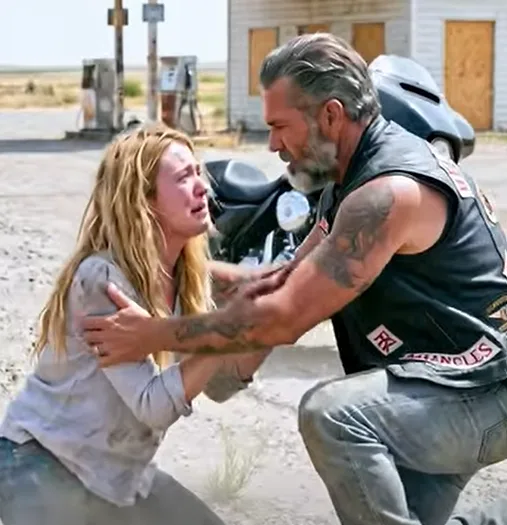
I leaned forward and wrapped my arms around his neck, and he held me against his chest with a fierce, trembling tenderness, and for a long time neither of us spoke.
Over his shoulder, I saw Ruth wiping her eyes with the dish towel, smiling through her tears.
That night, I slept in the narrow bed in the back room, under a quilt that smelled of cedar and sunshine.
I woke once in the darkness with my heart pounding, certain that I heard Arthur’s truck on the gravel.
But the sound was only the wind, and through the thin wall I could hear Daniel and Ruth talking in low, tender voices about the future.
I drifted back to sleep with a small, unfamiliar warmth glowing in my chest, and in the morning I woke to the smell of frying bacon and the sound of someone humming an old country song.
Daniel stood at the stove in a flannel shirt with a spatula in one hand, cooking breakfast with the intense concentration of a man defusing a bomb.
“You burned the toast,” I said from the doorway.
“I did not,” he said, and then he looked at the black slabs smoking in the pan and sighed.
“I did.”
I laughed, a real laugh, the first one in three years, and the sound startled both of us.
Daniel turned slowly, and his face broke into a smile so wide and so boyish that I almost didn’t recognize him.
“Say that again,” he said.
“Say what?”
“Your laugh,” he said.
“It sounds exactly like your mother’s.”
My eyes stung, and I crossed the kitchen and hugged him from the side, and he wrapped one arm around me and kissed the top of my head.
“I’m glad you found me,” I said.
“I’m glad you let me,” he answered.
The federal agents arrived at midday, three dark SUVs rolling up the dirt track with their dust trailing behind like gray ribbons.
A tall, composed woman in a navy blazer stepped out of the first vehicle, with a badge on her belt and a leather folder tucked under her arm.
“Miss Whitcombe?” she said.
“I’m Special Agent Laura Medina, and I’ve been looking forward to meeting you for a very long time.”
She shook my hand firmly, and then she turned to Daniel, and her stern face softened.
“Marshal Rourke,” she said.
“Your reinstatement papers came through this morning.”
I stared at him.
“Marshal?” I said.
Daniel rubbed the back of his neck, looking embarrassed.
“I was a deputy marshal before the fire,” he said.
“A very young one, right out of the academy.”
“The badge I showed Arthur yesterday was my old one, which Ruth kept safe in a biscuit tin for eleven years.”
“They cleared your name?” I asked.
“As of nine o’clock this morning,” said Agent Medina, and she opened her folder with a quiet flourish.
“The Bureau has spent the last year investigating Arthur Whitcombe independently, and the evidence your father gathered, combined with your ledger, was the final piece we needed.”
“The charges against Daniel Rourke have been formally dismissed, and the state has issued a full apology.”
Daniel did not move, and I saw his lips tremble.
“Twenty years,” he whispered.
“Twenty years, and they just wrote it off with a signature.”
“I know it isn’t enough,” Medina said quietly.
“But it is the truth, finally written down.”
Ruth came out onto the porch and put her arms around him, and he buried his face in her shoulder like a child.
I stood very still, watching, and a quiet, glowing joy rose inside me and spread through every limb.
Arthur’s trial began in the autumn, in the same white-pillared courthouse where my father had once been condemned.
I sat in the front row in a plain blue dress that Ruth had sewn for me, with my hand tucked inside Daniel’s, and he wore a dark suit and a silver marshal’s badge pinned over his heart.
Arthur sat at the defense table in a gray prison suit, and he looked old and shrunken, with sunken cheeks and trembling hands.
When I took the stand, he glared at me with a lingering ember of his old malice, but I did not look away.
I told the jury everything, from the day my mother died to the night I copied the first page of the ledger.
I described the sixteen-hour days at the ranch, and the locked doors, and the false medical records that had branded me unstable.
I told them about the letter in the false drawer, and I held it up in its clear plastic sleeve so that every juror could see the faded ink of my mother’s handwriting.
When I read her final line aloud, my voice broke, and the whole courtroom was silent.
“I will not let an innocent man rot while the guilty prosper,” I read.
“Tomorrow, I will tell the truth.”
I set the letter down, and I looked at Arthur, and I said quietly, “She never got the chance, but I did.”
The defense attorney tried to shake me, and he suggested that I was a grieving girl with a vivid imagination.
“Sir,” I said, “I am a girl who spent three years in a locked room, and I assure you that my imagination never once went anywhere near what you would find in your client’s safe.”
A ripple of laughter passed through the gallery, and the judge, a stern woman with silver hair, hid a smile behind her hand.
The jury deliberated for less than three hours.
When they filed back into the box, the foreman, a gray-haired rancher in a pressed shirt, stood and read the verdicts in a slow, clear voice.
“On the charge of arson, guilty.”
“On the charge of murder in the first degree, guilty.”
“On the charge of embezzlement and fraud, guilty.”
“On the charge of unlawful imprisonment of a minor, guilty.”
Arthur slumped in his chair, and his lawyer laid a limp hand on his shoulder, and the judge sentenced him to life in prison without the possibility of parole.
As the bailiffs led him away, he turned his head and looked at me one last time, and I saw in his small, pale eyes not rage, but a cold, hollow emptiness.
I felt no triumph, and I felt no hatred, only a deep, quiet release, like a hand finally unclenching.
Outside the courthouse, the autumn sky was bright and clear, and the maple trees along the square blazed red and gold.
A crowd had gathered on the steps, neighbors and farmers and old friends of my mother’s, and when we appeared, they began to applaud.
An elderly woman with a cane pressed a bouquet of chrysanthemums into my arms and whispered that she had known my mother at church.
A young man in a feed store cap shook Daniel’s hand and told him that his father had never believed the arson story for a minute.
Daniel received each kindness with a stunned, shy gratitude, and I saw that he was struggling not to cry in front of everyone.
“Come on,” I said softly, tugging his sleeve.
“Let’s go home.”
“Home,” he repeated, tasting the word as if it were something rare.
“I like the sound of that.”
The Whitcombe ranch had been returned to me by order of the court, along with the family estate and every dollar Arthur had stolen.
I had thought I would never want to set foot there again, but on a cool October morning, Daniel and Ruth and I drove up the long gravel lane together and stopped at the gate.
The house stood before us, white and sprawling, with a deep porch and tall windows that stared out over the hills like tired eyes.
I stood for a long moment with my hand on the cold iron gate, and my stomach tightened.
“We can sell it,” Daniel said gently.
“You do not have to go inside, Mila, not ever.”
“I know,” I said.
“But I think I need to.”
I walked up the path with Daniel on one side and Ruth on the other, and I opened the front door with the key the court clerk had given me.
The air inside smelled of dust and old wood polish, and sunlight slanted through the windows across the empty hallway.
I walked slowly from room to room, touching the walls, the banisters, the dusty windowsills, and in every corner I felt the ghost of the frightened girl I had been.
In the upstairs hall, I stopped before a closed door at the end, and my hand trembled on the knob.
It was my mother’s room.
Arthur had locked it for three years, and I had never been allowed inside.
Daniel’s hand settled warmly on my shoulder.
“I’m right here,” he said.
I turned the knob and pushed the door open.
The room was bright and quiet, with pale yellow curtains and a white iron bed, and on the dressing table sat a silver hairbrush and a small framed photograph.
I crossed to it with slow steps, and I picked up the frame, and I looked down at a young woman laughing in a sunlit field, with her arm around a lean, grinning man in a leather jacket.
They were so young, so radiant, and so utterly in love that my chest ached with it.
“That’s the day you proposed,” Ruth said softly from the doorway.
“She told me she never wanted to stop smiling.”
Daniel took the photograph from my hands and stared at it, and tears ran down his face without a sound.
“I forgot how happy we were,” he whispered.
“I forgot what her face looked like when she was happy.”
I put my arm around his waist, and he pulled me close, and we stood together in the quiet yellow room while the afternoon light turned gold on the wooden floor.
“She would be so proud of you,” he said at last.
“I think she’s here,” I whispered.
“I think she’s been here the whole time.”
We kept the house.
Over the winter, we scrubbed it from top to bottom, and Ruth sewed new curtains in warm shades of cream and green, and Daniel repainted the porch a cheerful sky blue.
We tore down the locked office where Arthur had kept his safe, and we built a bright, sunny kitchen in its place, with a long oak table where everyone could gather.
We opened the ranch to the town, and on Saturdays, the whole yard filled with children riding the gentle old horses and families picnicking beneath the cottonwoods.
I turned the old barn into a small school for kids who needed extra help, and Ruth taught reading in the mornings while Daniel taught the older boys how to repair engines in the afternoons.
He started a motorcycle club, too, a gentle, grinning band of old riders who spent their weekends raising money for the county hospital and teaching teenagers to respect the road.
They called themselves the Second Chances, and Daniel wore the patch on his vest with a pride that made my heart swell.
Spring came, and the hills turned green, and the ranch bloomed with wildflowers in every field.
On a warm evening in May, I sat on the porch steps with my chin in my hands, watching the sun sink behind the western ridge.
Daniel came out and sat beside me, holding two mugs of hot cocoa, and he handed me one without a word.
We sat in comfortable silence, listening to the crickets and the distant lowing of cattle.
“Do you ever think about what would have happened if I hadn’t stopped at that gas station?” he asked at last.
“All the time,” I said.
“And do you know what I think?”
“What?”
“I think my mother sent you,” I said.
“I think she looked down from wherever she is and said, that’s my girl, go get her.”
Daniel laughed softly, and his eyes grew bright.
“I wouldn’t put it past her,” he said.
“She was always the stubborn one.”
I rested my head against his shoulder, and he put his arm around me, and the porch swing creaked gently in the evening breeze.
“I have something for you,” he said.
He reached into his vest pocket and drew out a small, worn velvet box, and he opened it and held it out to me.
Inside lay the faded silver ring that I had seen on his finger that first terrible day, the twin of the one my mother had worn.
“I kept it for twenty years,” he said.
“Your mother had the other one, and I know that Arthur must have thrown it away or sold it.”
“But this one has been with me through every dark night, and I would like you to have it.”
“Daniel,” I said, and my voice failed.
“I want you to know that you don’t have to call me anything,” he said quickly.
“I know I have not earned the right, and I would never presume.”
“But I want you to know that you are my daughter, and I am yours, for as long as you will have me.”
I looked at the ring, and at the trembling, hopeful face of the man who had crossed twenty years of exile to find me, and I felt the last of the old fear melt away.
I took the ring, and I slipped it onto my finger, where it fit perfectly.
“Dad,” I said.
He drew in a sharp breath, and his whole body went still.
“Say it again,” he whispered.
“Dad,” I said, and I was laughing and crying at the same time.
“Dad, Dad, Dad.”
He pulled me into his arms so tightly that I could hear his heartbeat, strong and fast and joyful, and I felt Ruth’s warm hand settle on my back as she joined the embrace.
We stayed that way for a long time, the three of us, while the stars came out one by one above the dark, rolling hills.
The seasons turned, and the years passed softly, and the ranch grew into a home that was loved by half the county.
I went to college in the fall, studying law, because I wanted to help children who had been trapped the way I had been, and Daniel drove me to campus on his big black motorcycle with my suitcase strapped to the back.
“Call me every Sunday,” he said gruffly, trying to hide the tremor in his voice.
“Every Sunday,” I promised, and I kissed his weathered cheek.
“And come home for every holiday, and every long weekend, and whenever you miss the toast.”
“I will never miss your toast,” I said, laughing.
“Good,” he said.
“Because I’m never going to get any better at it.”
I graduated four years later at the top of my class, and when they called my name, I looked out into the audience and saw Daniel and Ruth standing on their chairs, cheering at the top of their lungs.
Daniel was wiping his eyes with the sleeve of his good suit, and Ruth was waving a handmade banner that said Our Mila in lopsided blue letters.
I opened a small legal clinic in town that autumn, in a sunny little office above the bakery, and I took cases for families who had nowhere else to turn.
There was a woman whose landlord had stolen her security deposit, and a teenage boy trapped in a foster home that did not feed him, and an old man whose nephew had forged his will.
I fought for every one of them with the fierce, patient determination that I had learned in a locked room at the ranch, and I won more often than I lost.
On the wall of my office, I hung two framed photographs, one of my mother laughing in a sunlit field, and one of Daniel and me on the porch of the ranch house, grinning at the camera with our arms around each other.
Beneath them, I tacked a small brass plate that read, Justice, however late, is still justice.
One golden afternoon in early summer, a young girl came into the clinic with her mother, thin and quiet, with a bruise fading on her cheek and a shadow of old fear in her dark eyes.
She stood in the doorway, clutching a ragged stuffed rabbit, and she looked at me as though I might vanish.
“Are you the lawyer who helps?” she asked, in a very small voice.
I knelt down in front of her so that our eyes were level, and I smiled.
“I am,” I said.
“My name is Mila, and I promise you that you’re safe here.”
She studied my face for a long moment, and then she looked at the silver ring on my finger.
“That’s pretty,” she whispered.
“It was my mother’s,” I said.
“And my father’s, too, and it reminds me that people who love you will always find a way to bring you home.”
The little girl’s lip trembled, and she pressed her face against her rabbit, and her mother laid a hand on her shoulder with tears streaming down her face.
“Come in,” I said gently.
“Let me make you a cup of cocoa, and you can tell me everything.”
Later that evening, after the clinic had closed and the sky had melted into a soft violet dusk, I drove out to the ranch and found Daniel sitting on the porch swing with his old guitar across his knee.
He was playing a slow, wandering tune, the one my mother used to hum, and the notes drifted out across the darkening fields like fireflies.
I sat beside him, and he played until the last note faded, and then he set the guitar down and looked at me.
“Hard day?” he asked.
“A good one,” I said.
“A little girl came in, and I think I can help her.”
“Of course you can,” he said, and his face glowed with pride.
“You have your mother’s heart and my stubbornness, which makes you unstoppable.”
I laughed, and I leaned my head on his shoulder, and the swing creaked softly beneath us.
The first stars appeared over the western ridge, small and bright, and a warm wind carried the scent of wildflowers across the yard.
Ruth came out with a plate of fresh-baked cookies and a pot of tea, and she settled into the rocking chair beside us with a contented sigh.
“Look at the two of you,” she said, shaking her head fondly.
“Twenty years ago, I never would have believed it.”
“Neither would I,” said Daniel.
“I used to lie awake in that prison cell and dream of this exact moment, and I thought it was too beautiful to ever be real.”
He reached out and took my hand in his rough, warm fingers, and I squeezed it.
I looked out at the dark, rolling hills where the girl I had been had once cried alone, and I thought of the scorching gravel and the shattered knees and the screaming prayer that someone, anyone, would come.
Someone had come.
He had crossed twenty years and a thousand miles, and he had knelt in the dust beside me and said that I was safe.
And I was.
The porch light glowed warm and yellow against the night, and inside the house I could hear the soft ticking of the old clock and the murmur of the radio playing an old, sweet song.
“Daddy,” I said quietly, using the name I had only dared whisper a few times before.
“Yes, sweetheart?”
“Thank you for coming back for me.”
He was silent for a long moment, and when he spoke, his voice was thick and low and trembling with joy.
“I’d cross a hundred years to do it again,” he said.
I smiled up at the stars, and I held his hand tighter, and I felt my mother’s presence settle around us like a soft, glowing blanket.
The nightmare was over, the long road had ended, and the family that had been torn apart by greed and lies had finally, finally been made whole.
“We’re home,” I whispered into the warm, sweet dark.
And somewhere out beyond the hills, I could have sworn that the wind whispered back.