By ordered off my own ancestral homestead in the freezing Wyoming mountains during a blinding blizzard by a bloodied
The folded document spun once in the doorway draft and landed on the threshold where snow was already melting into the grain. I kept the revolver on the judge until a marshal took his arms, then I crouched and lifted the page before the wind could claim it. The paper was warm from his coat. The seal was territorial. The name at the bottom was not his.
Elias Whitaker. My father. Dated five winters ago, the week the bank first posted notice on our gate.
My thumb smeared a wet flake across the ink. Outside, the judge twisted against the cuffs and saw what I held. Blood from a split lip had frozen at the corner of his mouth. He smiled anyway, the small smile of a man who had planned to lose the room and win the story.
“Read it under a lamp,” he said. “You’ll want privacy for that particular oath.”
Marshal Eddings, the one who had come through the window and whose badge I trusted, jerked the judge toward the porch. “Save it for the capital, Harlan.”
Judge Harlan Pike looked back at me through the blowing snow. “Ask her who signed the mineral lease before I ever touched a gavel. Ask her why the syndicate knew which cabin still had a woman in it.”
They dragged him into the white. The outlaw on my floor coughed and tried to sit up. I had not even learned his name. Lanterns from the federal line bobbed down the switchback, too late to have fired the rifle shot that warned me, which meant the shot had been his or theirs. I shut the splintered door as far as it would shut, set the page face-down on the table, and only then struck a match.
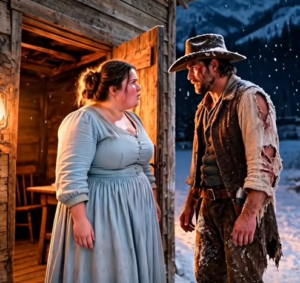
The outlaw’s name, he said when he could speak, was Samuel Reed. He had ridden for the bank’s survey crew until he saw them burn the Alden place with the family still arguing in the yard. He had run with a copied plat and a bullet in his side. The rifle shot in the canyon had been his signal to me, fired wild when he realized the judge’s men were ahead of the marshals. I believed half of it. Half was already more than I had believed an hour ago.
Eddings posted two men on the porch and came in stamping snow from his boots. He saw the page. I did not hide it. Four years undercover had taught me that concealed paper becomes the weapon pointed back at you.
“Pike dropped it,” I said. “It’s a mineral authorization. My father’s signature.”
Eddings was quiet the way good law is quiet when the ground shifts. “You want me to log it now or after you read it?”
“After. Then log it. If I hesitate, take it anyway.”
He nodded and stepped out to shout orders into the gale. Samuel watched me from the floor, one hand pressed to the crude bandage I had cut from a flour sack.
“You already knew,” he said.
“I knew the bank killed him. I did not know he opened the gate.”
The authorization was worse in lamplight. Elias Whitaker had not sold the homestead. He had consented to a subsurface survey in exchange for a stay of foreclosure, and he had initialed a clause allowing the syndicate to enter if the assay showed silver above a set grade. The assay, attached, showed silver. The stay had been revoked the day after his funeral. Pike’s court had called the consent a conveyance. The armed men who came for the cabin had called it law.
I set the page down and listened to the wind try the broken latch. My father had taught me to shoot on the ridge behind this room. He had told me never to sign a paper I had not read twice. He had read this one. The second reading was in a steadier hand than the first.
By morning the pass was drifted shut and the prisoners could not be moved. Pike sat in the root cellar with a deputy and a candle. Samuel lay on the bunk that had been mine, fever up, talking in pieces about plats and a clerk in Laramie who kept duplicate leases in a flour tin. I boiled snow and cleaned the wound and did not ask him to repeat the kind parts. Eddings spread the warrants on the table beside my father’s page and built the chain the way a carpenter builds a joint: bank draft to forged title to Pike’s order to the eviction crew. The authorization sat at the bottom like a stone that would not plane flush.
“Defense will say you planted it,” Eddings said.
“Defense will say I am a daughter, not a marshal. Both can be true. The drafts still have Pike’s endorsement. The crew still has powder burns. Samuel still has a hole in him.”
“And you still withheld a pocketful of warrants until we hit the door.”
“Those were mine to time. This page is not mine to time.” I tapped the signature. “Enter it.”
Pike heard the cellar hatch open and did not stand. The candle made a small honest circle on his face. “He came to me,” the judge said. “Your father. Winter of the note. He wanted the bank held off until spring so you could finish the term at the school in Cheyenne. I told him the only lever was the subsurface clause. He hated it. He signed it. When the assay came back he tried to withdraw. The syndicate does not allow withdrawals. I gave him a day to ride for you. He used the day to hide the strongbox you’re standing over. They met him on the switchback.”
“You ordered the meeting.”
“I failed to stop it. There is a difference the jury may not love, but it is the difference I have.” He looked at the hatch. “Reed will tell you I paid the crew. He is right. He will not tell you your school fees were itemized in the same ledger, line under the eviction bonuses. I kept that page out of his copy. Consider it a professional courtesy I am done extending.”
I closed the hatch. In the cabin Samuel was awake and sweating. I asked him once. He looked at the ceiling beams and said the Laramie tin had a tuition receipt with my name and the bank’s stamp. He had not brought it. He had thought I would shoot him if he did.
The storm broke on the third day. We came down the mountain in a file: Pike on a led horse, hands bound, Samuel in a travois, the warrants and the authorization in Eddings’ saddlebag, my badge pinned where the judge’s men could see it and not mistake the order of things. At the valley road the bank’s remaining enforcers had already scattered. The ones who had not scattered were face-down in the agency wagon with their weapons tagged. Word runs faster than horses when a judge is in irons.
In Laramie I stood in the clerk’s back room while Eddings pried the flour tin. The receipt was there. So was a letter in my father’s hand, never sent, telling me not to come home for the holiday, telling me the ridge was no longer safe, telling me the signature had been his and the blame should stay his. He had not survived to post it. The clerk, a thin man named Boyle, tried to eat a second page and lost three teeth for the trouble. That page named Pike’s cut and the crew chief’s cut and a column headed “beneficiary quieting,” under which my school was listed for two years.
I made myself read the figures aloud so the deputy’s notes would carry them. My voice held. The holding cost more than the reading.
Samuel testified from a cot in the infirmary, then from a chair when the fever broke. He did not embellish the burning of the Alden place. He did not need to. Pike’s counsel called the authorization a family conspiracy and me its heir. The prosecutor, a woman who had tried land cases since the territory was younger, set the unsent letter beside the receipt and asked the jury to count the days between signature and death. Eleven. Eleven days of a man trying to unmake his own lever. The eviction crew’s powder, the forged titles, the drafts endorsed in Pike’s hand: those belonged to the living defendant. The jury took one night. Guilty on the syndicate counts. The judge on the bench, a different man, voided the mineral entry on the Whitaker homestead and on four neighboring claims whose owners had signed under the same clause or lost husbands to the same switchback.
After the verdict Pike asked to speak to me in the holding corridor. Eddings allowed it with a deputy at each end.
“You could have burned the page on the mountain,” Pike said. “Reed would have backed you. Eddings liked you.”
“Eddings likes cases that survive appeal.”
“And you like being clean.” He almost laughed. “You are not clean. You were schooled on silver that should have stayed under another family’s corn. Remember that when they offer you a citation.”
“I will remember the eleven days,” I said. “You remember the cellar. We are even in the only way that matters. The record is heavier than either of us.”
They moved him at dawn. I did not watch the wagon. I took the unsent letter to the ridge instead, once the road was passable, and read it where he had taught me the rifle. The wind was ordinary wind. The cabin door was still splintered. I repaired the latch before I repaired anything I felt.
Samuel found the place in late spring, walking with a cane and a pardon application Eddings had initialed. He did not ask to stay. He brought the Alden widow’s new deed, recorded, and a sack of seed the court had ordered the bank’s receiver to provide. We planted the lower bench where the snowmelt ran clean. He talked less than he had on my floor. That was an improvement. When he left he said the tuition line would follow me longer than Pike’s sentence. I said that was correct, and that following was not the same as steering.
In Cheyenne the service offered the citation Pike had predicted. I accepted the paper and declined the speech. The citation listed the warrants, the arrest, the voided entries. It did not list my father. I added a supplemental memorandum in my own hand and filed it where citations go to be forgotten and memoranda go to be found: the signature, the eleven days, the receipt, the day and a half I might have burned the page and did not. A record that starts at the raid is only another eviction, prettier ink.
I kept the homestead. Not as a trophy and not as penance performed for an audience. The bench grew a thin stand of oats the first year and a better stand the second. Neighbors who had watched the judge leave in irons came for seed and stayed for fence wire. Some of them had signed clauses too. We did not absolve one another. We compared dates and walked the lines the court had restored. On the ridge the wind still found the gap in the cabin wall where the latch had been. I left the scar in the wood. It was a truer mark than a plaque.
What the mountain taught, and what the verdict only confirmed, was that stolen ground does not return because a badge flashes in moonlight. It returns when the person who benefited in ignorance refuses the second theft, which is the theft of the beginning. My father opened a door to buy me a winter of school. Other men widened it until families burned. I could have called the first act love and the rest crime, and many would have let me. The harder truth is that love which signs away another family’s ore is already a kind of eviction. Justice is not the ruin of the daughter. Justice is the daughter putting the page on the table, taking the smaller name, and planting the bench anyway so the next winter’s door is a latch and not a lie.