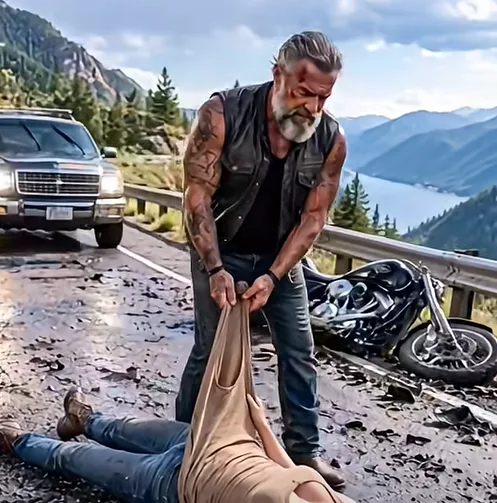
Being unconscious and bruised on the treacherous asphalt of a winding mountain pass while a scarred
Dawn on the pass was a thin gray cut between the ridges, not a pardon. The neon OPEN sign buzzed and died. Glass gritted under my boots. The hitman lay cuffed to the diner’s downspout with a marshal’s flex tie the veteran had taken off my own belt, breathing, cursing, alive because I still needed a mouth that could name the director in a room with a stenographer. The flash drive bit my palm. Sirens wound up the switchbacks. For a minute I let the biker’s hand stay on my shoulder and pretended the sentence he had offered was true.
“It is not over,” I said.
His name was Cal Rourke. The scar along his jaw was older than my badge. He looked at the drive, then at the tree line, where his crew had parked the bikes nose-out.
“No,” he said. “But the part where you bleed alone on the asphalt is over, if you allow it. Your director will not come up this road. He will be in a hangar or a capital office, already calling this a rogue operative and a biker gang. That drive has to reach someone he does not pay.”
“The field office in Red Knife. Deputy Director Halloran. She hated him before it was fashionable.”
“Then we do not wait for the cruisers. Half of them still answer his dispatch.”
A cruiser crested the bend anyway, lights off, which was wrong. Cal’s shotgun came up. I lifted the badge I had not been allowed to wear for eleven months. The driver was not a trooper. It was Agent Briggs, my old partner, face tight, vest on, hands visible on the wheel.
“Elena,” he called. “Do not get on those bikes. Solano is inbound. The director issued a recover-and-detain on you twenty minutes ago. I stalled the ping. I cannot stall the next unit.”
“Did you know he sold the route?” I asked.
Briggs flinched, which was an answer and a wound. “I knew the numbers on the armory logs did not match the trucks. I did not know he signed the order on Cal’s family. If I had, I would have been on this pass sooner, and worse at it.”
Cal did not lower the shotgun. “You have one minute to be useful.”
“There is a washout on the county frequency,” Briggs said. “Halloran is at the old ranger station, not the office. She moved when the director’s warrant hit the wire. Take the fire road. I will tell the cruisers you went east toward the interstate.”
“And you?” I asked.
“I stay with the hitman and the lie. If I run, the lie has no one to carry it.”
I wanted to argue. The sirens were closer. Cal swung onto his bike and nodded at the spare. My motorcycle was a ruin against the guardrail, front fork bent, cover blown in the most literal way. I got on behind a rider named Dee who smelled of wet leather and coffee. The flash drive went into the inner pocket I had sewn into the jacket the agency had not issued.
We dropped off the pass on a track that was mostly water. Pines closed over us. I counted the turns the way I had been trained, and then I stopped counting and listened to the engine, because training had also given me a director. The ambush on the ridge had been staged for the cruiser’s camera: a crash, a torn jacket, a veteran biker cast as assailant, so that if I died the report would read syndicate kidnapping. Cal had yanked the jacket to get to the tracker sewn at the collar, not the skin. I had come back to myself believing the worst because the worst had been the script.
At the ranger station Halloran stood under the eaves with a tin cup and a rifle she handled like a fact. She was smaller than her reputation and angrier than her memos.
“Vance,” she said. “You look like the file he wrote.”
“The file is late,” I said, and put the drive in her hand. “Pipeline manifests, shell buyers, his voice on a warehouse mic authorizing the Red Knife shipment. Also the order that sent a cleanup team to the Rourke house twenty years ago, mislabeled as a local dispute. Cal’s wife and son were in the kitchen. The syndicate needed the club’s route. He rented them the bureau to clear it.”
Halloran did not soften. “If this authenticates, I can freeze his access and move a warrant. If it does not, I have harbored a fugitive and a felony club, and he will use that to burn the warrant. You understand you may still be the expendable name.”
“I have been the expendable name since he recruited me,” I said. “I would like the name to spend itself on the warrant.”
She went inside. Cal’s crew stayed in the wet, watching the road. He drank nothing. Grief that old does not perform.
“I thought you pulled me off the bike to finish his work,” I said.
“I pulled you off the tracker,” he said. “Dee saw the cruiser park before you went over the lip. No lights. No aid. That is not a rescue. My boy would have been thirty-two this spring. I am done mistaking uniforms for timelines.”
Halloran came out with the drive in an evidence sleeve and a face that had chosen a side. “It authenticates. He is already moving. Charter flight filed out of the county strip in forty minutes. If he lifts, the warrant is a paragraph in another country.”
“Then we do not let him lift,” Cal said.
“You are not a deputy,” Halloran said.
“I am a man who knows the service road behind the hangar. Your cruisers will take the front, because he will expect the front. Vance rides with me. She is the only one who can pick his voice out of a radio if he tries to talk the tower into a delay.”
Halloran looked at me. I nodded. The lesson of the diner still sat in my shoulders: cornered is not the same as finished, and a family can be chosen in a doorway when the official one sells you.
The county strip was a ribbon of asphalt and one hangar with a tin roof. Fog sat on the threshold. A white twin-engine waited with its door open and a pilot who kept checking his watch. Halloran’s people took the gate. We took the drainage lane, bikes killed, last hundred yards on foot. My sidearm was light on ammunition. Cal had the shotgun and a patience that frightened me more than the weapon.
Director Ellison came out of the hangar office with a coat over his arm and a smile arranged for a camera that was not there. He saw the fog, the plane, the clean exit. He did not see Dee in the shadow of the fuel tank until she racked a round. He stopped. The smile tried to become authority.
“Agent Vance,” he said. “Stand down. These men are the pipeline. You have been turned. It happens in long covers. We can still write this as a rescue.”
“You sold the badge,” I said. “You sold his family. You sold the shipment I watched leave the warehouse while you told me the buyer was a ghost. The drive is with Halloran. The hitman is with Briggs. The only writing left is yours, in a cell, if you are fast.”
He looked past me, measuring distance to the plane. “Rourke. There was compensation. A fund. Your club took the road money for years before you grew a conscience.”
“We took protection fees from truckers,” Cal said. “We did not take a kitchen. Get on the ground.”
Ellison’s hand moved under the coat. I fired first, low, through the coat hem, not the man, the way the range had taught me when the goal was a living defendant. He dropped the pistol and sat down hard in the wet grass, surprise finally honest. Halloran’s cruisers swept the apron. The pilot raised both hands and became a civilian at record speed. Fog tore on the props and then the props stopped.
They cuffed him beside the wheel. He did not speak to me again. That silence was cleaner than a confession and less useful. Confessions came later, in pieces, from buyers who liked their own skin. The pipeline did not die in the grass. It lost a director, a route, a hangar, and the comfort of a badge. Cal watched the cruiser take Ellison down the front road and did not follow. Revenge that arrives as procedure is smaller than the kitchen it cannot restore. He stood there anyway.
Briggs met us at the ranger station by noon, hitman in the back, eyes older. “Dispatch believed the eastbound lie for eighteen minutes,” he said. “That was the margin.”
“It was enough,” I said.
Halloran signed the chain of custody in a hand that did not shake. “You are burned as a cover. You are not burned as a witness. There will be hearings. There will be people who call the club a contaminant. You will have to decide whether the badge is a tool you still want after it was used as a knife.”
I looked at Cal. He did not offer a patch or a speech. He offered the truth he had offered on the porch.
“Nobody touches her is not a permanent office,” he said. “It was a sentence for a doorway. You can go back to theirs. Or you can sit the hearings and then decide. The club fixes bikes. We do not fix governments. We remember who came up the pass when the cruiser had its lights off.”
The hearings lasted into winter. I said the warehouse dates until they stopped belonging to the dark. Ellison called me unstable, then compromised, then both. The drive called him specific. Briggs testified and did not decorate it. Cal testified last, short, the kitchen reduced to a date and a refusal to sell the road. No one applauded. A judge signed what the evidence could carry. Some names walked. Some did not. Justice looked like a docket, which is to say unfinished, and still more honest than a staged crash.
I did not put the badge back on. I did not pretend the club was a church. I kept a room in Red Knife, testified when called, and rode sometimes with Dee when the pass was clear, not as absolution, but as proof the road could be used for something other than a setup. Cal rebuilt the diner’s back door and left the bullet scars in the front wall. He said people should see what a script costs.
On the first clear morning I stood where the motorcycle had left the asphalt. The valley was only weather. The flash drive was in a vault. Ellison was in a room with hours instead of a plane. The lesson was not that outlaws are cleaner than agencies. It was that a badge is only as loyal as the hand behind it, and a family is whoever refuses the script when you are on the ground. I had been written as a corpse and a cautionary file. I kept the pen. That was the liberated part, smaller than dawn, and real.