Before a crowded luxury dining room while an arrogant waiter threw a glass of iced coffee directly onto my elderly father’s leather vest to humiliate hi
The emergency lights hummed on, washing the wrecked dining room in a pale, trembling white.
I stayed crouched behind the marble counter for a long moment, my palms flat against the cold stone, listening to the strange new quiet of a room that had spent three years running on fear.
“Jax Sterling?” a woman’s voice called. “Come on out, sir. Slowly.”
“It’s Jax Vance,” I said, standing with my hands raised, and the name felt like a coat I had been refusing to wear for two decades. “Marcus Vance is my father. Sterling is just the man who signed my paychecks.”
The woman who found me was small and brisk, with a gray blazer and a federal badge clipped to her belt, and her tired dark eyes took in my shaking hands without judgment.
“Special Agent Naomi Brandt,” she said. “Your father speaks very highly of you, and he’s also been very worried that you’d do something brave and stupid in the next five minutes.”
“I haven’t done anything yet.”
“Keep it that way.”
Across the room, Arthur Sterling was being hauled to his feet, his silk tie crooked, his silver hair wild, his face blotchy with outrage.
“Do you know who I am?” he shouted at the agents. “I have senators on speed dial! I have the mayor’s personal number!”
“Then the mayor’s going to have a very interesting evening,” Brandt said mildly.
Julian, the head waiter who had thrown the coffee, was sitting on the floor with his hands cuffed behind him and his white jacket stained with someone’s spilled wine, looking like a boy who had just been told the school was closing.
He caught my eye, and his lip trembled.
“I didn’t know,” he whispered. “Jax, I swear. I thought he was just a vagrant.”
“That’s what made it so easy for you,” I said quietly, and I turned away.
My father came through the shattered front doors a moment later, and the room seemed to rearrange itself around him.
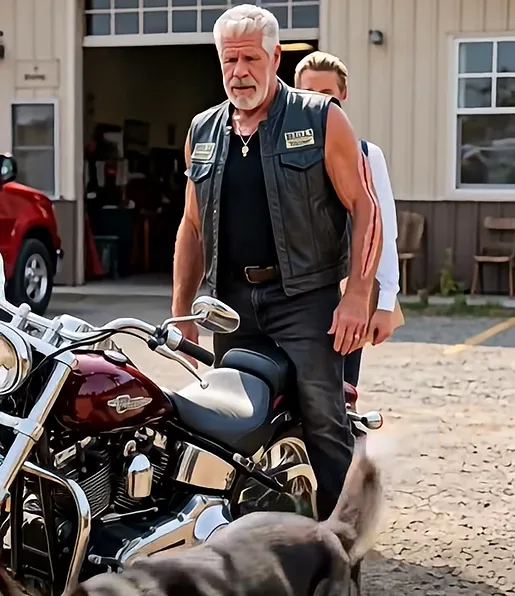
He had wiped most of the coffee off his vest, but the leather was still stained dark, and the faint sweet smell of it followed him across the glass-strewn floor.
Diesel padded at his heel, ears forward, tail low, the shepherd’s amber eyes sweeping the room like a tiny, furry sergeant.
“Dad,” I said.
“Son.”
Neither of us moved.
Twenty years sat between us like a river, and I did not know the first thing about how to cross it.
“You were good in there,” he said at last, gruffly. “You didn’t blink.”
“I wanted to hit him.”
“I know.”
“I wanted to hit all of them.”
“I know that too.” The corner of his mouth lifted. “I’m told it runs in the family.”
A strangled sound came out of me, half a laugh and half something else, and then I was across the broken glass with my arms around his neck, and he was holding me with the whole length of his arms, rough and warm and smelling of coffee and road dust and leather.
“I thought you were dead,” I said into his shoulder. “Mom said you were dead.”
“I know what she said.”
“Why would she say that?”
“Because I asked her to,” my father said, and his voice broke. “God forgive me. Because it was the only way to keep you both alive.”
The agents gave us the back office, a cramped wood-paneled room that smelled of cigars and cheap cologne, and a plain-clothed officer brought two paper cups of coffee and left without a word.
My father sat in Arthur’s leather chair and stared at the cup as though it were an enemy.
“Twenty-three years ago,” he began, “I was a motorcycle cop in Cleveland. Your mother was pregnant with you. We had a little yellow house with a swing on the porch.”
“I remember the swing.”
“You were three when I took the undercover assignment.” He rubbed the scar on his forearm with his thumb. “A trafficking ring was moving girls across the lake, and the Bureau needed a man who could pass as a biker. I told myself it would be six months.”
“It was twenty years.”
“It was the longest six months of my life.” He lifted his eyes. “The ringleader found out who I was in the second year. He sent your mother a photograph of you on that porch swing, with a note that said, Nice house.”
My stomach turned over.
“So I disappeared,” my father said. “I let the Bureau fake my death. I let your mother believe it, because her grief would have to look real or they’d come for you anyway. I stayed dead for nineteen years, and I told myself it was a sacrifice.”
“Was it?”
“It was a coward’s bargain,” he said. “I told myself I was protecting you. But really I was protecting myself from having to look at what I had done.”
I sat down heavily in the visitor’s chair.
My whole life I had imagined this conversation as a fight, a slammed fist, a thrown chair, years of rage finally let loose.
I had not imagined the way my father’s hands shook, or the gray in his beard, or the raw tired shame in his blue eyes.
“Mom died thinking you were gone,” I said.
“I know.” His voice cracked. “I stood at the back of that church in a black wig, Jax. I watched you carry her casket. I wanted to walk up the aisle and tell you everything, and I couldn’t, because the man who’d threatened you was still alive.”
“And now?”
“Now he isn’t.”
“Who was he?”
My father set down his coffee and looked at me for a long time.
“Arthur Sterling,” he said. “Twenty years ago he was a shipping broker with a nice suit and a respectable name, and he was moving girls in refrigerated containers. He has been moving them ever since, only now he does it through restaurants.”
“The supply orders.”
“Every box of tenderloin and case of champagne you ever signed for hid a person underneath it.” My father leaned forward. “I’m sorry, son. He hired you three years ago because he found out you were my boy. He wanted a hostage, and he wanted a patsy, and you were both.”
The room swam.
I thought of every Tuesday morning delivery, the sealed crates stacked in the cold storage, the drivers who never made eye contact, the muffled thumps I had once heard through a wall and told myself were pipes.
“Dad,” I said, and my voice cracked wide open. “There were people in there.”
“I know.”
“I signed for them. I counted them as inventory.”
“You didn’t know.”
“I should have known.”
“You couldn’t have.” He reached across the desk and gripped my wrist. “Listen to me. A man who has been lied to for three years is not guilty of the lie. You were a pawn, and your only crime was being my son.”
I put my face in my hands and wept like a boy.
My father came around the desk and knelt beside my chair, one scarred hand on the back of my head, and he did not say anything at all, which was exactly right.
“How many?” I asked, when I could speak.
“Seventeen, tonight,” Agent Brandt said from the doorway, and I looked up to see her standing with a clipboard clutched to her chest and her own eyes wet. “Seventeen women and four teenage girls, in the sub-basement. We found them twenty minutes ago behind a false wall in the wine cellar.”
The air left my lungs.
“They’re alive,” she said. “Hungry and terrified and very confused, but every one of them is alive, and every one of them is going to a hospital and then to a safe house with a social worker who knows how to listen.”
“Alive,” I repeated stupidly.
“Because of you,” Brandt said. “Your father told me the whole operation depended on getting somebody inside the building after eight o’clock to unlock the wine cellar from the kitchen side. You had the only key.”
My hand went to my belt, where a heavy brass key had hung for three years, the one Arthur had told me was for the inventory room.
“That’s the cellar key?” I whispered.
“It was the only key that opened the false wall,” she said. “You’ve been carrying it around your waist for three years, Mr. Vance. We just needed someone to turn it.”
I stared at the key as though it had grown wings.
“The coffee,” I said slowly, turning to my father. “The humiliation, the whole scene, that wasn’t just a way to plant the tracker.”
“It was a way to make Arthur sloppy.” My father’s eyes glinted. “A proud man who thinks he’s already won stops watching the doors. He laughed, and Julian laughed, and while every eye in that room was on a filthy old biker in a ruined vest, Naomi’s team was slipping through the loading dock.”
“You let him throw coffee on you.”
“I’ve had worse thrown on me.” He shrugged. “Besides, it was a very good vest. It’ll wash.”
I laughed until I cried, and my father laughed, too, a deep, rusty, astonished sound I had not heard since I was three years old.
They let us go at two in the morning.
We stepped out into a cool, empty street lit by the red and blue pulse of a dozen cruisers, and the whole city smelled of rain that had not yet fallen.
The crimson motorcycle waited at the curb with a patient dog sitting beside it.
“Where are we going?” I asked.
“Home,” my father said.
“I don’t have a home. Arthur owns my apartment.”
“Not anymore.” He held out a small envelope. “The Bureau seized his assets at midnight. The court is already moving to release the staff housing to the employees who were deceived. Yours is the third unit on the left.”
I opened the envelope, and a single key slid into my palm, the plain ordinary key to a plain ordinary door.
“I’d prefer to give you a better one,” my father said. “A key to a house with a yellow porch and a swing. But that one’s gone, and I’m told you can’t put back a thing that’s already been taken.”
“No,” I said slowly. “But you can build a new one.”
He looked at me, and the old, tired, gentle expression lifted from his face as though somebody had drawn back a curtain.
“Is that an invitation?” he asked.
“It’s the beginning of one.”
Diesel nudged my hand with his cold wet nose, and I rubbed his ears, and he leaned his whole warm weight against my leg.
“He likes you,” my father said.
“He’s very discerning.”
“He bit a mayor once.”
“Did the mayor deserve it?”
“The mayor deserved a great deal more.”
We rode home, the three of us, my father steering, me clinging behind him on the leather seat, and the shepherd riding proudly in his sidecar with his ears streaming in the wind.
The city blurred past, wet and gold and sleeping, and for the first time in twenty years I did not feel like a boy chasing the taillights of a man who was never coming back.
I felt like a passenger on a long road home.
The trial of Arthur Sterling began in March and lasted five months.
It was the biggest case the federal courthouse had seen in a generation, and every day the benches were packed with reporters and curious onlookers and, in the very front row, a growing group of women in plain dresses who held each other’s hands and did not speak.
They were the seventeen from the cellar, and by the end of the trial there were forty-one of them, because Agent Brandt’s team kept finding more.
I testified for three days.
I sat in the witness box and told twelve strangers about the crates and the signatures, the long grim Tuesdays, the muffled thumps in the wall. I told them about the afternoon Arthur Sterling had clapped me on the shoulder and laughed while a boy in a white jacket threw coffee over an old man in a vest.
I told them I had not known.
I told them I should have.
“Mr. Vance,” said the defense attorney, a smooth gray man with a voice like warm butter, “isn’t it true you signed every one of those supply orders?”
“Yes.”
“And isn’t it true you profited from them?”
“I was paid a salary.”
“A generous salary.”
“I was paid forty-two thousand dollars a year,” I said. “I lived in a one-bedroom apartment with a broken radiator. If that was profit, then it bought less than I would have liked.”
A faint ripple of laughter ran through the gallery, and the judge, a stern woman with spectacles perched on a sharp nose, rapped her gavel once.
“Mr. Vance,” the attorney tried again, “you expect this court to believe you didn’t know what was in those crates?”
“I expect this court to believe what it sees,” I said. “A man who gave three years to a lie. A man who wishes with every part of himself he’d asked the right question the first time.”
I turned my head and looked directly at the women in the front row.
“I’m sorry,” I said. “I’m sorrier than I can say.”
One of them, a thin young woman with long dark hair and enormous haunted eyes, gave me a tiny nod.
I did not know her name yet.
I would, later.
Arthur Sterling was convicted on every count, and the judge sentenced him to three consecutive life terms, plus restitution to every survivor that would strip him of every dollar he had ever owned.
Julian pleaded guilty to conspiracy and cooperated fully, and received eight years.
The restaurant, The Grandview, closed forever on the morning of the verdict.
Its steel doors were chained, its chandeliers carried out piece by piece, and by the end of the summer a bulldozer had flattened the whole building into a field of rubble and weeds.
I stood at the fence with my father and watched the last wall fall.
“How do you feel?” he asked.
“Light,” I said. “Strange. Like somebody took a hand off my shoulder that I’d stopped noticing was there.”
“That’s about right.”
“And you?”
He was quiet for a while, leaning on the chain-link with his arms folded and the morning breeze stirring his silver hair.
“I feel old,” he said finally. “Twenty years is a long time to carry someone else’s lie.”
“It wasn’t yours.”
“It was my choice.”
“It was your choice to protect your family,” I said, “and I’m trying very hard to be angry about it, and I keep failing.”
He glanced at me sideways, with that crooked, tired, hopeful half smile, and I laughed and put an arm around his shoulders.
It was strange to feel how thin he had become beneath the leather.
In the weeks after the verdict, he moved into the little apartment next to mine, the one with the cracked porch and the sagging mailbox, and every morning I woke to the smell of black coffee and burnt toast drifting through the thin wall.
He was terrible at toast.
He was worse at small talk, and he flinched at sudden noises, and he slept with a hunting knife under his pillow for the first month, until I told him quietly that nobody was coming.
“Habit,” he muttered.
“I know.”
“Hard to put it down.”
“Then we’ll put it down together,” I said. “A little at a time.”
He did.
He started with the knife, and then the second lock on the door, and then the strange old habit of checking every window before bed, and by Christmas he was sleeping through the night with Diesel curled at the foot of his bed like a furry black comma.
The women from the cellar came to dinner in January.
I had not expected it.
Agent Brandt had called one afternoon and said, in her brisk, careful voice, that several of the survivors had asked whether they might meet the man who had held the key.
“I don’t deserve that,” I said.
“Maybe not,” Brandt said. “But they’d like to say thank you anyway. And sometimes the kindest thing you can do for a person is let them.”
So on a cold bright Saturday, nine women came to my tiny apartment with a casserole, a loaf of bread, and a lopsided chocolate cake, and we sat around a card table that wobbled and ate with mismatched forks.
The thin young woman with the long dark hair sat next to my father.
Her name was Lucia, and she had been nineteen when Arthur’s men took her from a bus station in Laredo, and she was twenty-two now, and she laughed at every one of my father’s terrible jokes with a brightness that seemed to cost her something.
“Mr. Vance,” she said, after dessert. “The man in the dining room. The one who got coffee thrown on him.”
“That was me,” my father said.
“I know. Naomi told me.” She turned her fork over in her fingers. “I was in the cellar that afternoon. I could hear the laughing through the vents. I thought, there’s a room full of people up there who think nothing could ever touch them.”
“I’m sorry,” my father said.
“No.” She shook her head. “I’m not telling you for sorry. I’m telling you because when I heard it, I prayed. For the first time in two years, I prayed. I said, God, if there’s anyone good left in the world, let them have heard that laughing, too.”
My father’s throat worked.
“Somebody did,” she whispered.
He could not speak.
He reached across the card table and took her hand in both of his, and the two of them sat like that for a long while, a battered old man and a girl with wide dark eyes, while the rest of us pretended to be very interested in the cake.
In April, I quit my job at a restaurant supply warehouse, and with the money from a federal restitution fund and a small loan from my father’s pension, I leased a storefront on Fulton Street.
It was a narrow brick building, long and dim, with a pressed-tin ceiling and a front window cluttered with dust.
We cleaned it for three weeks.
Lucia painted the walls a warm buttery yellow, and Agent Brandt hung a string of lights over the counter, and my father built a long wooden bar from salvaged barn boards and sanded every inch of it with his own scarred hands.
The sign went up on the first of May.
THE KEY, it said, in plain black letters, and beneath it in smaller script, A table for everyone.
It was a restaurant, and a good one, a plain, honest place with a short menu and a long list of rules.
Nobody was turned away for how they looked.
Nobody was rushed.
Every employee, from the dishwasher to the head cook, was a survivor of the trafficking network or a worker the system had once left behind, and every one of them was paid double the going wage and offered a seat at the staff table at the end of every shift.
On opening night, a long gleaming line of motorcycles stretched down Fulton Street, nearly a hundred of them, chrome flashing in the evening light.
My father stood in the doorway in a clean leather vest, his silver hair combed neatly back, and watched them roll up one by one.
“Who are they?” I whispered.
“Old friends,” he said. “Men and women I rode with, when I was pretending. Some of them knew I was a cop. Some didn’t. But when I put out the word that my boy was opening a place, every one of them said they’d come.”
A big bald man in a faded jacket swung off the first bike, took off his helmet, and shuffled up the steps with his hat crushed in his hands.
“Marcus,” he rumbled. “You old fraud.”
“Tiny.”
“I never believed you were dead for a minute.”
“That’s because you owed me forty dollars.”
They embraced, and the big man wiped his eyes with a fist the size of a ham, and a hundred riders filed into The Key, laughing and hugging and slapping my father’s back, and they filled every chair and every stool and every inch of floor.
I stood behind the counter with a dish towel on my shoulder and watched it happen.
It was not the cold marble elegance of The Grandview.
It was warm and loud and crooked, with mismatched chairs and a chalkboard menu and a dozen conversations all happening at once, and it smelled of garlic and fresh bread and the particular joyful chaos of a room where everybody belongs.
Lucia carried a tray of sizzling steaks past me, flushed and beaming, and winked.
Diesel lay under table seven, enjoying a dropped crust.
My father caught my eye across the crowded room, and he lifted a glass of iced coffee in my direction, and I laughed so hard I had to put my forehead down on the counter.
“To the vest!” someone shouted.
“To the vest!” a hundred voices roared back, and the windows rattled.
Late that night, after the last rider had rumbled off into the dark and the last plate had been dried and stacked, my father and I sat on the back steps in the cool May air with two cups of black coffee between us.
The stars were thin and bright above the city, and somewhere far off a train hooted its long slow note across the river.
“Jax,” my father said.
“Yeah, Dad?”
“I want to say something, and I’d like you not to interrupt.”
“I’ll try.”
“I spent twenty years thinking the most important thing I could do was keep you alive.” He turned the cup slowly in his hands. “And I was right, and I was also wrong. Because staying alive is not the same as being loved. A boy needs a father who walks in the front door, even if the door is a little crooked.”
“Dad.”
“I’m not finished.” His voice caught. “I can’t give you back the years. I can’t un-miss your graduation, or your first job, or the day you carried your mother to the cemetery. But I can be here, from now until the end. I can sit on the back steps. I can burn the toast.”
“You really can’t make toast.”
“I really can’t,” he agreed, and a wet laugh broke out of him. “But I’ll keep trying.”
I reached over and took his scarred hand in mine.
We sat that way for a long, quiet time, two men with the same blue eyes, looking up at a sky that had finally stopped holding its breath.
“I never stopped looking for you,” I said at last. “Not really. Every time a motorcycle went by, I’d look. Every Father’s Day, I’d drive past the cemetery and tell Mom I was fine.”
“I know.”
“You can’t know that.”
“I do,” my father said softly. “Because I never stopped looking out for you. And I think that’s the same thing, in the end.”
I leaned my head against his shoulder, the way I had when I was a very small boy, and he let me.
Above the back door, the little brass bell on the screen jingled in the night breeze, and from inside came the sleepy clatter of the last dishwasher finishing up, and the smell of fresh coffee drifted out into the dark like a promise.
I closed my eyes, and for the first time in my entire life, I was exactly where I was supposed to be.
The long shadow of my past was gone, and in its place a warm yellow light was shining through the kitchen window, falling across two cups of coffee on the weathered steps.
Not a trap.
Not a disguise.
Not a lie.
Just a table, a key, and a father who had come home.