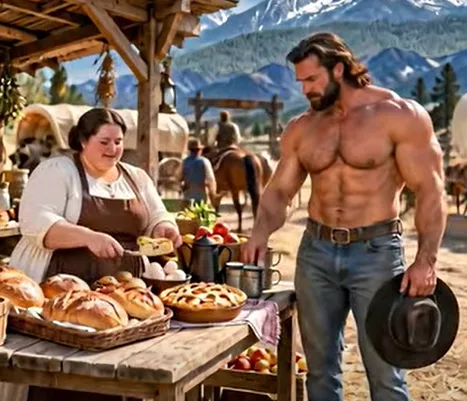
At the dusty trading post counter in my worn apron while the arrogant town sheriff publicly mocked my meager bakery prices and threw my fresh bread
The thunder rolled closer, and I stood very still behind the counter with my hand wrapped around my father’s revolver, watching the dark stallion shrink into the gray folds of the mountains.
The trading post had gone quiet, and every traveler in the wagon yard pretended to study their boots or their coffee.
Nobody wanted to be seen looking at the baker girl who had just threatened the sheriff in broad daylight.
“Child,” said a cracked, gentle voice at my elbow, “you had best sit down before you fall down.”
It was old Mrs. Penhallow, who sold wool and buttons from the next stall, a tiny woman with a face like a dried apple and eyes sharp as sewing needles.
She took my arm and steered me onto the overturned crate behind the counter, and she pressed a tin cup of cold water into my hands.
“I have known that man since he was a boy stealing eggs,” she muttered, glaring at the town hall in the distance.
“He has never once done a thing without a reason, and he has never once been afraid, until today.”
“I’m not sure what I did,” I admitted, and my voice shook.
“I only said what my father taught me to say if the day ever came.”
“Then your father was a wise man,” she said, patting my hand with her papery fingers.
“And that stranger was no common drifter, mark my words.”
I looked down at the silver dollar lying beside the pie tin, and I picked it up and turned it over in the light.
It was an ordinary coin, worn smooth on one side, but when I tilted it, I saw a tiny scratch along the rim, a small deliberate line like a tally mark.
I stared at it for a long moment, and a strange, tingling memory stirred at the back of my mind.
My father had carried a coin just like it, and he had called it his lucky piece, and he had pressed it into my palm the morning he left for the last time.
I had lost it in the grief of the funeral, and I had never stopped searching for it.
“It cannot be,” I whispered.
“What cannot be?” Mrs. Penhallow asked.
I did not answer, because the first fat drops of rain had begun to fall, drumming against the canvas awning, and the sky above the valley had turned the color of a bruise.
The market emptied in minutes, wagons rattling off toward shelter and merchants throwing tarpaulins over their goods.
I packed my loaves and pies into the wooden crate with clumsy, hurried hands, and I pulled the shutters of the bakery stall closed against the wind.
Then I knelt down in the mud and ran my fingers along the underside of the counter, feeling for the grooves my father had cut.
They were there, a neat row of numbers carved shallow into the wood, worn almost smooth by years of flour and elbows.
I had always thought them a carpenter’s marks.
I had never known they were a message, until the night before my father died, when he sat me down at our kitchen table and told me, in a low voice, what they meant.
“If the sheriff ever comes for the bakery,” he had said, “you must go to the old Hartley mill and count nine boards from the north wall.”
“Do not tell anyone, Clara, not even the people you love.”
“Especially not the people you love, because they may be forced to tell.”
I had laughed then and teased him for being dramatic, and the memory of that laugh now sat in my stomach like a stone.
The rain fell harder, and I tied my shawl over my head and hoisted the crate onto my hip.
The bakery was a small, crooked building at the end of Pine Street, with a sagging porch and a chimney that smoked in every wind.
I had lived there since I was a baby, in the two rooms above the oven, and I had never been afraid in it until the night my father failed to come home.
Tonight, as I slogged through the mud toward its warm yellow windows, I saw something that made me stop dead.
The door was standing open, and the lamp inside was lit.
I set down the crate without a sound and drew the revolver from my apron, and I crept up the porch steps with the rain pouring off my shawl.
“Whoever you are,” I called, my voice thin and furious, “you have exactly three seconds to walk out of my house.”
“Put the gun down, Clara,” said a quiet voice from the shadows near the oven.
“I would hate for you to shoot the only friend you have left.”
The stranger stepped into the lamplight, with his leather hat in his hand and rainwater dripping from the brim of his coat.
Up close, I could see that he was perhaps thirty-five, with thick dark hair going gray at the temples, a jaw like carved granite, and a long white scar running down the left side of his throat.
His eyes were the same piercing blue as the sky on a clear winter morning, and they were looking at me with an expression I could not read.
“You broke into my house,” I said.
“The door was unlocked,” he said mildly.
“It was not,” I snapped.
“I locked it myself, I always lock it.”
“Then I broke into your house,” he conceded with the ghost of a smile.
“I apologize, but I did not think it was safe to wait in the street.”
“Who are you?” I demanded, and I did not lower the gun.
He reached slowly into his coat, and I tensed, but all he drew out was a small, folded square of paper.
He laid it on the table beside the lamp and stepped back with his hands open.
“My name is Jack Corliss,” he said.
“Though for the last six years I have gone by a few others.”
“I was a deputy marshal in the territorial service, and I was the last man who spoke to your father before he died.”
The world seemed to tilt, and I gripped the doorframe with my free hand.
“You’re lying,” I whispered.
“Everyone says he fell from his wagon on the ridge road, and that it was an accident.”
“Everyone says what the sheriff wants them to say,” Jack answered gently.
“But your father did not fall, Clara, and he did not die on that road.”
“He lived for nearly an hour after they ran his wagon off the cliff, because I found him, and I held his head, and I promised him that I would look after you.”
Tears sprang into my eyes, hot and sudden, and I lowered the revolver at last.
“Why did you wait six years?” I asked, and my voice cracked on the last word.
“Why did you let me think I was alone?”
His jaw tightened, and a shadow of real pain crossed his face.
“Because the men who killed him were still watching,” he said.
“If I had come to you then, they would have known that your father had told someone, and you would have been in the ground before the week was out.”
“So I did the only thing I could, which was to disappear and build a case so strong that nothing could stop it.”
“I came back tonight because the case is finally ready,” he continued.
“And because I heard the sheriff had begun to look at the bakery.”
He nodded toward the folded paper on the table.
“Read that,” he said.
My hands trembled as I unfolded it, and I held it close to the lamp.
It was a letter in my father’s bold, slanting hand, and the first line was my name.
“My dearest Clara,” it began.
“If you are reading this, then I am gone, and you have found a man I trusted to bring it to you.”
“I want you to know that I am not afraid, and that I have never been more proud of anyone than I am of you.”
“The old Hartley mill holds the true deed to the western valley, signed by the territorial governor himself, and with it, the proof of what Sheriff Brandt and the council have done.”
“Give it to Jack, who is honest, and let him carry it where it can do good.”
“And please, my girl, do not spend your life in mourning.”
“Make bread, and sing, and laugh too loudly, and love someone who deserves it.”
“Your loving father.”
I read it three times, and the paper grew damp in my fingers, and I did not even try to wipe my eyes.
Jack stood quietly by the oven and let me cry, with his hat held in both hands and his gaze politely lowered.
When at last I could speak, I looked up at him through my tears.
“He told me to count nine boards from the north wall,” I said.
“Of the Hartley mill.”
“I know,” Jack said.
“He told me too, and I have not dared go alone, because the mill sits on land the sheriff’s men patrol every night.”
“But a baker girl delivering bread to the old caretaker’s widow, at dawn, would not draw a second glance.”
I looked at him, and at the revolver in my hand, and at the gentle, steady blue of his eyes, and I made a decision.
“Then I will bake the bread,” I said.
He smiled, and it transformed his whole stern face, crinkling the corners of his eyes and softening the harsh lines around his mouth.
“I was hoping you would say that,” he said.
I did not sleep that night.
Jack stayed in the bakery, sitting watchfully on a stool by the back window with his rifle across his knees, while the storm rattled the shutters and the rain streamed down the glass.
I mixed the dough by lamplight with floury arms and a pounding heart, kneading it harder than it needed, shaping loaves and braiding rolls until the whole kitchen smelled of yeast and warm wheat.
“You do that the way my mother did,” Jack said quietly from his corner.
“With your whole body, as though the bread had done you a personal wrong.”
I laughed, startled, and flour puffed from my sleeve.
“It has,” I said.
“It rises when it pleases and falls when it pleases, and it has never once listened to me.”
“My mother used to say the same thing,” he said, and for the first time his voice carried a trace of old, tender sorrow.
“She baked in a little house in Missouri, before the war took everything.”
“I have not tasted bread like hers in twenty years.”
I paused with my hands deep in the dough, and I looked at him across the lamplight, at the scar on his throat and the tiredness in his eyes.
He looked like a man who had been walking for a very long time without once being invited to sit down.
“Then you shall taste some tomorrow,” I said.
“Before we go.”
He did not answer, but he lowered his eyes, and I saw his jaw tighten, and I turned back to my work to give him his privacy.
At the first gray hint of dawn, the rain had stopped, and the world outside was washed clean and shining.
I loaded a basket with warm loaves wrapped in white cloth, and I tucked my father’s revolver into the bottom beneath a layer of rolls.
Jack handed me a slice of the first loaf with a smear of butter and a spoonful of apple preserves, and I watched him take a bite.
His eyes closed, and a long, shaky breath escaped him.
“That,” he said, in a voice gone thick, “is the best thing I have tasted in my life.”
I felt my cheeks grow warm, and I busied myself with the basket so he would not see.
We left through the back door, and I walked down the alley alone with the basket over my arm, while Jack slipped away along the creek bed on foot, to circle around and meet me at the mill.
The town was still asleep, with a thin mist drifting between the shuttered storefronts and a rooster crowing from some distant yard.
I passed the town hall, and I saw a light burning in the sheriff’s window, and I felt my pulse quicken.
I kept walking, slowly, easily, humming a little tune the way a girl with nothing to hide might do.
The Hartley mill stood at the edge of town beside the creek, a tall, dark, silent building with its great wheel rotted and still.
Its windows were boarded, its roof sagged, and a thicket of brambles had grown up around its door, but a thin path had been trampled through them, and I knew who had trampled it.
An old woman in a gray shawl sat on an upturned bucket by the porch, shelling peas into her lap, and she looked up with milky, curious eyes as I approached.
“Morning, Mrs. Tilley,” I said brightly.
“I have brought you fresh bread.”
“Bless you, Clara,” she cackled, and she took a roll and sniffed it.
“You are a good girl, just like your father.”
“May I leave the rest of the loaves inside, where it’s dry?” I asked.
“Go on, go on, the door’s open,” she said, waving a gnarled hand.
“Mind the third step, it’s rotten.”
I stepped carefully over the broken stair and pushed open the sagging door, and the smell of damp wood and old dust rolled out around me.
Inside, the mill was a vast cavern of shadows, with thin blades of pale morning light slanting through the gaps in the boards.
Jack was already there, standing beside the north wall with his rifle at his shoulder and his face tight with caution.
“Quickly,” he whispered.
“There is a patrol on the east road, and they will pass within ten minutes.”
I set down the basket, and I counted the boards from the north wall, one, two, three, my fingers trembling against the old gray planks.
At the ninth, I pressed my palm flat and pushed, and nothing happened.
I knocked, and the sound was hollow, and I knelt and ran my nails along the bottom edge, searching for a seam.
There, at the very base, I found a shallow groove, just wide enough to hold a coin.
I took the silver dollar from my apron and slid it into the groove, and I felt it catch.
With a soft click, the board swung outward on a hidden hinge.
Behind it was a narrow cavity in the wall, and inside the cavity, wrapped in oilcloth and tied with twine, lay a flat leather case.
My breath stopped, and Jack let out a low whistle behind me.
I lifted the case out with both hands and unwrapped it on the floor, and I opened the clasp.
Inside lay a thick, folded parchment bearing the red seal of the territorial governor, and beneath it a bundle of ledgers and letters tied with a faded blue ribbon.
I unfolded the parchment, and the ink leaped out at me in bold, elegant script.
It was the original deed, granting the whole western valley, its timber, its water, and its mineral rights, to the heirs of Thomas Harlan, my father, in perpetuity.
“Oh, Papa,” I whispered, and I pressed the paper against my chest.
“The ledgers record every payment the sheriff and the council took from the railroad men,” Jack said, flipping through the pages with quick fingers.
“Bribes, forgeries, even the order to run your father’s wagon off the ridge, in Brandt’s own handwriting.”
“This is more than enough to hang them all.”
I looked up at him, and my eyes were bright with tears and fierce with something new.
“Then let us hang them,” I said.
“Not literally,” Jack said, a faint smile touching his lips.
“But we will see them in front of a federal judge, I swear it.”
A sudden clatter of hooves sounded on the road outside, and Jack went rigid.
“Patrol,” he hissed.
“Take the case and go out the back window, now.”
“And leave you?” I said.
“I’m not leaving you.”
“Clara,” he said, and his voice was low and urgent.
“The case is more important than either of us, and I can hold them for a minute.”
“You can walk down to the creek, and cross at the shallows, and follow the water until you reach the marshal’s wagon at the old ferry.”
“The marshals arrived on the noon stage yesterday, as you told the sheriff, and they have been waiting for this.”
I stared at him, and then I understood.
“You sent them,” I whispered.
“I sent for them three weeks ago,” he said.
“Go.”
I wrapped the case in my shawl and clutched it to my chest, and I ran for the narrow window at the back of the mill.
The boards had rotted, and I pushed through them with my shoulder and tumbled out into the wet grass.
Behind me, I heard the splintering of the front door and the harsh shout of a man’s voice.
“Search the place!” the voice cried.
“The baker girl was seen coming in here!”
I ran.
I ran down the slope toward the creek with my skirts hiked up around my knees and the leather case hugged tight against my ribs, and the wind whipped my hair across my eyes.
Gunshots cracked behind me, one, two, three, and I flinched but did not stop.
I splashed into the shallows, and the icy water soaked me to the thighs, and I stumbled over slick stones and caught myself on my free hand.
“Stop her!” Sheriff Brandt’s voice bellowed from the mill, hoarse and frantic.
“Shoot her if you must, but stop her!”
A bullet whined past my ear and smacked into a willow trunk, scattering bark.
I scrambled up the opposite bank on my hands and knees, mud caking my arms, and I looked back just once.
Jack had come out of the mill door, and he stood in the open with his rifle raised, and he fired, steady and calm.
One of the sheriff’s deputies dropped his gun and clutched his shoulder, and the other three dove behind the porch rail.
Jack turned his head and caught my eye across the creek, and he mouthed a single word.
Go.
I went.
I tore through the alder thicket along the water, branches whipping my face and thorns catching at my sleeves, until my lungs burned and my legs felt made of lead.
At last, through the trees, I glimpsed a flash of white canvas, and a dozen men in dark coats standing in a clearing beside a ferry landing, with rifles in their hands and silver stars on their chests.
A tall, gray-bearded man in the center turned as I burst from the thicket, and he stared at me with astonishment.
“Miss Harlan?” he said.
“Is that you?”
“I am Clara Harlan,” I gasped, falling to my knees in the grass with the case still locked in my arms.
“I have the deed, and the ledgers, and a man named Jack Corliss is at the old mill with four deputies shooting at him.”
The gray-bearded marshal’s face changed instantly.
“Mount up!” he roared.
“Williams, Doyle, stay with the lady!”
In a heartbeat, the clearing was a storm of motion, with horses squealing and men swinging into saddles and the thunder of hooves shaking the earth.
I watched them vanish into the trees toward the mill, and I pressed the leather case against my chest and prayed harder than I had ever prayed in my life.
A young marshal named Doyle knelt beside me and wrapped a blanket around my wet shoulders, and Williams, a stout, kindly man with a bristling mustache, brought me a tin flask of hot, sweet tea.
“Drink, miss,” he said gently.
“You have done the bravest thing I have seen in thirty years of service.”
“He is alone back there,” I whispered, and my teeth chattered so hard I could barely form the words.
“Jack, he is alone.”
“Corliss has survived worse than four deputies,” Williams said.
“He is the toughest man I have ever known, and he has been waiting for this day for six long years.”
I clutched the flask in both hands, and I stared at the empty trail where the marshals had gone, and the minutes crawled by like years.
The shooting stopped, and in the silence the birds began to sing again, and I could hear my own heartbeat thudding in my ears.
At last, through the trees, came the slow clop of a single horse, and my heart nearly stopped.
It was the dark stallion, and a man sat in the saddle with his head down and one arm hanging at his side.
I was on my feet before I knew it, the blanket sliding from my shoulders, and I was running again.
“Jack!” I cried.
He raised his head, and his face was streaked with soot and blood, and a long raw gash ran across his forehead, but his blue eyes were wide and bright and alive.
“I told you,” he said hoarsely, and a tired grin spread across his battered face.
“Toughest man in the territory.”
I reached him just as he swayed in the saddle, and I caught his arm and threw my own around his waist, and he slid down into my embrace.
“You foolish, stubborn, impossible man,” I sobbed into his coat.
“I thought you were dead.”
“Not yet,” he murmured against my hair.
“I have not finished my pie.”
I laughed through my tears, and he laughed too, a weak, rumbling sound that turned into a cough, and the marshals came trotting out of the trees with the sheriff and his four deputies stumbling along in chains.
Brandt’s face was gray and slack, and he stared at me with such blank, bottomless hatred that I almost felt sorry for him.
“You,” he whispered.
“A little baker girl.”
“A little baker girl,” I agreed, and I lifted my chin.
“Who kneaded dough every morning and listened to everything you said at my counter, Sheriff.”
“You talked so much, and you never once looked to see who was listening.”
The gray-bearded marshal tipped his hat to me.
“Miss Harlan,” he said.
“On behalf of the United States government, I want to thank you.”
“Do not thank me,” I said.
“Thank my father, and Jack Corliss, who waited six years to keep a promise.”
The marshal glanced at Jack, who was leaning heavily on my shoulder, and his stern face softened.
“I will thank him too,” he said.
“But I believe he has been thanked enough by the look on your face.”
I flushed to the roots of my hair, and Jack coughed to hide a grin.
The trial was held in the spring, in the white-pillared courthouse of the territorial capital, and the whole western valley traveled for three days to watch it.
Sheriff Brandt, Mayor Hollis, and five members of the town council sat in the dock in rumpled black suits, while a parade of witnesses filed to the stand to tell what they had seen.
Mrs. Penhallow testified in her best bonnet and informed the court that she had known the defendants since they were thieving boys, and that she had always said no good would come of them.
Old Mrs. Tilley, who had once overheard the sheriff’s men planning the ambush on the ridge road, told her story in a quavering voice that silenced the room.
I testified last, with the old deed spread on the table before me and my father’s letter folded in my pocket, and I told the jury the whole truth from the day of the funeral to the morning at the mill.
When I finished, the courtroom was so quiet that I could hear the clock ticking on the wall.
The judge, a white-haired man with kind, tired eyes, leaned forward on his bench.
“Miss Harlan,” he said, “you have shown extraordinary courage.”
“Is there anything you would like the court to know before it deliberates?”
I thought for a moment, and I looked at the faces in the gallery, at the farmers and merchants and widows who had kept silent for so many years out of fear.
“Only that the law is a fragile thing,” I said slowly.
“It does not protect us unless we are willing to protect it, and I think my father understood that better than any of us.”
“I am only sorry that it took so long.”
The jury was out for an hour.
When they returned, they found every one of the defendants guilty on every count, and the sheriff sat in his chair with his eyes closed as the sentences were read.
He was to spend the rest of his life in the territorial prison, and the mayor and the council members would spend theirs beside him.
A great sigh rose from the crowded benches, like a wind passing through a field of grain, and then, one by one, the people began to stand and applaud.
I sat in my chair with my hands pressed over my mouth, and tears streamed down my cheeks, and I felt a hand slip into mine.
It was Jack, standing in the aisle in a new gray suit that did not quite fit his broad shoulders, with a clean white bandage still wrapped around his forehead.
“It is over,” he said softly.
“Is it?” I asked, and I looked up at him through my tears.
“Mostly,” he said.
“There is only one thing left undone.”
“What is that?”
“I promised your father that I would look after you,” he said, and a flush crept up his weathered neck.
“And I have discovered, over the last few months, that I should very much like to keep that promise for the rest of my life.”
My heart stopped, and I stared at him.
“Jack Corliss,” I said, “are you proposing to me in a courtroom?”
“I did not plan it,” he admitted, “but I find that I am not a patient man where you are concerned.”
Behind us, the whole gallery had gone silent, listening shamelessly, and I heard old Mrs. Penhallow whisper loudly, “Say yes, girl.”
I burst out laughing, and the tears kept falling, and I threw my arms around his neck in front of the judge, the jury, and the entire western valley.
“Yes,” I said.
“Yes, a thousand times yes.”
The courtroom erupted in cheers, and the judge, to everyone’s astonishment, was seen to wipe his eyes with a handkerchief.
We were married in June, in the meadow above the old family bakery, with the mountains standing blue and gold behind us and a canopy of wild roses overhead.
Mrs. Penhallow sewed my dress from cream-colored silk, and she wept for a full hour while she pinned the hem.
The whole valley came, and the marshals came, and even the gray-bearded one who had given me his hand that terrible morning at the ferry, and he danced a stately waltz with Mrs. Tilley while the fiddlers played.
Jack wore a black coat and a silver star pinned over his heart, because the governor had offered him the post of territorial marshal, and he had accepted on the condition that he could come home every night to a bakery.
I carried a bouquet of apple blossoms and sunflowers, and I walked down the grassy aisle on the arm of old Doc Whitmore, who had delivered me into the world and had never stopped fussing over me since.
At the end of the aisle, Jack waited with tears already standing in his blue eyes, and he did not even try to hide them.
“I thought you would be nervous,” I whispered when I reached him.
“I am terrified,” he whispered back.
“I have faced down outlaws and cattle thieves and a sheriff with a shotgun, and I have never been so frightened in my life.”
“Good,” I said.
“Then we are even.”
We said our vows with our hands tightly clasped, and when the preacher pronounced us man and wife, Jack kissed me so gently that the whole valley sighed.
That autumn, we reopened the bakery under a new sign painted by the town’s schoolchildren, a cheerful, crooked board that read Harlan and Corliss, Bread and Pies, Honest Prices.
The sheriff’s old office had been turned into a small library, with a cozy reading nook and a long oak table, and the town hall now hosted a weekly market where every family could sell what they made without paying a bribe.
The western valley bloomed under its true owners, and the timber was cut fairly and replanted, and the creek ran clear and cold beneath the old Hartley mill, which Jack and I bought and restored with our own hands.
The great wheel turned again that spring, creaking and splashing, and the whole town gathered to watch it.
I stood on the bank with Jack’s arm around my waist, and I felt the old ache in my chest finally loosen, like a knot slowly unpicked.
“He would have loved this,” I said softly.
“He does,” Jack said.
“I think he is standing right here, proud enough to burst.”
I leaned my head on his shoulder, and I watched the water spill over the wheel in a silver curtain.
On a golden evening some years later, I stood behind the counter of the bakery with flour on my cheeks and a small, round-faced boy of four tugging at my apron.
“Mama,” he said, “tell me the story about the bad sheriff.”
“Which story, Thomas?” I asked, scooping him into my arms.
“The one with the secret numbers,” he said, and his dark blue eyes shone.
I sat down on a flour sack with my son on my lap, and I pointed to the underside of the old counter, where my father’s carved numbers still ran in a tidy row.
“Your grandfather cut those,” I said.
“He was a baker, and a good man, and he loved this valley more than anything in the world.”
“And he left me a message that took years to understand.”
“What did it say?” Thomas asked.
“It said that the truth never stays buried,” I answered, smoothing his tousled hair.
“And that love is stronger than any lie.”
He thought about this with great seriousness, and then he nodded and rested his head against my shoulder.
The door chimed, and Jack walked in with his star gleaming on his vest and a bundle of wildflowers in his fist, and he crossed the room and kissed me on the forehead.
“Ladies and gentlemen,” he announced with mock gravity, “the most dangerous baker in the territory.”
“The most dangerous marshal in the territory is holding a handful of weeds,” I said.
“They are wildflowers,” he said, wounded.
“They are weeds, my love, but I will keep them,” I said, and I took them and put them in a jar on the windowsill.
We closed the shop together as the sun sank behind the mountains, flooding the valley with a rich, honeyed light.
The three of us walked up the path to the little house behind the bakery, with Thomas riding on his father’s shoulders and the evening breeze carrying the smell of fresh bread across the fields.
I paused at the gate and looked back at the valley, at the glowing windows and the winding creek and the gentle old mill, and my heart swelled with a quiet, shining gratitude.
Years ago, I had stood at a dusty counter with my tears swallowed and my father’s revolver in my hand, certain that the storm would destroy me.
Instead, it had washed everything clean.
Jack’s hand found mine, warm and strong and familiar, and he squeezed it gently.
“What are you thinking?” he asked.
“I am thinking that I am the luckiest woman in the world,” I said.
“And that I finally know what it feels like to be home.”
He smiled, and the first stars blinked awake above the hills, and together we walked up the path toward the light.