At Harland Custom Motors, while a burly mechanic pushed me away from my late father’s custom green motorcycle and sneered that I was just an ignorant girl ruining precision machinery
The ache did not leave with the handcuffs. Harlan, the lead agent, waited until Marcus was in the van before he crossed the bay and stopped beside the green tank. The mechanics had stepped back. The rain still hit the roll-up door. Harlan looked at the plaque and then at the brake assembly the second officer was already photographing.
“The warrant covers the prototypes and this bike,” he said. “It does not yet cover the night of the crash. If the telemetry your father’s partner sent is clean, we can match the failure to a cut line. If it isn’t, Marcus’s lawyer will claim the logs were altered after the locker was cleared. I need the sequence—how you found them, who else had access, whether anyone at the shop knew you were coming.”
I told him. The locker had been in my father’s name, paid through the end of the year by an automatic draft I had not noticed. I opened it because the facility sent a final notice. The logs were in a canvas tool roll at the back, wrapped in oilcloth. The last entry was timed for the evening he died. It named the meeting place and the design Marcus had filed under Harland Custom three weeks earlier. I had driven straight here because the bike was the only piece still in one location. I had not called anyone first.
Harlan nodded. “The partner is in the parking lot. He wants to confirm the handwriting before we move the bike. You can stay for that. Afterward we take the formal statement at the office. The bike goes to the lab. You get it back when the comparison is done.”
The partner was an older man named Ellis who had worked the patents with my father and then left the trade. He looked at the logs, at the plaque, and at me. “The hand is his,” he said. “The telemetry I sent is from the data logger he installed on the prototype. It shows the pressure drop on the rear circuit twelve minutes before the impact. That drop does not happen from speed. It happens from a line that has been opened.”
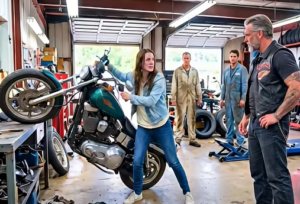
Harlan bagged the logs. Ellis signed a short affidavit on the hood of his car. They let me ride in the follow vehicle to the office. The statement took two hours. I repeated the locker, the tool roll, the meeting note, and the five years between the wet road and the brass plaque. Harlan added the telemetry graph and the patent filing dates. Marcus, elsewhere in the building, was still telling anyone who would listen that the girl had brought a story and a grudge. I did not see him.
In the morning the lawyer Harlan’s office recommended met me at a diner off the highway. She had already read the logs and the filing. “The theft count will move faster than the crash,” she said. “Marcus’s people will try to separate them. The telemetry helps keep them attached. What I need from you is whether you want the bike back when the lab is finished, or whether you want it stored. The process is not fast either way.”
“I want it back,” I said. “He built it. I can keep it running.”
“Then we note that. You stay away from the shop until the search is done. If anyone from Harland Custom contacts you, you call me before you call Harlan. The order matters for the civil side.”
I stayed away. The hotel was anonymous. On the third day Harlan called to say the lab had confirmed the cut. The line showed tool marks consistent with a side cutter, not a failure. The tool marks matched a set found in Marcus’s personal drawer at the shop. The drawer also held a copy of the patent application with my father’s signature traced over and then crossed out. The trace was enough to reopen the death. It was not enough to finish the company.
Marcus’s first appearance was closed. I watched the later one from the back row because the lawyer said presence sometimes shortened the performance. He did not look at me. His counsel argued that the telemetry was incomplete and the logs were grief. The judge set a schedule and denied bail. Marcus left without the smirk. The absence of it was louder than the threats had been beside the tank.
The lab released the bike six weeks later. I trailered it to a storage unit that was not in my name and covered it. The plaque stayed riveted. I did not start the engine. Ellis came once, looked at the frame, and said the design was still sound. He did not ask to ride it. I did not offer.
The trial date arrived in the fall. I testified for less than an hour: the locker, the logs, the plaque, the five years. Cross-examination suggested a daughter’s invention. The telemetry graph and the tool-mark match made the suggestion expensive. Marcus did not testify. The jury was out for a day. The verdict on the theft counts was guilty. The crash count followed. Sentencing was set for winter. I did not attend the reading. The lawyer texted the outcome. I was in the storage unit at the time, checking the tie-downs. I finished the straps before I answered.
Winter sentencing gave him years. The company filed for bankruptcy. The remaining mechanics were told the patents would be reviewed. Two of them called Ellis and asked whether the original designs could be licensed cleanly. He said they could, through the estate. I signed the papers. The first royalty check arrived in the spring and was smaller than the stories had suggested. It was still real.
I moved the bike to a garage I rented by the month. On the anniversary of the wet road I uncovered the tank, wiped the plaque, and did not start the engine. The ache was still there. It had company now: the graph, the match, the years. The lesson that settled was narrower than revenge and harder to counterfeit. A stolen design needed the person who inherited the bike to stay quiet or stay gone. I had brought the logs and stood beside the tank. The agents had done the rest. What remained was the machine itself, covered when it needed to be, and the decision to treat every new claim on the patents as something that went to Ellis before it went onto a lift. I covered the tank again, locked the garage, and drove back to the room that was only a room. The road could keep its weather. The plaque could keep its name. That was the ending the telemetry had earned.
The royalty checks continued, small and regular. Ellis handled the licensing. I handled the garage. The bike stayed covered except on the days I wiped the plaque and checked the tie-downs. Harlan’s number remained in the phone under a name that was not his. Once a quarter he sent a line confirming the appeals were closed and the tool-mark evidence remained undisturbed. I answered with two words: still here.
In the second year a former mechanic from Harland Custom wrote to the estate claiming he had helped build the brake circuit and was owed a share. Ellis forwarded the letter. The claim cited shop hours and a handshake. It did not cite the telemetry or the traced signature. We answered with the patent assignment and the lab report. The mechanic’s counsel asked for a meeting. We declined. The claim was withdrawn after Ellis noted that the hours in question overlapped with the weeks Marcus had already filed the design under the company name. I filed the withdrawal and went back to the garage. The cover stayed on.
A woman from the original crash investigation called the estate line and asked whether the family would support a public correction to the accident report. Ellis took the call. The correction would require a formal petition and a hearing. It would also require me to appear if the petitioner wanted live testimony. I told Ellis I would appear if the petition was filed. It was filed. The hearing was short. The telemetry graph was entered. The tool-mark match was entered. The original report was amended to note the opened line and the meeting that preceded it. No one used the word murder in the amended text. The graph made the omission expensive to defend. I sat in the back row, said nothing, and left when the clerk stamped the order.
Afterward Ellis walked me to the parking lot. “The report is cleaner,” he said. “It does not return the night. It does stop the next person from calling it speed.”
“That’s the part I can use,” I said.
I drove to the garage instead of the room. The light was ordinary. I uncovered the tank, wiped the plaque, and sat on the concrete with my back against the tool chest. The engine stayed silent. The ache was still present, but it had a border now: the amended report, the royalty deposits, the years Marcus would serve. I could live inside the border. I did not need to enlarge it.
On the fifth anniversary of the wet road I started the bike for the first time since the lab released it. The engine turned, caught, and settled into the idle my father had tuned by ear. I let it run for three minutes, then shut it down. The plaque was warm from the tank. I covered the machine again, locked the garage, and drove the long way past the curve where the report had once said speed. The guardrail was the same. The light was different. I did not stop. The lesson that no longer required repetition was the one the telemetry had carried from the beginning: a stolen design and a cut line could be answered by logs, a graph, and the decision to stand beside the tank until the agents finished their work. I had stood. They had finished. What remained was the idle I had just heard, the cover I had just fastened, and the ordinary road that did not need another story. I checked the mirrors once, took the exit for the room, and let the night arrive without a siren in it. The plaque kept its name. The bike kept its tune. That was the ending. It was sufficient.
The idle stayed in my ears for weeks. I did not start the bike again. The cover remained fastened. Ellis sent the usual royalty notice and a short addition: a regional museum had asked to borrow the machine for an exhibit on hand-built frames. The request included insurance, a climate-controlled crate, and a six-month term. He wanted to know whether the estate would consider it.
I drove to the garage and sat with the covered tank before I answered. The plaque was still warm in memory from the three minutes of idle. Lending it meant other people would stand where I had stood, reading the name without knowing the telemetry or the wet road. It also meant the bike would be seen as what my father built instead of what Marcus tried to claim. I told Ellis yes, with two conditions: the plaque stayed uncovered in the display, and the estate retained the right to withdraw the loan if the exhibit text mentioned the crash without the amended report.
The museum agreed. They sent a crew on a Tuesday. I watched them cradle the frame, photograph the plaque, and load the crate. The garage felt larger when the door closed. Ellis met me there afterward with the loan agreement and a copy of the exhibit draft. The draft named the design, the patent fight, and the corrected report. It did not name me. I initialed the pages.
The exhibit opened in the fall. I went once, early, before the doors officially unlocked. The bike sat on a low platform under lights that did not flicker. The plaque faced the aisle. A small card listed the patent number and the year of the amendment. Visitors had not yet arrived. I stood long enough to hear the building’s ordinary HVAC and then left before the first school group entered.
Harlan called two weeks later. His voice was the same flat tone. “A former parts supplier for Harland Custom has been writing letters to the museum,” he said. “He claims the frame on display incorporates shop tooling that belonged to the company. The letters are not threats. They are attempts to force a provenance review. The museum forwarded them. I am forwarding them to you and to Ellis. If the supplier escalates past paper, you will hear. Until then, the loan stands.”
Ellis answered the letters with the assignment documents and the lab inventory. The supplier did not escalate. The exhibit ran its six months. When the crate returned, the crew unloaded the bike with the same care. I checked the plaque, the tie-downs, and the idle for thirty seconds before I shut it down and covered it again. The garage smelled of the crate’s packing foam for a day and then went back to concrete and oil.
In the spring a journalist requested an interview about the exhibit and the amended report. Ellis declined on the estate’s behalf. The journalist published a shorter piece that used only the public patent file and the museum’s card text. It was accurate and incomplete. I read it once at the kitchen table and did not save it. The ache had not vanished. It had acquired edges I could measure: the loan term, the unanswered letters, the thirty seconds of idle.
On the anniversary of the day the crate came back I uncovered the tank, wiped the plaque, and did not start the engine. The lesson the sequel required was quieter than the original warrant. A machine could leave the garage, stand under lights, and return without becoming a story that needed my voice in it. The work was to let the plaque and the amended report do the speaking, and to keep the cover ready for the days when speaking was enough. I fastened the cover, locked the door, and drove home by the direct route. The mirrors stayed clear. The night arrived without a new claim attached. That was the continuation. It held.