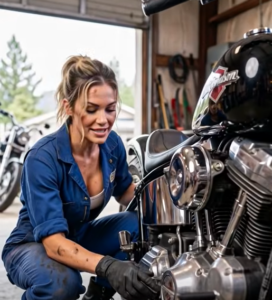
As I stood in the grease-stained garage holding my heavy iron toolbox, the veteran bikers scoffed openly
The wrench connected with the side of his knee before his hand could finish closing on my shoulder. He dropped more from surprise than damage, and the three men behind him moved at once. I rolled under the Harley’s frame, the flash drive already deep in my sleeve, and came up on the far side of the bike with the toolbox between us. The president was swearing and reaching for his belt. One of the others had a pistol half-drawn. I kicked the rolling creeper into his shins and ran for the side door that led to the parts yard.
They followed. The yard was gravel and chain-link, the gate chained from the outside. I cut left toward the dumpster and the gap behind it where the fence had been patched with wire instead of steel. The wire gave. I went through on my stomach, the overalls tearing, and kept running until the alley opened onto the street behind the garage. My truck was two blocks down where I had left it with the doors unlocked and the key in the ashtray. I made the cab, locked the doors, and pulled out before the first of them cleared the fence.
The drive stayed in my sleeve until I reached the storage unit I had rented under a different name. Inside, under a tarp, was the laptop my brother had used for the shop’s diagnostics and the external dock he had built for the micro-drives he hid in customer bikes. I slotted the drive. The files opened without a password because he had set it to recognize the dock’s serial. What came up was not a manifesto. It was a maintenance log with embedded audio, timestamps, and a single video file labeled with the night he disappeared.
I watched it once. The president’s voice was clear. So was the sound of the kill switch being engaged from under the frame while my brother was still on his knees beside the bike. The other two men in the garage that night were visible at the edge of the frame. One of them was still alive and still wearing the same vest. I copied the files to three places: the laptop, a second drive I mailed to a post-office box two towns over, and a cloud folder whose login I had written on the back of a parts receipt and left with the only person who still answered when I called from unknown numbers.
Her name was Mara. She had been my brother’s lawyer before she became the person who told me which debts were real. She met me at a diner off the highway and listened without writing until I finished. Then she asked whether the video showed the moment they moved the body.
“No,” I said. “It cuts when the president tells them to take the bike and the boy out the back. The rest is the log. He wrote the serial numbers of the guns they were moving that week. The same numbers showed up in a seizure six months later.”
“Then we have enough to interest the task force that already has the seizure,” she said. “We do not have enough to walk into the garage tomorrow and expect to walk out. You stay away from the shop. You stay away from the unit after tonight. If they made your face, they will check every camera between here and the yard.”
I stayed away. Mara contacted the agent whose card she still kept. His name was Harlan. He met us in a parking structure and watched the video on a laptop that never connected to anything else. When it ended he asked for the dock and the original drive. I gave him both. He asked whether I could identify the second man in the vest. I could. He asked whether I was willing to say so under oath if the video authenticated. I was.
The authentication took four days. On the fifth Harlan’s team hit the garage at dawn with a warrant that listed the bike, the back lot, and the president by name. I was not there. Mara and I watched the scanner in her office. The president was taken from his house. The second man was taken from the clubhouse. A third, who had not been in the video but whose prints were on the kill-switch housing, was picked up at a truck stop with a bag of cash and a phone that still held the text telling him to wipe the bike.
They found the body two days later. Not in the desert. In a culvert under the frontage road, wrapped in the same tarp the shop used for unfinished jobs. Dental records matched. The kill switch was still engaged. Harlan called to say the video and the location together closed the gap the original missing-person report had left open. I did not ask to see the culvert. I asked whether the bike was still in evidence. It was.
The hearings ran into winter. I testified to the serial number, the dock, the sleeve, and the five years between the night he vanished and the morning I knelt beside the exhaust. Cross-examination suggested a sister’s invention. The video’s metadata and the third man’s plea made the suggestion expensive. The president did not testify. The jury was out for a day. The verdict on the murder count was guilty. The weapons counts that rode with the serial numbers followed. Sentencing was set for spring.
I did not attend the reading. Mara texted the outcome. I was in the storage unit at the time, packing the laptop into a box that would go to her office for safekeeping. The unit would be emptied by the end of the week. The truck would be sold. The overalls were already in a landfill bag. What I kept was the receipt with the cloud login and the knowledge that the kill switch had done exactly what my brother built it to do: wait until someone who knew the family notch turned the crank.
Spring sentencing gave the president decades. The second man took a deal that named the route and the buyer. The third man received less and disappeared into whatever arrangement kept people alive after they turned. I moved to a different town, took a job at a dealership that needed a tech who could read a diagnostic without drama, and did not list the garage on any application. Once a month Mara sent a one-line email confirming the appeals were proceeding and nothing new had surfaced. I answered with the same line: still here.
On the anniversary of the night I swung the wrench I drove past the old garage. The bay door was down. A real-estate sign leaned against the fence. The gap behind the dumpster had been repaired with steel. I did not stop. The lesson that stayed was not that a hidden drive could undo five years of silence. The president had held the bike and the story long enough to bury a body and collect the payments. The lesson was that a kill switch and a dock only mattered if someone was willing to kneel in the oil, take the confession when it was offered, and get the files to a table where the metadata could be read before the men in the vests decided the girl was worth the risk. I had done that. Harlan had done the rest. What remained was a job that paid in checks, a login I no longer needed to open, and the decision to treat every new engine that arrived with a story attached as something that went to Mara before it went onto a lift. I checked the mirrors once, took the exit for the dealership, and clocked in on time. The tools were ordinary. The work could stay that way.
The dealership job held. I clocked in, ran diagnostics, and clocked out. The mirrors stayed ordinary. Mara’s monthly line stayed the same until the fourth month, when it changed by six words: appeal denied, mandate issued, no further action expected.
I read it twice in the parking lot and then deleted the thread the way she had taught me. The president’s decades were final. The second man’s deal had already been entered. Nothing in the mandate reopened the culvert or the video. I drove home, made coffee, and did not open the cloud folder. The login stayed on the old receipt in a drawer I rarely used.
A week later a man in a clean jacket came to the service desk and asked for the tech who had worked on a black Harley with a custom serial the previous spring. The service manager checked the computer, found no such ticket, and told him we did not keep bikes that old on the lot. The man left a card with no company name. I was under a hood in the next bay and did not come out. The manager brought me the card at the end of the shift and asked whether I knew the name. I said I did not. He threw the card away. I fished it out of the bin after he left, photographed it, and sent the image to Mara before I drove home.
She called from a number I did not recognize. “The name is a cousin,” she said. “He was not in the video. He was in the clubhouse the morning they took the second man. He has been asking at three other shops. None of them had the serial. If he comes back, you stay under the hood and the manager calls me. Do not correct the computer.”
“Understood.”
He did not come back. The manager mentioned the visit once more, then stopped when I offered to take the late diagnostics no one else wanted. The work was the same. The hours were longer. I used them. On the night the mandate became sixty days old I drove the long way past the storage facility where the unit had been. The gate code had changed. The row where I used to park was lined with different doors. I did not stop. The receipt in the drawer could stay there. The login could expire on its own.
Mara’s next line arrived on schedule and contained only the usual confirmation. I answered with the usual two words. The cousin’s card stayed in the photographed file and nowhere else. At the dealership the manager began leaving the late tickets on my bench without comment. I finished them, logged the parts, and went home by alternating routes. The lesson that continued was the one that required the least performance: a kill switch could wait five years and a video could close a case, but the quieter work was deciding, every shift, which engines belonged on the lift and which stories belonged with Mara. I kept making the same decision. The tools stayed ordinary. The mirrors stayed clear. That was the remaining part, and it was enough to clock out on time.
The late tickets became a habit the manager stopped mentioning. I took them, finished them, and logged the parts under the shop’s ordinary codes. The photographed card stayed in Mara’s file. No second visit came. On the ninetieth day after the mandate she sent a final line: file closed, retention complete, no further notices expected. I answered with the same two words and archived the thread.
A month later the service manager asked whether I wanted the open shift-lead slot. The pay was better. The hours were fixed. I said yes. The first week I trained two new techs on the diagnostic dock and did not mention any bike older than the current model year. They learned the steps. They did not ask about serial numbers that were not on the work orders. When a customer brought in a custom frame with the numbers ground off, I wrote the estimate, noted the alteration, and let the manager decide whether we would touch it. He declined. The customer left. The frame did not stay in the bay.
I kept the alternating routes. I kept the receipt in the drawer. Once, on a night the late shift ran long, I opened the cloud folder long enough to confirm the login still worked and then closed it without reading. The files were still there. They did not need me to open them. Mara’s number stayed in the phone under a name that was not hers. I did not call it.
On the anniversary of the wrench I did not drive past the old garage. I stayed for the late tickets, finished a wiring harness, and clocked out at the usual time. The parking lot was empty except for the manager’s truck. He nodded when I passed the office. I nodded back. The lesson that had settled into the shift-lead routine was the smallest one yet: the video and the culvert and the decades had done their work, and the remaining task was to treat every new frame and every new question as something that either fit on a ticket or went to Mara before it went onto a lift. I kept the distinction. The tools stayed ordinary. The mirrors stayed clear. I drove home by the longer route, checked the lock once, and let the night be only a night. That was the rest of it. It was enough.